4.15.1. Summary of the MTP Proposal
4.15.2. Interim Commentary and Programmatic Issues
4.15.3 Centre Response
4.15.4. Evaluation
4.15.5. Recommendations
ILCA's MTP proposal is based on the Centre's revised strategic plan, 'ILCA's Long-term Strategy 1993-2010', and takes into account the issues raised in the 1992 External Review and the recommendations on priorities and strategies for livestock research within the CGIAR. The MTP proposal reflects a more focused medium-term goal for 1994 to 1998. The research programme is outlined under seven themes, i.e., (i) mixed crop livestock systems, (ii) market-oriented smallholder dairying, (iii) conservation of biodiversity, (iv) biological efficiency of livestock, (v) livestock production under trypanosomiasis risk, (vi) livestock and resource management policy, and (vii) strengthening national research capabilities. A new emphasis is placed on strategic research and in particular on 'conservation of biodiversity' and 'biological efficiency of livestock' in the 1994-98 proposed Plan. The proposed MTP will be implemented through the existing organizational structure; ILCA recently reorganized its project-based matrix management structure in line with the recommendations of the 1992 External Review. However, the MTP proposal implies a continuing inter-disciplinary systems approach involving animal sciences, environmental sciences and socioeconomics.
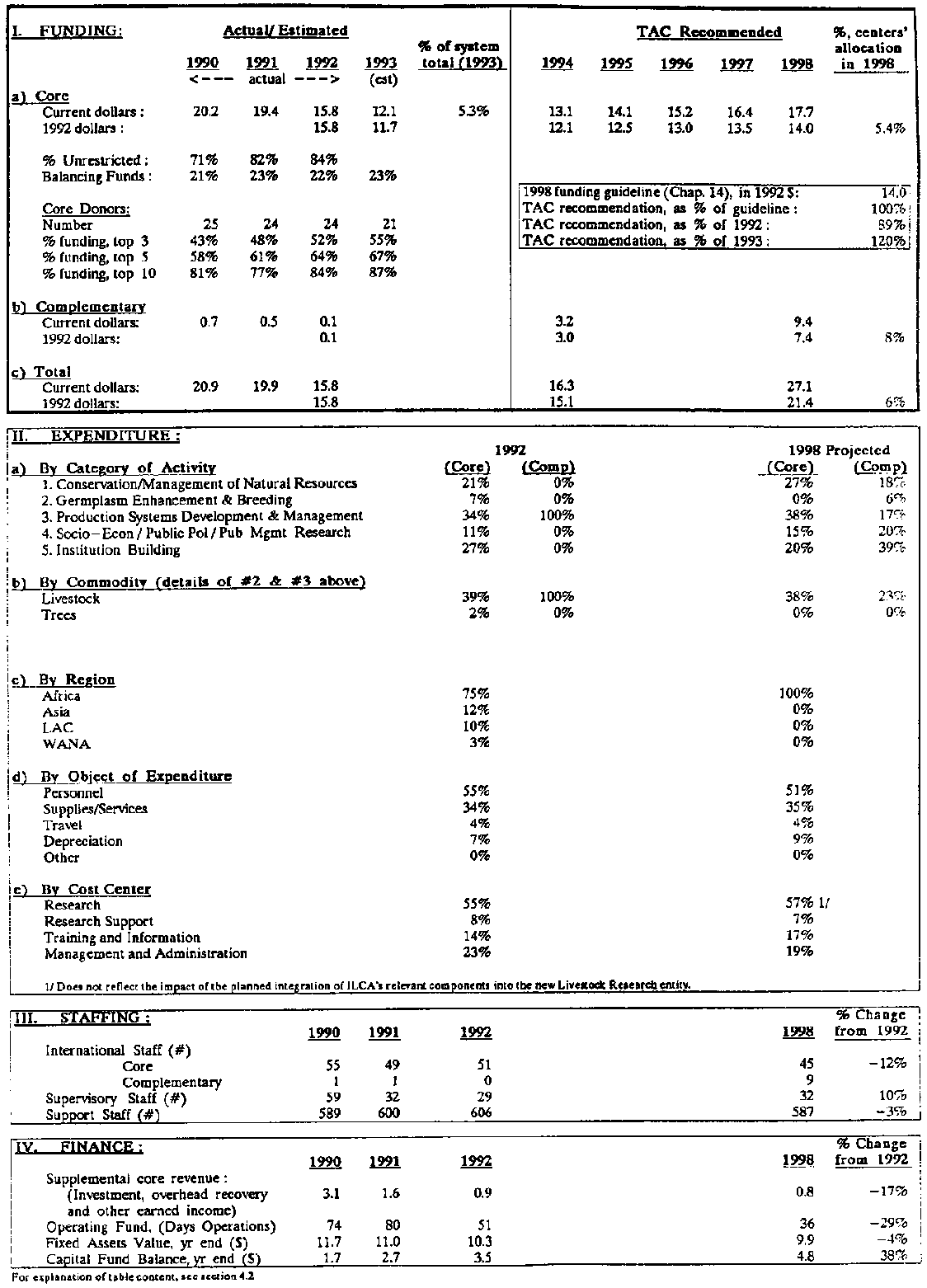
The core research programme outlined in the MTP proposal is based on US$ 17 million, which consist of the original base envelope of US$ 14 million supplemented by US$ 3 million from the US$ 5 million originally withheld from livestock centres' indicative envelopes. Any expansion of activities beyond the US$ 17 million level will be possible only with complementary funding. ILCA's proposed financial resources project a threefold increase in complementary funds (from US$ 3.2 to 9.4 million) over the MTP period. The MTP proposal has been developed on the premise that a total of US$ 17.8 million (over the five year period) in complementary funds will support the new strategic research themes, i.e., biological efficiency of livestock and conservation of biodiversity, and the ongoing programmes on policy, trypanosomiasis and strengthening national research capacities. The senior staff complement is projected to remain constant at the current level of 56.4 senior staff years (SSY) during the MTP period.
At the US$ 17 million level, ILCA projected the distribution of core resources over the five categories of activity as follows: 25% to natural resource conservation; 2% to germplasm enhancement; 38% to production systems; 12% to policy research; and, 22% to institution building. Across all activities, research commands 78% of core funds and 62% of complementary funds. The MTP proposal asserts that research across all five categories of activity has the following regional relevances: 75% for sub-Saharan Africa, 3% for WANA, 12% for Asia, and 10% for LAC.
Supplementary proposals at levels equivalent to 90% and 110% of the US$ 17 million base have also been provided. The 'plus 10% scenario' assumes an incremental funding of US$ 1.7 million. Four research topics have been identified as meriting priority for these additional funds, i.e. (i) embryo technology, (ii) rumen ecology, (iii) livestock and research management policy and impact assessment, and (iv) collaborative research networks.
Referring to TAC's commentary on the external review findings, the Committee noted an improvement in programme focus in ILCA's MTP proposal. The interim commentary raised a number of programmatic, financial, methodological and Systemwide issues TAC sought clarification of ILCA's rationale underlying its setting research priorities and for determining the balance of effort by programme theme. It also requested additional information on the programmatic implications of the Centre's global and ecoregional perspectives. ILCA's claim that 25% of its research programme relates to regions other than sub-Saharan Africa needed further justification, as were the mechanisms envisaged by ILCA to extend its expertise in crop-livestock research beyond sub-Saharan Africa. TAC requested clarification on how ILCA's proposed ecoregional activities in the Ethiopian highlands related to the ICRAF-led consortium on natural resources management research for the highlands of East and Central Africa, and an elaboration on the proposed modes of collaboration between ILCA and ILRAD, as well as with ITC and CIRDES. The Committee also noted substantial discontinuity in the research programmes between the 1988-93 MTP and the 1994-98 MTP proposal and sought information on the nature of the proposed changes. TAC also noted that ILCA's proposal did not have clear impact statements that incorporated milestones by which ILCA could measure progress. Finally, TAC requested ILCA to provide supplementary confidential information at the level of the base resource envelope of US$ 14 million.
In its response, ILCA explained that the research prioritization process was based on the Goal-Oriented Programme Planning (GOPP) technique, that ILCA used for setting the long-term strategic priorities of its programmes in 1998. The approach was described in ILCA's first MTP for 1989-93. The process was based on both qualitative and quantitative analyses and had further taken into account priorities identified by the national programmes, by TAC and the CGIAR Working Group on livestock research and by the Winrock study on Animal Agriculture in sub-Saharan Africa ILCA also elaborated on its evolving strategies on global and ecoregional research, stating that its proposals on animal nutrition (biochemistry, physiology and microbiology of digestion) and genetic resource characterization and enhancement (plant and animal) have global significance. On the other hand. ILCA sees its regional research programmes in the semi-arid (Sahelian Centre), sub-humid (Ibadan and Mombasa) and cool tropics (Ethiopian highlands) as ecoregional in nature, involving close collaboration with national programmes and other centres. ILCA also explained that its proposed collaborative inter centre programmes with crop-oriented IARCs, both within and outside Africa, would involve joint staff appointments and the development of linkages between its research networks in Africa and counterpart networks in other regions.
ILCA described its impact assessment methodology and noted that an impact perspective was incorporated with each research protocol. In reference to the issue of continuity of the research programmes initiated under the 1988-93 MTP. ILCA's response indicates that, whereas some research programmes (e.g., vertisol soil management, alley farming systems) will be terminated, the main research goals of the previous MTP are embodied in the new proposed plan. ILCA also elaborated on its partnership arrangements with ILRAD and shared with TAC recent proposals of ILCA's Board of Trustees which outline new initiatives taken in this regard. ILCA's assertion that 25% of its research efforts over the MTP period will have relevance to regions outside sub-Saharan Africa, is based on assumed spillover effects proportional to the relative economic values of milk and meat, from cattle, sheep and goats, in the different regions. In response to the question of ILCA/ICRAF collaboration in the East and Central African highlands, ILCA does not foresee any overlap or conflict of interest stating that the present proposals of the ICRAF-led consortium, of which ILCA is a member, relate to aspects of natural resources management under different cropping systems in the lower altitudes of the agroecological zone; ILCA's past and proposed future work is focused on the high altitude areas.
ILCA also provided a description of the reductions necessary to match the original base envelope of US$ 14 million. The senior staff (SSY) complement would be reduced to 45.4 SSY. Production systems research would be most severely cut back (3 SSY), all germplasm enhancement work would cease and institution-building activities (training and publications) and research support would be significantly curtailed.
In evaluating ILCA's MTP proposal, TAC first considered ILCA's assertion that the actual 1991 distribution of its resources over the five categories of activity (i.e., 10%, 4%, 39%, 10% and 28%) was significantly different from the distribution percentages used by TAC and shown in Chapter 14 of its report on CGIAR priorities and strategies. The Committee noted that the resource distribution in the 1994-98 MTP proposal mirrored closely the 1991 percentages as estimated by ILCA. Broadly speaking, TAC was satisfied with ILCA's response to the questions raised in the interim commentary. However, ILCA's assertion that 25% of its research activities would have direct relevance to regions outside sub-Saharan Africa lacked adequate justification, and the Committee was not convinced that the issue of ILCA/ICRAF collaboration in the East and Central African highlands is, as yet, adequately resolved. On balance. TAC did not see any compelling reason to change ILCA's original indicative resource envelope at this stage. Furthermore, TAC noted that ILCA benefitted from a devaluation of the currency of the host country during 1992, which reduced its dollar denominated expenditures and the cost of its headquarters operations.
TAC then proceeded to evaluate the focus, relevance and potential impact of the proposals outlined in ILCA's MTP document in reference to current CGIAR priorities for livestock research. In its deliberations, the Committee was very much aware of the recent CGIAR decision to integrate ILCA and ILRAD into a new global livestock research entity. TAC concluded that ILCA's proposed programmes are in line with the Centre's Strategic Plan, and in programme terms, are closely compatible with CGIAR Priorities and Strategies for livestock research. However, TAC considers that a number of ILCA's proposed programmes are premature at this point in time, in view of the pending integration of components of ILCA and ILRAD into the new global livestock research entity.
TAC considers that, overall, ILCA's proposals are of a strategic character, but that much of the proposed programme can be more appropriately planned within the framework of the new livestock research entity. In this regard, much of feed research will be organized within the framework of ecoregional initiatives. The recent external review raised questions about ILCA's past performance and about the institutional health of the Centre. TAC shared these concerns, but noted the recent improvements in research management, staff turnover, programme focus and publication output. TAC also commends ILCA on its strategy in developing strong partnerships with the national programmes in sub-Saharan Africa.
Based on these priority and institutional assessments, and in reference to the proposed establishment of the new global livestock research entity, TAC recommends that, in 1998, core programmes - for which ILCA presently assumes responsibility - be funded, in the framework of the new livestock research entity, at the level of US$ 14 million, i.e., the original indicative envelope assigned to ILCA in March 1992. In conjunction with this, TAC recommends that US$ 4 million of core resources be allocated to the new livestock research entity. Of this US$ 4 million, US$ 3 million would come from ILCA's supplementary envelope and an additional US$ 1 million would be generated from savings on overhead when relevant components of ILCA and ILRAD are integrated into the new entity. This amount of US$ 4 million would be used by the new entity to build and strengthen linkages with plant-oriented centres to develop integrated programmes on livestock feed and production systems, and for collaborative feed research with ecoregional initiatives. It is also envisaged that the new global livestock research entity will be an active participant in several of the Systemwide ecoregional programmes for which a further US$ 4 million has been recommended. Finally, TAC recommends a further support of US$ 750,000 to the global livestock entity within the US$ 280 million vector.
In view of the future integration of ILCA components into the new entity for global livestock research, TAC recommends that ILCA's budget be approved for a two-year period with a one-year rolling horizon.
For 1998, ILCA projects funding of complementary activities in the amount of US$ 7.4 million (in 1992 values), and for which the new livestock research entity will assume responsibility by that time.
For 1994, TAC recommends core funds for ILCA of US$ 12.1 million in 1992 dollars, or US$ 13.1 million in current values. Together with complementary funds projected at US$ 3.2 million, ILCA's total funding in 1994 would amount to US$ 16.3 million.
ILCA: FINANCIAL HIGHLIGHTS (US$ million & percentages)