4.16.1. Summary of the MTP Proposal
4.16.2. Interim Commentary and Programmatic Issues
4.16.3. Centre Response
4.16.4. Evaluation
4.16.5. Recommendations
ILRAD's MTP proposal has been structured so as to meet specific targets within the next five years in line with its strategic plan ('Strategic Plan: 1994-2003'), the recommendations of the 1992 External Review, the 1992 Winrock International report on Assessment of Animal Agriculture in sub-Saharan Africa, UNCED Agenda 21, and TAC's review of priorities and strategies for livestock research in the CGIAR. In addition, the recent decisions by the CGIAR to have a unified strategy, programme and institution for livestock research, into which the programmes of ILRAD and ILCA will be integrated within the MTP period, added to ILRAD's already numerous challenges.
In its MTP proposal, ILRAD presented three alternative scenarios for implementing cohesive sets of activities: (i) a 'Level 1', which would require 56 SSY and US$ 12.6 million, and would enable ILRAD to maintain its current critical mass and scope of activities; (ii) a 'Strategic' scenario, proposed in an addendum to the MTP proposal, and which would require 63 SSY and US$ 13.9 million, and reflects what ILRAD considers to be its needs to implement its strategic plan in full with increased emphasis on ruminant genetics and helminthiasis in small ruminants; and (iii) a 'Level 2', which corresponds to the supplemented TAC indicative resource envelope of US$ 11.1 million and would support 48 SSY per year. In addition, a confidential supplementary document describing the programmatic implications of ILRAD having to operate at the base resource envelope of US$ 9.1 million has also been made available to TAC.
During the MTP period, ILRAD plans to broaden the scope of its work from a previous focus on theileriosis to tick-borne diseases, and to continue its activities on trypanosomiasis, socioeconomics and environmental impact, and outreach research and training. Some activities under the Trypanosomiasis Programme have been emphasized in a new programme called Ruminant Genetics.
Under the 'Level 1' scenario, work on novel vaccine development for tick-borne diseases will require 15 SSY in 1994, rising to 17 SSY in 1998. Within this manpower allocation there will be a reduction of one position for development of serological tests when these are completed in 1995, and an increase from 3 SSY to 6 SSY per year for the identification and development of potential vaccine antigens to tick-borne disease organisms. The trypanosomiasis programme will require 22 SSY in 1994. Ten of these will be devoted to the development of improved diagnostic techniques, epidemiology and drug resistance, and 12 to the identification of mechanisms of resistance to disease, and the search for vaccines. The total manpower allocation will decline to 18 SSY in 1998 as targets for the production of diagnostic tools are met.
ILRAD is involved in a global network of laboratories working on gene markers to map the bovine genome. It is also creating a resource herd, by cross-breeding N'Dama and Boran (susceptible) animals, to study genetic segregation and determine the location of genes associated with trypanotolerance. Bovine genetic markers will be made available to other institutions, for use in studies of genetic resistance to helminthiasis, and for the identification of ruminant livestock species for germplasm conservation. This programme (ruminant genetics) will require 3 SSY per year.
The aim of the socioeconomics and environmental impact programme is to evaluate the impact of alternative methods for the control of the major disease constraints to livestock productivity. During the MTP period, ILRAD will supplement ex-ante impact assessments of livestock disease control with retrospective evaluations of vector-home disease control programmes so as to develop predictive methodologies that may be useful in prospective disease assessments in given production systems, and environments. The programme will require 4 SSY per year. Technology transfer, manpower and institutional development activities will be organized under the Cooperative Programmes, Training and Information Department and will require 3 SSY per year.
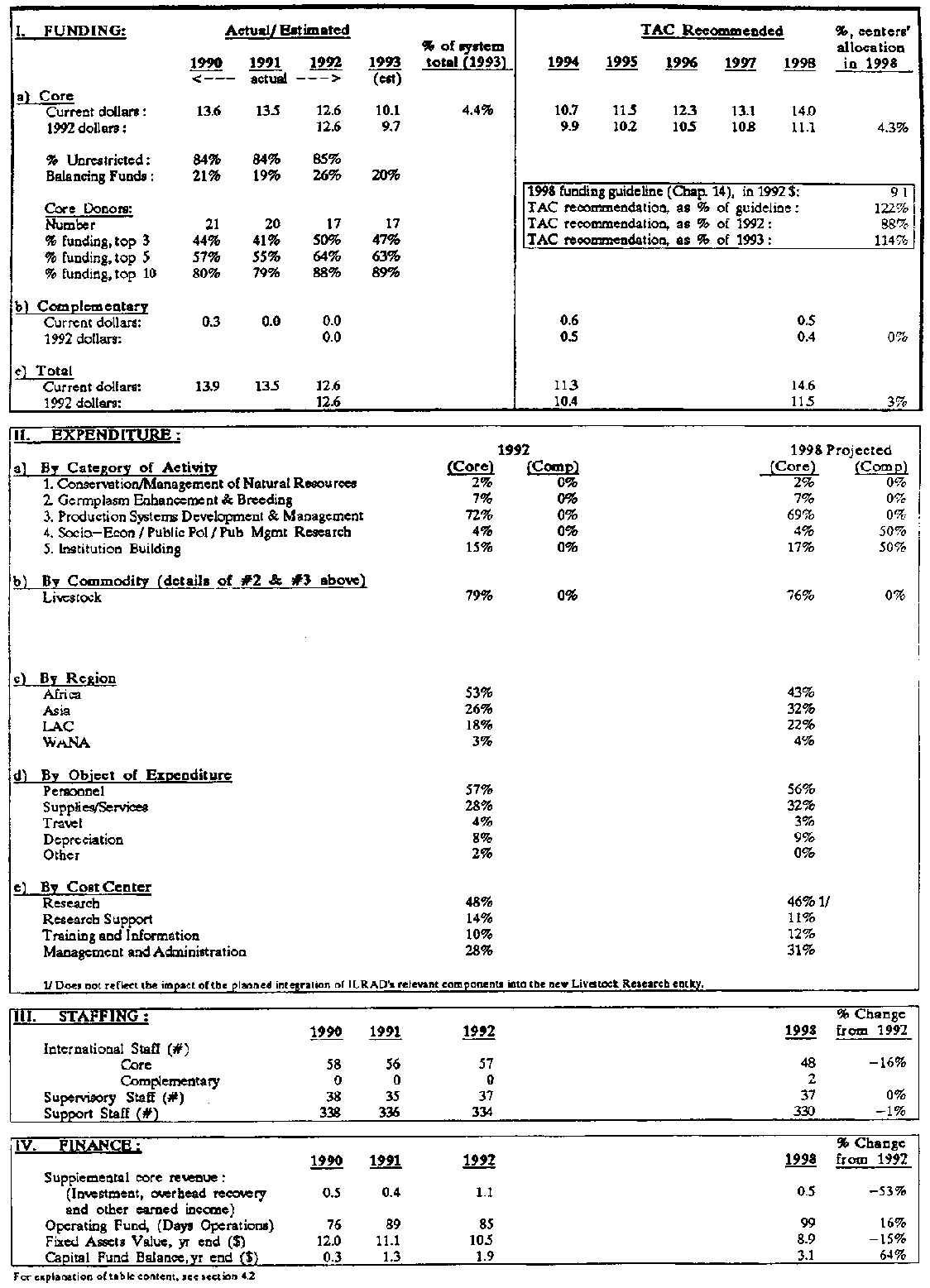
In its MTP proposal, ILRAD estimated the allocation of its efforts by region during the forthcoming quinquennium will be 53% for sub-Saharan Africa, 26% for Asia, 18% for Latin America, and 5% for WANA.
Implementation of the 'Level 2' scenario would result in a cumulative loss over the MTP period of 15 SSY in trypanosomiasis, 9 SSY in tick-borne diseases, 7 SSY in socioeconomics and 4 SSY from research support.
In its initial review of ILRAD's MTP proposal, TAC raised three programmatic issues on which ILRAD was requested to provide clarification. The first was TAC's concern that the projected expansion into other tick-borne diseases, ruminant genetics and animal physiology might divert attention from ILRAD's current effort on theileriosis and trypanosomiasis. The second was whether ILRAD had a policy and safeguards for the release of genetically modified organisms. The third related to the programmatic implications of operating at 'Level 2', i.e., the level of the supplemented resource envelope.
ILRAD plans to sustain its current focus on theileriosis and trypanosomiasis. At the 'Strategic' scenario level, aggregated over the MTP period, 87 SSY have been proposed for research on tick-borne diseases over the quinquennium of which 68 SSY (78%) would be required for research on East Coast fever and 19 SSY (22%) on collaborative research, primarily to develop novel vaccines for the control of cowdriosis, tropical theileriosis, anaplasmosis and babesiosis. At 'Level 1', also aggregated over the MTP period, 81 SSY are proposed for research on tick-borne diseases, of which 68 SSY (84%) will be devoted to East Coast fever and 13 SSY (16%) will be allocated to collaborative research on other tick-borne diseases, principally cowdriosis. At 'Level 2', 68 SSY would still be earmarked for research on East Coast fever. With respect to trypanosomiasis, an aggregated 100 SSY are proposed for research over the quinquennium at 'Level 1'. A similar figure is proposed at the strategic level. Of the cumulative 100 SSY, 90% will be devoted to research aimed at improved control of tsetse-transmitted trypanosomiasis, including the exploitation of genetic resistance to this disease, and 10 SSY will be devoted to research on the control of non tsetse-transmitted trypanosomiasis.
ILRAD recognizes that it has no authority to release genetically modified organisms in the form of a bacterial or virus-vectored vaccines against theileriosis. Such a release would need to be authorized by individual national governments following compliance in the use of such a vaccine with relevant national regulations. However, ILRAD is also aware that most of the countries affected by theileriosis do not yet have appropriate regulations, or facilities in place, for testing such vaccines. Consequently, ILRAD plans to comply with appropriate US regulations: (a) to ensure that experimental recombinant organisms are handled safely and not inadvertently released into the environment, and (b) to proceed with the process of vaccine development in a manner which will ultimately facilitate licensing of such a vaccine by countries which do not as yet have appropriate regulations or test facilities. It is for these reasons that ILRAD is urgently seeking complementary funds to construct a large animal containment facility which will allow testing of further stages of vaccine development in appropriate numbers of cattle.
ILRAD considers the programmatic implications of operating at 'Level 2' to be serious. Research on tick-borne diseases would be limited to East coast fever. As regards trypanosomiasis, research would be even more curtailed. The resources allocated to studies of drug resistance, parasite genetics and potential vaccines would be substantially reduced, and the Centre could not undertake any work on non tsetse-transmitted trypanosomiasis. There would also be reductions in the socioeconomics and environmental impact programme, and in research support and institution building. The net effect would be to restrict ILRAD's activities to research on East Coast fever and tsetse-transmitted trypanosomiasis and to limit the utilization of knowledge and techniques already generated to develop improved means of control of other major tick-borne diseases and other forms of trypanosomiasis, and to reduce ILRAD's capacity to strengthen national programmes.
TAC commends ILRAD for the transparent and analytical process followed in preparing the MTP proposals. The document is clearly written and the proposals are well argued and prioritised, reflecting the transparent nature of the analytical process adopted. ILRAD's proposal to safeguard past achievements through increased efforts in novel vaccine development for East Coast fever, maintaining the work on socioeconomics and environmental impact, and identification of genetic markers for trypanotolerance, deserves strong support.
The scientific achievements of ILRAD's work on theileriosis and trypanosomiasis are impressive, although TAC is aware that ILRAD has been less successful with regard to institutional development and production impact on animal agriculture in Africa. However, TAC notes ILRAD's expectations to complete laboratory development of an experimental vaccine for theileriosis, in the next five years.
The MTP proposal clearly reflects ILRAD's revised strategic plan, which projects an expansion of the Centre's operational mandate to include other tick-borne diseases, non tsetse-transmitted trypanosomiasis, and ruminant genetics. The proposed expansion is in line with ILRAD's mandate and TAC's views on priorities and strategies for livestock research, currently under discussion. However, TAC sees no compelling reason to change the priority currently allocated for research on livestock diseases in the CGIAR which it considers are adequately reflected in the supplemented resource envelope of US$ 11.1 million.
The proportion of complementary activities in ILRAD's work is very low. Due to the strategic and basic nature of the research, ILRAD does not appear to attract much donor support for complementary activities.
TAC recommends that, in 1998, core programmes - for which ILRAD presently assumes responsibility - be funded, in the framework of the new livestock research entity, in the amount of US$ 11.1 million, i.e., the supplemented indicative core resource envelope assigned to ILRAD. In the light of the CGIAR decision to have a unified strategy, programme, and institutional mechanism for livestock research, into which the relevant components of ILRAD, ILCA and other centres are expected to be integrated within the next five years, TAC considers ILRAD to be a centre in transition. In conjunction with TAC's recommendation on ILRAD's 1998 core funding level, TAC also recommends that US$ 4 million of core resources be allocated to the new livestock research entity. Of this US$ 4 million, US$ 1 million would be generated from savings on overhead when ILCA and ILRAD are integrated into the new single entity. It is also envisaged that the new global livestock research entity will be an active participant in several of the Systemwide ecoregional programmes for which a further US$ 4 million is recommended. Finally, TAC recommends a further support of US$ 750,000 to the new livestock research entity within the US$ 280 million vector.
In view of the future integration of ILRAD into the new entity for global livestock research, TAC recommends that ILRAD's budget be approved for a two-year period with one-year rolling horizon.
For 1998, ILRAD projects funding of complementary activities of US$ 400.000 (in 1992 values), for which the new livestock research entity will assume responsibility by that time.
For 1994, TAC recommended core funds for ILRAD of US$ 9.9 million in 1992 dollars, or US$ 10.7 million in current values. Together with complementary funds projected at US$ 0.6 million, ILRAD's total funding in 1994 would amount to US$ 11.3 million.
ILRAD: FINANCIAL HIGHLIGHTS (US$ million & percentages)