4.18.1. Summary of the MTP Proposal
4.18.2. Interim Commentary and Programmatic Issues
4.18.3. Centre Response
4.18.4. Evaluation
4.18.5. Recommendations
IRRI's MTP proposal reflected the implementation of its strategic plan which was prepared in 1989 and the continuation of the 1990-1994 workplan.
IRRI proposed to have four major rice ecosystem programmes in irrigated, rainfed-lowland, upland, flood-prone rice and one cross ecosystem programme. In addition, there would be programmes on: germplasm conservation, dissemination and evaluation; a crop and resource management network; information and knowledge exchange; training: and, support to national research services. IRRI's primary proposal was based on the level of the indicative resource envelope it was assigned in March 1992 (US$ 25.8 million), with supplementary proposals for a 90% and a 110% scenario.
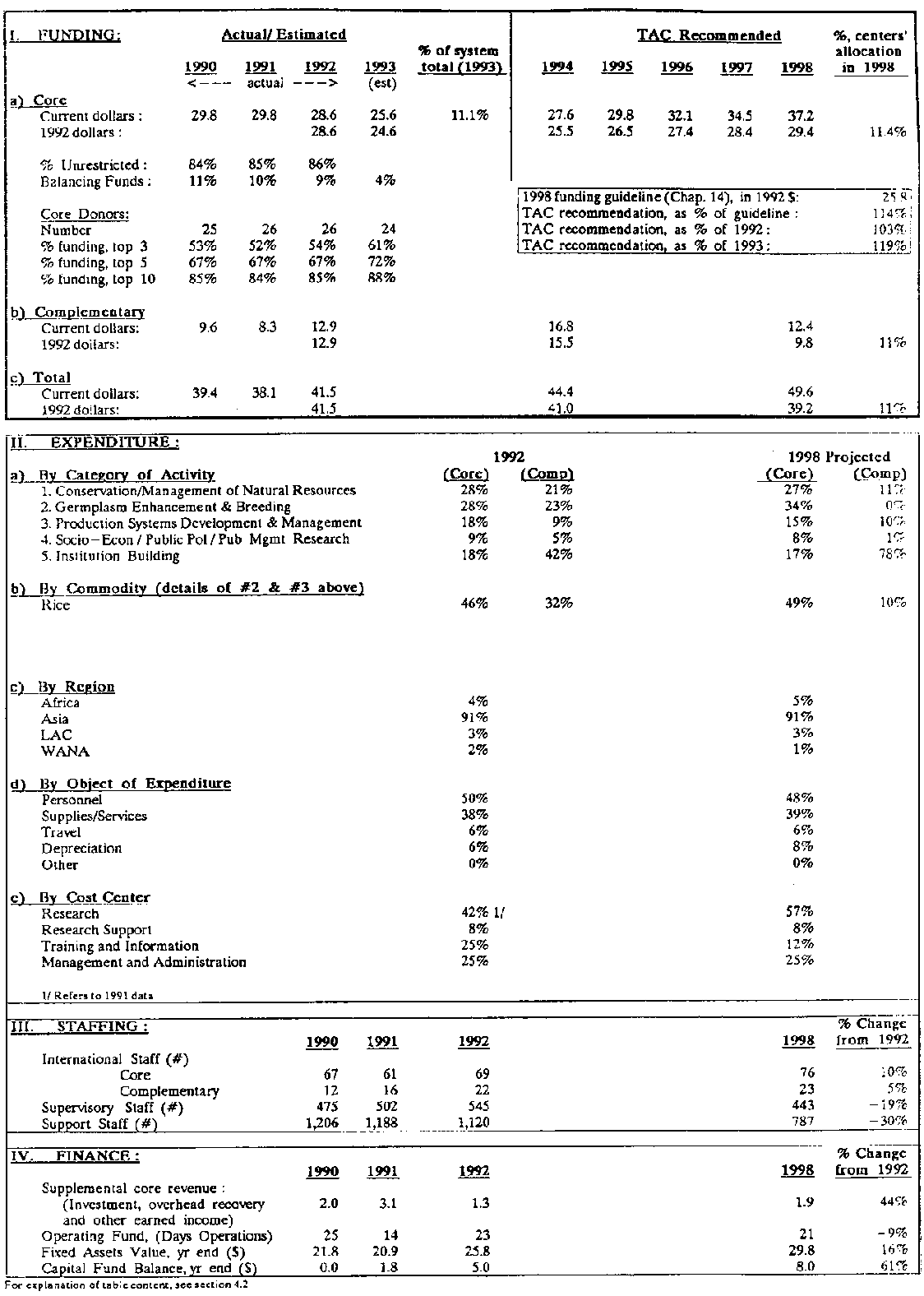
IRRI's proposed plan - at 100% of the base envelope - was characterized by the integration of crop improvement and resource management research. IRRI proposed to allocate 28% of its core resources to conservation and management of natural resources, 34% to germplasm enhancement and breeding, 15% to production systems development and management, 8% to socioeconomic, public policy and public management research, and 15% to institution building. In addition to support for its programmes at the 100% envelope level, IRRI also proposed that additional support be given to the mega projects, as well as to the research consortia (rainfed lowland upland, and flood-prone rice ecosystems) and the new frontier projects.
Mega projects are expected to have a significant impact but also require large resources for their implementation. The mega projects proposed relate to: raising the irrigated rice yield ceiling; reversing the decline in productivity trends in intensive irrigated rice; improving rice-wheat systems: conserving rice genetic resources; and, exploiting biodiversity for sustainable pest management. Each of these projects is to be funded by core resources only.
Of the three research consortia, two were officially established in 1991 - one for upland rice ecosystem and the other for rainfed lowland rice ecosystem. The third, on flood-prone rice ecosystem, is planned to follow in 1994. These consortia have the potential to he a mechanism for addressing ecoregional concerns. The new frontier projects focus on: exploiting apomixis; assessing opportunities for nitrogen fixation in rice; managing weeds using less chemicals; and, developing a perennial rice plant. Each of these projects has both a core and a complementary component.
At the 110% scenario, more core funds would be allocated to the proposed mega projects and the consortia, while at the 90% scenario, a range of training and network activities would be cut, and the flood-prone rice programme discontinued.
Since 1989, IRRI has down-sized considerably, and the number of staff has been reduced by 49%. IRRI expected to have presently 69 senior staff in core programmes and 25 staff in complementary programmes. IRRI's work is very much dependent upon partnerships with national programmes, CGIAR centres and other institutions, and virtually every project involves some sort of a collaborative arrangement.
TAC considered IRRI's MTP proposal to be well argued, transparent and coherent. The proposed mega projects and research consortia for the rainfed lowland and upland ecosystems address issues that are of high priority for global rice research. While TAC recognized that each of these carries a core component, the issues they are addressing are of such high priority and importance that, as much as possible, each programme should be fully integrated into the Centre's core resource programme. TAC requested therefore further information about the programmatic implications of fully integrating these projects both at the level of the base resource envelope and at the 110% level.
TAC also asked information about opportunities for handing over a larger share of responsibilities that are currently assumed by IRRI to national programmes. Finally, TAC welcomed additional information about the role and specific activities of IRRI as a global centre for rice research, as distinct from its regional activities in Asia, and about the multi-commodity perspective of its proposed consortium for upland farming systems.
In response to the issues raised by TAC and the members of the CGIAR, IRRI has prepared a set of papers on: opportunities for handing over a larger share of responsibilities to NARS; IRRI's role as a global centre for rice research; the multicommodity perspective of its consortium for upland farming systems; IRRI's current financial situation; the discussion by TAC and the CGIAR of the Inter-Centre Review of Rice; a reaction to TAC's commentary on the External Review and on the MTP; and, on TAC's estimate of allocation of resources by activity at IRRI in 1991.
IRRI considers that it has incorporated the proposed mega projects and research consortia as much as it could in the base resource envelope tentatively assigned by TAC. IRRI would require additional core funding of about 18% in order to implement these programmes with a critical mass and at a speed IRRI considers necessary. IRRI also notes that, under the 100% envelope scenario, the share of the budget allocated to research on the issues addressed by the mega projects is substantially greater than the budget of the mega projects alone. IRRI, indeed, envisages that the outputs of two other projects of the irrigated ecosystem programme will provide technologies for the mitigation of the productivity decline.
IRRI believes that the extensive consultation with national programmes in developing its MTP proposal has ensured that it is responsibly tapping the full capacity of national programmes. In its response to TAC, IRRI provides a detailed listing of those activities for which it has already handed over the responsibility to national programmes, those that are in the process of being handed over to national programmes within the timeframe of the new MTP, and those that are conducted collaboratively with national programmes. IRRI notes that it is holding biannual meetings with national programmes to develop joint workplans and review progress made. These meetings provide the continuing opportunity for IRRI to gradually shift responsibilities in rice research and training. IRRI also stresses the weaknesses of many national programmes in Asia and strongly believes that through the participatory process it has used, it has explored the full capacity of national programmes to undertake a larger share of responsibilities.
IRRI has provided a detailed response on how it sees its global responsibility for rice research. It sees this role as threefold: firstly, through the development and evaluation of germplasm, such as INGER and IGRCs: secondly, through the supply of intermediatory products of new knowledge and techniques; and thirdly, through a Systemwide role in information and knowledge exchange.
IRRI has carefully considered its ecoregional responsibilities. It has discussed with ICRISAT the sharing of responsibilities for resource management issues in the major agroecological zones of Asia. It has also provided additional information on the multicommodity perspective of IRRI's consortium. Due to the diversity of upland farming systems, IRRI considers that neither can it work alone in the uplands, nor can it work on rice in isolation. IRRI considers that integrated systems approaches are necessary. IRRI's upland rice programme emphasizes the rice-based component of upland farming systems within a holistic upland agroecology. In addition, IRRI has developed collaborative programmes with CIAT. CIP and AVRDC on additional crops, and with non-associated centres and ICRAF where system sustainability is a problem. In addition, the proposed 'Uplands for Life' Working Group will integrate bilateral initiatives in the planning process.
IRRI challenges TAC's estimate for 1991 that only 6% of IRRI's resources was allocated to natural resources conservation and management, 12% to germplasm enhancement, 40% to production systems, 6% to policy research, and 34% to institution building. It considers that the actual allocation has been 25%, 25%, 21%, 7% and 21% respectively. TAC has, therefore, in IRRI's view, very much under-estimated IRRI's work in natural resources conservation and management, which resulted in a too low indicative resource envelope for 1998.
Finally, IRRI indicates that in order to meet the 100% envelope target, it would have to cut 10 senior staff positions currently filled.
On the basis of the IRRI MTP proposal, additional information provided by IRRI and the recent Strategy Statement on Rice Research in the CGIAR, TAC considered that the amount of resources tentatively assigned to IRRI in March 1992 should be revised upwards. IRRI is addressing issues of very high priority to the CGIAR with a focus on upstream and strategic research, has proven capacity to undertake research on these issues effectively and has a well-argued and transparent approach to priority setting. IRRI's programmes provide a good example of how sustainability issues and research on resource management can be incorporated in crop improvement efforts. TAC was pleased with IRRI's response to the issues raised by TAC in its interim commentary and found IRRI's arguments to be persuasive. The CGIAR Strategy Statement on Rice Research recommends that much greater weight should be given to the priority of rice research in Asia and IRRI's proposed activities correspond to the priorities identified by TAC.
TAC considers that IRRI's Research Programme is of a highly strategic character and provides major potential for breakthroughs. Past performance of the Institute has been excellent, and IRRI has a superb record in obtaining farm level impact. The contributions of IRRI in increasing the production of rice throughout the developing world, but particularly in Asia, are impressive. The recent External Review considered IRRI to be a healthy institution, effectively led by a dynamic management team. The Institute has downsized considerably during the period of the previous MTP. TAC commends IRRI for its effective response to the needs for adjustment. IRRI has effective mechanisms for collaboration with national programmes and other institutions. TAC is pleased about the rapid progress made by IRRI and ICRISAT in developing joint proposals for an ecoregional approach to research in different agroecological zones of Asia.
In view of the recent Strategy Statement on Rice Research in the CGIAR, the recognition that IRRI is addressing issues of very high priority to the CGIAR with a focus on upstream and strategic research, the record of IRRI and its institutional health, TAC considers that the amount of resources tentatively assigned to IRRI in March 1992 should be revised upwards. Consequently, TAC recommends that IRRI be assigned core resources in 1998 in the amount of US$ 29.4 million (in 1992 dollars), which is equivalent to 114% of the indicative base resource envelope. TAC expects IRRI, however, to include within this level of resources all five mega projects presented in the base MTP proposal, as well as the remaining expansions presented in the 110% scenario. IRRI has also been identified as the convening centre for a Systemwide ecoregional programme for the warm humid and sub-humid tropics and subtropics in Asia, particularly through its upland farming systems consortium. TAC recommends core funding in the amount of US$ 700,000 for this Systemwide initiative. In addition, the CIMMYT-IRRI rice-wheat cropping systems programme will provide components of the Systemwide ecoregional programme for the warm arid and semi-arid tropics and subtropics in Asia, for which ICRISAT is the convening centre. At the US$ 280 million vector, TAC recommends that additional US$ 200.000 be allocated to this Systemwide initiative.
For 1998, IRRI projects complementary funding of US$ 9.8 million (in 1992 values), representing 33% of its recommended core funding.
For 1994, TAC recommends core funds for IRRI of US$ 25.5 million in 1992 dollars, or US$ 27.6 million in current values. Together with complementary funds projected at US$ 16.8 million, IRRI's total funding in 1994 would amount to US$ 44.4 million.
IRRI: FINANCIAL HIGHLIGHTS (US$ million & percentages)