4.19.1. Summary of the MTP Proposal
4.19.2. Interim Commentary and Programmatic Issues
4.19.3. Centre Response
4.19.4. Evaluation
4.19.5. Recommendations
ISNAR concentrates on strengthening public-sector national agricultural research in developing countries through impartial advice at the request of national governments. The service function is supported by research and training.
ISNAR has broadened its definition of a national programme to include public sector agricultural research institutions, universities and non-governmental and private sector organizations. The revised strategy for the 1990s - 'Service through Partnership' - describes the continuing evolution of its service to national programmes and provides the contextual framework for the MTP proposal. ISNAR will concentrate on three major strategic issues during the MTP period namely: institutional sustainability; assessment of institutional performance; and, institutional implications of increasing research on natural resources management.
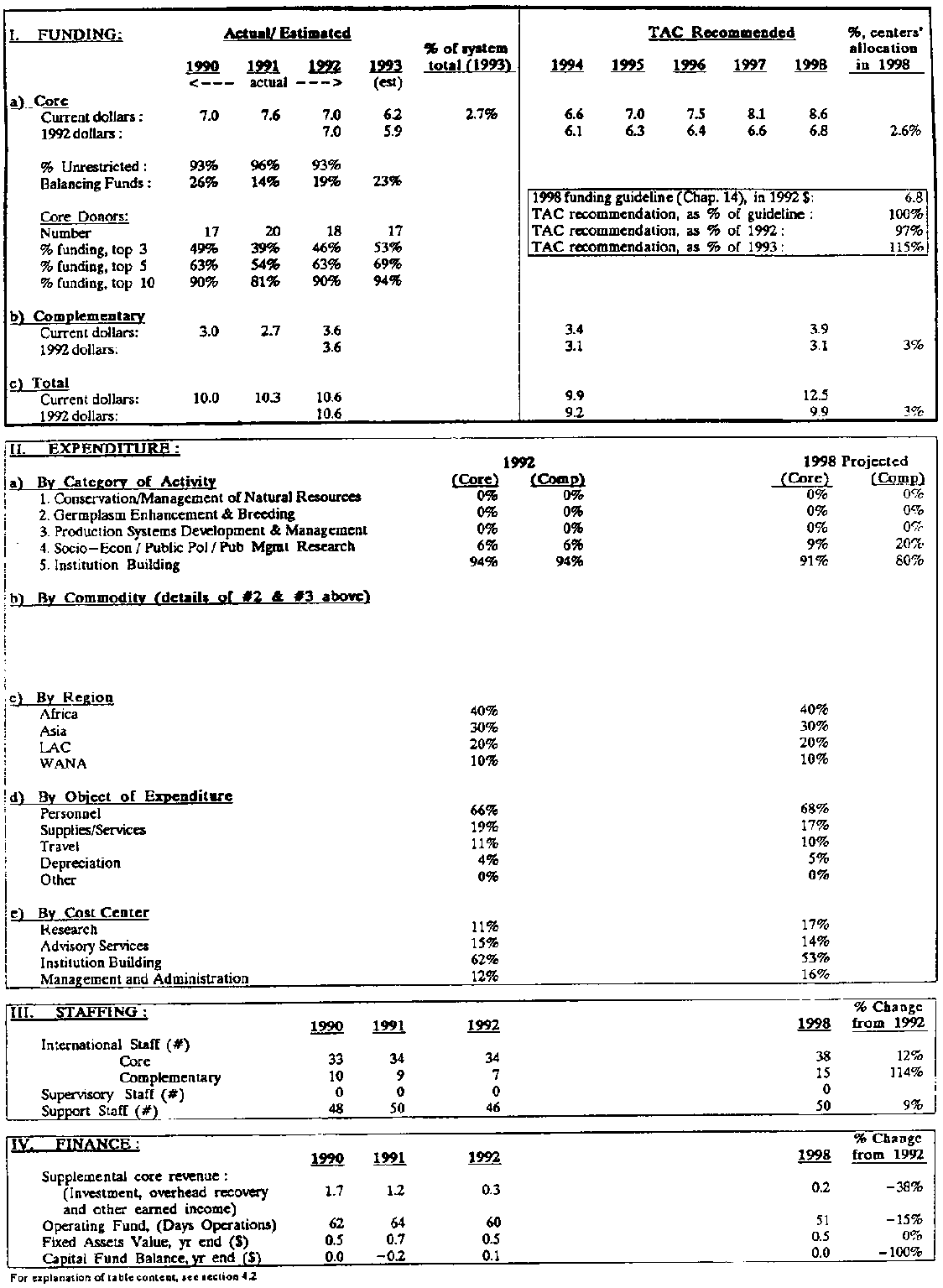
ISNAR will seek to multiply the impact of its work through partnerships with other organizations. These links will facilitate the development and dissemination of improved management approaches that can be used to support national systems. ISNAR's strategy foresees an allocation of core resources by 1998 as follows: 40% to sub-Saharan Africa; 30% to Asia; 20% to Latin America; and 10% to WANA.
During the MTP period, ISNAR will focus on three types of research-based service: comprehensive, long-term advice and support to strengthen the overall national agricultural research system for a few selected national programmes (30%); focused short-term support to strengthen specific policy and management components for many national programmes (42%); and research to generate up-to-date knowledge on national systems, research policy issues, research management, and institutional development for all national programmes (28%). ISNAR is planning to operate through a nexus of three administrative programmes and two services: research policies and system strategies programme; research programme design and management; management of organizations and resources programme; collaborative services and training; and information management services.
ISNAR has presented its primary MTP proposal at the 110% of the base resource envelope recommended by TAC, with a detailed breakdown of resources by programme and service, and by category of activity. A breakdown of senior staff years (SSY) was also provided at the base resource envelope. ISNAR has made available to TAC supplementary information on the programmatic implications of funding at 90% of the base resource envelope, as well as additional activities that would be undertaken if an extra US$ 2 million recommended by the 1991 External Review were to be provided.
TAC highlighted a number of issues arising from its initial consideration of the MTP proposal for further elaboration by ISNAR and, where appropriate, comments from the CGIAR. These included: internal priority setting; classification of core and complementary activities; criteria for country selection in respect of comprehensive long-term associations and the duration of such partnerships; criteria for deciding who pays for, and who receives free services from ISNAR; and, the proportion of research in each of ISNAR's programmes and services.
ISNAR considers all activities it undertakes to fall squarely within its mandate and priorities. It uses the general principle that the closer an activity is to a service benefiting only one individual country the better a candidate it should be for funding by a national system or its donors, either as complementary activities or as reimbursable services. The more an activity serves a general audience, the more likely it will require core funding because of lack of special interest among ISNAR's donors or partners. In practice, however, ISNAR also provides core-funded services to individual national programmes for reasons of equity, regional balance, thematic development, and opportunity for impact.
The nature of ISNAR's mission and goals as a service organization has made it necessary for it to have a good match between in-house skills and likely requests for expertise. To achieve this critical mass. ISNAR must hire and retain staff in anticipation of the demand for services. The principle of 'first come, first served' is applied in this regard to ensure that staff are used most efficiently to address the portfolio of problems presented to ISNAR, at any moment in time. To maintain its critical mass ISNAR requires more resources than would normally be available through core funding. Consequently ISNAR covers the extra cost by selling its services to some national programmes or their donors, following the principle that those who are able, should pay for the services they receive.
With regard to a sunset clause for long-term partnerships, ISNAR plans to conduct periodic joint reviews in order to determine criteria and modalities of continuation, new forms of collaboration or termination.
ISNAR conducts most of its research and development activities in the course of its service work with national programmes. The degree to which such activities can contribute to the creation of knowledge affects the willingness of ISNAR to engage core funds in the activity, and determines the proportion of research in the programme or-service With the help of tables included in the MTP proposal, ISNAR attempts to provide some insight in the scope of research in the various programmes and services.
The MTP proposal outlines the evolution of programme priorities and resource allocations consistent with current and projected financial constraints and the main strategic directions of ISNAR. On the basis of the additional information provided by ISNAR in response to the interim commentary on the MTP proposal and to comments from the CGIAR, TAC considers that the MTP proposal adequately reflects ISNAR's strategy for the 1990s and the recommendations of the 1991 External Review. The priorities among programmes and services, as well as the relative allocation of resources by region, appear to be appropriate.
The allocation of resources among programmes reflect ISNAR's desired strategic balance between work on research policy and systems structure, scientific programme management, and management of the institutional environment. TAC notes that at the 110% budget level, ISNAR has projected an increase in the share of resources allocated for research policy, which it could not do at the 100% scenario without reducing resources below critical mass in other areas.
Most of ISNAR's work is geared towards the production of international public goods. In this regard, TAC commends ISNAR's successful track record in securing complementary funds for core activities. TAC notes and concurs with the rationale used by ISNAR for classifying all of its activities as core, given the nature of ISNAR's mandate as a research-based service, while securing complementary funding to contribute to their implementation.
TAC considers that the priority to be assigned to institution building activities had already been adequately reflected in the tentative planning envelope assigned to ISNAR. ISNAR is institutionally healthy and has excellent collaborative arrangements with national programmes, CGIAR centres, and other relevant partner institutes.
TAC recommends that, for 1998, ISNAR be assigned core resources in the amount of US$ 6.8 million (in 1992 dollars), equivalent to 100% of the indicative base envelope. TAC saw no compelling reasons for revising ISNAR's resource envelope at the US$ 270 million vector. TAC recognizes that strengthening of national programmes remains a high priority. It sees an urgent need for a strong research base at ISNAR to facilitate a better understanding of the total context in which agricultural research operates, to support the services provided by ISNAR, to evaluate the impact of ISNAR's services, and to develop and refine new concepts and methodologies aimed at enhancing the quality of judgement by research managers. Therefore, at the US$ 280 million vector, TAC recommends an increase of US$ 1.0 million in ISNAR's core funding to enable the Centre to develop a more comprehensive research programme. Research should be strengthened on the strategic aspects of ISNAR's institutional building activities, particularly the role of national programmes in national government policy formulation and decision making for agricultural research and development. This would complement ISNAR's existing research on the operational aspects of the organization and management of national programmes.
For 1998, ISNAR projects complementary funding of US$ 3.1 million (in 1992 dollars), representing 46% of its recommended core funding at the US$ 270 million vector.
For 1994, TAC recommends core funds for ISNAR of US$ 6.1 million in 1992 dollars, or US$ 6.6 million in current values. Together with complementary funds projected at US$ 3.4 million, ISNAR's total funding in 1994 would amount to US$ 9.9 million.
ISNAR: FINANCIAL HIGHLIGHTS (US$ million & percentages)