4.20.1. Summary of the MTP Proposal
4.20.2. Interim Commentary and Programmatic Issues
4.20.3. Centre Response
4.20.4. Evaluation
4.20.5. Recommendations
WARDA's MTP proposal responded to three major challenges facing West Africa: the growing imbalance between regional production and consumption for rice; the increasing degradation of the agricultural resource base as agriculture production in general and rice in particular shifts from extensive to intensive land-use systems; and the future well-being of women, who are heavily involved in rice farming. The MTP proposal built on five elements of WARDA's strategy which define the key ecoregional aspects of its research approach: the environmental orientation of WARDA's operational mandate with a focus on agroecological zones at the institutional level, and agroecosystems at the project level; the focus on resource and crop management: sustainable production systems; the farming systems perspective; and partnership.
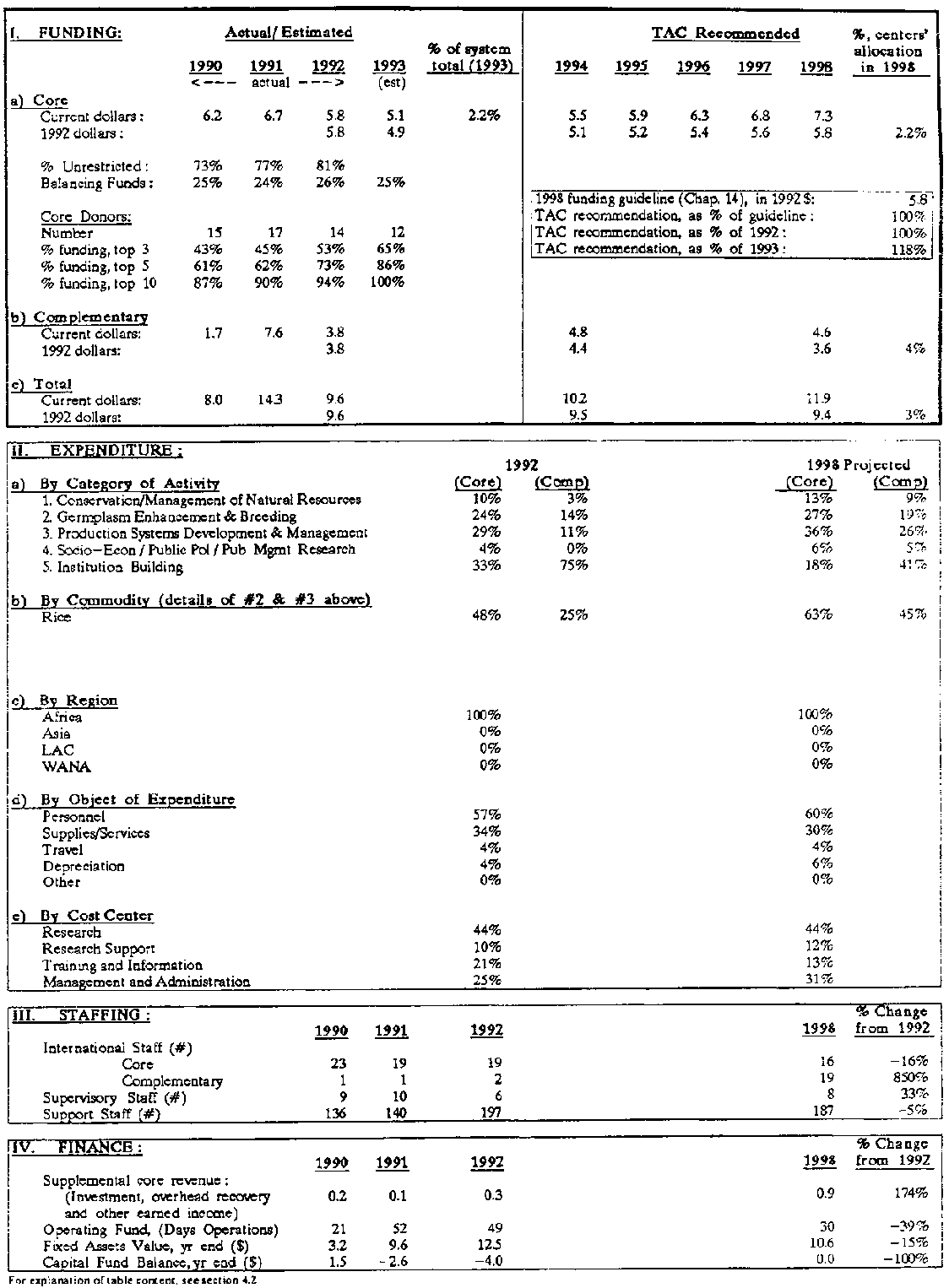
The proposed plan presented three scenarios for 1998 at different resource levels: the indicative base resource envelope (US$ 5.8 million), calling for 16 senior staff years (SSY); at 110% of the indicative resource base (US$ 6.4 million), calling for 17 SSY; and, at 130% of the indicative base (US$ 7.6 million), calling for 21 SSY and which WARDA feels is necessary for a viable programme. Under the 110% scenario, there would be a reduction of four SSYs from the 130% level, affecting the Continuum Programme, the Sahel Programme and the Training Programme; the policy analysis work would be conducted through a centre-based collaborating scientist. Under the indicative base scenario, there would be a further reduction in SSY from the Continuum Programme. WARDA also presented a 90% scenario and its implications for programmes and activities.
The plan focused on expanding research activities and achieving a balance between productivity and sustainability goals of the two primary Programmes: the Continuum and the Sahel and on strengthening the network activities within the Mangrove Swamp Programme. In the continuum ecosystems, WARDA's programme will increasingly address a diverse range of crops, especially in the inland valleys. The Plan allocates 75% of the resources to support core activities in the Continuum, and 25% in the Sahel.
The goal of the Continuum Programme is to develop technology options that will enable resource poor farmers to reduce pressure on uplands and shift towards intensified cultivation of high potential land types. The plan places increased emphasis on research to develop more productive and sustainable cropping systems for inland valley ecosystems within which rice has a strong advantage. The goal of the Sahel Programme is to enable farmers in more favourable irrigated environments to move towards sustainable and economic intensification through double cropping of rice. For less favourable irrigated environments, research will focus on a crop diversification strategy.
Through a new open-centre concept, WARDA will provide an institutional framework within which teams of collaborators including national programmes and advanced institutions, will work together in an integrated regional rice research programme. Through the regional task force mechanism, WARDA will achieve a complementary and effective sharing of research tasks based on relative advantage, and maximize research spillover.
TAC commended WARDA for the transparent and well-structured proposal. TAC requested clarification on why the greater emphasis on the conservation and management of natural resources in WARDA's institutional goal and programmes was not explicitly reflected in the allocation of resources by category of activity. Also, TAC requested information on the extent to which WARDA could use partnerships with advanced institutions to address effectively priority research areas under current funding constraints.
TAC sought an elaboration on what opportunities existed for an integrated programme of research with IITA on rice based cropping systems in the continuum/inland valley ecosystems, as suggested by both the Inter-Centre Rice Review and the WARDA External Review Panel. TAC requested further information on arrangements that are being negotiated for collaboration with IITA and other partners in the Continuum programme, and with IIMI in the Sahel programme. Also, it was not clear to TAC what was being proposed for INGER-Africa, and what the agreement reached by WARDA and IRRI implied for its future.
The financial support expected by WARDA from its Member States during the period of the MTP is relatively small. The capacity of West African national programmes for rice research that could complement WARDA's work is limited. In the light of this, TAC agreed with the recommendation of the External Review Panel that WARDA Member States take steps to bring their contributions to the WARDA budget up to the target level of 5% of the Centre's operating requirements.
WARDA's greater emphasis on the conservation and management of natural resources (category of activity 1) is more accurately reflected under category 3 (production systems improvement), because the focus of research to conserve and manage natural resources is through the vehicle of improved rice-based cropping systems. The proposed increase in the allocation of core resources to category 3 is from 29% in 1992 to 33% in 1998, with allocations to category 1 remaining constant at 11% at the 110% funding scenario.
WARDA will seek collaboration, through its open centre concept, to complement research of its core staff within the objectives and priorities set out in the MTP proposal. In most instances, staff from advanced research institutions will be based at WARDA locations for varying periods of time.
As a basis for the development of an integrated research programme with IITA on rice-based cropping systems in the continuum/inland valley ecosystems, WARDA and IITA have begun a joint collaborative research activity, aimed at characterizing continuum environments. This is now being followed-up with an expanded research project into technology development across West Africa through a consortium mechanism, allowing other, new collaborators, such as CIRAD and IIMI, to participate. Discussions are also under way with IIMI to establish a collaborative research project in the Sahel.
WARDA agrees that INGER-Africa be maintained as a unique network for the whole of sub-Sahara Africa, sponsored and managed jointly by WARDA and IRRI. Within this strategy, the IRRI liaison scientist, who currently serves as the INGER-Africa Coordinator, will be shifted from IITA to WARDA's headquarters once adequate facilities are available to ensure the continuing stability and effectiveness of INGER. The transfer will take place in agreement with IRRI, and discussions are under way to work out the details of these arrangements.
WARDA's MTP proposal was transparent and well structured, responding innovatively to the major challenges against a background of severe financial difficulties. WARDA incorporated sustainability concerns into its current strategy, and adopted a farming systems approach to research with a strong ecosystem focus. Thus, the priority given to research in the Continuum and in the Sahel was based on the needs and opportunities for increased productivity and sustainability of its cropping systems, and not for rice only.
TAC considered that WARDA's programme is forward looking and innovative. The programme is pragmatic in its mode of operation, given the severe financial difficulties faced by the Centre. WARDA's programme holds out prospects of a significant impact within a reasonable time horizon.
WARDA has an effective partnership with national programmes through an innovative model based on regional working groups and task forces. It has also developed an 'open centre' concept of cooperation with other international organizations and advanced institutions. The two mechanisms are capable of amplifying the scope of WARDA's programmes and maximizing the effectiveness of its resources. The location of WARDA at M'be allows the Centre to serve effectively both the francophone and the anglophone nations, and provide access to a range of rice growing environments.
On the basis of the recent Strategy Statement on Rice Research in the CGIAR. TAC considered that the tentative envelope assigned to WARDA should remain unchanged. While this level of funding could not be justified on the basis of rice research alone, it lakes into account the minimum level of resources required for a viable institution. It also recognizes the importance of research on rice-based farming systems in West Africa, and would allow WARDA to continue to play a major role in conducting research on the sustainability of important rice-based farming systems. Both TAC and WARDA have responded to the Group's wish to help WARDA to transform itself into a well-managed institute doing research of high quality. The report of the External Review Panel confirmed that this has been achieved.
TAC recommends that WARDA be assigned in 1998 core resources in the amount of US$ 5.8 million (in 1992 values), which is equivalent to 100% of the tentative envelope. TAC expects WARDA to play a major role in conducting research on the sustainability of important rice-based farming systems in West Africa. TAC would also encourage WARDA to seek a greater share of its funds from member states.
TAC considers that the complementarities between WARDA and IITA in their work on inland valleys be enhanced through the Systemwide ecoregional programme for the warm humid and sub-humid tropics for sub-Saharan Africa for which IITA has been identified as the convening centre. In this Systemwide initiative, WARDA would have a lead role in the inland valley component within the framework of a consortium arrangement with IITA. Within the US$ 270 million vector, TAC recommends that US$ 500,000 be made available for planning and organizing a Systemwide ecoregional programme for the warm humid and sub-humid tropics in sub-Saharan Africa of which an appropriate portion should be assigned to WARDA within the context of the consortium arrangement on inland valleys.
Under the US$ 280 million vector, WARDA would benefit from funds recommended for the proposed Systemwide fisheries initiative which will allow the integration of fisheries research into ecoregional initiatives, with particular reference to the inland valleys of West Africa.
For 1998, WARDA projects complementary funding of US$ 3.6 million (in 1992 values), representing 62% of its recommended core funding for that year.
For 1994, TAC recommends core funds for WARDA of US$ 5.1 million in 1992 dollars, or US$ 5.5 million in current values. Together with complementary funds projected at US$ 4.8 million, WARDA's total funding in 1994 would amount to US$ 10.2 million.
WARDA: FINANCIAL HIGHLIGHTS (US$ million & percentages)