2.1 Introduction
2.2 Three Major Themes
It has been estimated that global demand for rice will more than double by the year 2030 (see Chapter 3). The sheer magnitude of growth in demand provides the imperative for correctly identifying the priorities for research, and for the efficient allocation of limited resources to achieve the required output.
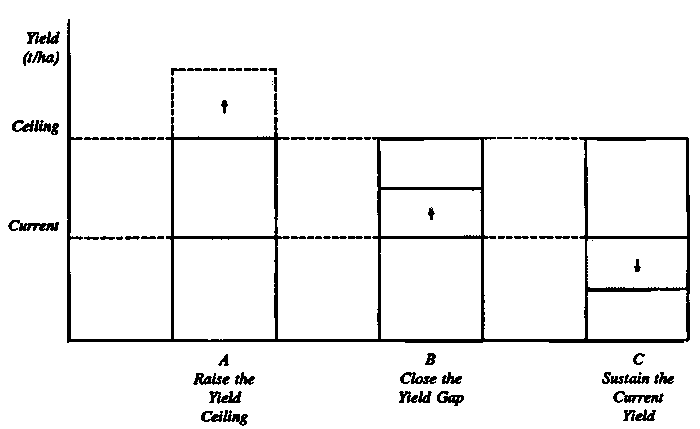
The Panel has considered the priorities for research under three major themes: raising the genetic yield ceiling; closing the gap between achieved and ceiling yields; sustaining the yields already achieved (Figure 2.1). These themes are discussed within regions and ecosystems. For convenience, ecosystems of all regions are classified according to IRRI definitions as "irrigated", "rainfed lowland", "upland", and "deepwater/tidal". Rainfed lowland includes both the usually bunded level or slightly sloping rainfed lowlands of Asia, as well as the sometimes unbunded valley bottoms within the inland valleys of sub-Saharan Africa. Similarly, the upper slopes of the sub-Saharan Africa "continuum" and the savannas of Latin America and the Caribbean are included within upland ecosystems. The deepwater/tidal ecosystem encompasses everything from the deepwater flood plains of Bangladesh to the tidal estuaries of Asia and the mangrove swamps of West Africa.
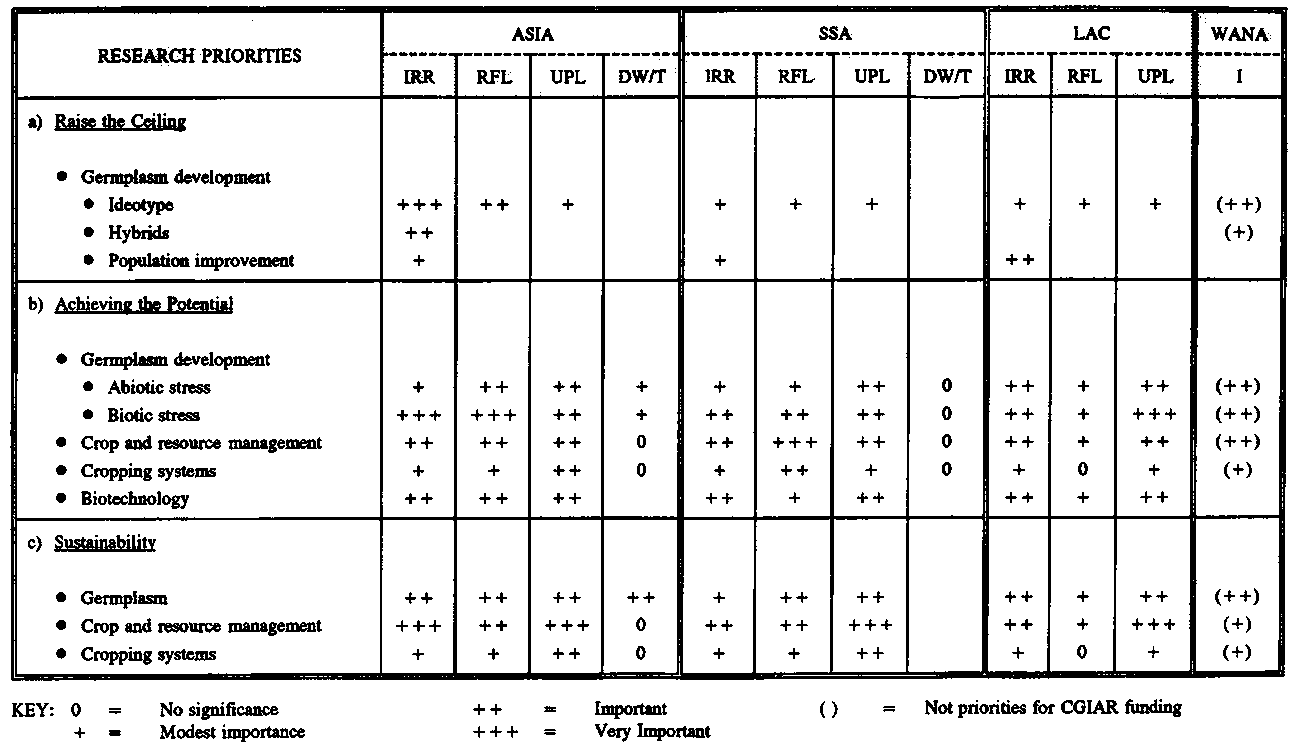
Table 2.1 illustrates some important features of currently recognized priorities within the system including:
· the importance of raising the yield ceiling in irrigated rice varieties, particularly in Asia and to a lesser extent in Latin America and the Caribbean;· the significance of disease and pest management for closing the yield gap on a sustainable basis across all regions;
· the relatively greater emphasis needed on crop and resource management compared to germplasm development in development of uplands and inland valleys of sub-Saharan Africa; and
· the crucial importance of resource management in areas of high cropping intensity in Asia, including special attention to the generation of yield decline under intensive irrigated systems.
Figure 2.1: Three Major Themes in Rice Research
Priorities for research and more importantly allocation of resources for research, are also affected by socioeconomic considerations. On the one hand, the fact that a large proportion of upland rice farmers in all regions are small scale subsistence farmers, often still practising shifting cultivation, raises questions of equity in the allocation of funds across ecosystems. On the other hand, the demonstrated capacity of large commercial rice farmers in parts of Latin America and the Caribbean to rapidly adopt and effectively use improved technology to increase yields, has led to a demonstrable reduction in the real cost of rice to the urban poor.
It would be inappropriate for the Inter-Centre Rice Review to attempt an analysis of research priorities, other than at a broad thematic level. The specification of detailed programmes of research is the role of the management and Boards of the centres. The Panel's attention has, therefore, been concentrated on the three major research themes referred to earlier; the yield ceiling, the yield gap, and sustainability.
Note: Because of the large differences in relative importance of total rice research between regions, the significance of priorities should only be compared within regions.
It is not always possible to distinguish between priorities for closing the yield gap and sustaining current yield; for example, the continuing battle to maintain host plant resistance embodies both these themes.
Current perceptions of ways in which research might contribute to advances in these broad areas are discussed below.
(i) Raising the Yield Ceiling
While the per hectare yield of irrigated rice has increased in many cases as a result of multiple cropping with early maturing varieties, the yield potential of modem rice varieties has not increased since 1966 when IR8 was released.
Three approaches to raising the yield potential of varieties have been suggested:
· New plant ideotype: Nearly 60 percent of the growth in rice production since 1960 can be attributed to widespread adoption of fertilizer-responsive, high yielding modem varieties which began with the introduction of IR8 in 1966 (IRRI, 1992). The most important characteristic that enables these varieties to produce high yields is their responsiveness to fertilizer (Dingkuhn et al., 1990a.). Significantly, none of the recent cultivars has proved capable of exceeding the yield potential of IR8.Dingkuhn et al. (1990b.) produced evidence that direct seeding, which is becoming increasingly popular in Asia, provides an increased yield potential. However, with current varieties, elaborate fertilizer management practices are required to produce those high yield. A new plant ideotype has been proposed for direct seeded rice varieties to further increase yields and avoid the need for complex management practices (Dingkuhn et al., 1990a.).
IRRI has now commenced building the new rice plant ideotype with low tillering, large panicles, sturdy culms, dark green, erect and thick leaves, and a harvest index of 0.6.
· Exploitation of hybrid vigour: China is the only country growing F1 hybrid rice varieties on an extensive scale. Hybrids were first distributed in China for commercial production in 1976 and by 1987 were cultivated on 10.9 million hectares or 34 percent of the total rice area of China. The yield advantage over conventional varieties has been found to be approximately 15 percent (Lin, 1992).
Research at IRRI also indicates that hybrids can be produced which have a potential yield 15 to 20 percent higher than the best available inbred varieties. However, problems related to the difficulty and cost of producing hybrid seed have so far discouraged attempts to use such varieties elsewhere. Recent successes by CIRAD and Latin American breeders in incorporating traits which enhance cross pollination and facilitate maintenance of male sterile lines may make production of hybrids more widely feasible. Chinese scientists are working to develop a two-line system based on environment dependent male sterility.
Attempts are also being made to identify and utilise other mechanisms such as apomixis which could be used to fix heterosis in pure breeding varieties.
· Population improvement: The degree of recombination between lines within hybrid populations of rice is normally limited by low levels of cross pollination and rapid approach to homozygoscity. Use of male sterile genes now makes extensive cross pollination possible without excessively high labour inputs. Enhanced ability to assemble favourable gene combinations and pyramid useful genes using recurrent selection makes this technique potentially useful for raising yield potential (CIAT, 1992). Success will depend on having an effective screen to identify high yielding genotypes.
(ii) Closing the Yield Gap
The extent to which the potential yielding ability is realized is largely dependent on the effectiveness of crop and resource management strategies. Key crop management factors include selection of variety, application of fertilizers, method of crop establishment and management of pests and diseases. Competition from weeds as well as biotic and abiotic stresses are major barriers to achieving yield potential. Choice of varieties with the ability to compete with weeds and the strategic use of herbicides is fundamental.
Breeding of varieties highly resistant to diseases and insect pests has made a major contribution to improving the level of yield potential achieved. Success in breeding for tolerance to abiotic stresses has been much less impressive. Biotechnology may provide the tools needed to incorporate still higher and much more durable resistances to biotic stress and make possible the transfer of high level resistances to abiotic stresses into rice.
Biotechnology is providing powerful new tools for breeders facing the need to produce varieties with improved and more durable resistance to diseases and insects, tolerance to abiotic stresses such as drought and having elite grain quality. Expansion of the genetic base will also be possible using techniques such as embryo rescue to improve the success of wide crosses and for the transfer of useful genes from wild relatives. Gene tagging will greatly improve efficiency of selection for complex traits such as drought resistance. Anther culture may also contribute by allowing production of homozygous (double haploid) plants within two generations which are free of dominance variance. More speculative transformations, such as the incorporation of N fixing capability in rice, are still remote possibilities.
(iii) Sustainability
Sustainability must mean more than maintaining an existing productivity level. It should recognize that in the long term what is required from a given environment may change. In future, a particular resource base may need to "sustain" a different farming system, or indeed some alternative use of that environment. Thus Sustainability must entail managing natural resources in a way that maintains the long-term capacity of the environment to respond to and satisfy changing human needs (FAO, 1989).
The underlying problem in achieving Sustainability in rice growing areas is the increasing pressure that is put on the environment by the need for higher crop output. In Asia, with little scope for adding new land for rice cultivation, future increases in production will largely depend on higher outputs on the same land area. This will have to be achieved by higher yields and, in the irrigated areas, more crops of rice per year. In sub-Saharan Africa and Latin America and the Caribbean, there appear to be somewhat greater opportunities for extending rice cultivation into previously uncropped lands. However, such moves may also increase pressure on the environment, with the same implications for sustainable resource management.
Sustainability can be regarded as having three elements; biological, physical, and socioeconomic. For the biological element a major concern is the preservation of current biodiversity. This is at least as important in rice as in other crops. It encompasses not only the preservation of germplasm of potentially useful wild species, but also the preservation of traditional cultivated strains that may be rapidly lost when new varieties are introduced. Thus the collection, preservation and characterization of rice germplasm remains a high priority. The other major component of the biological element is the long-term control of the biotic yield-reducing factors; weeds, pests, and diseases. Continued attention to host-plant resistance and integrated crop and pest management will remain the key pathway to achieve this control; an increasingly important aspect of this is the need to decrease the use of potentially harmful chemicals.
The physical element of sustainability for rice systems is primarily related to soil and water management. In poor upland environments, the main objective must be to prevent or arrest soil degradation by developing systems that avoid soil erosion and conserve or enhance nutrient fertility. Rice may be only one component in a complex cropping system that includes other crops, such as trees and legumes, for soil conservation and fertility restoration purposes. In the irrigated environments, some major sustainability concerns have arisen. They include increasing areas of salinity due to poor water management. In the areas growing two or three rice crops per year, yield stagnation, or even decline has emerged as a problem requiring serious attention.
The final element of sustainability encompasses socioeconomic issues. Economic policies, for example, can enhance or reduce the incentives for developing sustainable production systems. Increased pressure on rice producing areas will call for appropriate policies for production, trade, marketing infrastructure, investment in irrigation, research management and property rights. Research on these issues is an important element of the overall portfolio of rice research. Many of these issues cut across all regions and ecosystems and do not necessarily relate to one of the three major themes outlined above. This is simply a result of the taxonomy the Panel adopted; it in no way diminishes the importance of these matters in relation to the other research themes.