3.1 The Role of the CGIAR
3.2 The Overall Level of Investment
3.3 Regional Balance
3.4 Balance Between Ecosystems
3.5 Balance Among Research Themes
The CGIAR is only one small component in the global agricultural research system. As noted in Chapter 1, it accounts for approximately 6 percent of the total public sector resources invested in rice research. As a consequence, the CGIAR must be very selective in choosing, from the many demands for agricultural research in developing countries, those to which it can most effectively contribute. For this reason, TAC regularly reviews CGIAR priorities and strategies (TAC/CGIAR, 1992).
To qualify for CGIAR support, an activity must be research or research-related, be international in character, contribute to a priority programme consistent with CGIAR goals, and be undertaken by the best qualified entity (CGIAR Secretariat, 1992). CGIAR research should be largely strategic in nature and driven by the need for a supra-national effort requiring multidisciplinary inputs and regular access to characterized germplasm. Furthermore it needs to mount a continuous and stable effort. As a public sector-funded international organization, the CGIAR must focus on themes for which national research programmes or other research agencies have little incentive to make a major commitment, either because of economies of scale, or because the spillover effects are so large that they cannot capture adequate resources, or because their target farmer group is not the poor farmer or consumer which is the intended primary beneficiary of the CGIAR. An estimate of the total potential benefits resulting from investments in research must inevitably be an important guiding factor in priority setting.
The CGIAR has at times played a gap-filling and bridging role in agricultural research. It fills gaps which could be filled by national systems, but which currently lack attention; it provides a bridge to advanced institutes, active in basic and strategic research.
With respect to its role in the global rice research system, the CGIAR must give particular emphasis to the needs for strategic research on questions of international importance, to research opportunities for which the CGIAR is particularly well-qualified, and for which there is a large potential for breakthroughs which will ultimately benefit its primary target groups. Biological research must be complemented by socioeconomic, policy and management research, and research on the conservation and management of natural resources. The CGIAR must also continue to play a role in generating and disseminating information on rice research, and strengthening national research capabilities.
Having noted the principles on which support by the CGIAR to rice research should be based, we are left with the need to explore the magnitude and allocation of that effort. This is the purpose of the remaining sections of this Chapter.
The first question that must inevitably arise in any consideration of the investment in rice research is the following: is the current level of total core funding that the CGIAR locates to rice appropriate? In addressing this, one can start by asking whether the total CGIAR core funding for all activities is to be taken as given. If so, the question is whether the overall return to the CGIAR research portfolio could be increased by reallocating funds toward rice and away from other activities, or vice versa. Such a question lies beyond the mandate of this review. To answer this question, one requires a view of all the activities in the portfolio, and a framework which would assess the impact of marginal increases or decreases in funding on various outcomes. The report on CGIAR priorities and strategies prepared by TAC (1992), suggests that in relation to other commodities, the share of total funding going to rice research should remain unchanged. The Panel notes however that this exercise did not attempt to estimate explicitly the rates of return to different commodities.
An alternative question is whether the total level of funding should be increased, given that more resources were available. Again the Panel has not addressed this specifically. However it is worth noting that estimates of the rate of return to investment in rice research are typically high (David and Evenson, 1992, p. 17). This suggests that the level of funding might well be increased before the return on the investment fell anywhere close to levels regarded as unsatisfactory.
In light of the magnitude of the challenges to rice research identified in the present study, the Panel urges that the CGIAR constantly monitor this matter, and ask whether the contribution that research will need to make to expanding output can be realistically met with the current funding levels. It would be too easy to argue that past investment in rice research has been productive, and that more of the limited funding can now be diverted to other activities, perceived as neglected in the past. The CGIAR must be constantly conscious of the importance of rice, and the need to continue the past record of advances in productivity if future needs are to be met. The Panel became increasingly concerned with the need for adequate resources to be devoted to rice science, given the sheer magnitude of the increases in output that will be needed.
In considering the balance of research effort, the Panel has examined three dimensions: across regions; across ecosystems and across major research themes. Each of these is now addressed in turn.
As a starting point, we examined the current allocation of CGIAR core funding for rice research across the regions and ecosystems within regions (Appendix Tables A.2 and A.3). In order to capture the current balance of effort across regions, the core funding was converted to two measures of research intensity (Table 3.1). The first measure expresses the funding as a percentage of the value of output. This varies from 0.03 percent for Asia as a whole, or 0.05 percent when China is excluded, to 0.55 percent for sub-Saharan Africa. Within sub-Saharan Africa, West Africa receives funding equivalent to 0.79 percent of the value of output.
Table 3.1: Rice Research Intensities: CGIAR Core Expenditures - By Major Regions
|
Region |
CGIAR Core Research Expenditures' |
Value of Productionb |
Research Intensity |
|||
|
US$ m |
% |
US$ m |
% |
% |
Cents/ton raw rice |
|
|
ASIA |
25.80 |
65.6 |
82,429 |
92.7 |
0.03 |
6.1 |
|
ASIA (excluding China) |
25.80 |
65.6 |
49,187 |
55.5 |
0.05 |
10.3 |
|
SSA |
8.43 |
21.4 |
1,444 |
1.8 |
0.55 |
104.6 |
|
of which West Africa |
6.71 |
17.1 |
857 |
1.0 |
0.79 |
150.0 |
|
LAC |
4.20 |
10.7 |
3,498 |
4.2 |
0.12 |
22.2 |
|
WANA |
0.90 |
2.3 |
921 |
1.1 |
0.10 |
18.6 |
|
TOTAL |
39.33 |
100.0 |
88,291 |
100.0 |
0.05 |
8.7 |
|
TOTAL (excluding China) |
39.33 |
|
55,048 |
|
0.07 |
13.9 |
a 1991b Average production of milled rice (1968-88) valued at US$ 284/ton, and using a constant rolling ratio of 1 ton paddy = 0.67t milled.
Source: Compiled from Appendix Table A. 3.
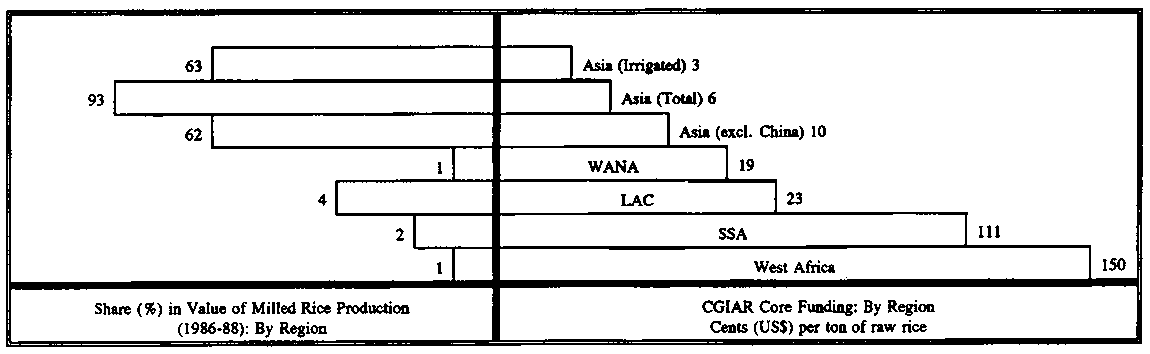
Fig. 3.1: Intensity of CGIAR Core Funded Rice Research and Value of Output by Region
An alternative and perhaps intuitively clearer indicator of research intensity, is the number of cents (of the US dollar) that the CGIAR allocates to each region per ton of raw (unmilled) rice that is produced. The results for this measure are depicted in Figure 3.1. Overall, Asia attracts 6 cents. The Asian irrigated rice sector, which contributes over 65 percent of total global rice output, receives 3.3 cents per ton (Appendix Table A. 3). The entire region of Asia, excluding China, receives 10 cents per ton. These levels are in marked contrast to those in sub-Saharan Africa.
Figure 3.1 highlights the extreme imbalances that have arisen in CGIAR core funding of rice research. In sub-Saharan Africa, rice research expenditures are equivalent to 111 cents per ton. Within sub-Saharan Africa, the West Africa region receives 150 cents per ton. This is a level of research intensity some 15 times greater than Asia, excluding China.
There is absolutely no presumption that the intensity of research funding should be uniform across all ecosystems and regions. Legitimate differences can arise for a myriad of reasons. Among these would be the heterogeneity of the cropping systems, environmental impacts, the extent to which the findings from research in one region can be captured in other regions, the level of past funding and the prospects of success. All these factors govern the optimal allocation of research funding across regions. However disparities of the magnitude observed here must raise serious doubts about the regional balance of current CGIAR investments in rice research. In view of the importance of this issue, the Panel has explained the implications of reallocation.
One cannot however make suggestions about reallocation without some indication of the possible costs and benefits. To address this question, a simple framework was developed. It involves examining the relation between expected productivity growth in rice due to the CGIAR, and the level of core funding allocated to each of the regions (see Appendix B). Were research funds to be reallocated from the sub-Saharan Africa region to Asia, then the future output of rice would be affected in both regions. The results in Table 3.2 show the loss in sub-Saharan Africa, the gain in Asia and the net gain from various levels of reallocation. To illustrate, a shift in 20 percent of the current funding from sub-Saharan Africa to Asia would result in additional net output over the period 1987 to 2030, worth US$759 million in today's terms. In other words, the opportunity cost of misallocating the limited core funding for rice is extraordinarily high.
In deriving this result, the only criterion used was that of ensuring that research funding made its greatest possible contribution to increased output. It is true that funding is allocated in practice on the basis of a wider set of criteria. Predominant among these has been the concern for equity. Stated in its simplest form, it has been argued that regions with poor farmers, with less bountiful resources for rice production, or which have been by-passed by past technological advances should receive a disproportionately greater share of funding than other regions.
This is a broad and complex issue. The location and extent of poverty is not easy to measure, nor does it follow that technological change is either necessary or sufficient, to ensure real income gains are captured by the poor. Rice research can be a blunt instrument for addressing complex social issues. Resolution of this debate lies well outside the mandate of this Panel. However the analysis presented here serves to emphasise the potential costs of attaining equity goals.
Table 3.2: Impact of Reallocation of Core CGIAR Research Rice Funding from sub-Saharan Africa to Asia
|
Share of SSA Funding Transferred to Asia |
Changes in the Value of Rice Outputa |
||
|
Gain in Asia |
Loss in SSA |
Net Gain |
|
|
0 |
0 |
0 |
0 |
|
0.2 |
+1,634 |
-875 |
+759 |
|
0.4 |
+3,202 |
-1,785 |
+1,417 |
|
0.6 |
+4,705 |
-2,727 |
+1,978 |
|
0.8 |
+6,147 |
-3,696 |
+2,451 |
|
1.0 |
+7,529 |
-4,686 |
+2,843 |
a Present value of changes in rice output valued at US$284/t over the period 1987-2030 including a real discount rate of 10 percent.Source: Derived from the framework outlined in Appendix B.
Even if it were the case that equity goals would be served in sub-Saharan Africa by the channelling of additional resources to rice research in that region, it is vital that the potential cost of that strategy for other regions be made explicit. If those limited resources could have been applied elsewhere, then any benefits attained in sub-Saharan Africa must be set against foregone gains in other regions. Clearly, the current allocation involves a net loss of global rice output. When it is recognized that the extent and magnitude of poverty, both rural and urban is vastly greater in Asia, one must question whether global equity might not also be worsened by the distorted regional pattern of research funding that has evolved.
An alternative approach to assessing the appropriate regional balance is to determine the level of funding for each region that would make the rates of return equal across regions. This was done by first estimating the rate of return to the investment in Asia, and then finding the level of funding in both sub-Saharan Africa and Latin America and the Caribbean that would make the rates of return in those regions the same as that for Asia. Under the assumption that the key parameters which determine the rates of return are comparable in all three regions, core funding in sub-Saharan Africa and Latin America and the Caribbean would need to be US$ 0.77 million and US$ 1.90 million (Table 3.3, Case A).
Table 3.3: Levels of CGIAR Core Investment in Rice Research for sub-Saharan Africa and Latin America and the Caribbean which would Equate the Rate of Return Across All Regions: 1987-2030
|
Case |
Region |
Assumptions |
CGIAR Core Funding |
|||||
|
Expected Annual Growth Rates Under |
Share of Impact Attributable to CGIAR |
Maintenance Research Costs as a Share of Base Research Expenditures |
||||||
|
Area |
Yield |
Output |
% |
% |
Region |
US$ m. |
||
|
A |
Asia |
0 |
2 |
2 |
25 |
25 |
Asia |
25.80 |
|
SSA |
0 |
2 |
2 |
25 |
25 |
SSA |
0.77 |
|
|
LAC |
0 |
2 |
2 |
25 |
25 |
LAC |
1.90 |
|
|
B |
Asia |
0 |
2 |
2 |
25 |
25 |
Asia |
25.80 |
|
SSA |
3 |
2 |
6 |
25 |
25 |
SSA |
1.87 |
|
|
LAC |
3 |
2 |
6 |
25 |
25 |
LAC |
4.58 |
|
|
C |
Asia |
0 |
2 |
2 |
25 |
25 |
Asia |
25.80 |
|
SSA |
2 |
2 |
4 |
50 |
0 |
SSA |
3.10 |
|
|
LAC |
2 |
2 |
4 |
50 |
0 |
LAC |
7.60 |
|
Notes:
1. Any inter-regional spillovers occurring under current funding levels would apply under the funding levels which equate the returns.2. The research and adoption lags are assumed to be each 10 years in all cases.
If it were assumed that because of past neglect, the gains to be made in sub-Saharan Africa from rice research are much greater at the margin than in Asia, sub-Saharan Africa funding could rise to US$3.1 million, at which point the rate of return would be comparable to that in Asia (Table 3.3, Case C). This would still be less than one half of the 1991 allocation to that region (Table 3.1).
On the basis strictly of the share in output, sub-Saharan Africa would justify 1.6 percent of the global funding, or US$0.63 million. To equate the return on sub-Saharan Africa funding with that allocated to Asia would imply funding for sub-Saharan Africa between US$0.77 million and US$3.1 million. The Panel notes that the upper bound of this range approximates the level estimated by TAC (1992, p. 174) on the basis of the system of modified weightings.
Finally, an estimate was made of the annual rate of output growth in sub-Saharan Africa which would be needed to make the returns to investment due to CGIAR funding, equal to those presently achieved in Asia. If the annual rate is 0.5 percent in Asia, based on a total rate of output growth of 2 percent of which 25 percent is attributable to the CGIAR investment, then the rate in sub-Saharan Africa would need to be over 5 percent per year, or over ten times the rate in Asia (Appendix Table B.3). Based on past evidence, it would seem difficult to sustain a case that output growth of rice production in sub-Saharan Africa, solely due to CGIAR efforts, could be sustained at 5.5 percent per annum from now till 2030.
It is widely recognised that research is characterized by lengthy delays, both in the generation and the adoption of new materials and knowledge. This means that relating current research expenditures to today's output levels is not necessarily appropriate. The Panel were cognizant of this difficulty, and considered that the question of balance in the CGIAR rice research portfolio would be better considered by looking ahead. This was done by projecting the future demand for rice, and then asking what increases in productivity would be necessary to meet that demand.
Details of the procedures for projecting demand and the matching increases in supply, are set out in Appendix C. Rates of growth for demand were taken from Crosson and Anderson (1992, p. 80) and applied to all regions, with the exception of sub-Saharan Africa, where significantly higher rates were used. A summary is given in Table 3.4.
Based on these projected levels of demand, the Panel sought to develop estimates of the increases in area and yield which would be necessary to ensure that future output matched projected needs. Clearly, a significant element of judgement entered into this process. It is stressed that the results are to be viewed as indicative only. Others may well want to substitute other values; the only restriction is that in any event, the output must match the projections for the quantity demanded. In each case, the indicative yield is that which would be needed to generate the required output once the contribution of any increases in harvested area and reductions in the yield gap had been incorporated. Details of the assumptions concerning yield ceilings and yield gaps are given in Appendix Table C.I. An overall summary of the results is presented in Table 3.5 (by region) and Table 3.6 (by ecosystem).
It is hardly surprising that over 90 percent of the increased output will have to come from Asia. In contrast, less than 4 percent of the increase would correspond to sub-Saharan Africa. Yet the current allocation of CGIAR funds has over 20 percent directed at sub-Saharan Africa (Table 3.5). These results serve to again highlight the over-riding issue of regional balance in the current CGIAR core funding.
Table 3.4: Demand Projections for Rice in Developing Countries (By Region, 1987-2030)
|
Region |
Annual Growth Rates (%) |
Total Projected Demand m.t |
|
|
1987 to 2005 |
2006 to 2030 |
||
|
Asia (excl. China) |
2.4 |
1.3 |
560.4 |
|
China |
2.4 |
1.3 |
362.3 |
|
SSA |
5.0 |
2.0 |
28.0 |
|
LAC |
2.4 |
1.3 |
38.8 |
|
WANA |
2.4 |
1.3 |
10.5 |
|
TOTAL - Developing Countries |
1,000.0 |
||
Source: Crosson and Anderson (1992, p.80) except for SSA (Panel Estimates).
Based on the demand projections and the analysis of the potential increases in supply necessary to match these, a summary by ecosystem was developed (Table 3.6). About 80 percent of the total required increase would have to come from the irrigated rice systems. The Panel estimates that some 20 percent of the increases could reasonably be expected to come from rain-fed lowlands and upland areas. Yet these latter sectors currently attract close to one half of the core funding of the CGIAR system. Naturally within the estimates that the Panel has made there is some scope for substitution between regions and ecosystems. However, a smaller contribution from one ecosystem, would necessarily require the contribution of other ecosystems to be greater in order to meet the target requirements.
Table 3.5: Actual and Indicative Output Levels and Current Research Expenditures: By Region
|
Region |
1986-88 Actual |
2030 Indicative Levels |
Increases in Output |
Distribution of Increases in Output |
CGIAR Core Research Expenditures |
|||||
|
Area |
Yield |
Output |
Area |
Yield |
Output |
m.t |
% |
US$m |
% |
|
|
Asia (excl. China) |
95.8 |
2.7 |
258.5 |
109.2 |
5.1 |
560.4 |
301.9 |
56.3 |
25.80 |
65.6 |
|
China |
32.7 |
5.4 |
174.7 |
37.2 |
9.8 |
362.3 |
187.6 |
35.0 |
0.00 |
0.0 |
|
SSA |
5.1 |
1.5 |
7.6 |
8.1 |
3.5 |
28.0 |
20.4 |
3.8 |
8.43 |
21.4 |
|
LAC |
7.9 |
2.3 |
18.4 |
9.1 |
4.3 |
38.8 |
20.4 |
3.8 |
4.20 |
10.7 |
|
WANA |
0.8 |
5.7 |
4.8 |
0.9 |
11.9 |
10.5 |
5.7 |
1.1 |
0.90 |
2.3 |
|
Total Developing Countries |
142.3 |
3.3 |
464.0 |
164.4 |
6.1 |
1,000.0 |
535.9 |
100.0 |
39.33 |
100.0 |
Table 3.6: Actual and Indicative Output Levels and Current Research Expenditures: By Ecosystem
|
Ecosystem |
1986-88 Actual |
2030 Indicative Levels |
Increases in Output |
Distribution of Increases in Output |
CGIAR Core Research Expenditures |
|||||
|
Area |
Yield |
Output |
Area |
Yield |
Output |
m.t |
% |
US$m |
% |
|
|
IRR |
67.5 |
4.9 |
329.7 |
77.4 |
9.1 |
705.2 |
375.3 |
70.1 |
16.80 |
42.7 |
|
RFL |
39.4 |
2.2 |
86.5 |
47.3 |
4.2 |
197.9 |
111.3 |
20.8 |
9.80 |
24.9 |
|
UPL |
23.6 |
1.3 |
30.2 |
27.8 |
2.3 |
63.7 |
33.6 |
6.3 |
8.46 |
21.5 |
|
DWT |
11.9 |
1.5 |
17.7 |
11.9 |
2.8 |
33.2 |
15.5 |
2.9 |
4.27 |
10.9 |
|
Total |
142.3 |
3.3 |
464.0 |
164.4 |
6.1 |
1,000.0 |
535.9 |
100.0 |
39.33 |
100.0 |
The Panel recognises that resources have been consciously redirected to these less favoured ecosystems, but cautions that a sustained misallocation of funding could be costly in terms of meeting global rice needs.
A final step in the analysis involved decomposing the sources of output growth in a manner that related to the principal research themes discussed in Chapter 2. Based on the assumptions concerning possible changes in area and yield increases, it is possible to estimate the contribution that each would make to the required growth in output.
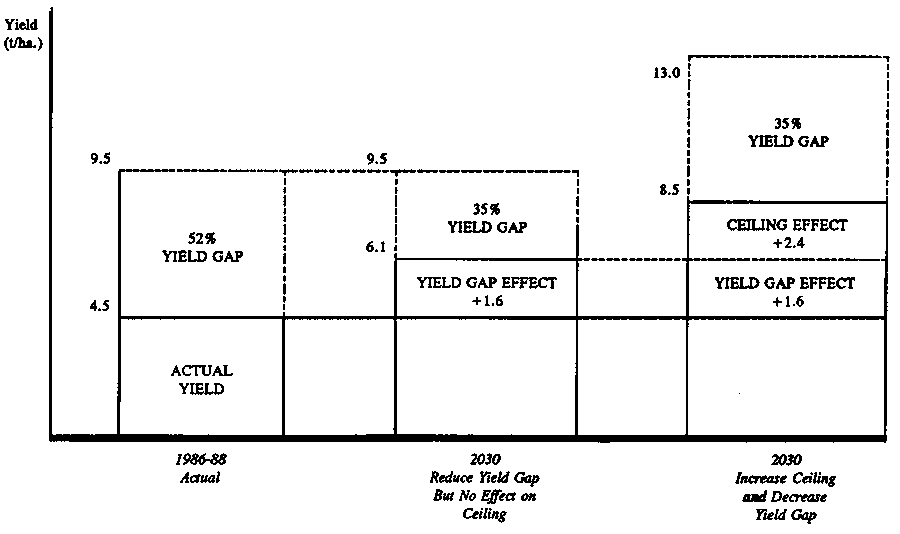
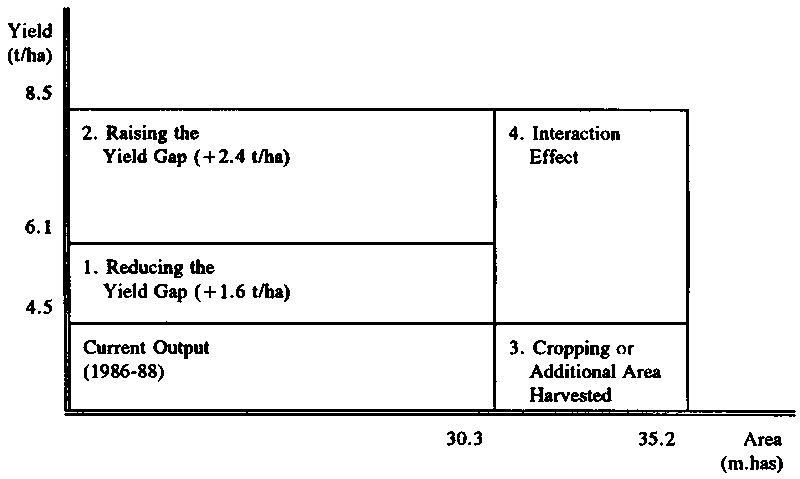
Figure 3.2 illustrates the indicative growth in yields needed in the Asian irrigated sector. Overall yields would need to rise from 4.5 to 8.5 t/ha. The increase of 4.0 t/ha is broken down into two components. The first is an increase of 1.6 t/ha due to a reduction in the present yield gap of 52 percent to an indicative level of 35 percent. The second is a further rise of 2.4 t/ha achieved by raising the yield ceiling from its present estimated level of 9.5 t/ha to 13 t/ha. In addition, increases in harvested area through higher cropping intensity or planting additional land, also add to output. The full decomposition of the sources of output growth for this sector are set out in Table 3.7 and illustrated in Figure 3.3.
These results highlight the importance of higher yield ceilings in the irrigated sector As seen in Table 3.7, the required increase in output of 160 mt in the irrigated sector of Asia could theoretically be achieved without an increase in the yield ceiling. But this would imply a very small yield gap and a high yield of 8.5 t/ha, both of which are unrealistic when it is considered that these are averages across all irrigated environments, including the less favourable, and across both rainy season and dry season crops.
A complete summary of the sources of growth for all regions and ecosystems is set out in the Appendix Tables C.3 to C.4. For all but the irrigated sector, there are some problems in deriving the results because of greater uncertainty about current and future yield ceilings, and the extent of yield gaps. Because future required yields in 2030 are mainly well below the probable level of current yield ceilings, closing the yield gap is clearly going to be the major priority. At the same time, an increased yield ceiling could well make an important contribution. The over-riding conclusions remain:
(a) approximately 70 percent of the needed increase must come from these two themes within the irrigated sector alone; and(b) over 90 percent of the increased demand is in Asia.
If the core funding for rice research by the CGIAR is to play its full part in contributing to the projected increase in the demand for rice, future funding will need to be directed in large part to these challenges.
Table 3.7: Indicative Sources of Growth in Irrigation Rice Output in Asia (excluding China) 1986-88 to 2030
|
Year |
Harvested Area |
Yield t/ha. |
Output |
|
1986-88 |
30.3 |
4.5 |
137.2 |
|
2030 |
35.2 |
8.52 |
297.6 |
|
INCREASED OUTPUT |
160.4 | ||
|
Sources of Output Growth |
m.t. |
% | |
|
1. Reducing the Yield Gap |
49.9 |
31 | |
|
2. Raising the Yield Ceiling |
68.9 |
43 | |
|
3. Increasing the Cropping Intensity (assuming area sown is constant) |
22.2 |
14 | |
|
4. Interaction Effect |
19.3 |
12 | |
|
TOTAL INCREASE |
160.4 |
100 | |
Table 3.8a: Sources of Output Growth: By Ecosystem as Percentage of Total
|
Ecosystem |
Reduce the Yield Gap |
Raise the Yield Ceiling |
Increase Area Harvested |
Interaction |
Total |
|
% |
% |
% |
% |
% |
|
|
IRR |
26.9 |
26.5 |
8.9 |
7.8 |
70.1 |
|
RFL |
7.7 |
6.8 |
6.2 |
3.0 |
20.8 |
|
UPL |
2.3 |
3.2 |
1.0 |
0.7 |
6.3 |
|
DWT |
1.1 |
3.0 |
0.0 |
0.0 |
2.9 |
|
Total |
38.0 |
37.4 |
13.1 |
11.5 |
100.0 |
Table 3.8b: Sources of Output Growth: By Region as Percentage of Total
|
Region |
Reduce the Yield Gap |
Raise the Yield Ceiling |
Increase Area Harvested |
Interaction |
Total |
|
% |
% |
% |
% |
% |
|
|
Asia (excl. China) |
20.5 |
22.7 |
5.5 |
6.7 |
55.4 |
|
China |
16.2 |
13.5 |
3.3 |
4.1 |
37.2 |
|
SSA |
0.8 |
1.8 |
0.3 |
0.4 |
2.5 |
|
LAC |
1.6 |
1.7 |
0.3 |
0.4 |
4.0 |
|
WANA |
0.4 |
0.4 |
0.0 |
0.0 |
0.9 |
|
Total |
39.5 |
39.2 |
9.6 |
11.7 |
100.0 |