


3.1 Evolution
3.2 Other External Evaluations
3.3. Achievements
3.4. Comments on the CCER and SGRP Reports
3.5 Assessment and Recommendations
The Genetic Resources Division (GRD) acts as a world repository of sorghum, millet, chickpea, pigeonpea and groundnut genetic resources and provides diverse and viable germplasm to scientists of ICRISAT, NARS and elsewhere. From 1972 to 1995 the GRD provided more than 1.15 million individual samples, 529,000 within the centre, 330,000 within India, and 296,000 to other countries. Over the years research support has accounted for most of the activity of the GRD and its predecessor, the GRU.
A Genetic Resources Unit (GRU) was established in 1979 by incorporating various crop germplasm activities of the Institute into a coordinated unit to "enhance ICRISAT's services as a world centre for the improvement of the genetic potential of the mandate crops". The unit's objectives were collection, evaluation, maintenance, documentation, conservation, and distribution of the mandate crops and six minor millets. Its initial holdings were sorghum (16,587), pearl millet (11,467), pigeonpea (8,775), chickpea (11,483), groundnut (7,679), minor millets (2,076), for a total of 58,067. Since that time it has nearly doubled its holdings, and materials from 128 countries are stored in the genebank at Patancheru.
ICRISAT's germplasm collections are central to all its crop improvement activities. Germplasm samples are collected jointly with scientists of national research programmes and are shared between the host country and ICRISAT. The assembled germplasm is characterized, evaluated, documented and conserved for current and future use in research.
In November 1993, in a major reorganization of its research programme, ICRISAT reorganized its staff into seven global research divisions, one of them, a new Genetic Resources Division which replaced the GRU. During that year, 13 GRD staff members took voluntary retirement, resulting in a 30% staff reduction, and causing considerable difficulties in GRD operations.
In 1996, the GRD combined its activities into a single global project, "Genetic resources collection, conservation, evaluation, and utilization", with six subprojects: ex situ conservation, in situ conservation, collection, evaluation, enhancement and training, with four subprojects for research targeted at specific regions (i.e., Asia, Southern and East Africa, West and Central Africa, and Latin America).
At present, the GRD has one internationally recruited staff position, the Director, three nationally recruited scientists, and 20 technicians, four of whom are temporarily employed on SINGER. Most of the work of the division is research support related to its genebank. Although the Director and some of the staff want very much to do research, limitations of time and budget allow little time for research.
The Panel was aided in its evaluation by two recent external reviews of ICRISAT's Genetic Resources Division. First was a Centre-Commissioned External Review (CCER) conducted at the request of the ICRISAT Board (hereinafter referred to as the CCER report) by a four-person panel headed by Dr. G.C. Hawtin, Director General of IPGRI (ICRISAT Genetic Resources Division, External Review, June 8-12, 1995).
The second review was part of the external review of the CGIAR genebank operations commissioned by the CGIAR Systemwide Genetic Resources Programme (the SGRP report) and conducted by a four-person panel chaired by Dr. N.L. Innes (Report of the External Review Panel of the CGIAR Genebanks Operations, ICRISAT Asia Centre, 18 November 1995).
The Panel was grateful for the reviews and has some observations on their recommendations. In the CCER report in particular, it was often difficult to determine just who or what group was proposed to be the recipient of the particular service or responsibility indicated by the CCER to be required from the GRD; was it aimed at: (a) service within ICRISAT and its programmes? (b) service directly to NARS? or (c) service to the broader needs of global germplasm management? Some of the recommendations appeared more suited to the responsibilities of the International Plant Genetic Resources Institute (IPGRI) or to the Systemwide Genetic Resources Programme (SGRP) than to ICRISAT. The Panel recognizes the need for ICRISAT, in its responsibilities in managing the conserving major germplasm collections, to be involved outside the Institute, but the Panel does not consider that ICRISAT should undertake work that does not relate, in large measure, to its own mandate crops and programmes.
The Panel also questions whether a Director General of one CGIAR centre should serve as chairman or a member of an external review of another centre such as ICRISAT, as some recommendations made appear to have elements of conflict of interest.
3.3.1 The Collections
3.3.2 Facilities
3.3.3 Genebank Management
3.3.4 Research
The GRD has a long list of accomplishments to its credit, perhaps the greatest being the trustee and custodian for nearly 112,000 samples of germplasm for its five mandate crops and the minor millets. ICRISAT's collections represent nearly 20% of all the germplasm held by 11 CGIAR centres. While the collections have not been completely evaluated, some accessions have been identified with desirable traits. This has involved collaboration of GRD with other divisions in the Centre. An important contribution has been the wide crossing programme which is carried out in the crop improvement projects. In groundnut, genetic traits from a number of wild relatives have been incorporated into the genepool of the cultivated groundnut. Wide crossing in pigeonpea, pearl millet and sorghum has been accomplished using materials identified from the genebank as having desirable traits for the cultivated forms of the crops. Inter-specific crosses of pigeonpea are being used to develop cytoplasmic male sterile systems which will allow hybrid production in this formerly traditional crop.
Numerous sources of resistance to diseases have been found in the collections, notably rosette virus of groundnut in West Africa, and downy mildew and ergot in pearl millet in India. Genes have also been found for short-duration pigeonpea.
The future for the GRD should be bright, holding as it does the genetic wealth of the most important food crops of the SAT. The germplasm held, and the successes to date in utilizing it in crop improvement auger well for the future. And that future can be even brighter if the GRD and its valuable collections are provided more financial and staff support and ways are found to exploit the collections even more systematically and scientifically.
Table 3.1 below summarizes the present germplasm collections held by ICRISAT in its genebank at Patancheru.
Table 3.1 Ex situ Collections of Crops Held at ICRISAT
|
|
Advanced Cultivars & Breeding Lines |
Landraces |
Released Cultivars |
Wild & Weedy Species |
Others |
TOTAL |
|
Sorghum |
4,359 |
30,511 |
- |
420 |
935 |
36,225 |
|
Pearl Millet |
142 |
19,446 |
- |
740 |
936 |
21,264 |
|
Chickpea |
660 |
16,123 |
- |
135 |
332 |
17,250 |
|
Pigeonpea |
1,764 |
10,024 |
- |
545 |
682 |
13,015 |
|
Groundnut |
4,666 |
5,701 |
324 |
456 |
4,033 |
15,180 |
|
Minor Millets |
98 |
8,802 |
- |
115 |
- |
9,015 |
|
TOTAL |
11,689 |
90,607 |
324 |
2,411 |
6,754 |
111,949 |
Although still not fully adequate to meet its responsibilities, the GRD has reasonably good facilities, including:
· Seed laboratory (seed germination, seed physiology, cytology).· Screenhouse for wild groundnut accessions.
· Short-term seed storage (600 m3).
· Medium-term seed storage (532 m3) with capacity for 20,640 groundnut accessions and 500 m3 capacity for nearly 120,000 accessions of other crops.
· Long-term storage for conservation of base collections (250 m3 capacity for 65,000 cereals and 21,000 pulses and 125 m3 for storage of 10,500 groundnut accessions).
· Extensive field facilities for evaluation and seed production.
The Panel notes with concern that total long term storage capacity is below the amount needed to store the entire global collections, although this situation is not yet critical as transfer of collections to long-term storage is progressing slowly. The Panel notes that ICRISAT has developed plans for increasing long term storage capacity, and suggests that those plans should be reviewed in the light of the Panel's recommendation at the end of this chapter and in its future vision in Section 9.1.3.
The Institute also stores groundnut germplasm which requires specialized facilities. The SGRP report praised the new screenhouse for wild groundnut, pointing out that it could be used for materials that could only be propagated vegetatively as well as in characterizing and obtaining seed of wild species under disease-free conditions.
GRD responsibilities include managing the flow of germplasm through collection, receiving, initial characterization, entry into medium-term storage, documentation, multiplication, distribution, etc. in a systematic manner. Many hands and activities are required in carrying out these steps, and the number of samples handled is daunting.
Genebank management also includes the process of placing germplasm into long-term storage as base collections. Many bottlenecks arise in this process, limiting the rate of transfer to long-term storage. So far, only about 20% of the collections has been placed in long-term storage, and at the current rate will take more than 20 years to complete the task. This is unacceptable. Both the SPGR and CCER reports recommended urgently speeding up this process, including accelerating germination tests, seed multiplication and drying. The Panel fully concurs with the recommendations and urges ICRISAT management and Board to expedite the work, noting that a new dryer under order will help speed the effort. For accessions that have sufficient amounts of seed and that meet international germination standards for long-term storage, the Director has a plan to speed up the process. In such cases, rejuvenation in the field would not be done but once germination tests and drying were completed, samples would be moved to long-term storage with the view that these would be safe for 25 years or so. Thus the collections would be protected while a comprehensive process was followed, including rejuvenation of a new set destined for long-term storage. The Director believes this could be completed in two years. The Panel endorses that approach as an interim measure to protect the collections.
The Panel is concerned that financial and staff limitations hamper genebank operations, believing that the importance of the work justifies more staff and operating funds. The genebank needs a curator to oversee its operations. At present, the Director is trying to carry out these duties in addition to many other responsibilities in the division.
The SGRP report commended ICRISAT's Plant Quarantine Unit for its close links with India's NBPGR Service, in dealing with import and export of germplasm, including phytosanitary certificates for ICRISAT materials. The Panel joins in that commendation, considering it an important and valuable partnership.
Globally, the knowledge base is woefully lacking for genetic resources conservation and evaluation, as well as for research on the collections that is necessary to support utilization. Previous warnings about this global knowledge gap have gone unheeded. The knowledge base is insufficient at best for ex situ conservation, the method of conservation and storage that is essential for crop improvement. Even so, the knowledge base for ex situ conservation is much better than for in situ conservation, on which so many groups and donors are placing their hopes and financial resources. Also, a fundamental lack of understanding exists about the complementary roles of ex situ and in situ conservation of plants. The discrepancy in understanding is wide. Slogans will not save genetic resources for the future, but research can help. The CGIAR must take the necessary steps to secure the knowledge base.
In ICRISAT's case the international knowledge gap is especially serious, because the Institute's mandate crops have received much less research attention than other major crops. An urgent need exists for ICRISAT to undertake, purposely and systematically, a greatly increased strategic research effort on conservation, evaluation and enhancement of its mandate crops. The Panel recognizes that ICRISAT is aware of some of these needs and has taken commendable steps to carry out some of the work in the GRD, and by dealing with genetic enhancement in its commodity improvement projects. The Panel commends ICRISAT for the results and scientific quality of much of this work, but has concluded that the scale and intensity of the work is well below what will be needed, and that an even more focused approach in strategic germplasm research will be required.
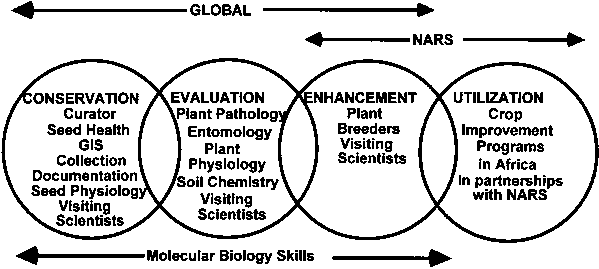
The strategic germplasm research envisioned by the Panel will require specialists from many disciplines working in three areas that are closely linked in a continuum of (a) germplasm conservation and management; (b) systematic evaluation of collections for resistance or tolerance to biotic and abiotic stresses, along with identification of novel traits; and (c) genetic enhancement. Figure 3.1 illustrates the Panel's concept of linkages between these three key areas of strategic research on the germplasm collections.
The strategic research agenda envisioned would include the following major elements:
· Strategic research aimed at germplasm management and genebank management, including ecogeographic studies of biodiversity of target crops and wild relatives, collecting methods, conservation and handling, including seed physiology and seed health studies aimed at storage of ICRISAT's mandate crops.· Strategic research on the collections themselves, using an interdisciplinary team approach to understand the genetic makeup of the collections, search for specific traits needed in production systems, find sources of resistance to pests and diseases, locate sources of tolerance to abiotic problems, and support genetic enhancement for raising productivity.
· Strategic research in genetic enhancement using conventional and non-conventional means coming from 'new science' to transfer needed traits into suitable genetic backgrounds to produce parental materials for use by NARS in crop improvement.
To do the research work discussed above will require more resources and staff, as well as a research action plan to carry it out. Disciplines required will likely include plant pathology, plant physiology, entomology, genetics, molecular and cellular biology, enhancement breeding, soil scientists, agroecologists, GIS specialists, and germplasm documentation specialists. It is envisaged that the strategic research centred on ICRISAT's global collections will create a centre of excellence that will serve as a 'magnet centre' for such work. It is conceivable that IPGRI might wish to station some of its staff at ICRISAT to participate in hands-on research on global germplasm problems that require - indeed cry out - for research. The 'new' ICRISAT will be an exciting place in which to work and learn.
Figure 3.1 Global Strategic Germplasm Conservation, Evaluation, Enhancement and Utilization Continuum.
In reviewing the research recommendations of the two review panels it is noted that in some cases the recommendations tend to lie in two categories: (a) those that relate to the needs of ICRISAT and its programmes; and (b) those that relate more to meeting global gaps in knowledge. The Panel understands the need for more research on genetic resources per se, but urges that ICRISAT's research effort should give highest priority to research on germplasm management, evaluation and enhancement of its mandate crops.
The Panel understands the Systemwide SGRP contains three elements: (a) programmes of the CGIAR centres, in which each programme is unique, independent and self-managed; (b) a coordination mechanism essentially comprised of the Inter-Centre Working Group on Genetic Resources (ICWG-GR) and its linkage and coordinating role; and (c) collaborative research to work on areas of specific cross-centre activities established and monitored by the ICWG-GR.
The Panel has concerns about the CCER recommendation that ICRISAT conduct its research in the context of the SPGR research Systemwide programme. The Panel understands the need for ICRISAT to work with other centres in matters of common interest, but is concerned that: (a) to avoid detracting from its own high priority research needs, ICRISAT should not carry out Systemwide research that should be done by organizations that have global responsibility for such research, unless ICRISAT has a compelling comparative advantage in doing so; and (b) that the amount of funds available to ICRISAT from the SGRP Systemwide research programme may be too small to support even one internationally recruited staff member. Thus, questions of research priorities, relative responsibilities and roles of individual IARCs in germplasm research, and, at present, apparently high transaction costs of the SCGP, cause the Panel to urge caution in participating in research aimed mostly at the goals of SGRP and having little to do with the mandate of the Institute.
The GRD of ICRISAT has a major global responsibility; that of collecting, conserving, documenting and making available useful materials from its world collections of the important food crops of the semi-arid tropics. Indeed, ICRISAT's genebank is a global resource that also represents the Institute's major long-term research asset. ICRISAT also has responsibility to contribute to improvement of agricultural production as a means of reducing poverty and resource degradation for some of the world's poorest people, and strategic research in germplasm evaluation and enhancement is a crucial strategy to achieve this.
To give some idea of the importance of the ICRISAT genebank, it should be pointed out that of the total germplasm holdings of the CGIAR, constituting more than 593, 000 accessions being held by 11 centres, ICRISAT holds 112, 000 or nearly one-fifth. Despite its importance in the CGIAR, however, ICRISAT's genetic resources work appears under-funded. As an example, during the period 1994-96, total average annual expenditure of the eleven centres on genetic resources activities was US$ 27.2 million, and of that average annual total, ICRISAT spent 3%, not counting what was spent on germplasm enhancement within the crop improvement projects, (calculated from figures presented in SGRP, 1996). The Panel acknowledges (see also SGRP, 1996) that the estimated expenditure for the eleven centres mentioned above may be "soft" in terms of defining what to include in the germplasm work of individual centres. At ICRISAT, germplasm enhancement has been done within the crop improvement projects, and therefore it is not easy to arrive at a figure for annual investment in enhancement research. In 1996, ICRISAT budgeted US$ 0.99 million for genetic resources work. The Panel estimates that if US$ 2 million had been expended by ICRISAT in 1996 for germplasm enhancement within the crop improvement projects, and if that US$ 2 million was added to the 1996 budget figure for GRD, it would raise the estimated annual investment by ICRISAT in genetic resources and enhancement to about 11% of the CGIAR total effort. This adjusted amount is still below what might be expected in a congruence analysis. The Panel does not intend these estimates to be critical of ICRISAT, but rather wishes to point out the need for increased investment in strategic germplasm research at ICRISAT.
The Panel commends the GRD and its staff for its hard work and good efforts in assembling and managing the large germplasm collections of the mandate crops and the six minor millets. The collections have already shown their potential in yielding genetic traits important to improvement of ICRISAT's mandate crops. The staff has carried out their work with dedication in a mostly research support mode, without fanfare and probably without enough credit. The Panel realizes their work has been made more difficult by limited funds and staff, and recognizes that some bottlenecks in the genebank and its operations are not easy to overcome under any circumstances, and are made more difficult when workloads are heavy and resources are limited.
To build on the good work to date, the Panel concludes that the present status of the genetic resources work at ICRISAT needs considerable change, and that genetic resources work requires higher priority and greater support in the Institute. The time is ripe to achieve this by rethinking the entire strategy and programme of genetic resources work at ICRISAT, so as to make these valuable collections more accessible to NARS for productivity improvement and improved food security. ICRISAT has shown that effective collaboration between the GRD and scientists in genetic enhancement can be very effective in SAT crops. Now is the time to utilize ICRISAT's worldclass research facilities at Patancheru and the global germplasm collections as a magnet centre for strategic germplasm conservation, evaluation and enhancement research for the major crops of the SAT.
The paradigm envisioned is one of strategic research centred on the global collections, employing the long research experience of ICRISAT in three continents to identify the major biotic and abiotic problems that need solution. The programme would include research across a continuum from collection, evaluation and enhancement of germplasm, involving applications of modem molecular biology as well as more conventional scientific techniques, and would undergird the genebank's dual service responsibilities in conservation and utilization of its holdings. Indeed, the paradigm would overcome the long-standing problem of a major gap in the global germplasm system between the curators on the one hand and the breeders on the other. It would decrease the reliance in many genebanks on chance or lucky dips, as one panel member put it, to find valuable traits among the thousands of accessions that are held. Lucky dips will just not do as the world faces a challenging future. A more powerful research approach is needed.
ICRISAT's valuable collections of crops have received much less research attention internationally and in NARS than many others, and enhanced scientific knowledge of the crops and collections is of strategic importance to global food security and therefore constitutes a strategic international public good. Thus strategic germplasm research on crops of the SAT has a valid claim on greater international resources for study and improvement of those crops. Also, ICRISAT's world class research facilities and its global germplasm collections at Patancheru present a major opportunity for the CGIAR to find a new way forward in plant genetic resources research to achieve more effective utilization and protection of biodiversity. The above paradigm is further elaborated in Section 9.1.3 in the context of the future of ICRISAT as a Centre for global germplasm strategic research based at Patancheru, complemented by a strengthened natural resource management research programme in Sub-Saharan Africa.
In view of ICRISAT's large international genebank holdings of its mandate crops, its world class research facilities at Patancheru and the need for greater emphasis on strategic research in germplasm of SAT crops, the Panel recommends that ICRISAT adopt a new paradigm in strategic germplasm research using all necessary disciplines and 'new science' to exploit, more scientifically, systematically and fully, the genetic endowment represented in the genebank.
