


4.1 Evolution and Current Focus
4.2 Achievements and Impact
4.3 Assessment and Recommendations
The semi-arid tropics are generally characterized by short but intensive rainfall seasons, providing some 75 to 180 growing days. The major soils of these regions comprise light to medium textured soils (Alfisols, Inceptisols) as well as heavy cracking soils (Vertisols). The former two have the problem of low fertility, low organic matter content and poor water holding capacity; Vertisols and Vertic Inceptisols have better water holding capacity but have poor drainage characteristics and are difficult to till when dry or wet. Crop production in these environments is dependent on: soil and water management to optimize the availability of soil moisture; availability of varieties that mature within the period of soil moisture availability; proper management of soil fertility; and carefully-timed land preparation and planting.
Natural resources management (NRM) research has been one of the major programmes at ICRISAT since its inception. In fact, the first experiments at ICRISAT Asia Centre included a catchment study on water conservation techniques and management of Vertisols. According to the 1994-98 MTP, NRM research at ICRISAT is aimed at designing strategies for sustainable food production in rainfed areas of SAT while improving the nutritional status and general economic well-being of low income peoples. The overall goal is to provide farmers with low cost sustainable technologies. This strategy is implemented through projects with specific objectives and measurable outputs.
During the period under review, NRM research has been undertaken primarily by the Soils and Agroclimatology Division, Agronomy Division, and the Socio-Economics and Policy Division, through four Integrated Systems Projects (ISP). These projects focus on specific production systems that appear to be stable in various agroecosytems:
· ISP1 covers production systems in the most marginal environments of the SAT, with a focus on pearl millet-based production systems in low rainfall environments where food security and sustainability are the most important objectives.· ISP2 covers production systems in more favourable but fragile environments, where closing the yield gap and sustainability are the principal objectives with focus being on sorghum and groundnut production systems on sandy soils.
· ISP3 covers relatively well-endowed environments, where the main concern is crop intensification and closing of the yield gap between research station and the farmer.
· ISP4 involves rice and wheat-based systems, in which rainfed legumes may be grown in rotation.
In the study of these production systems, emphasis is placed on generic and integrative research; use of GIS and modelling as tools to generate research outputs of wide applicability; integrated resource management; and ultimately, enhanced analysis of on-site/off-site impacts of natural resource management and land use.
Besides these studies, ICRISAT has established a series of long-term NRM studies on large plots in small and well-instrumented watersheds at Patancheru, and to a lesser extent at ISC. The original watersheds at Patancheru were established to evaluate the long-term benefits of new Vertisol technologies in soil and water management and the water use efficiency of the major crops featuring in Vertisol-based production systems. Effects of agronomic practices on the nutrient and soil moisture profile have also been monitored. In response to a 1990 EPMR recommendation, a new watershed experiment was installed in the same area, but focusing on a Vertic Inceptisol to study methods of rehabilitating degraded lands. The new watershed is intensively instrumented to monitor soil erosion, nutrient and water balances, and the effectiveness of agronomic practices in restoration of soil fertility. The two-year-old studies have already produced promising results. The Indian NARS has expressed interest in the high yields being achieved, and is prepared to finance demonstration of the technology in a rural setting and related technical training. A socioeconomist has recently been added to the research team. At ISC, watershed studies have focused more on soil erosion.
In May 1996, the ICRISAT Board commissioned an external review CCER of the Soil, Water and Nutrient Management Research within ICRISAT. The CCER report has documented a number of achievements in terms of research findings. In agroclimatology, analysis of rainfall of the SAT has resulted in the development of a computer model relating probable length of rainy season to the date of onset of the rains in the West African SAT. In agronomy, cropping systems for optimum utilization of rainfall have been developed for different rainfall and soil regimes in the Indian SAT. Results have also been obtained on the influence of plant populations and water deficits on the water use efficiency of pearl millet and groundnut crops in the Sahel. Collaborative research with IFDC at ISC has also demonstrated suitability for direct application of three of the rock phosphate sources available in the Sahel.
In general, natural resource management research could be expected to show progress at three levels:
· At the policy level, an improved understanding of the socioeconomic constraints to adoption of improved technology options may change policies and enhance adoption.· At the research level, a better characterization of the natural resources and of adoption constraints may lead to more efficient use of research resources through a better focus on constraints and transferability of results.
· At the production level, improved technologies should be accepted and widely adopted by farmers as means of reducing the cost of inputs, and increasing productivity and sustainability of production systems.
Progress at the research level has been achieved, as can be seen in the adoption of the agroecological classification of the SAT as a basis for targeting breeding and agronomy programmes at ICRISAT, and to some extent the collaborating NARS. As observed in the CCER report, ICRISAT has generally not been able to establish strong collaborative linkages in NRM research with NARS, especially in Africa. A notable exception is the collaborative experiments with the Institute for Agricultural Research of Ethiopia at Ginchi on the use of broadbeds and furrows technology in the management of Vertisols. Good collaboration has also been established with the Indian Council for Agricultural Research (ICAR) scientists at Hyderabad, Anantapur, Indore and Akola, where the stations have been adopted as benchmark sites for some of the major production systems identified in the SAT. Collaboration has also been established with scientists at Zaloke in Myanmar. Technologies generated at ICRISAT are jointly tested and refined at these and other sites and it is evident that techniques for agroclimatic characterization of the environment and production systems are finding increasing application in planning and prioritization of research.
Progress at farm production level implies widespread adoption of technologies by farmers and is dependent on many socioeconomic factors. For example, studies have shown that although modified broadbeds and furrows (BBF) technology for management of Vertisols has proved popular with farmers in certain areas, for example in Ethiopia, adoption of the complete package of Vertisol technology, including changes in cropping systems, is closely tied to the agroecology and to the levels of economic returns to the higher investments of labour and capital that the technology demands. At ICRISAT, no effort has been made thus far to quantify the overall impact of BBF technology on land productivity at farmer level.
4.3.1 Integrated Natural Resources Management (INRM) Research Framework
4.3.2 Simulation Modelling
4.3.3 Future Directions for Natural Resources Management Research
Over the years, ICRISAT scientists have collaborated with a large number of institutions in their work on soil and water management, nutrient management, modelling and soicio-economic studies. During the period under review, ICRISAT has made valuable contributions to NRM research, especially in the application of agroclimatic models for agroecological characterization of the SAT, and the use of the CERES model to estimate potential yields of mandated crops under different agroecological conditions. This work now facilitates better identification of the major natural resource constraints to production, and hence selection of research strategies to overcome such constraints on production. However, collaboration with NARS has been strongest in Asia, particularly in delineation of production systems, and NRM, and certain upstream modelling work. This is due largely to the steady improvement in the strength of the Asian NARS over the years. ICRISAT's work on NRM research in Africa involving NARS collaboration has focused on agroclimatic characterization in West Africa, surface management and soil erosion, fertility management including evaluation of the use of rock phosphate and methods of application of N and P fertilizers, and the BBF technology for Vertisols in Ethiopia.
Based on its own assessment of the ICRISAT-ICAR relationship, the Panel is convinced that ICRISAT is over-committed in India to commodity improvement, including production systems research. ICRISAT needs to adjust the balance of its commodity-related work to strategic germplasm research to address some of the most intractable biotic and abiotic stress problems and productivity aspects discussed in Chapters 2 and 3. Also, it is apparent from the consultant's report (see Section 6.1.3) and the Panel's observations and discussions, that the Indian national collaborators in NRM consider themselves undervalued and underutilized by ICRISAT and believe they should have been given a greater role in the execution of ICRISAT's integrated systems projects, particularly ISP2 and ISP3, and other NRM activities. The Panel concludes it is now opportune for ICRISAT to confine its NRM research efforts at its headquarters in India to mainly strategic aspects. At the same time, ICRISAT should shift the balance of its work in NRM towards Africa where it needs to broaden its scope along the whole of the strategic/applied/adaptive research continuum.
The Panel concurs with the CCER conclusion that ICRISAT has had a long record of research achievements in the domain of socioeconomic aspects of NRM. These studies have however been largely confined to the Indian environment. The CCER team observed that at the IAC, more on-farm research of a strategic nature in collaboration with the NARS, would be beneficial to the scientists engaged in soil, water and nutrient management work. The Panel concurs with this view, but considers that research on socioeconomic aspects of NRM will have to be strengthened especially in Africa where such issues probably constitute the main barrier to adoption of improved technologies.
The CCER report also draws attention to some deficiencies in the ICRISAT programme on NRM research, notably: lack of clear linkage between the modelling activities and the evolution of technologies for removal of production constraints; lack of a long-term strategy in development of crop models, their validation and broad applicability across different production systems; inadequate integration of soil physics, crop water use and hydrology; and domination of nutrient management studies by biological nitrogen fixation at the expense of fertilizer/manure studies.
The Panel's views on the issue of crop models are contained in Section 4.3.2. Regarding nutrient management research, the Panel reiterates that maintenance and improvement of soil productivity are major limiting factors to agricultural production in the tropics, and are more so in the SAT where many soils are intrinsically of poor fertility. Investment in fertilizers within rainfed agriculture in these regions is, however, discouraged by the low and erratic rainfall which often results in low yields (low returns) or total crop failure. The Panel believes that emphasis on relatively inexpensive and locally available rock phosphate as a source of P, and biological nitrogen fixation as a source of N has been well placed and productive. Commensurate efforts should be directed to strategies for building up the level of organic matter in the soils and adaptive trials on farmers' fields. The Panel commends ICRISAT for the ongoing collaboration with ICRAF and ILRI in West Africa, and the workshop on crop residues, a key issue in the management of livestock and soil fertility in the African SAT. ICRISAT activities in NRM have concentrated on West African environments and therefore results will need considerable adaptation in their application to the more complex agroclimatic and socioeconomic production systems of Eastern and Southern Africa.
It is now widely accepted that the traditional disciplinary approach to problems of agricultural production systems tends to emphasize the individual factors without considering the interactions between such factors that ultimately determine the success and sustainability of production systems at farm level. One of the outcomes is the realization of the importance of addressing, in an integrated manner, NRM issues (climate, soil, water, nutrients) alongside those concerned with crop (including trees) improvement and protection, livestock management, and socioeconomic factors. This more holistic approach has been endorsed by TAC as the way forward for NRM activities supported by the CGIAR.
In a recent TAC study on priorities and strategies for soil and water aspects of NRM research, TAC concluded that the CGIAR System could benefit from the introduction of a more consistent, systematic, and environmentally-sensitive INRM framework for research. The framework would provide: (a) a logical framework for linking the various NRM activities at the Centre and in the CGIAR System as a whole; and (b) a better means of showing the rest of the world how the CGIAR System is addressing the interrelated set of environmental and natural resources issues that are of common concern in moving towards sustainable production. Such a framework would involve four sets of interrelated linkages:
· Links between productivity-enhancing and resource-conserving research, for example, crop improvement and natural resources management.· Spatial or landscape level linkages, for example, on-site/off-site linkages in a watershed framework.
· Temporal linkages (sustainability considerations).
· Linkages between research and the diffusion/adoption of results from such research.
TAC emphasized that the linkages covered within the INRM framework need to be introduced into the CGIAR System not only through Centre activities, but also to a great extent through work in the Systemwide programmes, essentially those involving implementation of the ecoregional approach.
The current effort by ICRISAT towards integration of research on soil, water and nutrient management with socioeconomic and biological factors of agricultural production - through its integrated systems projects - is therefore a timely step towards INRM research. ICRISAT has gone even farther in its global project approach to identify specific production systems which will provide a sharper focus on the key problems associated with the productivity and sustainability of land use systems. The new projects are however still in their formative stages. The Panel, while commending ICRISAT for this initiative, observes that successful implementation of the strategy will be influenced by the accuracy with which the production systems can be defined. For example, unlike in Asia and to a lesser degree in WCA, it has proved difficult to identify in the Eastern and Southern Africa region, production systems that are uniquely and geographically associated in content with the natural resource characteristics in which the systems are found.
The Panel shares the concern expressed by the CCER regarding the dangers inherent in the current expectation that the relatively small team of NRM scientists can provide adequate inputs within a wide range of integrated system projects. Given the resource constraints, such broad coverage can only be achieved at the expense of research depth and scientific impact. The priorities established in consultation with NARS should therefore be used to ensure that ICRISAT research activities are limited to those areas of generic importance, such as: varietal differences in water and nutrient requirements; climatological and varietal influences on biological nitrogen fixation and recovery by crops; nutrient cycling under different crop rotations; soils and climatic conditions; integrated pest management, etc., in which ICRISAT may have a comparative advantage.
Because the Panel strongly supports the use of watersheds by ICRISAT as a basis for understanding production constraints, and notes the existence of seven on-station watershed experiments which occupy an area of 80 ha at Patancheru; and because the long-term data accumulating from these experiments are very valuable and already have been used in development and validation of biophysical production models; and considering that very few such watershed research facilities exist in the developing world and that their presence at Patancheru is unique in the SAT, the Panel recommends that ICRISAT give high priority to the maintenance of watershed facilities and studies at Patancheru, and in particular to the maintenance and analysis of the data which have accumulated over time from these experiments.
Watershed-based research is however time-consuming, demanding in resources and interdisciplinary collaboration, and requires long-term commitment to produce results. The Panel therefore suggests that ICRISAT selects and concentrates on methodological studies of critical components, such as nutrient flows and socioeconomic parameters, which may be less well understood. In order to do this, it will be necessary to speed up and intensify the analysis of data thus far accumulated in order to determine which trials are still needed, the levels of management desired and the intensity of data to be collected. Such an opportunity, if well publicized, could attract visiting scientists, research fellows and trainees who could help offset the cost by carrying out some of the tasks in return for their access to, and use, of the data sets.
On-station watershed experiments cannot adequately replicate the real situation in community-managed land use systems. Population densities, for example, have an influence on socioeconomic factors which in turn impact on the dynamics of biophysical resources through changes in land use. The main value of on-station watershed studies therefore lies in the development and testing of methodologies and models relating to biophysical factors. The results obtained at such sites must then be validated within community managed watersheds. The Panel considers that ICRISAT can play an important role by promoting such watershed-based studies in different regions of Africa. The studies will however involve many players, including NARS scientists and technicians, policy makers and farmers. ICRISAT activities will therefore have to be restricted to a few benchmark sites selected to cover a range of population densities and located in countries where a high level of participation by NARS can be reasonably assured. The Desert Margins Initiative provides a valuable opportunity and a potentially long term framework for such activities.
Simulation modelling that is complemented by on-farm research with farmer participation can be an efficient way of identifying critical factors and knowledge gaps and eventually facilitate application of research findings to the large variety of micro-environments which characterize the semi-arid tropics. ICRISAT has devoted considerable effort covering two decades to the evolution of agroclimatic and crop models. The former have contributed to a better delineation of agroclimatic environments within the SAT and, when enhanced with the GIS technology, should provide a powerful tool for better focusing of research programmes at ICRISAT as well as the relevant NARS. The CCER report is however critical of the balance between development, validation and application of models within ICRISAT. One reason for the time lag in application of such models to production systems is that there are still many relationships, for example interactions between physical environment (soil fertility, water availability, temperature regimes), biotic stresses and plant genotypes, and the influence of the socioeconomic factors that need to be quantified through experimentation and on-farm surveys. This is a gigantic task that will require active participation by all scientific disciplines and many partners. The Panel therefore suggests ICRISAT gives high priority to working with NARS towards the early interfacing of available climatic, soil, water, socioeconomic and crop data and models, with GIS technology. The resulting databases would then provide an invaluable resource to both ICRISAT and the NARS for identification of the critical constraints to agricultural production in different regions of the SAT.
An interesting project on application of simulation models to production systems, CARMASAT, is now underway at ICRISAT. The goal is to develop a farming systems research capability in ICRISAT that combines simulation of crop production systems with agronomic experimentation and socioeconomic research. Specific objectives include: training of ICRISAT staff and collaborators in the use of simulation modelling; enhancement of a new model under development, APSIM, to improve simulation of cropping systems in SAT; testing of the model's performance against field measurements; and eventually to apply APSIM in conjunction with NARS and NGOs in evaluating farmers' management options. In order to fulfill these objectives, an APSIM Support Unit has been established at ICRISAT. This unit is expected to work with the developers of the model (APSRU) and modelling working groups in the crop improvement and NRM research divisions, eventually linking up and extending its services to the ISP projects in Asia and Africa. A new ACIAR/ICAR/ICRISAT project using APSIM for supporting sorghum genetic improvement for rabi production is proposed along similar lines.
The Panel supports participation of ICRISAT scientists in validation and adaptation of integrative production system models. Participation in such activities is also a step towards the new role of ICRISAT in upstream research as proposed in this report. The Panel has, however, some concerns regarding APSIM that will need to be addressed:
· There is a problem of integration of CARMASAT activities with the research projects at ICRISAT. As a result, many scientists see their role in the project as suppliers of data rather than as collaborators in a potentially productive scientific development. Modelling is basically a mathematical way of setting hypotheses and representing the complex natural and socioeconomic phenomena. Any obstacles, real or perceived, to full participation by scientists in this project should be removed as early as possible.· Although ICRISAT scientists and other collaborators in CARMASAT are contributing to the development and validation of APSIM, there are proprietary rights attached to APSIM which affect free access to the model. It is therefore not clear what credit will eventually accrue to ICRISAT and whether and under what conditions the improved model will become international public goods.
The Panel therefore suggests that ICRISAT reviews especially the conditions attached to access to APSIM and their possible impact on the implementation of CARMASAT. The present internal arrangements for the APSIM Support Unit and GIS Unit in relation to the research projects also need attention. While the relatively rare programming expertise should be placed where it can be shared equitably between projects, scientists in all projects should also be equipped and encouraged to develop the necessary skills to participate fully in the use of their experimental results in validating the available model sub-routines.
A lot of information needed for validating models, such as dates of planting, daily rainfall, yield responses to fertilizer application and socioeconomic data are located within NARS and are not always documented in readily available formats. It may therefore be necessary to mount special projects in collaboration with NARS to assemble and collate the available data in formats that are amenable to computer applications. Collaboration with NARS at all stages will therefore be essential for the success of such an exercise. An important constraint is that there is still a dearth of trained personnel and physical infrastructure for such activities within the majority of NARS. Their effective participation in this type of research may therefore initially be low but could be improved through professional development programmes at ICRISAT.
The Panel therefore strongly suggests ICRISAT give priority, especially within the evolution of ecoregional initiatives and training in Africa, to activities that assist the NARS in developing sufficient capacity for truly collaborative research programmes in INRM.
It is explicitly stated in CGIAR policy documents that as the NARS become sufficiently strong to implement more of the applied and adaptive research, CGIAR Centres should adjust to complement the activities of national programmes through concentrating on global strategic issues in which the Centres will have comparative advantage. At the same time they would be expected to help build bridges between the national programmes and global scientific and technological developments relevant to alleviation of poverty and hunger. The Panel believes that this time has now come in the case of ICRISAT programmes in India.
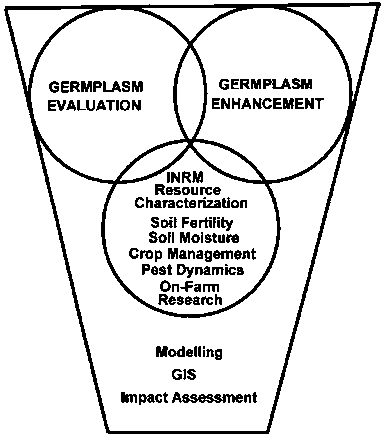
The implications in the field of NRM are that ICRISAT should in future concentrate more on collaborative activities with NARS in Africa, with emphasis on applied and adaptive research and socioeconomic analysis of the factors hindering adoption of known technologies. The new Africa-based programme, which should promote the INRM approach, should focus on selected benchmark sites where research activities (including trials on improved cultivars from the crop improvement work), along the whole of the strategic/applied/adaptive continuum would be undertaken. It will need strong linkages with the strategic germplasm and NRM research at ICRISAT headquarters. System-wide initiatives such as the Desert Margins Initiative, and other relevant programmes worldwide. Given the importance of livestock and trees, and the importance of cowpea in the SAT cropping systems in Africa, the Africa-based INRM projects should also have even stronger collaborative linkages with ILRI, ICRAF and IITA. The concept of strengthened NRM research in Africa and the expected linkages between strategic and applied/adaptive research is presented diagramatically in Figures 4.1 and 4.2 and is discussed further in Section 9.1.3.
An area of concern to the CGIAR, noted in the TAC study on NRM, is the widespread lack of adequate information on land and water degradation and the state of the environment, and knowledge of the impacts of environmental change, including both enhancement and degradation of the natural resources, on crop production and land potential over time. Arguments regarding the seriousness of the problem at the present time have added to the confusion in the understanding of the issues. Deficiencies in basic data, and differences in interpretation of the limited information available, are the source of such disagreements. Given the need for transnational information and research on the condition of natural resources and the environment, and particularly on the extent and impact of degradation and enhancement of the environment by humans, the Panel concurs with TAC that the Centres should play a role in developing a better understanding of some of the linkages between land use and the condition of the environment and the natural resources base. The Panel is pleased to note that some of these issues feature prominently in the Desert Margins Initiative and the Rice-Wheat Cropping Systems Consortium in which ICRISAT has a facilitating role.
Figure 4.1 Integrated Natural Resources Management Research Framework in Africa: General Content and Collaborative Strategies
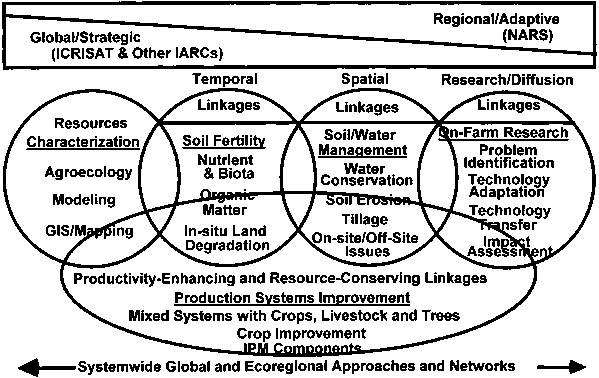
Figure 4.2 Strategic Integrated Natural Resource Management Research at Patancheru.
However, since the CGIAR has only limited resources to devote to filling information gaps, it must choose carefully what aspects of this momentous task it undertakes. TAC has recommended that the focus should be primarily on generating evidence on the impacts of natural resources degradation or enhancement on future production, and vice versa. The Panel concurs with TAC that this is an area in which CGIAR Centres collectively can be involved with other partners in generating and interpreting improved scientific evidence on the extent and magnitude of the impacts on production and food security, and suggests that ICRISAT explore the possibility of such a coordinated action.
In the light of: (a) the need to rationalize the balance and emphasis of natural resources management (NRM) research activities between Africa and Asia; (b) the complexity of NRM research; (c) the history and present state of NRM research of ICRISAT; (d) the need to adopt an Integrated NRM (INRM) research framework in Africa; (e) the need to give priority to strategic germplasm research at Patancheru while reducing commodity improvement and NRM work in India; and (f) the Panel's proposal to focus the bulk of the INRM work in Africa, the Panel recommends that the Institute should undertake a collaborative strategic planning exercise in INRM to formulate research priorities and operational strategies, particularly in fostering effective partnerships with NARS.
