7.1 The Governing Board
7.2 Centre Commissioned External Reviews
7.3 Recommendation
7.1.1 Background
7.1.2 Functioning of the Board
7.1.3 Board Performance
As per ICRISAT's Constitution, its Governing Board is to consist of not more than fifteen members including three nominated by the Government of India as the host country, three nominated by the CGIAR, and the Director-General an ex officio member. At the time of its February and September 1996 sessions, attended by members of the EPMR, the Board was at full strength with three of the members (including the Chair) retiring at the end of the February session and one member retiring at the end of the September session.
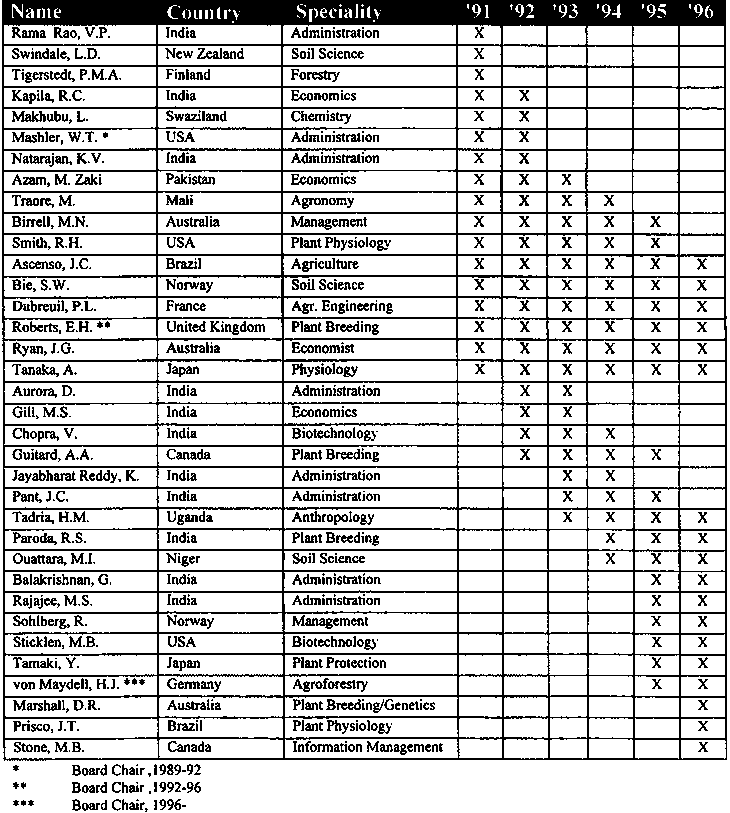
In view of the changes in ICRISAT since the last EPMR, the composition of the Board should be examined. Presently, the Board contains only 2 African members (Table 7.1). While it was not stated as a recommendation, the last EPMR suggested that a third African member could be accommodated within the present maximum size of the Board. The Panel suggests that an additional member from Africa be added to the Board while retaining total membership at fifteen and ensuring that African membership is not exclusively from either Anglophone or Francophone countries.
The Board has five committees: (a) a seven-member Executive Committee; (b) a three-member Nominations Committee; (c) a four to six-member Finance Committee; (d) a six or seven member Programme Committee (PC); and (e) a six or seven member Technology Exchange Committee (TEC). It is Board policy that all Board members serve on either the PC or the TEC. The Chair and the DG are free to attend meetings of the PC and the TEC but are not formal members. They mutually agree who will participate in what committee, as these meet in parallel sessions. The Nominations Committee and the Finance Committee have been established since the last EPMR. The Technology Exchange Committee, formerly the Technology Transfer Committee, has been renamed since the last EPMR.
7.1.2.1 The Executive Committee
The Executive Committee exists to act on behalf of the Board when a full Board meeting is not possible or practical. It takes special interest in management policies and performance, approves selection of senior managers of the Institute and deals with issues not covered by other committees. Membership includes the Chair, the Vice Chair, Chairs of all committees and the Director General who serves as Secretary. Based on observations of two Board meetings, the Panel notes that the Executive Committee makes preliminary decisions in anticipation of endorsement by the full Board. In the two meetings attended by the Panel, members of the Executive Committee, because they had previously come to a consensus, supported the proposals of the Chair and did not engage fully in debate of the issues at the Board level. The result, in some instances, was a somewhat convoluted decision process by which the final decision of the Board was reached without the full participation of members of the Executive Committee, other than the Chair. The Panel suggests that the Executive Committee strive to frame the issues for the Board but avoid making preliminary decisions and recommendations that bind its members before they interact with the full Board. The Panel also wonders whether a separate meeting of the Executive Committee, where issues are discussed in detail and preliminary decisions reached, is warranted when a full Board meeting is scheduled the following day and all Board members are available anyway. This practice results in inefficient use of time of the Executive Committee members who must go through discussion of the same issues twice in a row. The resulting less-than-full discussion of the issues at the Board level also potentially makes other Board members 'second class' citizens.
Table 7.1 Composition of ICRISAT's Governing Board
7.1.2.2 The Nominations Committee
The Nominations Committee was created to handle nominations for Board membership, previously handled by the Executive Committee, and also handles nominations for Board committee memberships. The Committee's reports are presented at closed sessions of the Board. While scheduling conflicts prevented EPMR attendance at any of the Nominations Committee meetings, indications are that this newly established Committee is functioning effectively and that its role, now distinct from the Executive Committee, is appreciated by the Board.
7.1.2.3 The Finance Committee
The responsibilities of this Committee include both a control-oriented audit function and a forward looking financial planning oversight function. Scheduling conflicts did not permit the EPMR to observe the functioning of the Finance Committee. While clear and well-formulated summaries of its discussions were presented to the Board meetings attended by EPMR members, the Panel is concerned that the Committee: (a) has not insisted on the implementation of a better management information system especially for financial/cost monitoring and reporting; (b) does not seem to monitor closely management's follow-up to the recommendations and observations contained in the Management Letter prepared by the External Auditor in conjunction with the annual Audit Report; and (c) appears to be over-optimistic in its assessment of the funding situation and of the possibilities for ICRISAT to raise funds. The Panel suggests that the Finance Committee be reconstituted as an Audit Committee with full responsibility for budget, expenditure, and operational oversight of the Institute and that the oversight of the financial planning function be transferred to the Board's Executive Committee.
7.1.2.4 The Programme Committee
The Programme Committee (PC) is composed of six or seven members. The PC at ICRISAT would be more appropriately described as a scientific advisory committee. It does not monitor the programme of the Institute on behalf of the Board and does not endorse the programme of work and budget to the Board for approval. In that regard, it is advisory (along with the Finance Committee) to the Executive Committee, which in turn endorses the programme of work and budget to the Board for approval. The Panel suggests that the Programme Committee be charged with guiding the Institute's research and research-related activities, recommending the programme of work and associated budget to the full Board and monitoring the progress of research work on an annual basis.
7.1.2.5 Technology Exchange Committee
The Technology Exchange Committee (TEC) is composed of six or seven members. TEC meets at least once a year to monitor the role and activities of ICRISAT that develop and support effective technology exchange with NARS, paying particular attention to the impact of the Centre's research, and advises the Board on such matters as necessary. The TEC takes special interest in information services, conferences, consultancies, training and partnerships with NARS, and the development of methodologies to measure and report impact of ICRISAT research. In practice some overlap occurs in the coverage of the PC and TEC agendas, hence they do occasionally have joint meetings.
In its meetings the TEC invites key members of the scientific staff to discuss the general status of technology exchange, efforts related to the Institute's work, the impact of ICRISAT research, approaches and methods used to achieve effective technology exchange, and identification of bottlenecks that limit technology exchange. To help assure its effectiveness, the TEC is developing a plan of work to help focus on important emerging problems in matters pertaining to technology exchange, as well as to identify and take advantage of opportunities. Examples of topics handled by TEC at recent meetings include: (a) impact assessment and evaluation, e.g., of the SADC/ICRISAT Sorghum and Millet Improvement Programme; (b) the Cereals and Legumes Asia Network; (c) the Training and Fellowship Programme; (d) upcoming projects of the Information Management and Exchange Programme; (e) an update of Southern and Eastern Africa Region technology exchange activities; and (f) special projects that were linked to special situations in the SEA Region, mostly those related to drought or famine relief.
The TEC is a good concept, and it might indeed prove useful in other CGIAR centres. The TEC provides a forum for scientists and staff dealing with all aspects related to technology exchange, following an agenda that allows time for meaningful discussions that can lead to necessary follow-up actions. Here plans for impact studies can be presented and discussed, allowing the Board a fuller understanding of technology exchange opportunities and problems, as well as to provide counsel and advice. The Panel concluded that the TEC provides a good complement to the Programme Committee, which often has many topics to handle and cannot give as much time or attention to technology exchange matters as might be desired. The Panel commends the Governing Board for developing the concept of the TEC and for working to find ways to develop annual plans for work aimed at improving technology exchanges between ICRISAT and its partners in developing countries of the SAT.
Based on the individual qualifications of its members, the Board might rank among the stronger in the CGIAR System. But it faces some of the most difficult challenges in the CGIAR. Leadership and teamwork are needed in the face of the serious challenges facing the Institute. The Panel notes that during the past five years the Board has supported many of the difficult changes in programme priorities, organization and management undertaken by the senior managers of ICRISAT. Board members have also taken a keen interest in the issues covered by the TEC and these discussions have been very detailed and productive.
However, the last EPMR encouraged the Board to become more effective in discharging its basic functions of policy-setting and oversight; but this has not happened in certain aspects of the Board's functioning. The EPMR Panel has noted with concern the Board's variable performance in several areas over the five-year review period:
· The Board seems to be over-optimistic in its assessment of the possibilities for ICRISAT to raise funds; it has not helped management develop a clear long-term institutional vision and financial strategy to deal with funding shortfalls; and it should provide closer financial monitoring and oversight of the Institute.· The Board should avoid being drawn into debating and making decisions on issues which should be management's prerogative and responsibility (e.g., organizational and research management issues, composition of management committees), while at the same time ensuring that the management of the Institute does not become excessively top-heavy.
· Especially in view of the 1990 EPMR Report's warning that "flexible retirement can be a blunt instrument, under which you run the risk of losing primarily those you wish to retain", the Board should not have agreed to an untargeted 1994/95 Voluntary Retirement Scheme. This VRS turned out to be very costly, resulting not only in short term expenditures but also in long term liabilities. In addition, as foreseen in the 1990 EPMR, some of the better performers, whom management would have liked to keep left the Institute.
· The Board should interact more frequently with the scientific staff. The Panel suggests that a monitoring arrangement be organized by the Programme Committee to provide for organized interaction among Board members and scientists. This could consist of a full day during each Board meeting at which Board members would interact freely with staff according to a prearranged schedule (e.g., by project or department).
The suggestions made earlier by the Panel with respect to the Board committees are intended to enable the Board to take suitable corrective action. The Panel also suggests that the Board formally adopt the new CGIAR Guidelines on the Role, Responsibilities, and Accountability of Centre Boards. Of particular interest at the present time are the provisions that: each member of a CGIAR Centre Board acts in his or her individual capacity, not as a representative of any constituency or outside entity; ex-officio and host country representatives would not normally serve as Board Chair or take an active part in the Nominating Committee; and the Programme Committee advise the Board on all aspects of the Centre's research and research-related programmes, focusing on the formulation of policies and plans and the monitoring of performance and impact.
Centre Commissioned External Reviews (CCERs) represent a new approach to the review process in the CGIAR System. The merits of this approach are discussed in a document entitled "Improving the Quality and Consistency of the CGIAR's External Centre Reviews," a discussion note prepared by the CGIAR and TAC Secretariats for ICW'95. In the case of ICRISAT, time did not permit a full set of CCERs to be undertaken prior to the EPMR. The CCERs available to the Panel included:
· Genetic Resources Division (June 1995)
· Organization and Management (July 1995)
· ICRISAT Western and Central Africa Region (March 1996)
· ICRISAT Southern and Eastern Africa (April 1996)
· Soil, Water and Nutrient Management Research (May 1996)
The quality of the CCERs depends heavily on the quality of the commissioning process. This should be the responsibility of the Board in general and the Programme Committee in particular. In the case of ICRISAT, however, the Board, in its February 1995 meeting, specifically asked management to advise it on the topics on which CCERs should be conducted, on their Terms of Reference, and on the composition of the CCER panels. Management, therefore, played a fairly active role in the CCER process. This may have been due partly to the short time horizon as a result of the impending EPMR.
The Board's involvement in the CCERs has varied. In the case of the Organization and Management CCER the Board felt that, as it had initiated the 1993 reorganization, it should be clearly involved. It therefore decided to have a former ('pre-reorganization') Board member on the CCER panel and to have the then Board Chair serve as a resource person. On the other hand, it left it mostly to management to investigate the possibility of a CCER on Soil, Water and Nutrient Management Research. In all cases, however, the Board approved the Terms of Reference, membership and workplan of the CCERs, and each CCER panel also had a Board member as a resource person, in addition to one management resource person.
In view of this experience, some CCER panel members and some Board members have wondered about the advisability and usefulness of such arrangements. In its September 1996 meeting the Board decided to leave it to the future CCER panels to decide if they wanted a Board resource person. The Panel endorses this view. The Panel also considers that participation of a management representative should be for logistical support only. In any case, CCER panel members should be free to conduct their panel discussions and their interviews on their own, and Board or management participation in such meetings should only be at the CCER panel's request.
For the future, it is suggested that the Programme Committee of the Board be more fully involved in the commissioning and monitoring of CCERs, for example by designating one of its members to monitor the different phases of the CCER process more closely. The Panel further suggests that the Board as a whole participate more actively in the discussion of the CCER reports and recommendations and in the follow-up of their recommendations.
The Panel commends ICRISAT for selecting exceptional reviewers as panel members for the CCERs. While the choice of the DG of IPGRI as a panel chair of the Genetic Resources Division CCER was made for compelling reasons, the EPMR Panel strongly suggests that, as a matter of principle, the staff of the IARCs should not be on any CCER panel. The quality of the CCER reports varied, and is discussed in the relevant sections of this report.
Despite these shortcomings, the CCER process achieved the major objectives of (a) widening the coverage and improving the quality of the information base available to the EPMR team, and (b) providing in-depth coverage of the areas treated, leaving the Panel free to focus on strategic questions and the longer term horizon. However, in view of the significant time and financial resources (US$ 0.25 m) devoted to the five CCERs conducted so far, members of the joint Programme/Technology Exchange Committee of the Board believe there is a need to review the outcomes, costs and perceived benefits of the CCERs and that their frequency, duration and scope should also be reviewed. The Panel endorses this view.
Because the Board must deal with declining resources requiring careful assessment of priorities; because of major impending changes in the ICRISAT management; and because of shortcomings in Board oversight since the last EPMR (which highlighted the same problem) the Panel recommends that the Board be diligent in its basic functions of providing financial and management oversight; setting vision, strategy and policy; and constituting its membership in a manner appropriate to the task.