


9.1.1 Option I: Downsized Present Model
9.1.2 Option II: Africa Centre Only Model
9.1.3 Option III: Strategic Partnership Model
ICRISAT has nearly a quarter century of experience of developing improved technologies in the SAT, one of the harshest and most challenging production zones of the world. The crops in ICRISAT's mandate are the major foods for some of the poorest people anywhere. Over the years ICRISAT has shown that these crops will respond to research and that farmers can derive benefits from good scientific work. For example, ICRISAT research on global problems (e.g., leafspot and rosette virus resistance in groundnut, downy mildew and ergot in pearl millet, short-duration pigeonpea, and Vertisol technologies, etc.) has proven to be of benefit to NARS and the farmers they serve. This success in the SAT indicates the need for, and promise of, continuing ICRISAT involvement. Continued involvement by ICRISAT in the SAT is essential and compelling for three additional reasons:
· The numbers of poor in the SAT continue to grow. This is a major concern especially because, for the foreseeable future, most of the population will continue to derive their living from agriculture. The poor in both Africa and Asia are of concern, although at present, the poor in Asia (and in India in particular) are seen by most donors as less needy than the poor in Africa, despite the fact they are probably poorer in a relative sense, and that their numbers are greater than in Africa. The CGIAR System should not turn its back on the poor in either of these continents.· To ensure that major improvements will occur in crop technologies relevant to the SAT, strategic research will be needed. ICRISAT is essentially the only institution well placed to play such a role. Concentrating strategic research in an international institute is justifiable not only on grounds of efficiency and lack of alternate suppliers, but also ensures that the potential multiplier impact of such work is maximized.
· Many NARS in the SAT, particularly in Africa, are in a state of crisis. This is especially true with respect to research funding and sometimes with respect to availability of qualified researchers. Logically, most of these NARS would concentrate more on adaptive research and rely on ICRISAT to provide results of strategic research. However, for the continuum of strategic/applied/adaptive research to operate efficiently, NARS must have the requisite funding and qualified personnel. To reach this desired result will require the strengthening of mutually supportive and collegial partnerships between ICRISAT and NARS in the SAT.
The Panel is convinced that there is a definite continuing role to be played by ICRISAT in the SAT. However, some rethinking of strategic direction and rationalization of programme thrust is required. The Panel believes that in developing a relevant practical plan for ICRISAT in the future it is important to take into account the following contextual factors:
· The poor financial and infrastructure status of many NARS, particularly in Africa.
· The presence of qualified but poorly supported research staff in many NARS.
· The likely continued shortfall in funding for ICRISAT through the CGIAR.
· The increasing influence and strength of some regional research organizations.
· The strength of agricultural research in India.
In recognition of the above realities the Panel concludes that three major groups of factors should be considered in charting the future for ICRISAT:
· ICRISAT should build on its strengths and past successes, and emphasize specialization and concentrated effort based on the following principles:- taking advantage of, and building on, 'new science'
- production of international public goods
- comparative advantage
- internationality
- critical mass
- partnership
- efficiency
- equity· ICRISAT should continue to employ complementary research relationships with NARS and regional research organizations to build partnerships in collaborative activities, to share human capital and infrastructure, and develop mechanisms for mutual support and accountability.
· The Asian and African SAT have differing research needs. Most of the Asian SAT lies in India which has a large and competent NARS; therefore, research in Asia should be strategic and global in nature. On the other hand, Africa will require special research attention in improvement of SAT crops and natural resource management, and the research profile there will need to emphasize more applied and adaptive research - but will build on the strategic research results coming from Patancheru.
Another consideration concerns the extensive and well developed research facilities at Patancheru. These facilities, which would be virtually impossible to replace today, present an inviting place to conduct strategic research on important global or continental problems. The facilities include, for example:
· World class laboratories, greenhouses, library and communications capabilities, and outstanding field research facilities and equipment.· Global germplasm collections of sorghum, pearl millet, groundnut, chickpea, pigeonpea and minor millets.
· Internationally and nationally recruited scientists and support staff, who have many years of valuable experience in working in an international research culture that relies on many nationalities and skills. Collectively this constitutes a significant asset of human resources that would take a decade or more to develop elsewhere.
· Low costs of research compared to other regions or continents.
· A location that permits close collaboration with one of the largest NARS in the world, that of India, and its own impressive strategic research capability as well as its extensive network of research stations.
· The opportunity for research collaboration in key areas of mutual interest; a special feature could be the opportunity to use carefully planned contract research in areas where ICRISAT might not wish to build long-term capacity.
In taking the above points into consideration, the Panel developed the following three possible scenarios or options for the future of ICRISAT:
· Option I: Downsized Present Model
· Option II: Africa Centre Only Model
· Option III: Strategic Partnership Model
The merits of each option in terms of some of the points raised earlier are discussed in the following sections and are summarized later in Table 9.1.
The present model has a number of advantages. For example, ICRISAT under Option I could be used to host other IARCs and advanced research organizations around the world as partners in research in India and could continue to be involved in research partnerships in some of the global initiatives being organized within the CGIAR or by other groups. But the Panel concluded that ICRISAT, as presently constituted, has an uncertain future in India, and that funding prospects are unlikely to improve (the recent example of emergency funding support is unlikely to be repeated) unless major changes are made. Reasons for this conclusion follow:
· Relations with the host country could continue to be strained, partly because ICRISAT's activities do not look all that different from what the Indian NARS is already doing or is capable of doing. Many donors question why the CGIAR is doing research for India, a country with some 22,000 agricultural scientists.· Despite the large campus and capital investment at Patancheru, some donors could be ready to walk away from a facility that might require more than US$ 100 million to duplicate elsewhere.
· Some donors have suggested splitting ICRISAT into two, making efforts in Africa independent, thus potentially inhibiting internationality, critical mass, and comparative advantage (e.g., in strategic research).
· Continuing essentially the present Centre at less cost is not likely to attract more donor support.
The Panel concluded that Option I would look much like the present, but a bit dowdy, with problems of critical mass in some fields and with poor prospects for improved morale and funding. There would be less of everything, but the overall programme thrusts would probably remain intact. The research programme would be broad and shallow in most areas of effort, reducing necessary strategic research. A broad and shallow approach tends to detract from and trivialize the good work in areas where ICRISAT has shown research success. Broad and shallow does not usually produce 'international public goods', which should be the major purpose of an IARC.
This option was considered by the Panel as one way for ICRISAT to divest itself of involvement in India, a strategy that, as mentioned above, is favoured by some donors and has also been discussed, at least privately, within the CGIAR.
The Panel concluded that the Africa Centre model is neither a viable nor desirable option. Reasons for the lack of viability include the fact that there is no relevant centre of excellence (i.e., with a scientific heart or generator and a critical mass of staff) upon which to build. No one country or location in the African SAT fits an international centre model very well. Problems of stability (including potential civil unrest), high operational costs, variability in agricultural production conditions, and finding a representative site for international research all argue against an Africa-only ICRISAT. After all, it is no accident that three IARCs (i.e., ILRI, ICRAF and ICIPE) are all headquartered in Nairobi, which is seen as a stable place with school and other amenities to suit international scientific professionals. No viable alternatives for a headquarters site exist in the African SAT. The ICRISAT Sahelian Centre has good laboratory and training facilities, but is located in a zone much too dry for most crop improvement work, except perhaps for pearl millet, but even that is argued in scientific circles. ICRISAT does have several field stations in Africa that can be used as locations for research, and as places where partner IARCs and NARS can work, but these are more suited to applied and adaptive research and technology transfer activities than for even limited strategic research.
While the above discussion relates to viability, neither is the option desirable. An Africa-only ICRISAT would likely experience problems relating to internationality, comparative advantage, and efficiency (high costs). Also, the potential for ready access to germplasm presently held by ICRISAT at Patancheru as well as potential collaboration with Asian NARS, would at best be inhibited and at worst, seriously jeopardized.
In examining the present ICRISAT situation the Panel decided that a more focused, easier to manage, operational mandate was required. ICRISAT has a complex mandate (5 crops and a geographical mandate that covers parts of three continents) and many demands on its resources (Systemwide activities, ecoregional responsibilities, balance between Asia, Africa, and Latin America). Also, the many demands plus financial problems and downsizing were resulting in the Centre becoming too broad and shallow.
The Strategic Partnership Model proposed by the Panel (Figure 9.1) builds on the comparative advantage of a strategic research presence in Asia while at the same time addressing pressing research needs in the SAT of Africa. The proposed model consists of three components:
· Strategic and global germplasm research at Patancheru, serving all three continents, complemented by applied crop improvement research in Africa (see Chapters 2 and 3).· Integrated natural resources management (INRM) research concentrated primarily in Africa (see Chapter 4), complemented by a small INRM strategic research team at Patancheru that would also be linked to the global germplasm research (see Chapters).
· Research partnerships and networks implemented via ecoregional approaches and visiting scientists to help improve the momentum and impact of the first two components.
A comparison of the three options is provided in Table 9.1, after which a brief overview of the three components of Option III is given, followed by a short discussion on operational and management implications.
Figure 9.1 Strategic Partnership Model: The Proposed New Research Paradigm for ICRISAT
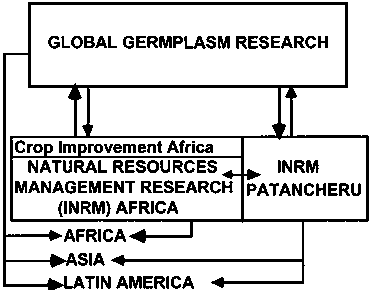
Table 9.1 Comparison of the Three Options with Respect to Principle or Concept (1 = high; 5 = low)
|
Principle or Concept |
Option I |
Option II |
Option III |
|
Global emphasis |
1 |
4 |
1 |
|
Internationality |
2 |
4 |
1 |
|
International public good |
2 |
4 |
1 |
|
Equity |
1 |
3 |
2 |
|
Efficiency |
3 |
5 |
2 |
|
Comparative advantage |
3 |
5 |
1 |
|
Critical mass |
3 |
1 |
1 |
|
Potential for using new science |
3 |
3 |
1 |
|
Potential sustainability of the Centre |
4 |
2 |
1 |
|
Potential for productive partnerships |
3 |
3 |
1 |
|
Potential for improved India relationships |
3 |
3 |
2 |
|
Clarity of operational mandate |
4 |
3 |
2 |
9.1.3.1 Strategic Germplasm Research
Strategic germplasm research at Patancheru would build on past and present strengths of ICRISAT and its headquarters facilities and campus, while improving relationships with the host country. It would take on responsibility for global genetic enhancement of ICRISAT mandate crops by building on the Institute's most important and valuable long-term asset, its global germplasm collections. The concept would function as follows:
· Building on the current direction of the crop improvement programmes, strategic research in germplasm conservation, evaluation, and enhancement aimed at utilization would be the main focus of continuing activities at Patancheru. Activities not central to strategic germplasm research would be phased out or, in the case of natural resource management research, be reduced greatly.· The germplasm effort would be global in scope and would emphasize strategic research in all fields necessary to carry out genetic conservation, evaluation and enhancement on ICRISAT's global germplasm collections, for the benefit of the world's harshest croplands and the poor people living there. By focusing on the Institute's greatest international asset, as well as its greatest comparative advantage -strategic research centred on the germplasm collections of its mandated crops - relations with the Indian NARS should improve. Under this option, with the proposed fundamental shift in programme thrust in Patancheru, ICRISAT becomes a major asset and partner for the Indian NARS and as a result, should not be perceived as a research competitor. This strategic and global germplasm research at Patancheru will be complemented by applied crop improvement research in Africa (Figure 9.1).
· As is the current practice, ICRISAT would not produce finished varieties, but would provide improved parental lines and enhanced materials with full documentation of traits to African, Asian and Latin American NARS. This focused effort should accelerate the capacity of NARS to develop locally adapted, acceptable varieties.
· ICRISAT staff needed would include outstanding international and national scientists in a number of disciplines and fields, including inter alia: pathologists, entomologists, soils specialists, plant physiologists, molecular and cell biologists, geneticists, breeders, agroecologists, biochemists, GIS specialists, etc. Some of these scientists would also be part of a small strategic research team in natural resources management at Patancheru.
· Building on the base of knowledge gained through ICRISAT's nearly 25 years of research on three continents, the main work of the research team would be to understand the main edaphic and biotic problems facing the mandate crops in the SAT; and to survey, characterize, evaluate and mine the germplasm holdings to find and make available in usable form, genetic traits needed by NARS. The research team would use new developments in science along with conventional means to advance this work. New research methodologies and new approaches to strategic germplasm work would also be outputs. Such strategic research focused on global germplasm holdings should attract partners from research organizations around the world. Indeed, ICRISAT would be establishing a new paradigm in strategic germplasm research and should become a 'magnet centre' for research partnerships through superior creativity and innovation.
· The germplasm component would make use of the excellent laboratories, screenhouses and greenhouses, rain-out shelter and other field facilities that exist at Patancheru.
In developing this paradigm the Panel attempted to address an underlying concern that the global germplasm conservation, evaluation and utilization system around the world is incomplete. A void is present in the system, and it lies at its very heart - the global collections and the lack of a systematic approach to apply science to their conservation, evaluation, and exploitation. On the genebank end of the continuum is the curator whose responsibilities lie mostly with conservation concerns and genebank management, rather than research on the collections per se. On the other end is the breeder whose goals are more immediate and who, unless forced by unavoidable necessity, does not want to reach back to the genebanks to work with landraces or wild materials. Hence, a gap exists between curator and breeder, without a systematic way of studying the collection. Of course, there are examples of success in finding traits in 'the library with a poor index and few readers', a term which applies to most genebanks. Even so, there have been successful 'lucky dips' [or serendipitous forays] into germplasm collections to find traits missing in breeding materials and some have paid off, often when a breeder had reached a dead end in finding the traits needed in breeders' collections. However, 'lucky dips' will not do anymore, especially for crops of the SAT which have received little research attention and which, unlike other major food crops, do not enjoy research by scientists in many places and with more resources.
All germplasm research should be purposeful, systematic and thorough, and should be linked to developments in genetic mapping and biotechnology. The new model of ICRISAT would establish a new paradigm in germplasm work and, in dealing with global collections, should pay off handsomely in the future. Also, rational and systematic genome mapping and evaluation of the germplasm collections of the mandate crops should well position the SAT crops for wider use. In addition, the private sector is currently interested in working on the major food and feed crops, but the ready availability of a well documented germplasm bank providing intermediate products could attract their attention to the ICRISAT mandate crops. This would shorten the period for obtaining positive results and hopefully entice the private sector to address more fully the needs of some of the poorest people in the world.
9.1.3.2 Natural Resources Management Research
The Panel believes the new ICRISAT should continue its work in natural resource management research (NRM) in the SAT by maintaining a staff of international and national scientists in building partnerships and working on research methodologies with NARS scientists. Most of this team would be stationed in Africa. A few NARS, probably those associated with locations where ICRISAT currently has germplasm enhancement activities, would collaborate with the Institute in developing integrated natural resources management research (INRM).
Given the shortage of current expertise in NRM research in most African NARS, the range of activities would extend along the full continuum of strategic/applied/adaptive research. ICRISAT would concentrate in a few carefully chosen field locations and, in collaboration with the relevant NARS, implement applied and adaptive research activities relating to NRM. ICRISAT would also engage in strategic research targeted to fill knowledge gaps of linkages within the INRM framework. The principles that need better characterization are: linkages between productivity enhancement and resource conservation; spatial or landscape level linkages; temporal linkages that are indicative of sustainability; and linkups between research, diffusion and adoption of results.
In analyzing the long term role of the CGIAR in NRM research, TAC has observed that there will always be strategic research issues and environmental problems that transcend specific production systems, and geographical and ecological regions. These include basic understanding of soil/water/plant relationships, soil nutrient-biota dynamics, sustainable input/output models, soil erosion and other forms of environmental degradation. ICRISAT would select issues most relevant to its mandate and develop the necessary capacity and programmes to generate international public goods. While most of the ICRISAT scientists associated with NRM research would be located in Africa, a few would be posted at Patancheru because of ready availability of facilities and lower costs. This small team would undertake strategic research designed to understand global natural resources management issues and principles (using modeling and GIS techniques) and provide linkage with the global germplasm research projects (Figure 9.1). The team would be augmented by visiting scientists as the need arises, and as part of professional development of NARS scientists.
9.1.3.3 Partnerships
A critical issue in positioning ICRISAT to play more of a strategic research role is to ensure that the results of that research (in terms of methodologies and intermediate products) are readily available to NARS. To ensure that necessary linkages are forged and sustained, the Panel is convinced that the CGIAR should support ICRISAT in developing two initiatives:
Visiting scientists. A key component of the strategic research programme should be to have an expanded proactive visiting scientist programme supported through core funds. This programme would provide not only a wider pool of scientific talent to the strategic work as a complement to the skills of core staff, but also would help ensure that national scientists can participate as partners in international agricultural research, while helping these scientists to improve their capacity for research in their home countries. At the same time, visiting scientists could provide expertise to the ICRISAT strategic research programme in topics or areas that do not justify a full time ICRISAT scientist by adopting a programme philosophy with true partnerships and a collegial nature.
The Panel envisions a dynamic visiting scientist programme for ICRISAT that would require innovation and imagination. Especially important will be designing and implementing a strategy to make ICRISAT a 'magnet centre' in strategic research in germplasm (see Chapter 3). The Panel does not consider visiting scientists to be part of training, but rather as colleagues and partners in the global research effort. The concept envisioned for strategic germplasm research is one that allows scientists in fields relating to any part of the germplasm continuum from collection, conservation, evaluation or enhancement, to be able to come and work as members of the relevant team to strengthen and enrich the effort while gaining skills and experience needed in their personal development. Such partnerships will advance the state of science, allow scientists from all countries to participate in the global effort, and ensure strong working relationships with advanced research organizations and NARS.
Visiting scientists would also be needed in the NRM research effort, but this area may require broadening the effort through the continuum of strategic/applied/adaptive research within the context of the INRM approach elaborated in Chapter 4. The INRM approach calls for specialists with interdisciplinary skills to address key research areas along the continuum. The approach also calls for skills not normally available at ICRISAT. The benchmark sites for the implementation of the INRM research framework would offer attractive opportunities for visiting scientists from advanced research institutes and NARS. Of particular interest to ICRISAT would be to achieve a holistic and sustainable attack on issues related to enhancement of land productivity, sustainability and control of land degradation. The Panel is of the opinion that ICRISAT's future approach to INRM research would strengthen ICRISAT's role as a 'magnet centre' in Asia and Africa.
Visiting scientists may come from any country or institution and may obtain their support in many ways. Details are discussed in Chapter 6. ICRISAT should consider its present capacity in housing, transportation and scientific facilities to accommodate a larger, strategically designed visiting scientist programme.
Partnership Networks. Networks, both formal and informal, have tremendous potential not only for effectively improving partnerships and the efficiency, productivity and impact of ICRISAT's research but also in fostering research in problem areas where ICRISAT does not have adequate staff. Networks can also help develop and nurture inter-NARS communication and collaboration. Regional fora can play an important role in these efforts. The facilitating role in research partnerships may also involve preparation of joint research proposals with NARS and providing leadership in making the efforts operational. Some NARS have indicated to the Panel their appreciation for such initiatives on the part of ICRISAT. Due to financial exigencies, many NARS staff are not fully utilised and their access to the donor community is more circumscribed. The Panel is concerned about the trend towards CGIAR encouraging IARCs to seek their own funding which may push their programmes into more short-run, and less strategic, focus. Potentially, partnerships and networks could play an important and constructive role in the use of such funds, as the focus of such work is more likely to lie in the adaptive/applied end of the research continuum and in areas that are likely to be more appealing to many donors.
Contract Research. Another cornerstone of the Panel's vision is increased use of contract research targeted to meet the needs of ICRISAT and its partners, particularly in strategic research. For example, contracts might be with advanced institutions involved in molecular biology or cell biology in areas where ICRISAT does not wish to develop in-house capacity. Some contracts might be with developing country institutions, either directly or through networks, for example, for evaluation of germplasm materials that require a particular 'hot spot' for diseases or insects, or where particular environmental conditions require such work. Contract research can be a good strategy for ICRISAT in 'extending its arms' around the SAT by using established scientific capacity in NARS or ARIs. Contract research with selected NARS can also have the advantage of supporting scientists who are presently underutilized because of lack of operating funds. The potential problem is that every partner may expect a contract, adversely affecting the productive partnerships that now exist.
9.1.3.4 Organizational and Management Implications
The 'new' ICRISAT would be much simpler in structure and management would be more direct. For scientific activities, the panel envisions a reduced number of IRS at Patancheru and about the same number in Africa. To assist the DG, two types of research leaders would be required, one at Patancheru to guide the strategic research on germplasm, and another in Africa operating with considerable autonomy to guide the effort there in natural resource management coupled with crop improvement (see Section 8.3.2) Visiting scientists, partnerships and 'networks' would flesh out the research complement. Only a few projects would be needed in Patancheru, perhaps three global projects for the strategic germplasm work (e.g. conservation and genebank management, biotic and abiotic stresses, and enhancement), one global project for strategic natural resources management work and one global project for impact assessment. In Africa, two or three projects would probably suffice, including integrated natural resource management and germplasm improvement.
The new model would present a much more sharply defined profile in India and Africa. It would deal with global and strategy problems mostly through its global germplasm evaluation and enhancement work, and in natural resources management, and with applied and adaptive research on African problems through a network of IRS working with NARS and other partners. The 'new' ICRISAT, therefore, would be focused, purposeful and lean in nature and would avoid diversions from its main purpose.
The germplasm strategic research effort could begin very soon. Many of the scientific disciplines on the staff can be fitted into the new model. What will be different is that the staffs research agenda would centre on strategic research on the germplasm collection. Because these crops have had such a brief history of research, it is imperative that the collections be studied and assessed systematically and thoroughly to obtain maximum benefit for the poor and to increase food security in marginal areas.
For the complex natural resources management area, careful planning is needed to set priorities in strategic research and in selected field (benchmark) locations where research activities along the strategic/adaptive continuum can be conducted in association with NARS. Similar care needs to be taken with respect to partnership and networks to ensure that the most important areas are selected for collaboration, and that adaptive work is not done at the expense of the main strategic research agenda of ICRISAT.
Working out the research agenda would require interactions of selected individuals from, inter alia, scientists at ICRISAT, the ICRISAT Board, ICAR, one of the major African NARS, one of the major donors, IPGRI, and an internationally respected natural resources management scientist. Such consultation with all stakeholders would provide the basis for detailed planning for implementing the proposed model (see Section 4.3.3).
The Panel realizes that the model proposed carries with it a number of challenges that will require enlightened and decisive leadership, coupled with flexibility on the part of host country officials, understanding of staff and workers, and support of donors. Three of the major challenges in ensuring the future viability of ICRISAT are as follows:
· A phased adjustment of staff size and composition at Patancheru and elsewhere would be needed, covering IRS, national scientists, and support staff. In the face of likely financial exigencies it has been recognised that some right-sizing was going to be necessary in any event. That would not make it any less painful and challenging. What this model does do is to provide a targeted approach to staffing the new ICRISAT. In terms of the future viability of ICRISAT, the Panel considers it preferable to adopt such an approach to possible downsizing, rather than the less focused, but probably less painful, VRS that ICRISAT went through a short time ago.· The timing of this review was inconvenient for ICRISAT, coming as it does towards the end of the planning exercise for the MTP 1998-2000. If the model proposed by the Panel is accepted, some considerable adjustments in the MTP will be required. What the draft MTP does not do at the moment (although Management has a plan) is to prioritise among projects. The model proposed by the panel should help with this prioritization.
· The comparative advantage of ICRISAT lies in having a strategic research focus. This raises two major concerns related to donor support. The first is the long gestation period required to derive results of strategic research and the second is that the products are intermediate in nature. Regarding the first concern, strategic germplasm research would be compromised if the 'new' ICRISAT did not receive adequate funding over time. Regarding the second concern, IARCs currently are under great pressure to demonstrate impact in terms of adoption of final technological products by farmers and that results in the improved welfare of society. The Panel considers a major challenge to ICRISAT and the CGIAR is to find ways to convince donors that strategic research requires good science, concentrated focus, and time, and if done properly can result in useful and even powerful intermediate products. These in turn can result in a greater number and variety of useful final products, and with greater predictability and efficiency than the hit-and-miss approaches that often underlie some applied research ventures.
Although the Institute appears to be bordering on a crisis of confidence, reflected in poor morale and continuing shortfalls in donor support, it also has many strengths to draw upon - notably a dedicated cadre of research leaders, scientists and staff with a demonstrated record of programmatic achievement.
The Panel is convinced that the next few years hold considerable promise for ICRISAT, provided the changes proposed in this Report are implemented effectively; and in view of the CGIAR community's interest in the continued success of the Institute, the Panel recommends that a Mid-Term Review of ICRISAT be undertaken by the CGIAR in two years (i.e. completed by end 1998) to assess the progress made by the Institute in transforming itself into a 'new' strategic research and partnership-oriented centre of excellence.
Further, since the proposed mode of research - of combining strategic and applied/adaptive research on germplasm, commodities and natural resources management, on more than one continent (particularly Africa and Asia) - could be of value to other Centre centres, the Panel also suggests that this approach be examined further during the System Review of the CGIAR planned for 1997-98.
ICRISAT's scientific achievements during the review period have been considerable, as noted throughout this Report. Despite its complex mandate to address seemingly-intractable problems of an exceptionally difficult agroecological region, the Institute's management, scientists and staff over the years have done a commendable job in achieving scientific and technological success in many programme areas, in partnership with their collaborators from national programmes and advanced research organizations.
In recognition of this record of accomplishment, ICRISAT received the prestigious King Baudouin International Award from the CGIAR at its 1996 International Centres Week; and one of its staff members was recognized as an outstanding nationally recruited scientist at the CGIAR's 25th Anniversary Celebration in Washington, DC. These honours add to the list of numerous national and international awards presented to ICRISAT staff for their dedicated scientific contributions. Based on its own assessment as well, the Panel joins the CGIAR community in congratulating ICRISAT staff for its hard work, dedication and achievements in helping alleviate poverty in the SAT of Africa and Asia. This effort towards sustained productivity improvement in ICRISAT's mandate crops, which are an essential part of the daily diet of several hundred million people in the world, deserves the full continued support of the CGIAR.
As the Institute gears itself to address the many challenges ahead, in pursuit of the more-sharply defined strategic research agenda proposed in this Report, ICRISAT's Board and management must be able to rely on the unequivocal support of all its major stakeholders, internal and external. The new direction recommended by the Panel for revitalization of ICRISAT holds the promise of Grafting a 'magnet centre' of excellence. It will be a unified centre, held together by an operational mandate that emphasizes a global/strategic comparative advantage in both germplasm and natural resources management research, and relies on a strong programme and administrative presence in both Africa and Asia. In this context, the heads of research in Africa and Asia would be functionally equivalent; and in the Panel's view, this structural differentiation of ICRISAT is not incompatible with programmatic integration and coherence of the Institute as a whole. The 'new' ICRISAT would rely on cutting-edge science in the fast-evolving fields of genetics, biotechnology and natural resources management, coupled with a systematic effort to strengthen partnerships with the Institute's many collaborators, especially NARS. The progress will not come easily; but the envisaged collective effort of ICRISAT staff and management must not be allowed to falter.
The task of moving ahead will require single-mindedness of purpose - that of reinvigorating a unique centre of excellence unmatched anywhere in the SAT. ICRISAT has amply demonstrated during the past few years that it welcomes the challenge of developing and implementing new ideas - be they in the fields of science, both strategic and applied, or in the equally difficult fields of research organization and management. The Institute has also demonstrated that it believes in learning from experience, and is willing to make the adjustments needed to maintain its comparative advantage in the inevitable, and healthy, competition for resources and results.
The Panel has made only a few recommendations, but they are potentially far-reaching in the important areas of programme strategy, priorities, research management, and partnerships. It was beyond the scope of the EPMR to examine in detail the logical implications of these recommendations for the future funding, organization and staffing of various activities of the Institute, both in Africa and Asia. This task is therefore the next order of business, assuming of course that the Panel's recommendations are endorsed in large measure by ICRISAT's Governing Board and the CGIAR in the coming months. Accordingly, the next draft of the MTP 1998-2000 should be considered preliminary, and subject to further revision in 1997 by the management. Board and TAC.
The task ahead will require: careful examination and fleshing out of details by ICRISAT management; adequate consultation with staff, NARS partners and donors; and, ultimately, the full support of the Board in guiding the Institute towards implementing the agreed-upon recommendations. The next few months and years, therefore - especially during the proposed phased-transition to a new strategy and a re-shaped, right-sized Institute - will require a tough-minded yet sensitive approach to decision making.
The Panel is convinced that the time has come to launch ICRISAT boldly into its next quarter-century of successful service to the poorest of the poor in its mandate areas. The Institute's new management is expected to be in place by mid-1997, and deserves the unstinting support of the Institute's many friends around the world.
By nature, reviews such as this one tend to over-emphasize the negative at the expense of the positive - the purpose of the review being not only to take stock but to correct the deficiencies so as to progress further. Its sometimes critical analysis and its genuine concerns not withstanding, the Panel wishes to reiterate its high regard for the efforts and achievements of ICRISAT's Board, management and staff during the period under review as well as for the longer term. We are convinced that the Institute will continue to display a good head and a strong heart in the years ahead, and wish it continued success in the future.
