1.1 Roots and Tubers in the Third Millennium
1.2 Research Needs
1.3 CIP as an Institution
1.4 CIP in Profile
This section provides an outlook for roots and tubers, the institutional setting, and the resources and the methods for achieving CIP's goals. It was against this background that the Panel conducted the review.
Potato and sweetpotato, along with cassava, are the main root and tuber crops utilized by mankind. They have a unique capacity to produce high yields of carbohydrates and, to a lesser degree, protein per land area.
These crops produce high yields on soils frequently not suitable for cereals, e.g. due to soil acidity (potato, cassava), low nutrient status (sweetpotato) or water stress (cassava, sweetpotato). All three crops are vegetatively propagated, and their usable part has a low dry matter content. The latter attribute has important implications - poor storability and costly to transport over long distances. These aspects have made root and tuber crops essentially crops for rural consumption, in settings where the chain from the producer to the consumer is short.
One major difference between potato, and both cassava and sweetpotato, is their ecological niches. Potato has a broad range of adaptation, growing in temperate, sub-tropical and tropical highland environments, while cassava and sweetpotato are largely tropical and sub-tropical crops. The importance of potato production in temperate, developed countries has led to a substantial research investment in this crop while cassava and sweetpotato have been relatively neglected. CIP's mandate includes potato and sweetpotato; lesser known Andean root and tuber crops have been added recently, in recognition of the importance of conserving this rich source of biodiversity for the future.
Developing countries produce 82 million tons of potato (30% of the world potato harvest) and 122 million tons of sweetpotato (99% of the world production, 1991-93 averages). About 85% of the latter is produced in China.
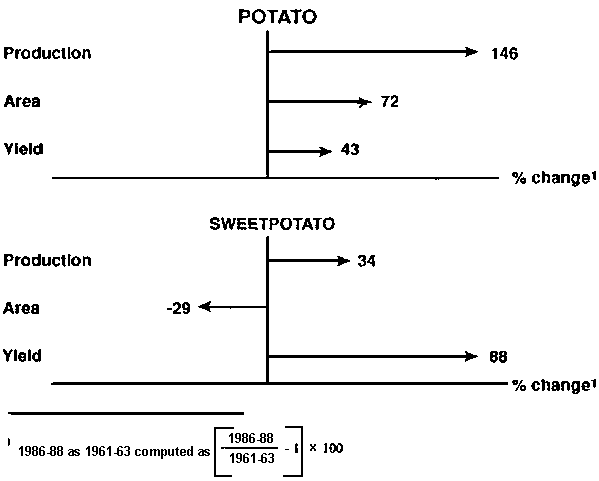
Long-term trends in the evolution of production, area and yield of both crops are presented in Fig. 1.1. Two markedly distinct development patterns become apparent. Potato production has grown substantially faster than sweetpotato production. Potato production is rapidly expanding in terms of both areas and yields in all developing regions. Potato, and particularly potato products, rank high in consumer preferences around the globe, allowing the crop to contribute significantly to employment and income generation in the rural sector. Consumption of processed potato products is rapidly expanding in developing countries1.
1 Scott, G. 1994. The Emerging World Market for Potatoes and Potato Products with Particular Reference to Developing Countries. In: Economie et Gestion Alimentaire No. 30, Janvier 1994.
On the other hand, sweetpotato is presently declining in area in all developing regions except Africa, in spite of increasing yields in Asia and stagnant yields in Africa and Latin America. Consumer preference for sweetpotato is low, and existing uses in processing are not very competitive in terms of using available resources to link the crop to expanding markets.
Figure 1.1: Trends in Potato and Sweetpotato Production, Area and Yield in Developing Countries, 1961-88
Source: Scott, G. 1992. Transforming Traditional Food Crops: Product Development for Roots and Tubers. In Scott. G., S. Wiersema, and P.I. Ferguson (eds.). Product Development for Soot and Tuber Crops. Vol. 1-Asia
Two distinct scenarios can be drawn for sweetpotato. In the context of the increasing degree of urbanization of developing countries and rising per capita incomes, the key to generating income opportunities for the rural and landless poor seems related to success in linking sweetpotato, through improved processing, to dynamic urban markets.
But, a pessimistic scenario of increasing population pressure, restricted international trade, and mounting pressure on the resource base (particularly in highly populated countries, such as China), begs for a different role for the sweetpotato crop. In this case, sweetpotato will likely play a key role as a famine relief crop.
There are a number of important constraints to the production and expanded consumption of potato, sweetpotato, and the lesser known Andean roots and tuber crops (ARTC) that are related to the cultivation and genetics of the crops. These crops are vegetatively propagated, which has two obvious consequences. First, vegetative propagation spreads pests and pathogens more readily than do true seeds. Second, vegetative propagation virtually assures genetic uniformity of the crop, thus providing an opportunity for rapid pest and disease build up in the absence of any genetic diversity.
Beyond the cultivation and genetic problems specific to potato and sweetpotato is the universal need to provide sustainable, profitable, and farming-systems-compatible technologies appropriate to production and consumption requirements of the target regions. With directly consumable crops such as potato and sweetpotato, there is a real challenge to meet the culinary requirements of consumers. The needs of post-harvest processing industries can also represent a significant research challenge.
Potato and sweetpotato are not easy to breed as both crops have difficult genetic systems that are, scientifically, poorly understood, relative to other crops. Expectations for rapid advancement through plant breeding are often unrealistic. Experience has shown that a concerted research effort in genetic enhancement is necessary for significant progress in either crop.
In the aggregate, the research issues and problems of potato and sweetpotato are considerable, and are often significantly beyond the research capacity of many national agricultural research systems, particularly among the developing country NARS. While there is a relevant stock of knowledge to be tapped for potato, this does not apply for sweetpotato, which is almost exclusively grown in developing countries. It is from this perspective, and in recognition of the importance of these crops for the developing world, that international potato, sweetpotato, and the lesser known Andean root and tuber crops (hereinafter referred to as potato and sweetpotato) research has been mandated to the International Potato Centre (CIP).
1.3.1 Mandate and Evolution
1.3.2 Governance
1.3.3 Management
1.3.4 Infrastructure
A 1971 agreement for scientific cooperation between the government of Peru and North Carolina State University created "an international centre for potatoes in Peru .... of scientific nature, non-profit, dedicated to research with potatoes and tuberous roots ... to carry out research, prepare and train scientists ... under the leadership of high level scientists ... to collect, maintain and distribute germplasm ... (to be) utilized nationally and internationally". This statement constitutes the legal mandate for CIP.
At the inception of CIP, potato was selected as the primary focus of research attention because of its importance. Hence, it was as a single commodity centre that CIP was admitted to the CGIAR in 1972, with the following operational mandate:
"To develop, adapt, and expand the research necessary for technology to solve priority problems that limit potato production in developing countries. This includes adapting the collective knowledge that has contributed to the stepwise increase in potato production in developed countries".
The original operational mandate stood until 1985, when CIP's Board of Trustees decided to add sweetpotato to the Centre's research agenda, and a revised operational mandate was adopted:
"To conduct the research necessary to solve priority problems that limit potato and sweetpotato production and consumption in developing countries. This includes adaptation of the collective knowledge existing in the industrialized countries, as well as pertinent post-harvest research".
This statement is also CIP's current operational mandate.
At its meeting in Indonesia in April-May 1992, the CIP Board of Trustees, in the light of the proposed new activities in the Andean region including Andean root and tuber crops (ARTC), asked management to redraft the operational mandate to include the work on these crops. In 1993, CIP proposed, and TAC concurred, to include "lesser-known Andean root and tuber crops" as a core-funded activity, on the basis of ensuring biodiversity.
CIP's Board consists of 12 members and is organized into four committees: Executive; Programme; Audit; and Nominations. The Executive Committee meets twice a year, and the others once in conjunction with the annual full Board meeting. Board composition and Trustees' committee responsibilities throughout the 1990's are shown in Table 1.1.
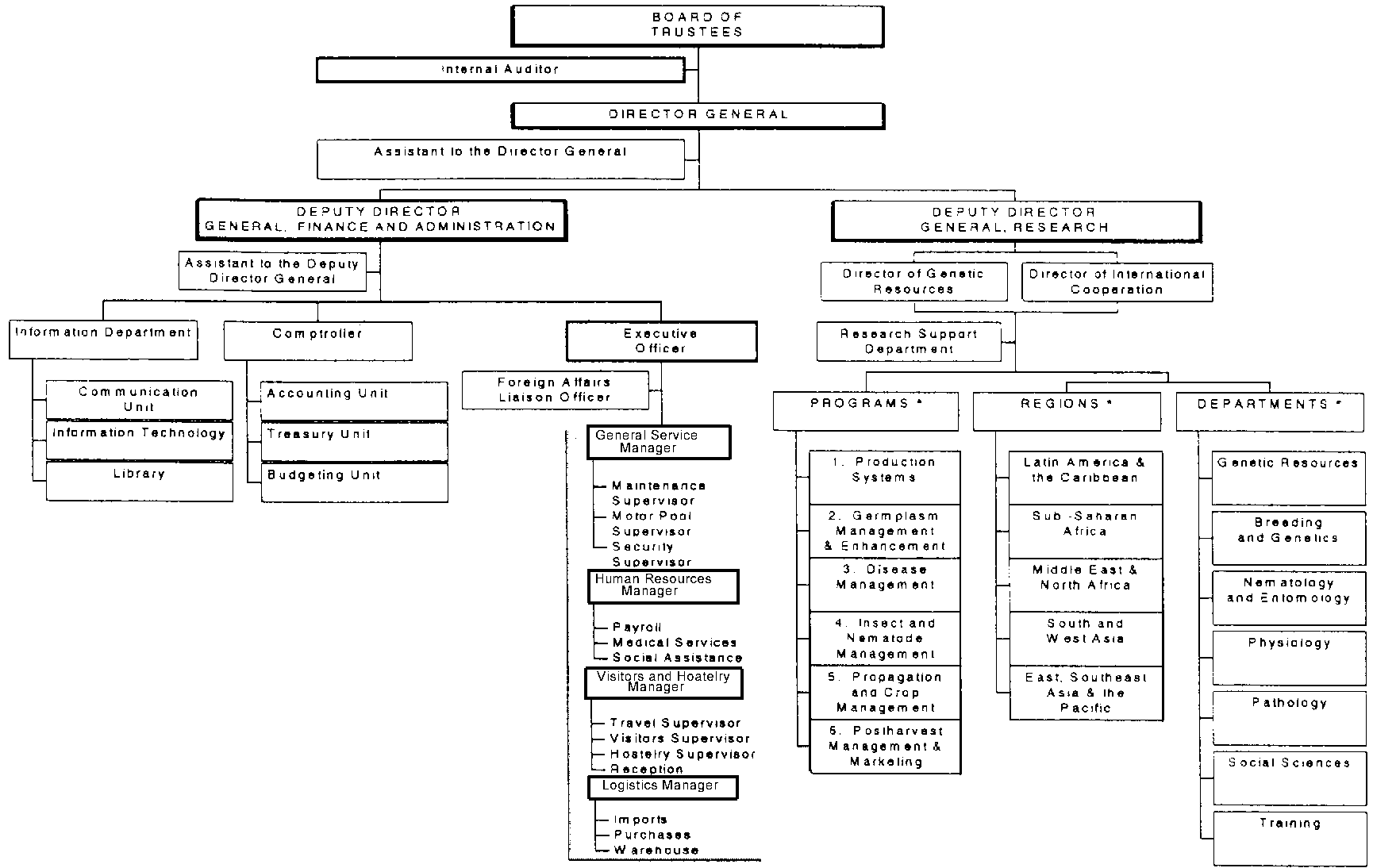
CIP's management structure is portrayed in the organizational chart in Fig. 1.2. The two operational divisions of CIP (Finance and Administration, and Research), are headed by Deputy Directors General. The three new managerial functions created since the 1989 External Review are:
· Secretary to the Board, (performed by the Deputy Director General, Finance and Administration);· Director of International Cooperation (a re-assignment made possible through reducing regions);
· Director of Genetic Resources (appointee arrives March 1995).
Table 1.1 - CIP Trustees' Terms of Office, 1990-94 (as at 31 December 1994)
|
Name |
Nationality |
1990 |
1991 |
1992 |
1993 |
1994 |
|
Bateman, D. |
USA |
|
x |
x |
x |
x |
|
Brandolini, A.* |
Italy |
x |
x |
x |
|
|
|
Call, D. |
USA |
xC |
xC(a) |
|
|
|
|
Cerrate, A.** |
Peru |
|
|
x |
x |
x |
|
Chadha, K.L. |
India |
x |
x |
x |
x |
x |
|
Innes, L. |
UK |
xSN |
x |
xC |
xC |
xC |
|
Kajiwara, T. |
Japan |
x |
x |
x |
x |
x |
|
Mensah, M. |
Benin |
|
|
|
|
x |
|
Muturi, S. |
Kenya |
x |
x |
x |
x |
|
|
Pacora, L.** |
Peru |
x |
x |
|
|
|
|
Raven, K.** |
Peru |
x |
x |
x |
xVC |
x |
|
Sastrapradja, S.* |
Indonesia |
x |
x |
x |
xP |
xP |
|
Sawyer, R.L. (Dir. Gen.) |
USA |
x |
|
|
|
|
|
Schilde, L.* |
Germany |
|
|
|
x |
x |
|
Shen, J. |
China |
x |
x |
x |
|
|
|
ter Kuile, M. |
Canada |
|
|
|
x |
xVC |
|
Winiger, F. |
Switzerland |
x |
x |
x |
x |
x |
|
Zandstra, H. (Dir. Gen.) |
Canada |
|
x |
x |
x |
x |
|
|
|
12 |
13 |
12 |
12 |
12 |
|
* |
CGIAR Nominated |
|
** |
Host Country Nominated |
|
C |
Board Chairperson |
|
VC |
Board Vice Chairperson (also Chair, Nominating and Audit Committees) |
|
P |
Chairperson, Programme Committee |
|
N |
Chairperson, Nominating Committee |
|
S |
Secretary |
|
(a) |
Term of Chairperson extended one year |
INTERNATIONAL POTATO CENTER ORGANIZATIONAL CHART
The three research dimensions (Programmes, Regions and Departments) operate in a matrix mode for execution of CIP's research programmes (see Section 3.3). While staff are grouped for operational purposes in disciplinary departments, the axis for programmes carries the authority for resources along with the accountability for meeting programme objectives.
To operationalize the matrix concept, CIP has adopted a project-based budgeting and control system underpinned by a fit-for-purpose financial management information system (CIPFIS). The system is now fully operational at the Centre and is being progressively installed in the Regional Offices.
CIP's Headquarters is located in Lima, Peru, with field stations in Huancayo, San Ramon and Cajamarca. The Centre operates in a highly decentralized mode with Regional Offices in Indonesia, India, Kenya and Tunisia. The Regional Office for Latin America and the Caribbean operates out of the headquarters in Lima. Additionally, the Centre operates liaison offices in China, Ecuador, Egypt, Nigeria and the Philippines.
CIP's personnel in 1994 was composed of 34 internationally recruited staff supported by 433 nationally recruited staff at Headquarters, with 27 internationally recruited staff outposted in the regions supported by some 100 locally recruited staff. Internationally recruited staff include researchers, trainers, administrators, etc.
CIP's budget in 1994 was some US$ 17 million for core activities and US$ 5 million for complementary projects2.
2 This reflects a reclassification of funding in 1994. On a basis consistent with prior years the core portion would have been US$ 15 million, and the non-core US$ 7 million.
1.4.1 Vision and Strategy
1.4.2 Research Programmes
1.4.3 CIP and its Partners
The strategic plan entitled "Strategy for the 1990's and Beyond" (hereinafter called Strategy) formed the basis for CIP's Medium-Term Proposal (MTP) for the period 1994-1998. The formulation, content, direction, progress and/or achievements on these proposals are key components of this review. While the Centre's vision was not made explicit in the Strategy, the foreword to the MTP stated that "CIP's research will continue to be characterized by the effort to promote well-being for the widest possible range of producers and consumers. The goal of making valuable, low-cost roots and tubers a viable alternative within diverse production systems will, as in the past, be balanced by the concern for developing technologies - such as biological control - that will also contribute to preserving and enhancing our fragile resource base". The Panel took this to be CIP's Vision as of 1991.
The strategic plan was a response to the 1989 External Review recommendation for a clearly articulated strategic plan. The plan also incorporates the External Review's recommendations concerning CIP's organization and management process and takes into account changes envisaged in the scientific and institutional environment.
The MTP (Sept. 1992), based on the Strategy, and in response to the 1989 External Review, consolidated CIP's total core research into six programme thrusts, down from ten in the previous programming period. This consolidation was also a response to the 1989 External Review's recommendation to reduce the number of thrusts (and departments) to focus programmes more sharply.
In summary, the re-cast programmes in 1994 were:
|
· Programme I: |
Production Systems; 5 projects with 31 sub-projects |
|
· Programme II: |
Germplasm Management and Enhancement; 5 projects with 35 sub-projects |
|
· Programme III: |
Disease Management; 9 projects with 54 sub-projects |
|
· Programme IV: |
Integrated Pest Management; 6 projects with 29 sub-projects |
|
· Programme V: |
Propagation and Crop Management; 7 projects with 57 sub-projects |
|
· Programme VI: |
Post-Harvest Management and Marketing; 3 projects with 40 sub-projects. |
The Strategy provided indicative guidelines for resource allocation among commodities, among regions and among programmes. Projects and sub-projects were prioritized within the programmes according to their contribution to CIP's three goals:
· to increase agricultural productivity and efficiency in order to produce more products of better quality at lower costs, to raise farmers' income and increase consumers' welfare (efficiency);· to protect the natural resource base (sustainability); and
· to improve the well-being of the poorest populations of the world more than the better-off populations (equity).
CIP's main partners are the host country, NARS, IARCs, and research institutes and universities in the industrialized world. CIP maintains excellent relations with its host country, Peru. Close working links exist with the National Agricultural Research Institute (INIA) and the Agrarian University, La Molina.
With respect to its links to NARS, CIP has maintained a policy of having a considerable proportion of its research staff in regional teams to conduct research on key constraints in strategic locations, to facilitate the transfer of technology to national research systems, and to encourage the two-way flow of information between NARS and CIP.
Since the 1989 External Review, the regional structure and operations have been extensively revised. The eight regional offices have been consolidated into five3 and the proportion of research staff (i.e. exclusive of administrators, etc.) in the regions has increased from 49% in 1989 to 63% in 1994, maintaining the earlier policy of intensive interactions in the countries (see Table 3.1).
3 Latin America and the Caribbean; Sub-Saharan Africa; Middle East and North Africa; South and West Asia; East Asia, South East Asia and the Pacific.
CIP places heavy emphasis on regional networks as cost-effective mechanisms for implementing collaborative research programmes and disseminating research results. Currently there are six networks: three in Latin America, two in South East Asia and one in East Africa.
Training and information dissemination are key elements of CIP's service portfolio, and have now been integrated into the research programmes.
CIP has good collaborative relationships with its sister centres, especially in the areas of logistics, training activities and social science research.
The above channels provide CIP with effective linkages into the global agricultural research and development continuum.