2.1 Programme Success and Impacts
2.2 Research Programme Management
2.3 Institutional Organization and Management
2.4 Funding for CIP
Under the able leadership of the current Director General, who took office in 1991, CIP has responded to the recommendations of the 1989 External Review with energy and dedication, and the Panel finds a CIP that is in many ways rejuvenated. The improvements have been brought about against a background of political upheaval in Peru and funding uncertainties in the CGIAR. The Panel has been impressed with a number of CIP's achievements since the last External Review in 1989. These include aspects related to programme success and impacts, to research programme management, to institutional organization and management, and to Centre funding which are described in the following sections.
2.1.1 Biological Control and IPM
2.1.2 Plant Virology
2.1.3 True Potato Seed
2.1.4 PROINPA
2.1.5 Training
2.1.6 Information
2.1.7 Impact Assessment of CIP Research Results
2.1.8 Awards for Research Accomplishments
CIP has made significant progress in important areas of potato and sweetpotato research since the 1989 External Review. The Panel has selected some particularly impressive examples of CIP research achievements that have had impacts for CIP's intended clients.
The Andean potato weevil and the potato tuber moth are both destructive insect pests of potato, particularly in storage of ware and seed tubers. CIP entomologists have developed safe, cost effective biological control techniques for deployment by national programmes at the village level. The technology is easily accessible and very compatible with "cottage industry" production technologies.
Concurrently, CIP developed innovative approaches for the management of sweetpotato weevil. This was done through the development of a pheromone (sex attractant) that is used to "bait" this important pest of sweetpotato. Congregated beetles are then sprayed with a fungal biological control agent (Beauveria bassiana) to kill them.
CIP's research progress in the area of biological control of pests has been considerable, and the prospects for this technology appear significant. The Panel commends CIP's efforts in developing environmentally friendly and publicly safe technologies for potato and sweetpotato pest management.
The Panel further notes that these technologies are important components of integrated pest management (IPM). These IPM components are now available to national programmes for integration with other crop protection practices.
The virus diseases of potato and sweetpotato are considered primary constraining factors limiting yield in many of CIP's client countries. Plant viruses can cause considerable crop losses and they interfere with the safe international shipment of germplasm.
The long-continuing success in plant virology at CIP is widely acknowledged. This reputation is firmly established within the scientific community, based on its science quality, and on the programme's scientific contributions, which are highly appreciated by national programmes as relevant research.
The virology programme is perhaps best known for its "tool kits" that each year evaluate, through ELISA serology and DNA hybridization assays, a total of more than 180,000 potato tissue samples. This is a research service provided to CIP's extended research community. This remarkable technology is particularly well suited to CIP's regionally distributed research activities. The kits use the latest technologies to accelerate research by accurately identifying healthy plant material.
CIP's virology research is particularly well known for using innovation to keep abreast of emerging technologies. CIP's scientists are currently working on a non-radioactive assay process to replace the current radioactive NASH (Nucleic Acid Spot Hybridization test) kits. With the new kits, researchers will be able to do their own on-site assays of their sampled plant material.
The virology programme has supported the important CIP germplasm distribution facilities in the Philippines and in Kenya. The programme has also diffused its technologies throughout CIP's extended research community through education and training.
In the Panel's analysis, the reasons for the programme's success are strong leadership, excellent science quality, and a research group that is truly integrated and collaborative. The Panel commends the successes of the plant virology at CIP.
CIP has pioneered the strategy of using botanical seed of potato as an alternative to solve many of the problems of the more conventional planting of "seed" tubers. This technology, called True Potato Seed or TPS, has been developed by CIP and has been tested in a number of countries. TPS has demonstrated considerable feasibility and commercial potential.
The advantages of using TPS arise from the problem that propagation of potatoes by "seed" tubers has an enormous capacity to transmit plant pathogens, nematodes, insects pests, and other biotic agents that can be harmful to potato plants and crop yields. True potato seed is relatively clean, although not entirely free from some plant pathogens.
CIP's technology has "domesticated" true potato seed, and researchers have also found ways of producing a crop of TPS potatoes. Although TPS requires a somewhat elevated level of technical capacity, its technology does permit the growing of potatoes in regions in which, for economic or for phytopathological reasons, it would otherwise not be possible.
CIP has conducted a largely ex ante impact analysis of TPS in India, and shared this with the Panel. CIP asserts that there is a clear need for continued genetic enhancement of TPS parents, but acknowledges that TPS production technology "has been pretty much worked out". CIP has worked with 13 countries, 4 of which are now capable of producing TPS on their own. CIP has worked "downstream" to provide services to NARS in attempts to overcome technological barriers to the adoption of TPS in areas such as consumer acceptance. The Panel acknowledges that CIP has proven this concept beyond doubt, even though more research remains to be done.
CIP operates a project in Bolivia called PROINPA - Programa de Investigación de la Papa. This Swiss-funded activity is designed to build national capacity in potato research and provide CIP with a future partner. Many of the activities of PROINPA are very applied and some are, by design, training programmes for Bolivian scientists.
The Panel has concluded that PROINPA has been successful in a large part because of the valuable leadership provided by the Co-Directors and considerable "buy-in" by the Bolivian Government. PROINPA staff exhibit an "esprit de corps" and an obvious commitment to the purposes of the project. A critical factor in CIP's leadership success appears to be a consequence of the unique (and very successful) personnel management style of CIP's Co-Director, who shares management decision-making with his counterpart and deflects credit for success to his Bolivian colleagues. This self-effacing approach appears to have significantly contributed to the positive attitudes of the participating Bolivian scientists.
The Panel commends CIP's participation in PROINPA. This programme is clearly putting the Bolivian potato programme in a position to take advantage of a stronger research partnership with CIP.
During the past five years, CIP, in collaboration with other national and international institutions, has trained more than 4,000 researchers, extensionists, educators, and agribusiness specialists. This brings the total number of people from developing countries that have participated in CIP's training programme over the past two decades to more than 10,000. These trainees form a global network for the exchange of knowledge, methodologies, and germplasm. Up to 1991, 60% of CIP's training was in the form of production courses; the rest were specialized courses. Past annual figures include some 70 undergraduates and 20-30 graduate students, and between 400 and 700 participants in group training.
CIP's training strategy for the nineties is characterized by integration with the research programme, and an increase in specialized courses to 80%, because much of the time-consuming production training can now be carried out by national programmes and networks, which CIP has been encouraging. To achieve greater focus and cost-effectiveness, CIP's training efforts are now distributed among research areas according to priority, CIP's special advantage, and national programme needs and capabilities. Priorities are now aligned directly with research priorities, and the Training Department operates a five-year rolling plan based on an analysis of needs in each research programme and national research and training needs. The current budget for training is US$ 420,000, of which US$ 320,000 is in core, with one International Senior Scientist. In addition, several research staff at Headquarters and in the regions allocate 10-20% of their time to training activities.
CIP has introduced a variety of programmed learning procedures that are made available through the widespread use of computers and video facilities. CIP is also promoting the use of techniques such as computer-assisted instruction and simulations through a pilot distance-training approach. Simultaneously, CIP has increased its specialized training activities, for which there is a growing demand, particularly in the areas of molecular biology methods and transformation techniques in germplasm enhancement and breeding, specialized seed and molecular virology, and IPM. For these specialized training activities, CIP is making particular use of workshop-based approaches backed by electronic methods for transferring information and follow-up communication.
The Panel commends CIP for its forward-looking training strategy that responds to the changing circumstances in national programmes, and to the decreasing allocation of resources to training activities in the CGIAR System. The Panel is particularly pleased to note the significant transfer of resources away from in-country training toward regional and international courses. CIP is now well placed to shift its emphasis in the future from the current institution building objective, through training, to institution strengthening through research collaboration.
The Information Department at CIP has continued to maintain the high quality of its activities through its Communication Unit, Information Technology Unit, and the Library, with expenditures of US$ 700,000 - US$ 800,000 (3 Senior Staff Positions) in 1993 and 1994. CIP has undergone major changes in the area of information technology. Notable changes include the move from a monolithic, centralized system involving two DEC VAXes to a decentralized, flexible system involving 180 PCs and five servers; installation of electronic mail; and the adoption of modern information management. The Panel agrees with CIP's sentiments that these changes offer significant efficiency gains.
CIP's Library continues to have a useful collection of potato and sweetpotato literature, with particular reference to developing countries, and databases with bibliographic references and search facilities are now available on-line and on diskettes. The Library is extensively used by national programmes, who generally have a good opinion of CIP's information services (Appendix IV).
The 1989 External Review recommended that CIP "management consider the organization of an information planning conference, similar to the type it uses for its priority research areas". This recommendation received a low priority from management in the light of competing demands for funding. However, through an internal review process, CIP has formulated proposals for a revised information strategy that envisages future information activities at CIP to be segmented by "customer need". These will be coordinated, using efficiently designed information packages in the form of database services, publications and bulletin boards. CIP plans to combine printed and electronic products and diverse means of delivery, and to emphasise on-line access for major databases and other tools. This should allow CIP to seek further efficiencies and reorganize some of its information activities to facilitate greater inter-centre collaboration.
The Panel commends CIP for its positive response to the recommendation to find ways to increase efficiency in the vital supporting role that information has in CIP's delivery mechanisms. The Panel is pleased to note that CIP is aiming to take greater advantage of the opportunities created by advances in information technology.
The 1989 External Review strongly recommended that CIP focus on achieving impact in farmers' fields and documenting it. It also stressed the need for a comprehensive ex ante analysis of the status of the mandated crops in the different regions as an essential input into a strategic plan and a focused medium-term plan. CIP was also advised to incorporate the lessons of the ex post case studies into the research planning process.
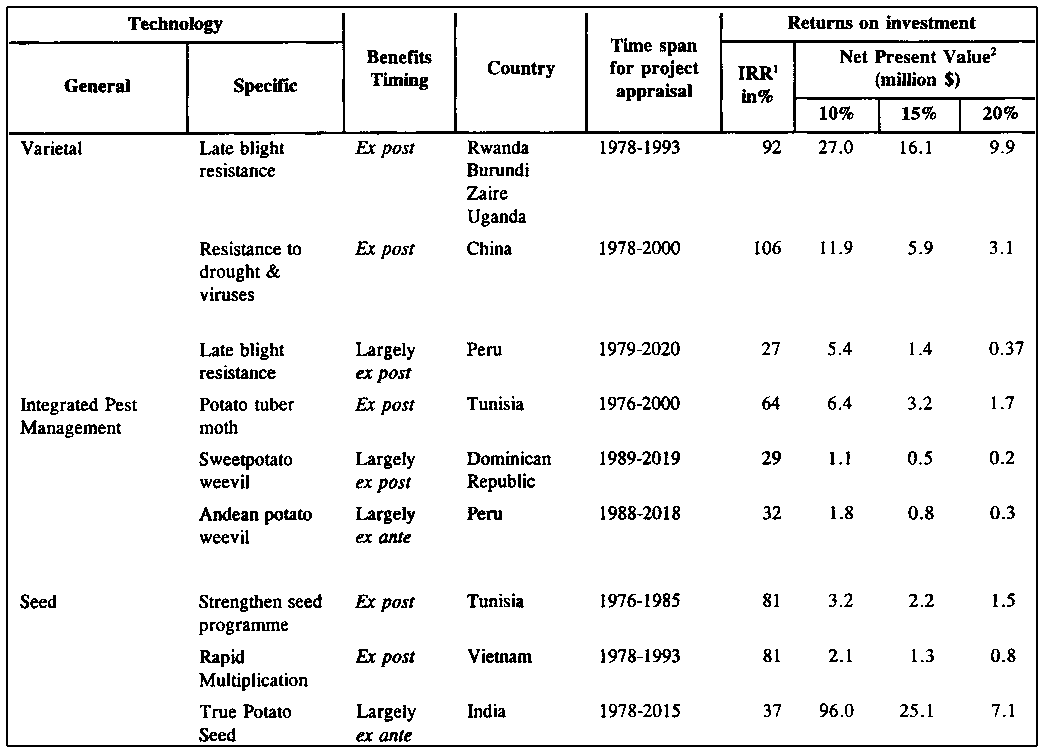
CIP has responded with an increased "impact assessment culture", which led to a series of activities and projects (in close collaboration with NARS) to be able to document impact in the field. CIP should be commended for having undertaken a series of nine case studies documenting field level impact (mainly ex post) and related to varietal improvement, integrated pest management and seed programmes4. A summary of the conclusions of the nine case studies is given in Table 2.1 which shows very favourable internal rates of return (ranging from 27% to 106%) on marginal investments in these selected, successful cases (see Section 3.6 for Panel's further views on impact assessment).
4 CIP 1995: Case Studies of the Economic Impact of CIP-Related Technologies, First Draft, January 1995.
At the same time, CIP implemented a priority setting exercise with the help of ISNAR, which involved a relatively subjective ex ante assessment of potential impact5. The Panel sees these activities as positive steps in the direction requested by the 1989 External Review.
5 Collion, M.H. and P. Gregory 1993: Priority Setting at CIP. An Indicative Framework for Resource Allocation. CIP-ISNAR.
Table 2.1 - Impact Case Studies
Source: CIP, 1995. Case Studies of the Economic Impact of CIP-Related Technologies, First Draft, January 1995, p.3.
Since the last External Review, CIP and its scientists have received a number of awards in recognition of their contributions to research and related activities. The most notable of these was the King Baudouin Award to CIP in 1992, which acknowledged innovative research in integrated pest management, and the creation of a hybrid potato population (the "hairy" potato) with resistance to a range of insect pests.
In 1993, the Vietnam Order of Friendship was conferred on CIP for its positive contributions over the past two decades to the National Programme for Food Crops Research. This award recognized CIP's collaboration with Vietnam in rapid multiplication and distribution of planting material of both potato and sweetpotato, the introduction of varieties, and training of Vietnamese scientists.
A number of CIP scientists have received recognitions in different parts of the world for their outstanding work on: germplasm collection; the development and diffusion of rapid multiplication techniques; true potato seed; biological control; and marketing.
The Panel commends the Centre for the work that has won CIP and its scientists these national and international tributes. The Panel is particularly pleased to note that the Centre has recently recognized the scientific contributions of one of its scientists by distinguishing him as CIP's first Principal Scientist.
2.2.1 Formal Priority Setting Process
2.2.2 Project-budgeting
2.2.3 Use of Contract Research
The Panel considered that achievements in three aspects related to research programme management need to be noted. These are the: priority setting process; introduction of project-based funding; and use of contract research.
Since the 1989 External Review, CIP has adopted a systematic method of priority setting as an aid to deciding on the ranking of a limited number of research projects to be included in the six main Programmes. A group with wide participation of senior scientists and leading local staff was established with the authority to reach decisions on the weighted balance of criteria reflecting the main objectives of efficiency, environmental impact, equity (and scientific validity, implied).
CIP is to be commended for introducing such a formal process that can help a diverse group reach decisions on multivalued options. In the future, with more experience and information, the weights may be revised and alternative criteria selected, but the intellectual discipline of the procedure should continue to be of lasting value. Together with the project-budgeting system, it has given the research programme a welcome clarity and transparency.
CIP not only has applied a formal priority setting process for deciding on research projects, but also has taken steps to allocate specific budgets to each sub-project. This has the profound advantage of linking the budget components to essential, targeted elements of the research programme. With this basis, rapid accounting is facilitated, the aggregated budgets for main programmes can be easily computed to compare with broad plans, and expenditures can be readily monitored. The process also assured that all research allocations were essentially assigned at one time, in line with agreed priorities and needs, rather than ad hoc.
The Panel commends CIP for the introduction of project-budgeting down to the level of sub-projects. It has introduced a new clarity into the understanding of the quantitative side of the research programme, and enabled the individual scientist responsible for a sub-project to have a clearer and independent picture of the resources available, and to plan accordingly within the scientist's area of work. The Regional Offices find this development particularly encouraging. The computerization of the process makes it possible for all staff to keep reasonably up-to-date records on resource balances of their research projects.
CIP pioneered the use of contracts with leading research laboratories in developed countries to enable key experimental work to be carried out on behalf of CIP for the final benefit of CIP's developing country clients. Not only did this provide information rapidly in a cost-effective manner, but it also kept CIP scientists up-to-date with the development of the latest sophisticated scientific methodologies. The Panel was pleased to find that this valuable pattern of activity was still being followed vigorously and that contracts were also being awarded to strong NARS in developing countries such as Argentina, China, India and Brazil, in addition to traditional partners in USA and Europe. There were a total of 68 ongoing research contracts in 1994. CIP's direct contribution to the cost of these contracts was US$ 238,000.
The full benefit of flexible funds from unrestricted core is shown in contracted research. However, CIP support can also be instrumental in having donor funds released to partner institutions for particular research projects, as for example in the case of ODA "holdback" funds to a joint project of CIP and the Scottish Crops Research Institute.
2.3.1 Governance and Management
2.3.2 Transition Through a Violent Period in Peru
2.3.3 Downsizing
2.3.4 Efficiency Enhancements
2.3.5 Positive Responses to the 1989 External Review
In the area of Board operations (self-management), such as preparation of materials for the Board meeting, etc., CIP management and the Board have complied with many of the recommendations in the 1989 External Review. CIP management satisfies the Board's logistical and documentation requirements (the latter including record and minute keeping) with high quality work, and a Board manual has been prepared. Agenda setting is efficient. The DG issues a quarterly newsletter which provides a wide range of information on programme developments, funding status, visitors, etc.
The Board Chair is highly praised by Trustees for his style of operation, and the extent to which an effective working relationship exists between him and the DG. Members stated in a survey that they felt involved and interested in the deliberations regarding CIP. A process now exists, and is used, for self-evaluation of Trustees and for evaluation of the DG.
CIP's Board has been re-organised in a manner that should facilitate greater in-depth oversight of CIP policies and macro-governance issues. Whereas, prior to the last Review, the Board "depended heavily" on the Director General, particularly in the areas of finance, administration and strategic planning, the current Board committee structure - Executive, Programme, Audit and Nominations - gives the Board the opportunity to interact with the Director General and his management team more effectively. The creation of the function of a secretary to the Board, with the task of providing relevant and timely information to Trustees, should facilitate effective discharge of their responsibilities.
The Panel saw considerable evidence that the current Director General has created a culture of collegiality, used appropriate delegation of authority, introduced consultative processes, and encouraged bottom-up flows of ideas. All CIP staff met by the Panel during this review process were appreciative of this change.
The pace at which these changes have been made, particularly in a period of political and financial turbulence - which must surely have preoccupied the Director General and the Board Chair - is also worthy of commendation.
During the period covered by this Review, CIP had to operate under particularly difficult security conditions in Peru, as the terrorist organization, Shining Path, escalated its violence in the Sierra initially and later also in Lima. The murder of one of the security guards of the Huancayo research station in December 1988 led to a substantial reduction of activities in the Huancayo and San Ramon stations.
The crisis peaked in 1991, when bomb attacks in Lima were frequent. CIP had to allocate substantial time and funds to manage the situation by investing heavily in security services, and developing an intelligence network and contingency plans for staff evacuation. Some international staff were redeployed to institutions outside Peru, and germplasm collections were moved to Cajamarca in Peru and to Quito in Ecuador. Quito was envisaged as an alternative site for CIP in case it might become necessary to close the Lima operation. The Panel assumes that these actions and other measures, such as the need to undergo security training, curtailment of germplasm duplication and collection activities, evacuation of staff, and difficulties with communication, must have affected productivity.
Delicate management of these factors allowed CIP to largely retain its operating capacity and to rapidly resume field work in Peru as conditions improved from 1993 onward. In this way, a major loss of investment, particularly in the human capital represented by the skills of the team of local staff, could be avoided. CIP management deserves to be credited with this success. The Panel is pleased to note that the working environment in Peru is now normal.
Three convergent forces, the CGIAR System funding constraints, spiralling local inflation (not balanced by devaluation of the Peruvian currency) and high security costs in the turbulent period, meant that a radical review of costs and staffing became imperative. Commencing in early 1992, CIP undertook an array of internal reviews covering all departments. The Panel learned that the guiding principles for downsizing were:
· "humaneness" in the process;· preservation of priority areas;
· functionality in the downsized units; and
· close coordination with the Ministry of Labour with respect to redundancy terms for national staff.
The process generated cost-effective ways to perform existing tasks, innovative approaches to contracts, removal of avenues for wasteful expenditure and the intelligent use of "smart" systems (information processing, surveillance, alarms and automatic shut-down devices).
The Panel believes that:
· the communication with all staff on the need to downsize;
· the sensitivity in handling redundancies;
· the use of natural attrition; and
· the timing of key events and encouragement given to ideas for innovative action.
all contributed to the commendable bottom-line results achieved. Between December 1991 and December 1994, CIP made an 18% reduction in Peru-based nationally recruited staff (from 526 to 433), eliminated overtime payments equivalent to 45 nationally recruited person-years per year, and reduced the internationally recruited staff by 31% (from 88 to 61). Other innovative measures (reduced insurance costs, etc.) provided net savings of some US$ 1 million in CIP's annual operating costs.
Despite the "humaneness" of the actions taken, morale, particularly of nationally recruited staff, was bound to have been affected. To gauge the extent of this expectation, CIP undertook an attitude survey among the staff and, indeed, identified several areas where action was needed if morale, motivation and confidence in CIP's future, were to be restored. CIP is also to be commended for this follow-up initiative.
In terms of purely process innovations, CIP management has developed procedures and the necessary manuals for specifying levels of authorization and administrative/financial authority within the Centre. In addition, the Centre's internal committee structure has been simplified and the number of different specialized committees has been significantly reduced and rationalized. Management deserves credit for investing the time and effort in improving such processes, especially when there were many pressing issues and problems of a substantive nature to solve.
The changes in organization, such as the rationalization of programme thrusts and regional coverage, are noted elsewhere. Changes also included a recombination of several administrative departments into a smaller, more tightly focused management unit in Lima. Staff numbers have been reduced, partly through enhancements in technology (databases, more widespread use of personal computers, etc.). Some technical services have been contracted out (such as computer repair and even some software development), allowing CIP to purchase relatively high-cost services only when needed. Prior to this decision, all such personnel were employed directly. Through tighter management of human resources and better scheduling, CIP has virtually eliminated the need for staff overtime.
Systems improvements include the adoption of a financial management information system, with a large pay-off in efficiency. The system has proven to be extremely user-friendly, and is used not only by specialists in the Centre, but by all budget managers, at all levels. CIP has adopted computer networking, and the use of electronic mail is widespread with real savings in supplies, staff (messenger positions have all been eliminated, for example), and postage/telefax costs.
CIP is justifiably proud of its efficiency achievements, and continues to seek ways to tighten up its operations even further. This is not only to save resources and redeploy them for direct support of programmes, but because it has shown that many things can be done better as well as more economically if the right investments are made in selected technologies or organizational changes.
The 1989 External Review of CIP made 42 recommendations, of which 20 were on programme, 17 on management, and 5 on research organization and management. They were endorsed by TAC and the CGIAR. In broad terms, there were 5 recommendations on Board and governance issues; 16 on various aspects of management; 8 on planning; 5 on potato germplasm and improvement; and 8 on sweetpotato germplasm and improvement. The Panel considers that taken together, the recommendations were far-reaching and demanding.
CIP, to the full credit of its management and Board, endorsed the body of the recommendations received and has attempted to implement them with vigour and commitment. Although the results of the change process are not yet fully realized, much has been achieved via the positive responses, and good-faith efforts of all staff which are clearly visible. The Panel has been impressed with the progress achieved and considers that CIP has benefited significantly as a result. Management and the Board deserve full credit for setting in motion the institutional transformation of CIP.
CIP's actions in response to the recommendations are tabulated in Appendix VI, together with this Panel's remarks and implementation scores. According to the assessment by the Panel, CIP has implemented 24 recommendations in full, and 18 partially. Overall, the Panel believes that CIP has taken positive, though sometimes incomplete, actions on most of the main recommendations. The Panel comments on CIP's actions in the appropriate sections of this Report.
The Panel also evaluated, with CIP's assistance, the Centre's progress in attaining milestones set out in CIP's 1994-1998 Medium-Term Plan. Based on information provided to the Panel, and confirmed through other sources, CIP has made commendable progress, particularly in the areas of: training documents; information systems; the detection of, and resistance to, potato viruses; documentation of the impact of CIP technologies; and germplasm management. Some planned milestones were identified as not yet attained or no longer on the CIP agenda for specified reasons (e.g. no funds to initiate the activity).
The first half of the 1990's has been difficult financially in the CGIAR. Funding for core programmes of most centres declined. While CGIAR funding increased, so did the number of centres. In an increasingly constrained environment, CIP has done a remarkable job of maintaining a stable and well-diversified funding base, and a consistent level of support in current dollars. (In real terms, funding has declined in value over the period.) CIP's total 1990-94 funding, that is, core plus complementary or special projects, was approximately US$ 105 million distributed quite evenly throughout the period. Table 2.2 summarizes CIP's funding.
Taking into account the 1994 reclassification of complementary funding, CIP's core support as a percentage of its total, and its unrestricted funding as a percentage of overall core, compares favourably with that of many CGIAR Centres.
Funding for core programmes has decreased as a percentage of the total - even in 1994 after the reclassification exercise - relative to the 1990 level. Similarly, the unrestricted share of funding also declined slightly. This means that while CIP's funding has increased overall, it is due to the growth of project grants (in a slightly higher proportion for non-core activity than for core). The CIP strategy of seeking funding from many donors may explain why the Centre has been able to maintain at least a constant funding flow. Evidence of this diversification is the fact that CIP received an estimated 45% of its core funding from its largest five supporters (out of a total of 24), whereas the CGIAR overall received 56%6. The Panel believes this diversity of donors is a healthy indicator of broad support, and the Panel commends CIP management for nurturing such a diversified base.
6 Sources: CIP estimate and 1995 Funding Requirements of the CGIAR and Tentative Financing Plan, CGIAR Secretariat.
In addition to CIP's research programme portfolio that donors value, factors contributing to ensuring solid donor support include CIP's imaginative public awareness activity and effective fund raising. Combined, these activities have helped to both, protect CIP's critically important unrestricted core funding base and secure a steady stream of project/programme grants for a wide range of research and training activities, in many locations.
Table 2.2 - CIP Funding, 1990-94 (current $ million and %)
|
|
1990 |
1991 |
1992 |
1993 |
1994 |
|
CIP Core funding |
16.8 |
16.2 |
15.3 |
14.7 |
17.1 * |
|
Annual Change |
|
-3.4% |
-5.6% |
-3.7% |
15.9% |
|
|
|
1994 as % 1990: |
101.8% |
||
|
CIP Complementary funding |
4.3 |
4.1 |
5.6 |
5.9 |
5.1 |
|
Annual change |
|
-5.1% |
38.8% |
5.0% |
-13.1% |
|
|
|
1994 as % 1990: |
118.6% |
||
|
CIP total funding |
21.1 |
20.3 |
20.9 |
20.7 |
22.2 |
|
Annual change |
|
-3.8% |
3.3% |
-1.3% |
7.6% |
|
|
|
1994 as % 1990: |
105.2% |
||
|
Core funding as % of total |
80% |
80% |
73% |
71% |
77% |
|
Unrestricted funding % of core |
80% |
86% |
89% |
83% |
78% |
|
Unrestricted funding % of total |
64% |
68% |
65% |
59% |
60% |
Source: CIP financial statements for 1990-1993. Numbers may not sum up due to computer rounding.The 1994 data are based on unaudited figures provided by CIP management at the time of the main phase of the review. CIP's core funding for 1994 includes US$ 2 million which was redirected from the complementary programme, in the context of the CGIAR "re-engineering" exercise which started in 1994. It excludes a one-time grant of US$ 0.8 million, which was made available to the Centre strictly for the purposes of re-building CIP's cash reserve, which was depleted during the years of high inflation in Peru.
The Panel believes that CIP's investment in a public awareness programme has paid off, for both the Centre and the CGIAR overall - the latter point meriting special commendation. For the Centre, the public awareness activity has also been combined with fundraising that has generated positive results. For the CGIAR System, CIP's public awareness effort has added a significant volume of valuable material suitable for broad distribution, and made an overall contribution to the reputation of the CGIAR as a generator of technology and positive results generally.
Because CIP has a demonstrated ability to attract support for its wide-ranging programme, the Panel is confident that in the future, core programmes may be even more strongly funded. It would be desirable if complementary donors could direct more of their present support to the highest priority activities of the Centre. For example, Section 3.10 describes an important activity which requires additional financial support.