NORAD/UNDP/FAO PROGRAMME
Reports on Surveys with R/V Dr. Fridtjof Nansen
Institute of Marine Research, Bergen
|
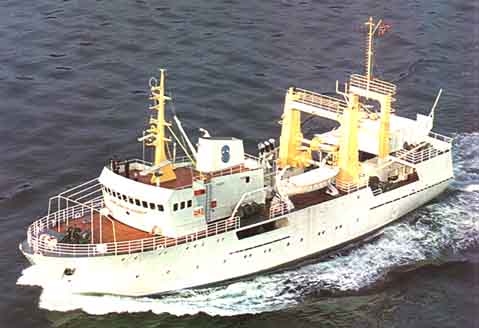
«Dr. Fridtjof Nansen» The fishery research vessel «Dr. Fridtjof Nansen» belongs to the Norwegian Agency for Development Cooperation (NORAD). It was designed and built for scientific and exploratory investigations of fishery resources of developing countries, under a joint plan with the Fisheries Department of FAO. A list of the vessels operational assignment from 1975 to 1987 is shown on the back cover. The Institute of Marine Research, Bergen is under a subcontract with NORAD responsible for the operation of the vessel, and the various research programmes were planned and conducted jointly with FAO and the relevant fisheries research organizations in the countries concerned. Results of the previous surveys have been presented in a
number of cruise and progress reports under each programme. |
This electronic document has been scanned using optical character recognition (OCR) software and careful manual recorrection. Even if the quality of digitalisation is high, the FAO declines all responsibility for any discrepancies that may exist between the present document and its original printed version.
1.1 Programme background
1.2 Investigational effort
1.3 Methods of investigations
CHAPTER 3. THE COMPOSITION, DISTRIBUTION AND ABUNDANCE OF THE FISH RESOURCES.
3.1 Introduction
3.2 Small pelagic fish
3.3 Trigger fish
3.4 Demersal fish
3.5 Assemblages of demersal fish
4.1 Review and discussion of biomass estimates
4.2 Estimate of resource potentials
Annex 1. Course tracks with fishing- and hydrographic stations.
N. STAT. (TRAIT.) ANNEE: 124-159
FISHING STATION NO. 305-330
FISHING STATION NO. 331-361
FISHING STATION NO. 529-573
FISHING STATION NO. 711-743
Annex 3. Catch data by species with reference to fishing stations.
Annex 4. Processed length data by species and samples.
Annex 5. Length frequency distributions by species and samples.
Annex 6. Pooled length frequency diagrams by species and surveys.