


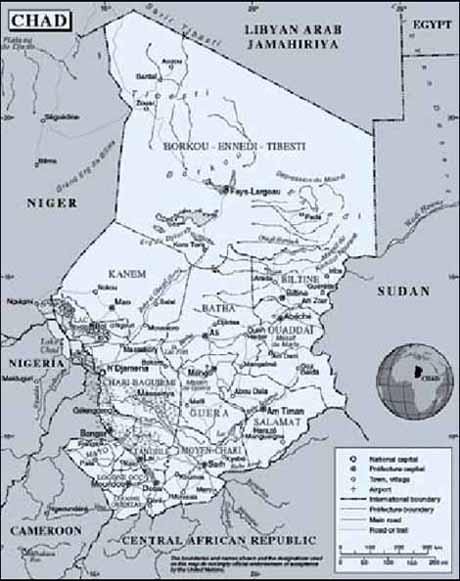
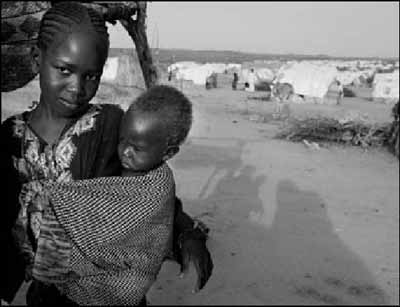
In mid-October 2004, UN agencies and NGOs had registered 186 335 Sudanese refugees, divided between 11 camps on Chad territory and it was estimated that at least 20 000 more were unaccounted for, as well as another 30 000 refugees from the Central African Republic in the southern parts of the country. In September 2004, UNHCR predicted that a new wave of around 100 000 refugees will arrive from the Darfur region in Sudan over the next seven months (IRIN, 2004). This influx of refugees is putting a lot of stress on a geographically isolated country, with a harsh, erratic climate and a history of chronic political instability.
About 80 percent of Chad’s population survives on agriculture - subsistence farming, fishing and herding livestock. Livelihoods are regularly threatened by climatic disturbances and natural disasters. Chad has not suffered major food crises in recent years and has recently experienced increased foreign investment, mainly due to development of its oil industry. However, oil revenues are expected to be invested in the country’s extremely poor communication infrastructure, health and education. Such revenues could also be absorbed by the constant threat of civil unrest: a military coup was aborted on 16 May 2004, ethnic rivalries are endemic in certain areas of the country and conflict is spilling in from some of the six nations bordering Chad. The Sudanese border is particularly unruly, constantly suffering from incursions by the Janjaweed militia.
Needs Assessment
Sudanese refugees have arrived in Eastern Chad with their cattle, thus increasing the livestock population in the area. With more cattle, there has been an increase in the competition for pasture and a decline in the food sources for the livestock. The arrival of additional cattle has also contributed to the deterioration of the sanitary condition of the herd, a situation that may lead to an outbreak of animal disease. Livestock breeding is an important source of livelihood for both refugees and host communities. Therefore, protection of livestock is urgently needed to ensure the food safety and security of the population in the area.
While Chad in general has good ecological conditions for farming, the refugees and the most vulnerable host populations require assistance in accessing essential agricultural inputs, technical training and means of organization.
Assessing the needs of refugees and host communities and implementing agricultural and livelihood programmes require effective coordination efforts. FAO intends to establish an effective emergency coordination unit. This unit will be responsible for the provision of technical assistance to relevant government ministries on agricultural emergency and rehabilitation programmers. It will also provide information gathering, project formulation, implementation and evaluation, as well as training.
PROJECTS
(full French version available in Annex
Tchad)
FAO agricultural relief component: US$6 649 230
Livestock safeguard and small animal development
Objective
In order to prevent a livestock health crisis in Eastern Chad, urgent measures have to be taken for the protection of herds, which constitute the only economic capital for most of the refugees and the host population. To improve their food safety and livelihoods it is crucial to promote small animal development for the most vulnerable segments of the population. The project seeks to: (a) improve poultry farming by providing high quality poultry to 10 000 households; (b) to supply three ewes and a male, as well as veterinary kits to 5 000 households; and (c) reduce the pressure on the pastures by promoting fodder crops, organizing the collection and distribution of residual peanut paste (tourteaux d’arachide) as animal feed and installing of 20 pastoral wells in suitable pasture areas around refugee camps; and to treat 4.5 million animals in the zones heavily populated with livestock.
Project code: CHD-05/A01
Beneficiaries:
Total: 100 000 refugees (women and children: 85%)
100 000 vulnerable hosts
(women and children: 50%)
Implementing partners: Ministry of
Agriculture (ONDR, Délégation Régionale de
l’élevage), UNHCR, WFP, national and international NGOs (AFRICARE,
SECADEV, CARE international, OXFAM)
Project duration: January -
December 2005
Funds requested: US$2 451 000
Emergency supply of essential agricultural inputs to Sudanese refugees and host populations and reintegration of women and young people in income generating agricultural activities
Objective
Through reinforcing agricultural production capacities and promoting income generating activities, the project aims at improving food security of Sudanese refugees and host populations in Eastern Chad. During the 2005 wintering period, food crop seeds and hoes will be provided to 50 000 households. During the same period, cash crop seeds will be offered to 10 000 households, as well as hoes for the farming of inland valley wetlands. Assistance will include the drilling of a sump (forage d’un puisard), supply for the manufacture of one shadoof (water lifting device) for every owner, and the supply of market-gardening seeds, sorghum and tools to 3 000 host families for the exploitation food recession crops (0.25 hectares per household).
Moreover, women and youth groups will be organized and trained. These groups will be supplied with seeds, tools, plant disease control products (produits phytosanitaires), as well as provided with one mill per group. Vegetable shafts will be constructed (creusement de puits maraîchers) around refugee camps. In an effort to safeguard the environment and soil fertility, rational agricultural techniques and relevant training programmes will be promoted.
Project code: CHD-05/A02
Beneficiaries:
Total: 200 000 refugees (Women and children: 85%)
200 000 vulnerable hosts
(Women: 50%; Children: 20%)
Implementing partners: Ministry of
agriculture (ONDR), UNHCR, WFP, National and international NGOs (AFRICARE,
SECADEV, INTERSOS, CARE international, Première Urgence)
Project
duration: January-December 2005
Required amount: US$3 322
800
Supply of emergency essential agricultural inputs to central African refugees and host populations
Objective
Refugees and vulnerable host populations in the zones of Gore and Maro will be assisted in the reinforcement of food and market gardening production. The project will supply food crop seeds and hoes to 10 000 households (6 000 refugees and 4 000 hosts around the camps) and cash crop seeds and tools to 3 000 households (1 500 refugees and 1 500 host, mostly women and youth groups) for the farming of hollow and stream surroundings.
Project code: CHD-05/A04
Beneficiaries:
Total: 30 000 refugees, mainly women and children; 15 000 hosts amongst the most
vulnerable ones; Women: 50 per cent
Implementing partners: Ministry of
Agriculture (ONDR), UNHCR, WFP, CRT, national and international NGOs (AFRICARE,
Africa Concern, APICA BELACD)
Project duration: January - December
2005
Funds requested: US$561 255
Support to the coordination of agriculture emergency and rehabilitation operations
Objective
An emergency coordination unit will be created to promote an efficient coordination of agricultural emergency and rehabilitation programmes for refugees from Sudan and the Central African Republic within their host communities. The unit will work closely with government ministries in charge of livestock and agriculture, the environment, as well as UN agencies, relevant NGOs and farmer associations. It will provide technical assistance to the relevant government ministries on agricultural emergency and rehabilitation programs; implement, manage and follow-up emergency and rehabilitation projects; reinforce national capacities and foster local expertise that continuously will provide assessment for agriculture sector rehabilitation; inform donors on the evolution of the country’s agricultural and nutrition situation and fundraising; making available relevant and updated agricultural information to the stakeholders; and coordinate training and project formulation, implementation, follow-up and evaluation in the most vulnerable areas.
Project code: CHD-05/A03
Beneficiaries: Rural
vulnerable households
Implementing partners: Ministries of livestock
and agriculture, ONDR, Délégations régionales de
l’élevage et de l’environnement, United Nations Agencies,
national and international NGOs
Project duration: January - December
2005
Funds requested: US$314 175
