


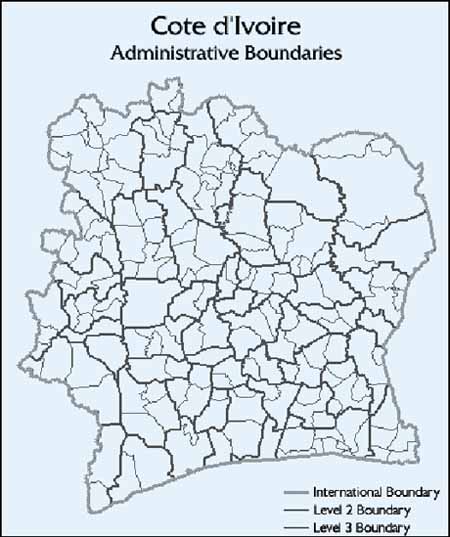
Until a coup d’état in 1999, Cote d’Ivoire was one of West Africa’s most stable and prosperous countries. About 70 percent of the population depends on agriculture, which contributes to 27.6 percent of the country’s GDP. However the sector’s growth rate is now negative and will worsen further, now when the country once again has drifted into civil war.
A slow and difficult peace process supervised by 6 240 UN peacekeepers was shattered in March 2004, when a demonstration was violently broken up in the capital. The renewed fighting will probably increase the number of the 500 000 persons who already are internally displaced, putting an extra strain on the resources of the people hosting them. There are currently few cases of food shortage and malnutrition. However, the situation is steadily worsening and in the northern parts of the country the breakdown of the health structure is enabling the spread of epidemic diseases. Furthermore, 70 000 refugees, mainly from Liberia, still reside in the country.
Needs Assessment
Since June 2003 a substantial portion of the rural population resumed farming activities in Cote d’Ivoire. Nevertheless, out of an estimated 100 000 needy households, only some 30 000 have received assistance. The rest have been of reach due to a lack of resources, late return, or insecurity in their area and they rely on the resources of relatives or assistance from a host family, who in turn are only able to cultivate a limited area of land. Additional agricultural assistance is therefore needed to aid the recovery process, boost production, and facilitate return, resettlement and reintegration.
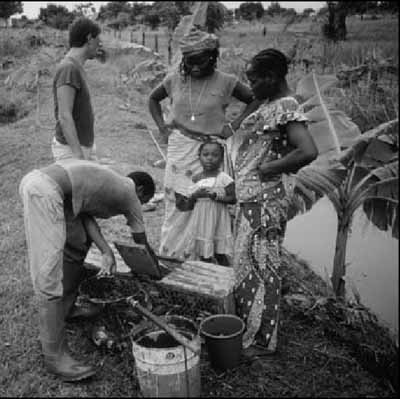
The restoration of agricultural production also requires the rebuilding of destroyed and looted private and public assets such as dwelling houses, stores, farm machinery and processing equipment. In addition, obstacles to the freedom of movement are currently preventing the trade of agricultural products and seriously affecting food security.
Furthermore, the fishing sector, which is the main income source for people living in the area surrounding Lake Kossou in the Vallée du Bandama Region, is also in need of assistance. Fishing communities have been forced to leave and their boats and fishing equipment have been looted or destroyed. Today, difficulties in accessing fishing equipment, as well as limited opportunities for fish marketing, are hampering recovery efforts in the fishing sector.
Breeding small animals used to be an important and widespread activity in rural communities of western Côte d’Ivoire. It provided a significant share of the protein consumed by the family and represented a useful source of income when necessary. However, displacement has considerably diminished livestock. In most areas, over 90 percent of the farm animals, including small ruminants or poultry, have been lost. The poor, rural population can no longer afford to eat animal protein.
In terms of humanitarian intervention, the limited quantity of available financial and human resources means that a careful coordination of operations is necessary to increase synergies and avoid duplication. Improved results could be achieved if stakeholders have access to technically sound, timely and reliable information at both national and local levels, thus facilitating the decision-making on priority areas such as the selection of beneficiaries and the availability of inputs.
PROJECTS
FAO agricultural relief component: US$2 655 000
Emergency provision of agricultural inputs to vulnerable rural households in Côte d’Ivoire
Objective
The purpose of this project is to increase the food production capacity of the vulnerable farmers, thus improving household food security and decreasing the long-term need for relief assistance. Project activities include the provision of a complete kit of essential inputs, including staple crop, pulse crop, vegetable seeds and a basic set of tools to 21 000 IDPs, returnees and vulnerable resident households.
The assistance package will allow each beneficiary farmer to cultivate one hectare, thus ensuring coverage of basic family needs. Vegetable production will improve the nutritional value of the food basket and generate income for the farmers. Priority will be given to the most vulnerable households and female-headed households with a minimum knowledge of gardening techniques.
Project code: CIV-05/A01
Beneficiaries: Total
of 21 000 vulnerable farmers, including IDPs, returnees and host population,
with priority for female-headed households
Geographical coverage: The
most vulnerable areas of western, central, and northeastern Côte
d’Ivoire
Implementing partners: Extension services of the
Ministry of Agriculture (where applicable), international and national
NGOs
Project duration: January - December 2005
Funds
requested: US$1 100 000
Emergency rehabilitation of artisan fresh water fisheries in central Côte d’Ivoire
Objective
A complete kit of essential fishing gears, fishing nets, fishing twines will be provided to 900 fisherfolk in the communities of Béoumi and Sakassou. The kit will be adapted to the different fishing techniques used by the fishermen communities. To facilitate marketing of increased catches, FAO will build capacity of fishermen communities by improving fish mongering and conservation techniques (drying and smoking). The project will therefore not only improve the nutritional status of the targeted population but also contribute to community-driven early rehabilitation programmes and to peacebuilding by facilitating the sustainable resettlement and reintegration of displaced populations.
Project code: CIV-05/A04
Targeted
beneficiaries: 900 war affected fishermen and their
families
Geographical coverage: Vallée du Bandama
Region
Implementing partners: Ministry of Livestock production and
fisheries extension services (where applicable), fisherfolk groups,
international and national NGOs
Project duration: January - August
2005
Funds requested: US$379 000
Emergency support to backyard poultry breeding in western Côte d’Ivoire
Objective
Through support to backyard poultry production household food security and the nutritional status will be improved for about 6 000 destitute rural families in returnee and internally displaced communities in western Côte d’Ivoire. As women play a key role in poultry breeding, priority will be given to women in the provision of project inputs.
One improved breed cockerel and five local breed pullets will be supplied to each beneficiary. The animals will be vaccinated, treated and pre-positioned at specified locations before distribution to beneficiaries. To increase survival rate in the initial adaptation period, a small ration of feed will also be distributed. Beneficiaries will receive training and follow-up visits from specialized staff. FAO will implement the project in close collaboration with the Ministry of Livestock Production and with NGOs operating in the agriculture sector. FAO will ensure the active participation of beneficiaries at all levels of project implementation.
Project code: CIV-05/A03
Targeted
beneficiaries: 6 000 vulnerable households, mainly women
Geographical
coverage: The most vulnerable areas of west Côte
d’Ivoire
Implementing partners: Ministry of Livestock Production,
international and national NGOs
Project duration: January - December
2005
Funds requested: US$450 000
Livelihood support to vulnerable population in war affected areas of Côte d’Ivoire
Objective
This project aims to support the rehabilitation of marketing facilities and reintroduction of simple postharvest processing equipments such as concrete drying floors, micro rice mills, maize and cassava mills, etc.
Some 20 vulnerable groups, associations and traders in war-affected villages of central and northern Côte d’Ivoire will be supported through (a) the organisation of simple food processing and marketing centres in 20 communities along a trade axis, enabling the targeted communities to better market their produce; (b) the setting-up and maintenance of basic facilities and equipment; and (c) the training of 20 female farmer associations in the operation and routine maintenance of food processing equipment as well as in small business management. While the project will provide imported materials, the communities are expected to contribute local materials and workmanship. Installation of the milling and grating equipment will occur through self-help projects.
Project code: CIV-05/A05
Targeted
beneficiaries: 20 women’s associations
Geographical coverage:
Central and northern Côte d’Ivoire
Implementing partners:
National Government extension services where applicable, community based
organisations, international and national NGOs
Project duration:
January to August 2005
Funds requested: US$326 000
Support to the coordination of agricultural emergency activities in Côte d’Ivoire
Objective
The project aims (a) to improve coordination and facilitation of agricultural relief activities for the benefit all humanitarian partners engaged in agricultural emergency and early rehabilitation assistance; and (b) to support the development of an inter-agency Early Warning, Vulnerability and Food Security information system that will make available and allow dissemination of timely and reliable information and analysis on agriculture and food security.
Beneficiary identification will be improved through better recommendations on how to support the coping mechanisms of a target population; increased effectiveness of interventions through improved planning, as well as harmonized and concerted distribution plans; relevant and well-analysed information products, including analytical reports. Regular bulletins and thematic maps will also be provided to all partners.
Project code: CIV-05/A02
Beneficiaries:
Actors engaged in the agricultural sector and donors
Geographical
coverage: Countrywide Côte d’Ivoire
Implementing
partners: WFP and all the actors in the food security sector
Project
duration: January - December 2005
Funds requested: US$400
000
