


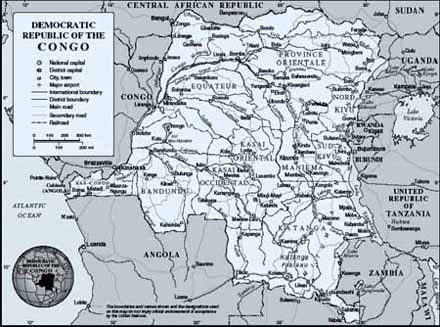
After five years of fierce civil conflict, the Democratic Republic of Congo (DRC) is slowly moving towards reunification and national elections. The country has great agricultural potential and an abundance of mineral resources, woods, lakes and rivers. Many public buildings, however, including schools and clinics, were destroyed by the fighting. The communication infrastructure in the vast country is damaged or nonexistent, thus isolating large population groups. At least 1 320 000 of children under five years of age are affected by acute malnutrition.
By mid-August 2004, some 725 000 of a total of 2.3 million IDPs had returned to their original homes. However, most the country is still very insecure. Despite deployment of UN observer forces to a number of locations throughout the country, armed groups are operating in several areas being responsible for pillaging, extra-judicial killings, rapes and kidnappings. The large number of rebel and government soldiers to be decommissioned as a result of the peace process poses a constant source of potential security concerns.
In 2004, two coup offensives were attempted in Kinshasa and in May, Bukavu was taken by rebel forces. Persisting insecurity continues to be the greatest single threat to the further development of the country.
Needs Assessment
IDPs continue to return to their original homes despite the fact that living conditions are not always suitable for their reinstallation. Displacements also continue in areas where localized conflicts persist.
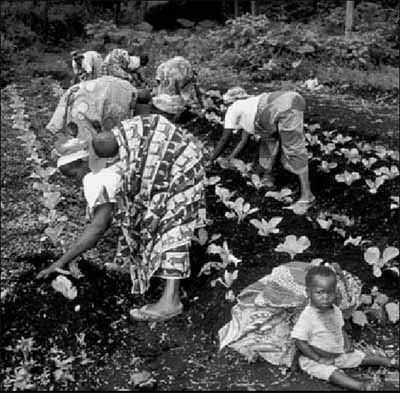
There is insufficient operational capacity to assist the enormous number of vulnerable populations living in this vast area of difficult access. Thus, monitoring the food security level of vulnerable populations and responding appropriately to their needs is a daunting exercise for humanitarian organizations.
One factor inhibiting the access of humanitarian organizations is the lack of road infrastructure, particularly in the provinces of Maniema, South-Kivu, Orientale, the two Kasais and Equateur. Nonetheless, the UN Office for the Coordination of Humanitarian Affairs (OCHA) has, with the help of its operational partners, been able to identify the most urgent needs of these isolated areas, including seeds and agricultural tools, vaccinations, potable water, fishing kits and the rehabilitation of roads and bridges to facilitate the IDPs return to remote villages.
PROJECTS
(full French version available in Annex
République Démocratique du Congo)
FAO agricultural relief component: US$12 553 200
Implementation of buffer stocks for a rapid response in support of the food production of conflict and natural disasters affected households
Objective
In areas where localized conflicts continue, FAO will support NGOs activities by supplementing the distribution of seeds and farming equipment (buffer stocks) to some 125 000 refugees, internally displaced populations and isolated families. The seeds will be adapted to the specific climate and expected to multiply for future planting. Farming is possible throughout the entire year. The need for a rapid response for these newly accessible zones requires a pre-packing of buffer stocks. The assistance will help beneficiaries resume their socio-economic activities and will diversify their diet and improve their nutrition status.
Project code: DRC-05/A06
Beneficiaries: 125
000 host, displaced, returned and isolated families
Implementing
partners: Ministry of Agriculture, UN agencies, Congolese and international
NGO’s
Project duration: January - December 2005
Funds
requested: US$1 875 000
Rehabilitation of agricultural and commercial roads
Objective
In consultation with the Pole Urgence Congo pour la sécurité alimentaire (PUC-SA), which is composed of five UN agencies and NGOs, FAO seeks to implement rehabilitation of agricultural and commercial roads. Rehabilitating roads will be fundamental in restoring rural development. When completed, the roads will connect large agricultural production zones with important consumption centers. The rehabilitation project will reinforce rural production capacities, market access and income, at the same time as it will improve humanitarian access to vulnerable groups.
Project activities include the identification of the most important roads with the cooperation of special committees and government ministries; the repair of roads by contracting local companies or NGOs; and the promotion of community participation in road maintenance.
Project code: DRC-05/A04
Beneficiaries: 40
000 isolated farming households
Implementing partners: Ministry of
Agriculture, UN agencies (WFP), local companies, international and Congolese
NGOs
Project duration: January - December 2005
Funds
requested: US$2 125 000
Agricultural rehabilitation for families with malnourished children
Objective
In partnership with WFP, UNICEF and NGOs, FAO seeks to extend assistance to families with highly malnourished children by distributing kits of agricultural inputs. This project aims to decrease the cases of relapse and to allow the families to be self-sufficient once they have left behind the emergency situation under the Centre nutritionnel de supplémentation (CNS) and the Centre nutritionnel thérapeutique (CNT). The distribution will complemented with training on agricultural techniques.
The Pole Urgence Congo pour la sécurité alimentaire (PUC-SA), composed of five UN agencies and NGOs, will be responsible for determining the priority activities for this nutrition intervention and selection of beneficiaries. FAO will implement the distribution of agricultural inputs to and for training of the beneficiary families.
FAO assistance will allow the beneficiary households to meet their food requirements during five months and to diversify their diet.
Project code: DRC-05/A05
Beneficiaries: 300
000 families with malnourished children
Implementing partners:
Ministry of Agriculture, UN agencies, international and Congolese
NGOs
Project duration: January - December 2005
Funds
requested: US$4 500 000
Support to the agricultural emergency operations coordination and strengthening of the food security information, early warning and assessment system
Objective
In partnership with the Government’s institutions, especially with the decentralized structures of agriculture and humanitarian partners, FAO will continue to support the coordination of the agricultural emergency operations and the technical support for the implementation of a monitoring system on the food security status of vulnerable groups.
The project will strengthen the institutional capacity of the Ministry of Agriculture, especially in term of emergency and rehabilitation operations at the provincial level; allow a regular targeting of food insecurity vulnerable populations; and provide timely information needed by the international community to provide quick response and appropriate assistance to food insecure population.
Project code: DRC-05/A07
Beneficiaries:
Vulnerable populations with food and nutritional risks, decentralized
institutions of the Ministry of Agriculture, national and international NGOs, UN
agencies, Government, Donors
Implementing partners: Ministry of
Agriculture, Inspections provinciales de l’agriculture, UN agencies
(UNICEF, WFP, HCR, WHO), international and Congolese NGOs
Project
duration: January - December 2005
Funds requested: US$813
200
Support of livelihood survival mechanisms through emergency supply of agricultural inputs to vulnerable families in post-conflict situation
Objective
FAO seeks to implement a new input distribution campaign which will allow the 180 000 vulnerable households in the recently accessible post-conflict zones in DRC to prepare for sustainable development initiatives and reduce malnutrition. To be sustainable, the input distribution will be supported by various training efforts. This project will provide agricultural inputs amounting to US$18 per beneficiary family.
Project code: DRC-05/A03
Beneficiaries: 180
000 families amongst the most vulnerable
Implementing partners:
Ministry of Agriculture, UN agencies, international and Congolese
NGOs
Project duration: January - December 2005
Funds
requested: US$3 240 000
