


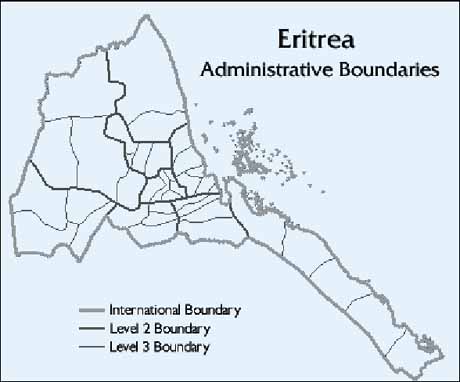
Five years after the 1998-2000 war with Ethiopia, Eritrea continues to endure its aftermath - destroyed houses, mined villages, shattered livelihoods and malnutrition. Poor seasonal rains in 2004 followed a chain of droughts over the three preceding years. Approximately 40 percent of all young Eritrean children and an estimated 41 percent of all women are chronically malnourished. Some 2.2 million out of a population of 3.8 million are unable to feed themselves. Of the 1.9 million vulnerable persons who required food aid in 2004, only 1.3 million received it. Over 70 000 internally displaced persons remain in unsustainable camps.
In summary, the vast majority of Eritrea’s agropastoralists face enormous difficulties in restoring their livelihoods. In spite of the fact that the humanitarian community, in collaboration with the government, has taken significant steps towards fulfilling the short-term goals described in CAP 2004, the year also witnessed a decrease in donor response and the situation continues to be very grave.
Needs Assessment
The lack of quality seed has contributed to a dramatic decrease in staple crop production. Frequent droughts have disrupted the seed saving practices and rendered many saved seed stocks impure and unproductive. International donors supplied only 39 percent of the national seed shortage in 2004. The threat of another crop failure makes it necessary for humanitarian partners to repeat the seed intervention in 2005. Support to the conservation of the base seed and germoplasm of locally adapted varieties are necessary steps to restore the seed system in Eritrea. It is also important to multiply and distribute cereals/pulses seeds with a minimum standard of quality to allow vulnerable farmers to increase average output within a relatively short timeframe.
Moreover, large-scale population movements, including internal displacement, influx of deportees from Ethiopia and returnees from Sudan, and mobilization of young men and women to the military and national service have created a social and economic environment that is conducive to the spread of HIV/AIDS. The Ministry of Health estimates that the HIV/AIDS prevalence is around three percent. About 70 percent of the reported AIDS cases are among young people. Clearly, if left unchecked, the spread of the HIV/AIDS infection will have a devastating effect on the fragile agricultural production, economic and social environment of Eritrea. It is therefore important to target the HIV affected population with suitable assistance.
The MoA, donors, NGOs, UN agencies and other organizations are presently implementing food security programs in the country. FAO, which co-chairs with MoA the Food Security Sectoral Working Group (FSSWG), plays a key role in the coordination of humanitarian activities in the agricultural sector and in the dissemination of information. WFP, UNICEF and a number of NGOs are supporting the Ministry of Health in providing food rations and health care for people assisted by the Supplementary Feeding Centres in the six regions of the country.
PROJECTS
FAO agricultural relief component: US$2 195 498
Distribution of vegetable seeds and tools in support to Supplementary Feeding Centres
Objective
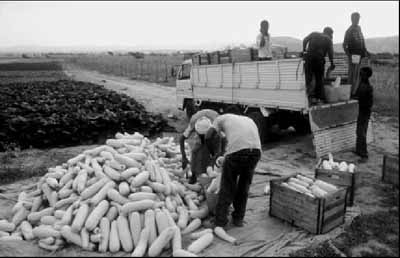
FAO will provide vegetable seeds and small agricultural tools to approximately 10,000 families, who will be identified in cooperation with WFP and UNICEF. With these inputs, beneficiaries will be able to prepare backyard plots to produce fresh vegetables for home consumption and for selling. The easier access to food and improved income of the beneficiaries will help alleviate their nutritional level.
Training will be organised by FAO to ensure the correct use of agricultural inputs and to ensure quality vegetables production. Monitoring and evaluation of project impact will be carried out in close collaboration with WFP and UNICEF.
Project code: ERI-05/A06
Beneficiaries: Total
of 10 000 families affected by malnutrition
Implementing partners:
Ministry of Health, ERREC, UNICEF, WFP
Project duration: January -
December 2005
Funds requested: US$272 640
Emergency provision of seeds of cereals, legumes and vegetables to drought-affected farmers
Objective
Some 700 tonnes of seeds of wheat, barley, sorghum, pearl millet, maize, chickpea and beans will be procured to address the essential needs of approximately 40 000 farmers in the main crop production regions. Depending on local availability, part of the seeds will be procured through the National Agricultural Research Institute (NARI) or from NGOs promoting seed multiplication programmes. Remaining requirements will be purchased overseas, in close collaboration and consultation with the Ministry of Agriculture (MoA).
The project is not intended to satisfy the total national seed requirements. It focuses only on the most drought-affected and poorest farmers. Seed distributions will be targeted to address vulnerable groups as jointly assessed with WFP, UNHCR, and UNICEF in the most drought-affected areas of Gash Barka, Debub and Anseba regions.
Project code: ERI-05/A04
Beneficiaries: Total
of 40 000 needy farmers
Implementing partners: Ministry of
Agriculture, NGOs
Project duration: January - December
2005
Funds requested: US$680 535
Improved food security for HIV/AIDS affected households
Objective
Rural and peri-urban areas will be provided with necessary agricultural inputs and technical support to enable up to 5 000 HIV/AIDS affected vulnerable households to produce vegetables for home consumption and sale of surplus. To complement the intervention, FAO will also distribute chicks to 400 of the poorest of the affected households to increase their income. NGOs will be contracted by FAO to identify beneficiaries and carry out the distribution and follow up activities.
Training for educators among the implementing partners (NGOs) will be organised to sensitise the participants about the important role of balanced nutrition for the well-being of HIV/AIDS affected households, as well as providing training on basic techniques of vegetables production and management of backyard poultry farms.
Project code: ERI-05/A03
Beneficiaries: Total
of 5 400 HIV/AIDS affected households
Implementing partners: UNICEF,
WFP, NGOs
Project duration: January - December 2005
Funds
requested: US$264 120
Support to the coordination of emergency agricultural activities and improvement of information system
Objective
The project aims to improve the capacity to share information on food security situation, focusing on the identification of vulnerable groups with rapid needs assessments, by MoA and all the members of FSSWG. The project will provide regular information on the agricultural needs and vulnerability of affected groups/communities; draw up a detailed matrix of agricultural needs by regions; strengthen existing coordination of FSSWG; offer training sessions for MoA staff and organisations involved on needs assessments, data collection management and analysis; and organize a workshop on vulnerability assessments performance, formulation and implementation of appropriate recovery and rehabilitation strategies in Eritrea.
The collection, elaboration and dissemination of this information will facilitate the efficient delivery of humanitarian aid in the food security sector, sharing of up-to-date figures on the humanitarian situation in Eritrea with donors and implementing agencies. Coordination of sectoral activities will also contribute to the optimal impact of humanitarian intervention.
Project code: ERI-05/A02
Beneficiaries: MoA,
vulnerable farmers and rural communities
Implementing partners:
Ministry of Agriculture, NGOs
Project duration: January - December
2005
Funds requested: US$313 110
Support to the quick rehabilitation of the production of quality seeds
Objective
The project aims to assist in the rehabilitation and recovery of the seed system by: (a) supporting the National Agricultural Research Institutes (NARI) to conduct a survey to identify promising local landraces of crop varieties for the 2004/05 growing season mainly in Debub and in Gash Barka Regions; (b) implementing a seed multiplication programme at rural level with selected farmers and provide training and technical assistance to help ensure the quality of the produced seeds; and (c) conducting research on the selected landraces in order to evaluate them compared to currently preferred varieties and subject them to selection pressure to improve overall performance.
Subsequently the harvest can be used for future multiplication in the following years.
Project code: ERI-05/A05
Beneficiaries:
Total: 31 540 (farmers participating in seed multiplication programme: 1 500;
MoA technicians: 40 will receive training; farmers: 30 000 will receive better
quality seeds through seed multiplication programmes)
Implementing
partners: Ministry of Agriculture, NARI (National Agriculture Research
Institute), NGOs
Project duration: January - December 2005
Funds
requested: US$665 093
