


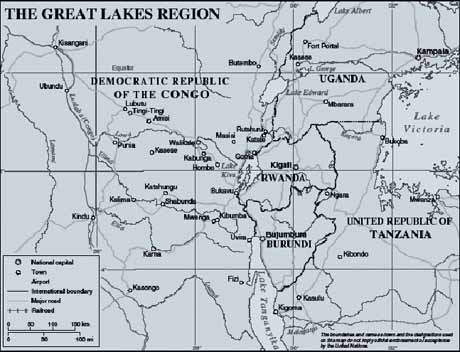
For several years the Great Lakes Region (GLR) has been plagued by conflicts, population displacements, drought and disease. Many of these problems are affecting the entire region and are not hindered by any political borders. Over six million people are displaced in the region, either as refugees in neighbouring countries, or within their own national borders. Food insecurity is widespread, often as the combined result of manmade and natural emergencies. The escalation of the prevalence of HIV/AIDS continues to intensify these problems.
Through on-going collaboration, stakeholders in the region have worked together to identify existing areas of concern, to plan for new eventualities and to identify strategic priorities. A particularly grave problem is the delayed and inadequate demobilization processes. It is often the case that ex-combatants remain excluded from civilian life and as they cannot be considered for humanitarian and development assistance, they are recruited by political or criminal actors, who challenge negotiated peace agreements. The sub-region is renowned for its dangerous and unstable fighting units that use under-age combatants, child abductions and rape as means of war and terror during their merciless attacks on the civilian population. The issue of providing protection for vulnerable civilians is increasingly understood as an essential element in the provision of assistance to affected populations.
Needs Assessment
The populations of the GLR are highly dependent on agriculture for their livelihoods. Among local food crops, cassava is the most important and inexpensive source of staple food and income. However, the severe Cassava Mosaic Virus has devastated cassava production. Efforts to restore production have been hindered by a lack of virus-free and high-yield varieties. Recent interventions in the Democratic Republic of Congo (DRC) have shown that multiplication and distribution of mosaic-free cassava cuttings can make significant contributions to improving the food security of disadvantaged groups, particularly poor farmers.

The HIV/AIDS epidemic further undermines food security in the GLR. Households with an infected member come under increasing stress due to medical expenditures and less time available for agricultural activities. The pandemic has affected productivity, food security and nutrition. Thus, support to HIV/AIDS-affected households through food security activities will help sustain their livelihoods. Training in agricultural techniques and nutrition, creation of vegetable gardens, and the provision of agricultural inputs will altogether improve the condition of HIV-afflicted families.
The persistent volatility in the region also demands constant readiness to respond to any food crisis. The role of stand-by resources and flexible early response solutions to food crises is vital. Ideally, the provision of basic seeds and tools immediately follows the first food aid distribution. Prompt distribution will allow beneficiaries to resume their agricultural activities within a normal time frame before any sudden or unexpected problems of access to the beneficiary population occur. The creation of a virtual seed buffer stock is the most appropriate means to achieve a reliable seed supply.
Finally, given the trans-national character of humanitarian problems facing the countries of the GLR, regional response and coordination have become increasingly more important. At present, the Emergency Coordination office for Africa provides guidance on policy development, strategic programming and planning to in-country emergency coordination units. The regional office allows the exchange and dissemination of best practices and lessons learned and the consolidation of partnerships. Resource mobilization and advocacy are core functions of the regional office that directly support field-level activities. To further enhance regional coordination, there is a need to strengthen regional capacity in terms of the coordination with donors, and the allocation of resources and operations of multi-country projects.
PROJECTS
FAO agricultural relief component: US$2 785 000
HIV/AIDS mitigation through improved food security for HIV/AIDS-affected households
Objective
This regional initiative addresses the needs of HIV/AIDS-affected households through agricultural projects directed at improving the diet, enhancing nutrition and providing income through the production of marketable food surpluses. The project will build on existing initiatives in Burundi, Uganda and the DRC. Exchange of experiences will be supported between stakeholders within the areas of HIV/AIDS mitigation and home-based care, thus improving the knowledge of potential food security responses through distribution of materials, lessons learned training and exchange visits. The regional emergency coordination unit in Nairobi will support the development of similar initiatives in the GLR and the Horn of Africa.
Project code: GLR-05/A02
Beneficiaries: 10
000 peri-urban and rural households with infected and affected members, orphans
and care-givers in the GLR
Implementing partners: Ministries of
Agriculture, NGOs
Project duration: January - December
2005
Funds requested: US$600 000
Rapid Response Fund for Seed Procurement (RRFSP)
Objective
The Emergency Coordination Units (ECU) in the GLR will be provided with an early response capacity to rapidly mobilize and distribute seed and tool kits to suddenly affected agricultural households during on-going crises. The seed of locally adapted varieties will be of standard quality and properly treated. The distribution of seed will be accompanied with training of farmers in on-farm seed production and saving, thus facilitating access to seeds for the next growing season. Previous experiences indicate that the availability of such a flexible mechanism dramatically increases the effectiveness of the activities. The mechanism has been conceived by FAO to provide assistance to 50 000 households with the most appropriate varieties of seeds and tools according to the agriclimatic conditions in their area.
Project code: GLR-05/A04
Beneficiaries: Rural
agricultural populations in the GLR affected by natural disasters and/or complex
emergencies (up to 50 000 households).
Implementing partners: Local
and international NGOs, UN agencies, donors and counterparts
Project
duration: January - December 2005
Funds requested: US$650
000
Regional cassava multiplication
Objective
Based on experiences of seed multiplication and distribution of resistant varieties from an ongoing initiative in DRC, a similar initiative will be extend to Uganda, Burundi and Rwanda. The project will target 3 000 farmers (1 000 farmer ‘multiplicators’ per targeted country) to disseminate virus-free cassava cuttings. The multiplication and establishment of cassava primary gardens in target areas will create a source of planting materials for future use by target groups and other beneficiaries.
Project code: GLR-05/A01
Beneficiaries: Up to
3 000 farmers in Rwanda, Burundi, and Uganda affected by cassava mosaic coupled
with natural disasters and/or complex emergencies
Implementing
partners: Local and international NGOs, UN agencies, donors and
counterparts
Project duration: January - December 2005
Funds
requested: US$935 000
Support to regional coordination
Objective
Regional coordination will be improved through assessment and rapid response to emergency developments in the region; enhanced coordination of interventions; provision of information on food security in the region to donors and other humanitarian partners; and strengthened collaboration as well as transparency with donors and other partners.
The FAO Emergency Coordination office for Africa provides guidance on policy development, strategic programming and planning to in-country emergency coordinating institutions. It also facilitates the exchange and dissemination of best practices and lessons learned, consolidating partnerships and mobilizing resources to support field-level activities.
Project code: GLR-05/A03
Beneficiaries: IDPs,
returnees and refugees in the region; rural host communities; other vulnerable
rural populations, particularly families affected by HIV/AIDS
Implementing
partners: Local and international NGOs, UN agencies, international
organizations, donors and counterparts
Project duration: January -
December 2005
Funds requested: US$600 000
