


Despite being one of Africa’s potentially richest countries, Guinea has a large percentage of the population confronted with food insecurity due to limited means of production and poor crop yields. In some areas, particularly in the densely populated southeast, deforestation and exploitation of the land have taken place as a result of the refugee influx from neighbouring countries.
Guinea has been hosting nearly one million refugees for over ten years. The armed conflicts that ravaged Liberia and Sierra Leone for more than a decade have led to massive population movements and the opening of refugee camps in the Lola, N’zérékoré and Macenta.
The humanitarian community is assisting in repatriating refugees from Sierra Leone and Liberia (nearly 100 000 Sierra Leoneans and an estimated 73 000 Liberians in 2004). Neighbouring conflicts are not only providing refugees, but illegal weapons are brought in over the borders and minors and unemployed youths are recruited or abducted into the ranks of armed groups.
Needs Assessment
The refugee registration exercise that took place in June 2004 indicates that some 80 000 refugees are still living in camps in Guinea. The improvement of the security situation in Liberia has stimulated the beginning of spontaneous return while UNHCR was starting the formal refugee repatriation process in October. Even though the repatriation process has just begun, it is anticipated that some 5 000 households will choose to permanently settle in Guinea, having developed strong ties with local communities who granted access to land.
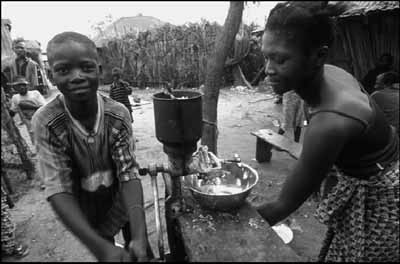
The use of unsustainable farming techniques together with the exploitation of cash crops and natural forests have accelerated environmental degradation of camp sites and their immediate surroundings, thereby impacting host communities livelihoods through marked reduction of their natural resource base. During 2002, FAO managed to rehabilitate more than 100 hectares of old camp sites. However, due to lack of resources an estimated 1 000 hectares of damaged areas were left unattended.
Additionally, poor families are often unable to generate revenues sufficient to ensure adequate levels of food intake for children and cover increasing education costs. The already weak primary school enrolment rates (55 percent for girls and 85 percent for boys, while only 47 percent of enrolled children ever complete primary education) cannot be maintained. To address short-term hunger among children and encourage families to send their daughters to school, WFP has set up an emergency school-feeding programme in the most vulnerable regions of the country.
Furthermore, following armed incursions, 15 000 young volunteers who participated in combat were subsequently discharged without a proper demobilization process. It is estimated that 5 000 of them are currently settled in the Guinée Forestière region in proximity of the borders with Sierra Leone, Liberia and Côte d’Ivoire. The presence of a large group of young, unemployed persons is a major concern and represents a potential threat to the security and stability of the region.
PROJECTS
FAO agricultural relief component: US$1 833 000
Emergency agricultural assistance to facilitate reinsertion of young demobilized soldiers in Guinea
Objective
FAO proposes to help ease tensions among young unemployed former combatants by involving them in agricultural production activities. Accordingly, the project aims to support 3 000 young unemployed persons in the Kissidougou, Guéckédou and Macenta prefectures with a package of agricultural inputs, taking into consideration beneficiary preferences and capacities, as well as the agro-climatic conditions of the region. The assistance will support each beneficiary in seeds (rice, maize, groundnuts and vegetable crops) enhancing self-reliance and the capacity to generate income. An awareness and sensitization campaign will be carried out to identify and involve communities willing to host former combatants. In order to facilitate acceptance by the community, the project will integrate vulnerable individuals in the programme. The project will make use of the expertise and capacity of local authorities, CBOs and NGOs. A close collaboration is envisaged with all the humanitarian organizations intervening in the sector, thus ensuring support to beneficiaries until the first harvest is realized and self-reliance has been ensured.
Project code: GUI-05/A03
Beneficiaries: 3 000
young unemployed demobilised soldiers in Kissoudougou, Guéckédou
and Macenta prefectures
Implementing partners: Ministry of
Agriculture, Ministry for Youth, Ministry for the Armed Forces, WFP, UNHCR,
UNICEF, national and international NGOs
Project duration: January -
December 2005
Funds requested: US$442 000
Emergency agricultural assistance to refugees willing to settle in Guinea and vulnerable host populations
Objective
FAO supports the distribution of food crops and vegetable seeds and farming tools to 5 000 refugees. The distribution will progressively reduce food aid dependency, while generating surplus production for marketing purposes and increase food availability in host areas. The project will also assist 3 000 vulnerable host households, as well as facilitating the acceptance of refugees by local communities. FAO is envisaging a close collaboration with other UN agencies already engaged with resettlement of refugees. These organizations will provide additional assistance for shelter, water and sanitation and food assistance until the first harvest.
Project code: GUI-05/A04
Beneficiaries: 5 000
refugees with access to land and 3 000 vulnerable host
households
Implementing partners: Ministry of Agriculture, Livestock,
Water and Forest, UNHCR, WFP, national and international NGOs
Project
duration: January - December 2005
Funds requested: US$587
000
Rehabilitation of old campsites and surrounding areas damaged by refugee presence
Objective
The initiative aims at rehabilitating old refugee camps and damaged surrounding areas in N’Zérékoré, Guéckédou, Kissidougou and Lola prefectures. Project activities are designed to re-establish adequate landcover, promote sustainable agricultural and natural resources management, as well as they will contribute to the improvement of the natural and social environment of the project area.
The project will be carried out with the full participation of the affected communities and is by the national authorities considered to be a priority. A preliminary inventory of sites to be rehabilitated has already been completed. At project inception, the list will be further reviewed and complemented. It is anticipated that some 100 hectares of damaged land will be restored and managed in a sustainable way.
Project code: GUI-05/A02
Beneficiaries: Local
communities living in proximity of refugee camps in
N’Zérékoré, Guéckédou, Kissidougou and
the Lola prefectures
Implementing partners: Ministry of Agriculture,
Livestock, Water and Forest, local communities, national and international
NGOs
Project duration: January - December 2005
Funds
requested: US$474 000
Support for the establishment of school gardens in food insecure regions in Guinea
Objective
FAO aims to support an on-going WFP school-feeding programme by contributing to the improvement of nutritional status of primary school pupils. The schools will be assisted in setting up vegetable gardens in regions with high levels of malnutrition and low school enrolment rates. This activity will also increase self-reliance of school feeding activities and improve pupil and parents’ knowledge of nutrition and vegetable production techniques.
Fifty schools will be selected and supported with an agricultural input package comprising of vegetable seeds, fertilizer, farming tools and technical assistance. A committee including the parents’ association and the school management will manage activities. The parents will also provide the labour for the farming activities. The production will be used primarily to provide fresh food for the children’s diet and improving quality and quantity of the rations. All surplus production will be marketed and the revenues generated will be used to improve school facilities. Parents, teachers and students will benefit from simple training on nutritional issues and in improved vegetable production techniques.
Project code: GUI-05/A01
Beneficiaries:
Children in 50 schools in food insecure regions together with pupil-parent
associations
Implementing partners: Public services for agriculture,
health and education, WFP, UNICEF, national and international NGOs
Project
duration: January - December 2005
Funds requested: US$330
000
