


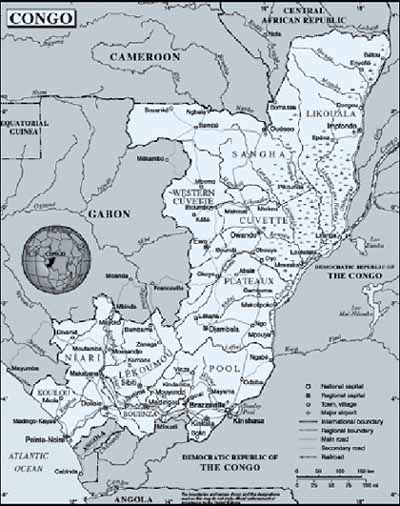
The Republic of Congo was once a middle-income country. However, since 1999, the country has experienced successive waves of conflict that resulted in massive destruction, a substantial loss of life and damage to physical, social and health infrastructures. Over 15 years, the country’s GDP shrank by almost 20 percent and more than 70 percent of the population now lives below the poverty line.
The conflict has caused the displacement of more than 100 000 persons and the death of more than 50 000. A ceasefire was negotiated in 2000 which paved the way for a new constitution and elections. However, the situation in the Pool region continues to deteriorate. The intermittent armed conflicts in the region, as well as poor road conditions, have restricted humanitarian access and forced people to take refuge in the forests. Basic social services ceased to exist due to the conflict and looting. Farmers have turned to subsistence farming and to producing just enough not to attract the attention of armed elements likely to seize crops. As a result, the nutritional situation of the Pool region is precarious and may become even more difficult. Further, there is fear that unemployed young people who head households may loose hope and join armed groups to survive. Thus, the promotion of income generating activities will not only help alleviate the dire nutritional status of the remaining 150 000 to 250 000 people in the Pool but also contribute to the improvement of the general security situation.
Needs Assessment
Before the hostilities the Pool region has traditionally been an important farming region and supplied great quantities of animal meat to Brazzaville. During the war, all the livestock was destroyed. This sudden and continued interruption largely affects women who represent over 80 percent of active workers in livestock breeding. It also has led to the significant reduction of the purchasing power of the population who lost their goods especially their livestock, orchards and fish breeding ponds and to the deterioration of the food and nutritional situation of the households.
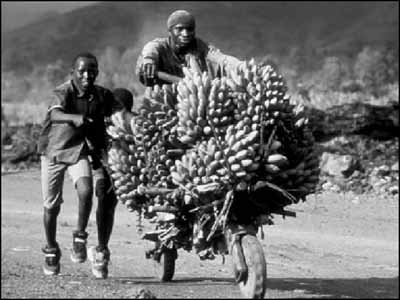
The Pool region is endowed with significant potentialities and has a tradition of fruit growing, fish breeding and poultry farming, thus it presents reintegration opportunities in agriculture. To restore the production capacity of the Pool households urgently need seeds and farming tools and the provision of basic inputs to re-launch small livestock breeding. The resumption of farming and livestock breeding will further assist displaced populations who hope to return to their place of origin. Incomegenerating activities targeted for the women and the large number of unemployed youths is a priority.
PROJECTS
FAO agricultural relief component: US$1 763 640
Support small ruminants breeding, improve the household income generation capacity and increase animal protein consumption
Objective
The project seeks to improve food and nutritional situation, as well as income opportunities, for the vulnerable population in the Pool region by re-launching small ruminants and poultry breeding. It will provide 2 000 lambs and 2 000 sheep to 2 000 families, as well as training the beneficiaries on breeding techniques. Meanwhile, the poultry farming component will provide two-month age improved cockerels to 2 000 families, five kilograms of food to each family and veterinarian kit and offer training to beneficiaries on breeding techniques. The selection of beneficiaries will particularly focus on women heads of family.
Project code: ROC-05/A02
Beneficiaries:
Total: 60 000 (Women: 36 000; Men: 24 000)
Implementing partners:
Ministries of Agriculture, Breeding, Fishing, WFP, local and international
NGOs
Project duration: January - December 2005
Funds
requested: US$473 000
Support to the social reintegration of youths and women in income generating activities in the Pool region affected by hostilities
Objective
This project seeks to promote the reintegration of youth in income generating activities with the goal to improve food security and purchasing power of vulnerable families. The project will cover the settlement of 60 rural youths in six groups of ten young people to be identified in the districts of Boko, Loumo, Kindamba, Louingui, Goma tse tse and Mbandza Ndounga for the production of 300 000 fruit trees to cover 300 hectares of newly initiated orchards; the support of 300 groups of ten women or youths to commence market gardening activities; and the re-launch of fish breeding that will allow 25 groups of youths and women to increase fish production, thus decreasing the impact of over fishing in the area. The group will get fish breeding equipment and young fish to enable them to exploit 6 400 square meters representing 32 ponds of 200 square meters, to produce 1 792 tons of fish.
The fruit transformation will help to increase the value of the fruit production, a great part of which is neither consumed nor sold and get rotten on the ground. This activity will employ ten groups of youths and women. Modern poultry farming will assist ten groups of five youths who will be offered 500 chicks, a veterinarian kit, breeding equipment and livestock food for a period of seven months. Each group is expected to produce 30 pallets of 30 eggs per month after the seventh month.
Project code: ROC-05/A03
Beneficiaries:
Total: 3 510 (Women: 1 755; Other group: 1 755)
Implementing partners:
Ministry of Agriculture, WFP, local and international NGOs
Project
duration: January - December 2005
Funds requested: US$592
000
Urgent provision of essential agricultural items to the vulnerable population affected by the continued crisis in the Pool region
Objective
The project aims to improve food security, as well as general living conditions for the most vulnerable populations of the Pool region, in particular those who did not benefit from previous assistance, to build farming production capacities. Specific activities include provision of food crops seeds (maize, peanuts), vegetable seeds and 13 000 agricultural tools; technical and operational capacity building in the farming sector and among NGO partner; and support to the coordination, harmonization and the monitoring/evaluation of urgent and recovery agriculture. Beneficiaries will be identified among the most vulnerable populations in close collaboration with local authorities, farming department directories and partners NGOs.
Project code: ROC-05/A01
Beneficiaries:
Total: 100 000 (Women: 75 000; Men: 25 000)
Implementing partners:
Ministry of Agriculture, WFP, local and international NGOs
Project
duration: January - December 2005
Funds requested: US$698
640
