


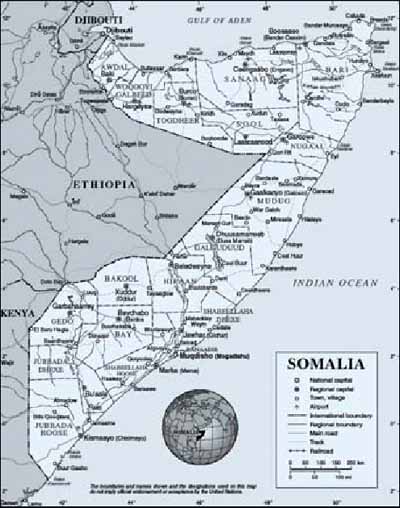
Somalia’s estimated 6.8 million people are extremely poor. The absence of a central government for 13 years since the collapse of the Sadi Barré government in 1991 has led to serious domestic conflicts within and among clans, particularly in the central and southern regions of the country. Natural disasters such as droughts have exacerbated the political catastrophes. The result is a disruption of traditional livelihoods, chronic humanitarian crisis and large-scale population displacements both within the country (370 to 400 000 persons) and into neighbouring countries (350 000 persons) as refugees. These disasters have dramatically weakened the coping mechanisms of Somalis.
The situation in Somalia is complex. While the regional governments in Northern Somaliland and Puntland have allowed for the provision of humanitarian and recovery assistance, the areas in south and central Somalia continue to suffer from insecurity and displacement. The severely restricted humanitarian access to these areas and has meant that the needs of the vulnerable groups have remained unmet.
Needs Assessment
A recent drought and the level of insecurity prevailing in Somalia have resulted in one of the worst harvests since 1995. Extended areas of severe crop failures and acute malnutrition rates reaching over 18 percent of the population are reported in Bakool, Gedo, Middle & Lower Juba, Hiran, Galgaddud and the north east regions. In the agriculture areas of southern Somalia, a total of 300 000 people are in need of urgent assistance, 105 700 in a state of humanitarian emergency and 193 500 facing a severe livelihood crisis. The level of production has diminished two-fold while the requirement for the purchase of staples has increased by approximately the same. Cereal deficits are estimated to be at least 36 000 tonnes next year.
Crop failures in recent years have contributed to the promotion of fish consumption among ethnic Somalis. Well designed fisheries initiatives remain the most cost-effective, both in terms of the quantity of animal protein produced and made available at low market value and in terms of the cash incomes generated. Dried fish has indeed proven to play a crucial bridging role during the hunger gap period (45-60 days between first rains and first harvests).
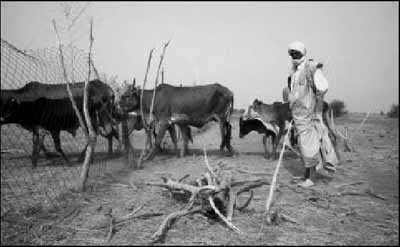
The livestock industry is in great need of assistance. Livestock export is the core of the Somali economy. The report “Somalia - Towards a Livestock Sector Strategy” by FAO, the World Bank and the European Union identified improved livestock nutrition and better animal welfare as key issues to be addressed in order to increase livestock export prices and thus improve pastoral livelihoods.
Coordinated planning and programme implementation are other key areas where FAO sees the importance of continued assistance for Somalia. The ‘thematic meetings’ (eg. Animal Traction and Crop Diversification) initiated and chaired by FAO during 2004 have assisted in defining revised strategies to be used by agencies already involved or interested in implementing such types of activities. FAO will therefore further develop its networking capacity through enhanced collaboration with the Somalian Aid Coordination Body (SACB) and through the above-mentioned thematic meetings to facilitate in-depth discussions at the sub-sector level.
PROJECTS
FAO agricultural relief component: US$4 190 153
Coordination in the Food Security Sector
Objective
This project will continue to develop and regularly update the food security data system that was put in place in 2003, drawing from all available sources of information (e.g. the Food Security Analysis Unit (FSAU) of FAO and the Somalia Water and Land Information Management Project (SWALIM)) to facilitate the work of operational agencies. In close collaboration with the FSAU, the project will undertake a comprehensive crop survey through the use of plot yield estimates, area sample frames, satellite imagery and other techniques to re-establish the working baselines and provide sound information for relief, early rehabilitation and longer term development planning. The project will also ensure that FAO has the capacity to coordinate emergency responses within the sector and to fill gaps where necessary.
This project is expected to result in increased availability of comprehensive, accurate and up-to-date baseline (reference) data available on crop production; shared strategy for food security reviewed and endorsed; and coordinated responses to food security needs and thematic/technical issues implemented.
Project code: SOM-05/A02
Beneficiaries: SACB
partners and local authorities
Implementing partners: Local and
international NGOs, counterparts and local communities
Project
duration: January - December 2005
Funds requested: US$772
242
Enhancement of food security and nutritional status
Objective
Within the overall context of the need for livelihood diversification, the project seeks to assist communities to become more self-reliant while building the capacity of local partners in project implementation. Activities under this project include (a) distribution of staple food crop seeds and farming tools and support to flood relief initiatives (canal/river desilting, head gates and embankments rehabilitation); (b) provision of food processing equipments (grinding mills, oil presses) as well as legumes and oil crop seeds, root crop cuttings and saplings; (c) promotion of improved cropping/labour saving techniques (ox-ploughs, irrigation pumps, donkey carts), (d) provision of seed selectors and the rehabilitatation of traditional grain and seed storage methods; (e) development and implemention a communication strategy to promote the production and appropriate use of diverse nutritious foods, including HIV/AIDS awareness, using health facilities, schools, feeding centres and radio as potential routes for communication in rural and urban areas; and (f) initiation of new agricultural training concepts for urban poor and ex-combatants.
Project code: SOM-05/A06
Beneficiaries:
Total: 125 000 households (750 000 people); IDPs, returnees, ex-combatants and
other minorities (i.e. urban destitute);
Children: 450 000; Women: 175
000
Implementing partners: Local/international NGOs, counterparts,
local communities
Project duration: January - December
2005
Funds requested: US$2 073 203
Improvement of the quality of livestock exported from Somalia
Objective
This project includes two livestock components: animal nutrition/fodder production and welfare of livestock. A preliminary assessment mission will identify sites in irrigated and irrigated/rain fed areas of central and northern Somalia where trials for potential fodder crops can be made. Local workshops at the selected sites will promote the concept of fodder production, introduce methodologies to be used and select up to 20 suitable farmers to run the trials. Once the impacts of the trials have been jointly assessed by project specialists and local farmers, recommendations will be made for further activities. Important project inputs will include new types of crop seeds, assistance with post-harvest storage, and advice on marketing. Successful sites will be expanded to include approximately 200 farmers, and the creation of marketing co-operatives will be encouraged.
Furthermore, recommendations from a planned preliminary review of livestock shipping conditions from up to three main ports in Somalia will be introduced to livestock owners and traders, to shippers and road transporters and to municipalities and livestock authorities in a series of workshops. Then, recommendations on how to ensure immediate improvement of animal welfare during transport will be jointly adopted. The project will then assist the various stakeholders in the implementation of these recommendations, which could include the promotion and training in animal welfare, improved watering in transit, etc. Project inputs could include water tanks, watering facilities in boats, improved marshalling facilities prior to embarkation, etc.
Project code: SOM-05/A03
Beneficiaries: All
livestock producers and exporters in Somalia
Implementing partners:
Ministry of Agriculture, of Livestock, NGOs
Project duration: January
- December 2005
Funds requested: US$579 332
Promotion of poultry production among IDPs, returnees and poor urban dwellers in drought affected areas of Somalia
Objective
This project is aimed at promoting poultry production among internally displaced persons and poor urban dwellers in drought-affected areas of Somalia. Small scale poultry production for these vulnerable groups will become an alternative source of livelihoods and assist diversification of agricultural productions and represent an important source of income for female-headed families. It will also contribute to improved nutrition through consumption of poultry meat and eggs, especially for children and mothers. In addition to the provision of production inputs which will benefit some 10 000 household beneficiaries, the project will also offer group training support in management of chicken production, especially to women.
Project code: SOM-05/A05
Beneficiaries:
Total: 10 000 households (60 000 persons: Children: 35 000; Women: 18 000; Other
group: IDPs, returnees and drought affected
agro-pastoralists)
Implementing partners: Local and INGOs, local
communities
Project duration: January - December 2005
Funds
requested: US$541 800
Support to small riverine fisheries production
Objective
The objective of this project is to provide food insecure, particularly IDPs, with light fishing equipments to allow them to fish while moving along rivers and not having the capacity to carry much belongings and food reserves. Fishing equipment is almost totally unavailable on any market in Somalia. Accordingly, the project will provide the beneficiaries with necessary support, but on a cost-recovery basis for sustainability. While IDPs and destitute people would continue to receive fishing equipments on an emergency basis, professional fishermen would be given the opportunity to buy their own fishing gear. A maximum of four community owned pilot ‘bush shops’ will be established in order that emerging shops are not swamped by free distributions of fishing equipment but become self-supporting, providing fishing gear to their respective communities on a cost-sharing basis.
Women are not involved in the growing fishing ‘industry’in Somalia, hence their fishing activities are restricted to traditional basket traps, the use of which is limited to the end of the dry season. By providing adequate training to women in net making and fish processing, they will be in a better position to re-establish coping mechanisms and to feed their close dependants while reducing usual global malnutrition rates. These training sessions would include HIV/AIDS awareness sessions.
Project code: SOM-05/A04
Beneficiaries: 15
000 Households (90 000 people) composed of IDPs, returnees, minorities, fisher
families
Implementing partners: Local and international NGOs,
counterparts and local communities
Project duration: January -
December 2005
Funds requested: US$223 576
