


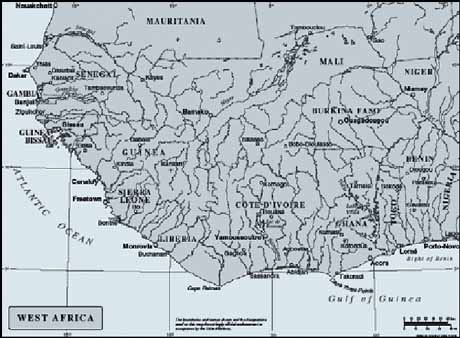
In 2004, the region of West Africa experienced the most severe locust infestations in 15 years. Exceptional rains in the summer of 2003 initiated locust breeding over large areas of the region. The swarming of Desert Locusts has led to significant crop losses in the northern part of Sahel affecting farmers and pastoralists. Seven Sahelian countries in the region have been affected (Burkina Faso, Cape Verde, Chad, Mali, Mauritania, Niger and Senegal).
West Africa is also host to other complex emergencies resulting from a combination of man-made and natural disasters: the drought in the Sahel region (particularly in Mauritania), conflict in Cote d’Ivoire, slow progress of reconstruction in Liberia, social unrest and economic meltdown in Guinea and inter-ethnic conflicts in Nigeria.
The 2005 Appeal for West Africa highlights the fact that “the region has created a pattern of humanitarian needs that transcend national borders and that there are now a number of interdependent clusters of countries in crisis that serve as potential exporters for further instability.” Thus, to be effective, humanitarian intervention should also focus on regional solutions to the trans-national nature of crisis in this particular region.
Needs Assessment
The locust infestations that are currently affecting seven Sahelian countries may in the coming months spread to other countries in the West African region. If a concerted action to mitigate the effects of the locust attacks is not taken in time, the short and medium-term impact of these infestations on poor farming and pastoral households could be devastating. This new threat is arising in an already very poor region that recently has been confronted by severe crises and complex emergencies, making several nations economically and socially vulnerable to further shocks. It is in this context that there is need for a continued monitoring of the locust infestations.

PROJECTS
FAO agricultural relief component: US$660 000
Support to regional coordination
Objective
A regional coordination unit has been established in Dakar to inform and guide the response activities of all concerned partners on the locust infestations. The unit will support the elaboration of mitigation strategies and targeting criteria that take account of the livelihoods of the affected households, and inform the allocation of resources. This unit should be the reference point for timely, reliable and updated information that includes estimates of affected areas, crop losses (including pasture), impact on household food availability and consumption, levels of vulnerability and household coping mechanisms.
The outcome of this project would be to assure the elaboration and implementation of well-designed response plans by all actors, making optimal use of available information and resources, and taking into full consideration the particular situation faced by each of the countries affected by this disaster. This would serve to reduce the impact on the population, limiting their need to move in search of assistance and would protect the social stability of the region.
While the structure of the unit will be flexible to reflect the changing requirements as the locust disaster unfolds, it will be envisaged to include a food security expert working with agronomists in the affected countries to ensure the continuous assessment of needs and the preparation of response plans and with a locust expert to monitor the movement of the locust population in time and space, a GIS/database expert working on data collection, analysis and mapping in collaboration with partners and a Liaison/Information Officer to ensure the flow of information among all those involved.
Project code: WA-05/CSS08
Beneficiaries:
Governments, vulnerable rural households affected by locust infestations,
internally displaced persons, returnees, refugees and rural hosts, other
vulnerable rural populations, donors, UN partners and non-governmental
organizations (NGOs)
Implementing partners: Ministries of Agriculture
and Livestock, research institutions and national counterparts, UN agencies, FAO
offices in the countries of the region and their partners, including local and
international NGOs
Project duration: January - December
2005
Funds requested: US$660 000
