


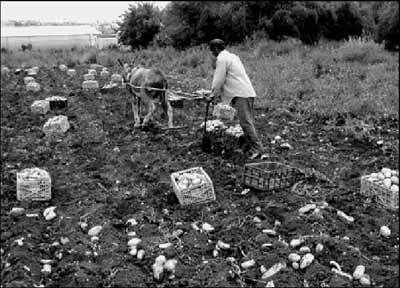
Food insecurity and poverty in the West Bank and Gaza Strip can be largely attributed to an unsettled political atmosphere, marked by significant civil unrest and an increasing amount of economic uncertainty. The major factor affecting food insecurity is the lack of employment, to a large degree caused by severe restrictions on free movement. The territory is criss-crossed by a dense network of over 700 security checkpoints, road blocks and other movement restrictions.[1]
The year 2004 was the fourth successive year of crisis. The closures have led to a grave recession, unemployment has increased to 34.3 percent and poverty now affects 47 percent of the Palestinian population. Worst off are the inhabitants of the Gaza Strip where 64 percent live below the poverty threshold and around a quarter of the population lives in deep poverty.
Needs Assessment
Monitoring of food insecurity and vulnerability is important to ensure that humanitarian interventions reach the most vulnerable groups, appropriate strategies are adopted and programmes are properly coordinated. In this respect, there exists a need to develop and manage a food insecurity and vulnerability information mapping system to inform the project planners of the humanitarian community.
FAO also needs to intervene in the agricultural production sub-sectors, such as bee keeping and horticulture. Bee keeping constitutes an important source of income for many families, but quality and quantity of production could be greatly improved by making better use of the rich climatic and plant diversity of the country. As 70 percent of local consumption is imported, local honey has great market potential and will provide good income diversification opportunities for the marginalized beekeepers.
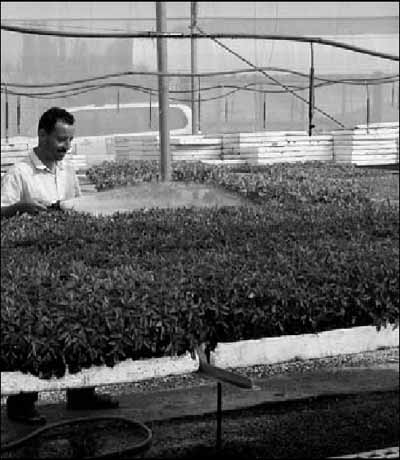
Horticultural production is vital to the rural economy and national food security, as vegetables contain sugars, minerals, vitamins and fibres and are a very important component of the diet. The widespread damage and almost total destruction of a large number of greenhouse facilities in the West Bank and Gaza Strip have destroyed the crops and facilities of local producers, or at best, prevented them from providing their crops with adequate care.
Given the importance of greenhouse cultivation for the rural economy (it is estimated that about 25 percent of vegetables in the West Bank and Gaza Strip are grown in greenhouses) and the nutritional importance of the crops grown, the Ministry of Agriculture (MoA) and FAO recommend immediate action in terms of technical assistance and material support.
Olive is another major crop. It constitutes up to 25 percent of the gross agricultural income. Olive production provides the bulk of income for about 71 000 families, distributed throughout the West Bank. Most olive farmers are poor and they represent a marginalized part of the Palestinian population which needs to be targeted by any emergency intervention.
PROJECTS
FAO agricultural relief component: US$4 000 000
Support to the Food Insecurity and Vulnerability Information and Mapping System (FIVIMS) Phase 2
Objective
This project seeks (a) to develop and manage a food insecurity and vulnerability information mapping system in order to monitor and provide up to date information on food security and nutrition status in the West Bank and Gaza Strip, and (b) to improve targeting, strategy and policy making and coordination of interventions for vulnerable groups. Already, significant progress has been made in terms of establishment of the Project Steering Committee, identification of key indicators to be monitored, as well as the set up of the Food Insecurity and Vulnerability Information Mapping System (FIVIMS) database structure.
The project will further develop and manage the FIVIMS which will assist national authorities and donors in monitoring and identifying the most nutritionally vulnerable and food insecure households and groups. The Inter-Ministerial Working Group (IMWG) will use FIVIMS to make relevant information more readily available to decision-makers and UN agencies, so that policies, programmes and interventions can be appropriately targeted and designed to improve food security, nutritional well-being and livelihoods in the short-term. Monitoring bulletins and other information products would be issued by the IMWG on a regular basis.
The project will further build the capacity of national and international institutions in the collection of data on food and nutritional security, including the monitoring of the food security situation, as well as of health and nutrition indicators and livelihoods.
Project code: oPt-05/A03
Beneficiaries: Food
insecure population in the oPt
Implementing partners: Palestinian
Central Bureau of Statistics (PCBS), Ministry of Planning, Ministry of
Agriculture, Inter-Ministerial Working Group (IMWG) on National Food Security
Strategy, other sector stakeholders
Project duration: January -
December 2005
Funds requested: US$726 100
Bee keeping and honey production
Objective
The low productivity and consequently low profitability of bee keeping in the West Bank and Gaza Strip (10 kg vs. 37 kg in Israel) is due to the lack of certified productive honeybee strains, low capacity of beehive farms (most of the beekeepers are small farmers having less than 20 beehives) predominant use of traditional beehives and lack of the technical knowledge needed for modern bee keeping.
The project will help to diversify income for the marginalized farmers, especially women and femaleheaded families. To this end, beneficiary households will be provided with the necessary technical knowledge of beekeeping and with suitable honeybee strains, beehives, small tools, jars and support services, while the MoA will be assisted to set up a central apiary to provide the required productive honeybee strains.
Project code: oPt-05/A04
Beneficiaries:
Jobless especially women and female-headed families, marginalized farmers in the
oPt. A total of 2 600 families (15 600 beneficiaries: Children: 10 400; Women: 2
600)
Implementing partners: Ministry of Agriculture, research
institutions, NGOs and CBOs
Project duration: January - December
2005
Funds requested: US$417 900
Rehabilitation and revitalisation of the horticulture sector
Objective
Approximately 300 poor greenhouse vegetable farmers will be assisted in the re-establishment and improvement of their farming activities by providing equipment, material and training to re-construct, rehabilitate and manage damaged or destroyed greenhouses. Where required, seeds, seedlings, fertilizers and pest management measures will be made available for one production cycle. Through training activities and technical support, the project will assist in developing market opportunities for fresh produce, adding value to agricultural produce through processing, adoption of Integrated Crop Management and meeting standards for local and export markets.
Rehabilitation of the damaged greenhouses has great emergency value. The targeted farmers will regain the possibility to grow their crops and harvest them within few months and thereby become less dependent on food distribution.
Key support industries such as nurseries, bumble bee production, greenhouse manufacturing and construction, small-scale niche breeding and local seed production will also be encouraged and supported by this project. This, in turn, will help provide beneficiaries with sustainable income and improve supply of vegetables for markets and household consumption and generate employment opportunities.
Project code: oPt-05/A05
Beneficiaries: Poor
vegetable farmers affected by damages and losses to their plastic houses
structures and activities. A total of 300 families (1 800 beneficiaries:
Children: 1 200; Women: 300)
Implementing partners: Ministry of
Agriculture, NGOs and CBOs
Project duration: January - December
2005
Funds requested: US$1 000 000
Support to olive production in the West Bank
Objective
Given the large share of olive production in the cultivated areas of the West Bank, this project aims to rationalize olive production by providing farmers with the necessary inputs and training. A series of activities will also be initiated to promote sustainable enhancement of the production and marketing of organic olive oil, through raising its competitiveness and opening new internal and external markets. In fact, the relatively poor quality of Palestinian olive oil has resulted in a sharp decrease in the demand for olive oil, not only in external markets but also locally.
Specifically, the project will undertake the following: assessment of olive varieties present in the area and their relative economic importance; provision of information about the varieties, performance and uses to farmers; enhancement of cooperative olive oil production through the establishment of farmers’ cooperatives or Community Based Organizations (CBO) and providing them with production inputs; improvement of the knowledge and production skills of technicians and farmers; introduction of organic olive tree cultivation and its certification system; and increase of local awareness of the use of pesticides and their impact on food quality, health and the environment.
Project code: oPt-05/A07
Beneficiaries: Poor
farmers in West Bank whose main source of income is olive production
Farmers:
1 040; Others: 140 technicians; Communities: 65; Districts:
13
Implementing partners: Ministry of Agriculture, research
institutes, NGOs and CBOs
Project duration: January - December
2005
Funds requested: US$848 000
Support to female-headed households, food security and income generating activities
Objective
With a view to developing sustainable small-scale farming systems in food insecure areas, the project will build the capacity of local communities to solve local problems with local resources and will capitalize on the role of women and rural families in improving food security at household, community and national level. The coping mechanisms of vulnerable groups will be strengthened by improving their nutritional and health status through their own sustainable food production activities and by focusing on how to improve nutritional awareness. The idea of preserving food to be consumed later when there is food scarcity or in case of closures and curfews has many positive effects: female employment, income generation, as well as increased market opportunities. The income generation element will be further enhanced by combining the support to production with training on food preservation techniques for horticultural and livestock products. Project implementation will take into consideration the results of a socio-economic survey and a market appraisal conducted in the targeted communities.
The project aims to complement activities of other partners, including WFP’s food distribution activities. However, this project will utilise the resources available (surplus) or readily available (backyard activities) to produce and secure more food through cottage industry. The inputs to be provided will include vegetable seeds/seedlings and fertilizers; poultry, ewes and goats for household milk production, tools and small equipment for cottage industry production, as well as other arrangements to secure water supply.
Project code: oPt-05/A06
Beneficiaries:
Female-headed households. A total of 1 000 families (6 000
beneficiaries:
Children: 3 000; Women: 480 female-headed households; Other
groups: chronic poor, households with disabled members, and small households
without resources) and technical staff
Implementing partners: Ministry
of Agriculture, NGOs, CBOs and Universities.
Project duration: January
- December 2005
Funds requested: US$1 008 000
|
[1] Data quoted from ‘The
Consolidated Inter-agency Appeals for Occupied Palestinian Territory 2005’,
United Nations. |
