Competitiveness of forest products
Competitiveness of forest products at global markets; with particular emphasis on tropical forest products and small - medium scale producers in developing countries
A global trend in forest ownership shows a shift from public ownership of large tracks of (natural) forests towards devolution of the land or the forest management responsibilities to local communities and/or private ownership. For natural forests in tropical countries, devolution has started recently but the trend has accelerated since the last 2 decades and community-ownership/management of forests is expected to reach 40% of the total area of natural forests in the tropics by the year 2040. Hand in hand with this devolution, and particularly in the tropics, goes a process of increased fragmentarization of the forest area into smaller ownership/management units with a corresponding surge in the number of small to medium-sized raw material producers and small scale timber processing enterprises. Although production, processing and marketing skills and efficiencies of those producers (particularly in the tropics) is improving, it is still far behind those of large and globally interconnected larger corporations. For example, in the plastic and metal sectors that produce raw materials and products competing with timber for the construction and furniture markets, the opposite trend is taking place towards the further consolidation of enterprises into larger entities for reducing raw material costs and to enhance transport, processing and marketing efficiencies at a global scale.  "Wood-looking" beams made of concrete painted like wood "Wood-looking" beams made of concrete painted like wood
Competition among materials and competition between tropical and non-tropical timbers is fully acceptable. However, a loss of competitiveness of forest-based products in general (and particularly those from the tropics) may have serious impacts on the financial viability of sustainable forest management (and more particularly of natural forests in the tropics); and which may reduce the attractiveness to maintain land under forest cover, particularly of natural forests in tropical countries, hence increasing deforestation pressures. Competition from non-wood based materials can now be observed even in those specific market segments where “wood” was traditionally considered the main raw material, such as for the manufacturing of flooring, decking, windows, doors, panels, decorative veneers, etc. Such competition reduces the relative market share of wood-based products and lowers the absolute demand from the building and manufacturing sectors for forest or wood-based raw materials not only in developed countries, but also more and more in developing countries as well. For several of these products, the raw material supply was/is mainly from timbers harvested in tropical natural forests. Competition with other materials such as plastics or metals, as well as competition with timbers from temperate and boreal regions is seriously affecting their competitiveness and reducing the market share tropical timbers (used to) supply at those niche markets.
The impact of these changing forest ownership-, trade- and manufacturing trends on the competitiveness of forest products at global markets, particularly from small and medium scale producers in and from the tropics is not well understood. A series of market reviews is ongoing to identify trade trends and market share of wood-based products in the building and furniture sectors. These reviews will contribute to guide policy formulation and trade procedures for the promotion of more trade in wood-based products originating from sustainable managed forests.
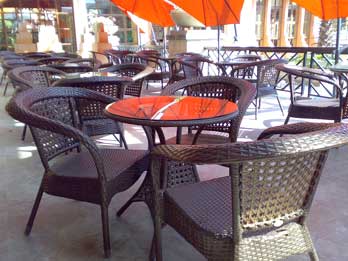 "Rattan" furniture: made from plastic and iron "Rattan" furniture: made from plastic and iron |