
International Day of Combating Sand and Dust Storms, 12 July
The theme of this year's United Nations (UN) International Day of Combating Sand and Dust Storms is “Sand and Dust Storms: Working Across Agendas for Resilience and Sustainability”.
Sand and dust storms (SDS) are an increasingly global issue affecting 151 countries worldwide with numerous impacts on the environment, food security, agriculture, health, transportation, energy, human–societies and economies.
In 2023, the United Nations General Assembly (UNGA) proclaimed 12 July as the International Day of Combating Sand and Dust Storms to highlight the growing need for cooperation between countries on a global and regional scale to manage and mitigate the effects of SDS .
With this resolution, the Assembly also invited all Member States and other relevant stakeholders:
to observe that International Day in an appropriate manner and in accordance with national priorities, through education and activities aimed at raising public awareness of the importance of combating such storms for human health and well-being; the promotion of sustainable land use and management; enhancing food security and resilience to climate change; and sustainable livelihoods.
This call to action represents a significant step in enhancing awareness of SDS and mobilizing the political will and resources needed to address the SDS related issues which present a serious challenge to the achievement of the Sustainable Development Goals (SDGs) and associated targets.
Sand and dust storms and agriculture
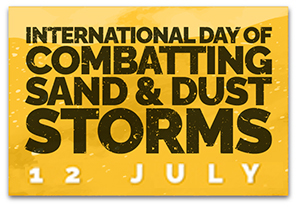
Agriculture is one of the drivers of roughly 25 percent of global dust emissions caused by human activities. Sand and dust storms also have numerous direct negative impacts on agriculture, resulting in the loss of crops, trees and livestock, or significant decreases in their production.
While agriculture is a driver of SDS, it can also be part of the solution, combating SDS risks and mitigating their impacts through the implementation of resilient and sustainable agricultural practices. Sand and dust storms should be addressed as part of the strategies for national multihazard disaster risk reduction (DRR) and disaster risk management, linked to the Sendai Framework for Disaster Risk Reduction 2015–2030.
Efforts are growing to support SDS affected countries through mitigating SDS sources and the impacts on agriculture. These efforts include promoting sustainable land and water management, integrated land use planning, forest and landscape restoration, agroforestry, shelter belts, afforestation and reforestation programmes, and the restoration of agricultural soils and lands including croplands and pasturelands.
Sand and dust storms (SDS) and climate change
Climate change, including changes in temperature and precipitation levels, is altering SDS hazard levels and increasing associated risks.
The hazards posed by SDS and climate change particularly affect people who directly depend on natural resources for their livelihoods, such as those who practice rainfed agriculture, pastoral farming and dryland forestry. These groups of people are more vulnerable to intensified climate variability and extreme events such as floods, droughts and storms that are likely to become more frequent, more widespread or more intense due to climate change.
The United Nations Coalition on Combating Sand and dust storms
Through the United Nations Coalition on Combating Sand and Dust Storms, 20 UN agencies and non UN organizations have joined efforts to foster global action against SDS. This coalition, established in September 2019 and currently co chaired by the United Nations Economic and Social Commission for Western Asia (ESCWA) and the United Nations Economic and Social Commission for Asia and Pacific (ESCAP), work on the following priority areas: identifying and analysing SDS source areas; assisting countries in developing policy plans; implementing effective practices for source and impact mitigation; facilitating knowledge sharing and capacity enhancement; and identifying vulnerable locations and populations.
More information about the United Nations Coalition on Combating Sand and Dust Storms is available here.