![]() |
![]() ![]() |
![]() ![]() ![]() |
|
| Soil Biodiversity Portal | ||||
| Conservation and Management of Soil Biodiversity and its role in Sustainable Agriculture | ||||
|
Soil Biodiversity and Agricultural Context
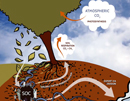
"Soil organisms contribute to a wide range of essential services to the sustainable function of all ecosystems, by acting as the primary driving agents of nutrient cycling, regulating the dynamics of soil organic matter, soil carbon sequestration and greenhouse gas emission; modifying soil physical structure and water regimes, enhancing the amount and efficiency of nutrient acquisition by the vegetation, and enhancing plant health. These services are not only essential to the functioning of natural ecosystems but constitute an important resource for the sustainable management of agricultural systems". ![]() The goals of Member Nations of the Food and Agriculture Organisation of the United Nations (FAO) include food security for all, sustainable agriculture for economic and social development and the sustainable utilization and conservation of natural resources, including land, water, forest, fisheries and genetic resources for food and agriculture. In today's global context, of imbalanced population and economic growth, persisting food insecurity and undernourishment and increasing urban populations and urban poverty, this is a major challenge. In the work of FAO, with its Member countries, it has been widely recognised that there is a need for holistic consideration of soil health and integrated soil management approaches through integrating biological, chemical and physical considerations. The Conference of the Parties to the Convention on Biological Diversity (CBD) identified soil biodiversity as an area requiring particular attention. This initiative for the conservation and management of soil biodiversity and its role in sustainable agriculture, responds to both the decisions of the COP/CBD and the mandate and programme of work of the Land and Water Development Division of the Agriculture Department of FAO.
Biodiversity and AgricultureDefinition of BiodiversityBiodiversity (short for "biological diversity") is a notion, a representation of the complexity or web of life, in all its forms. The Convention on Biological Diversity (CBD) defines biodiversity as "the variability among living organisms from all sources, including terrestrial, marine and other aquatic ecosystems and the ecological complexes of which they are part; this includes diversity within species, between species and ecosystems". Biodiversity and agriculture interactions Practising agriculture means selecting a few species of plants or animals that are useful or edible, and modifying their environment to provide them nutrients/food, water and air, so that they grow in the best conditions. As a result, many farming systems consist of artificial ecosystems with very low biodiversity. This sometimes leads to catastrophic imbalances in the system, threatening natural resources as well as agricultural productivity and thereby endangering human beings. Solutions can only be found through integrated and holistic approaches that pay adequate consideration to the synergies between the soil ecosystem and its production capacity (fertility, water retention, structure, etc.).
To learn more about the context and the work FAO is conducting on biodiversity visit What is Soil Biodiversity and what are its functions? Soil is one of the most diverse habitats on earth and contains one of the most diverse assemblages of living organisms (Giller et al., 1997). Nowhere in nature are species so densely packed as in soil communities (Hågvar, 1998). For example a single gram of soil may contain millions of individuals and several thousand species of bacteria (Torsvik et al., 1994). Soil biota includes Micro-organisms (bacteria, fungi, etc.), Micro-fauna(protozoa, nematodes, etc.), Meso-fauna (acari, springtails, etc.) and Macrofauna (insects, earthworms, etc.). It also includes the roots that grow in the soil and interact with other species above and below ground. Agricultural practices have significant positive and negative impacts on soil biota. Therefore, an integrated approach to agriculture should enhance the biological efficiency of soil processes, in order to maintain soil fertility, productivity and crop protection. This may be useful in modern commercial agriculture, and it is of major importance in marginal lands to avoid degradation, in degraded lands in need of reclamation and in regions where high external input agriculture is not feasible. We are currently updating the website
|
![]() © FAO AGL (2004) ![]() ![]() |
Contact: Webmaster | Last update: 3 November 2003![]() |
| Home | Land | Water | News | Site Map | Contacts | Help |