Objectives of government interference1/
The major instruments and their effects
Some examples of policies being pursued
2.01 It appears to be generally accepted that despite severe technical production problems, national policies play a critical role in livestock development (World Bank, 1981, 9. 55). Not only do they structure the overall economic environment for agricultural production but they often interfere directly with the production processes, trade channels, and consumption, as well as with external trade. The term "policies" requires some explanation at this stage. In many cases it is necessary to distinguish between those policies governments really intend i.e. deliberate policies, and for which they design effective instruments, and those they publicly expouse but which they know will not be effective. The next distinction is between policies which are clearly defined and targeted on dairy imports, consumption or production and the indirect effect of other policies not specially directed towards dairy imports. The effect of exchange rate setting on dairy imports may be cited as an example of the latter. Finally, there is the distinction between policies which are consistent in their resulting effects and those which are not, regardless of the government's original intention. A government may make decisions in two areas which by their spillover effects have a perfectly consistent though unintended influence on a related third area. To take a hypothetical case, consider a government that devalues its currency in order to comply with IMF or IDA credit requirements, and decides to impose a duty on beef exports to increase its tax revenues. By curbing imports and reducing the profitability of beef production the government produces a consistent policy that stimulates dairy production.
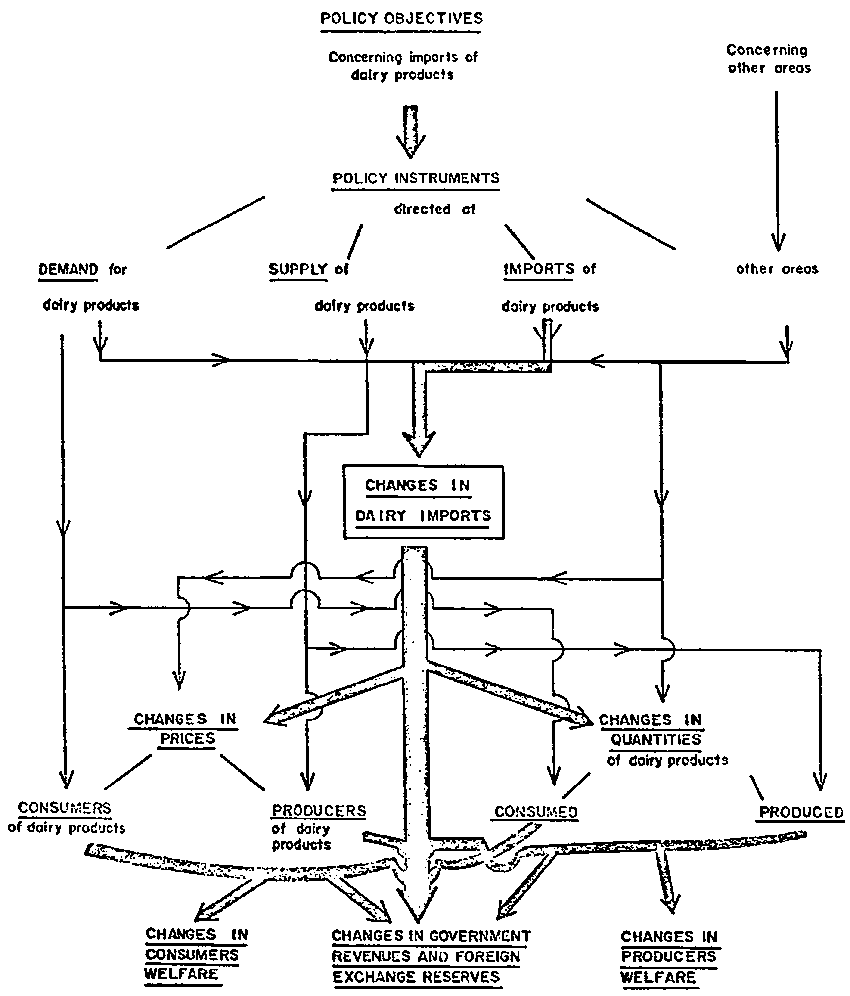
2.02. The following paragraphs discuss some of the most common policy objectives governments pursue in the general areas of food policy and dairy imports in particular. The major instruments to reach these are, presented (paragraph 2.11 et seq.) and some examples from particular countries are given, for illustration (paragraph 2.22 et seq.). Before going into detail, however, the theoretical concept that underlies the discussion should be described. As is shown in figure 5, several causal chains link the policy objectives concerning dairy imports with policy instruments designed to implement these objectives and lead to the final measure of policy impact. The instruments can be directed at the demand and supply sides or directly at dairy imports to influence, along with. any indirect policy, the trade flow in dairy products. Any resulting changes in dairy imports will have a direct influence, on government revenues, and will change the prices for milk producers and consumers
Figure 5: A conceptual model of causality in policies related to dairy imports.
and their respective production and consumption which can in turn, be transformed into welfare figures to complete the chain. The following discussion concentrates on the direct links between government policy and dairy imports.
[1/ Some of the following points concerning policy objectives and instruments assimilate the material prepared for the "Expert Consultation on Agricultural Price Policies" at FAO, Rome, Nov. 29 - Dec. 2, 1983. However, no published report is available yet.]
2.03 As Bates (1983) puts it "bluntly, food policy appears to represent a form of political settlement - one designed to bring peaceful relations between African governments and their urban constituents" (p. 297). If true, this attitude is in marked contrast to that in most developed countries, especially the EEC, where the overall objective has usually been to support agricultural incomes (see Heidhues, 1976). For African countries it seems appropriate to assume that agricultural policies favour the consumer rather than the producer2/. What are the possible objectives behind such policies? Three issues can be mentioned: governments aim to survive; they also have general objectives in the area of food policy; and finally they may have certain, specific objectives relating to dairy imports. To briefly comment on the first two issues, democratic governments will seek re-election and those who came to power by other ways will try to make sure that they are not ousted like their predecessors. Food policy often plays a crucial role in these desires because it has direct effects on the population and their goodwill. Therefore, the objectives of food policy whether it be to secure food supply, to increase self-sufficiency or to support special groups like city dwellers, are often closely related to government self-interest. Of course governments have other objectives (see e.g., Christensen and Witucki, 1982 p. 890) but these are the most common ones.
[2/ Still, for existing policies careful examination is required, as can be seen, for example, from von Braun and de Haen (1983) who show that the actual policy in Egypt turns out to be much less at the cost of agriculture than generally expected.]
2.04 Not all the various policy objectives are necessarily consistent with each other: there may be trade-offs between objectives. Often one objective can only be reached at the expense of cutting back on other ones. To try and provide equally attractive farm incomes and low food prices without imposing huge costs on the national budget - is a typical example where one objective has to be sacrificed for the sake of the others. In the field of dairy import policy six common objectives are discussed below. These are to meet certain milk consumption targets; to generate tariff revenues; to protect producers against world market competition; to save foreign exchange; to stimulate domestic dairy development; and to realise the benefits of free trade. The starting point for the following descriptions relate to a country that is a net importer of dairy products and whose government has no policy on such imports.
The Consumption Targets Objective
2.05 Whether it be vulnerable groups like children or pregnant women or the population as a whole - any increase in milk consumption will substantially improve their overall nutrition. A government wanting to increase milk consumption will have to do so by way of increased imports if domestic production is insufficient or if market links between producers and consumers are weak. The major instruments used to stimulate imports are a reduction in tariffs, import subsidies or (subsidised) state trading and distribution. Alternatively the government can request food aid. Depending on the instruments used there will be some burden on the national budget.
The Tariff Revenues Objective
2.06 In a case where dairy imports already exist, the government can try to make them contribute to the national budget. By imposing an import tariff it will create the desired revenues at the expense of the consumers and/or the external suppliers. Since budgetary considerations are the major force behind such a policy, the economic effects on consumers and producers are given lower priority. Trade-offs may occur particularly between this objective and a policy that sets consumption targets.
The Protection Objective
2.07 Tariffs to raise tax revenues increase domestic prices over world market prices and thereby favour domestic production over imports. The same protective wall around local producers can also be erected by introducing quantitative restrictions, i.e. import quotas, or other non-tariff barriers such as quality requirements, port procedures and fees. In any case, the successful protection of domestic milk producers imposes a burden on consumers, either by way of their having to pay higher prices or through increased taxes that are needed to finance additional government compensation. Again, the protection objective is not compatible with any objective that aims at increased consumer welfare.
The Foreign Exchange Objective
2.08 A government's effort to save foreign exchange is similar in its effects to the protection objective. Dairy imports unless they are in the form of food aid or can be paid for in local currency, can be reduced by one of the above mentioned instruments. The primary effects are the same as in the protection case. However, the secondary effects need to be analysed, to see whether or not the stimulus to milk production increases the demand for foreign inputs. Thus, the net effect on the foreign exchange balance needs to be calculated. In some situations trade-offs occur between the protection and the foreign exchange and/or the tariff revenue objective, although some of the instruments to be used may at first glance seem to serve all three objectives.
The Dairy Development Objective
2.09 It may not be immediately clear how a government can develop the domestic dairy sector other than by reducing imports and increasing domestic prices. However, the dairy development objective can be pursued positively by a channeled increase in imports. Two major strategies emerge: the first strategy is based on the assumption that dairy production needs a minimum level of marketing channels and processing facilities to get off the ground. Where production is scattered and insignificant, dairy imports can help create infrastructure and stimulate demand at the same time. However, many reservations apply and such a policy will usually only be a short-term devices The second strategy is based on the same fundamental assumption but includes the concept of using revenues from sales for investment. As in the Indian "Operation Flood", dairy food aid can be sold locally to generate funds for dairy development. The same procedure is possible with controlled commercial imports if the balance between domestic supply and demand results in prices above world market levels. It is clear that any such dairy development policy incorporates a whole package of policy instruments with dairy import policy instruments prominent.
The Free-Trade-Benefits Objective
2.10 The welfare of particular groups like dairy producers, consumers and the government has been addressed. The last objective to be discussed focusses on the free trade argument whereby overall national welfare is considered to be maximized by the undistorted allocation of resources according to their economic value as expressed in international prices. According to the pure theory governments should not interfere with dairy imports. Does this mean 'trade-without policy'? A minimum requirement for a consistent trade policy would be, according to Tangermann (1982), that "those responsible for running the policy take some interest in how agricultural trade flows and international market conditions develop" (p.2). Under such a premise there is a role for government policy and this does not necessarily conflict with the principle of comparative advantage. In particular, there may be reasons to offset price movements on the international markets that are not true indicators of the supply and demand situation, but merely reflections of other countries' protectionist policies. The instruments used to balance out these market defects, for example, anti-dumping tariffs, will be of a transient nature. They may be supplemented by quality controls, price monitoring and other means to ensure fair competition. The difficulty in such an 'adjusted free trade' policy lies in the inherent temptation for governments to lapse into the protectionist stance they originally set out to combat.
2.11 The following-policy instruments have been mentioned as promoting one or more objectives related to dairy imports import subsidies or subsidised state trading, requests for food aid, import tariffs, non-tariff barriers, import-development packages and instruments to ensure fair competition. In addition there are other less commonly used instruments and combinations of instruments.
Since many are similar in their main effects only differing in minor details, only their major effects will be presented with the details left for specific case studies. In the following paragraphs import subsidies and import tariffs are discussed and their economic implications analysed. Same other instruments will be described briefly before the instruments directed at other major policy areas are discussed.
Import Subsidies
2.12 A common example of an effort to meet milk consumption requirements of specific target groups is that of a school milk programme. Consider the case of previously balanced market where the government does not interfere in dairy imports. Accordingly the world market price Pw is also the relevant domestic price pd (see figure 6).
Figure 6: Economic implications of a targeted subsidy (school milk programme)
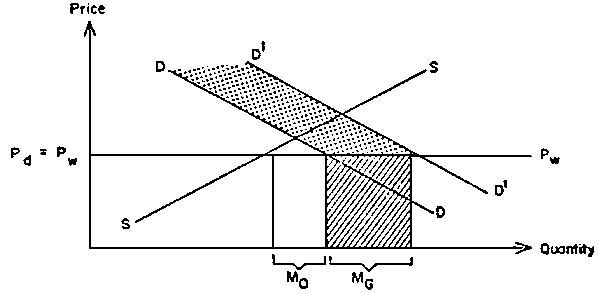
In figure 6, the country imports originally at the price Pw a certain amount MO. The government's decision to implement a school milk programme adds additional demand to the existing domestic market demand thereby shifting the demand curve: to the right (DD ® D1D1)1/.
[1/ For reasons of simplicity D1D1 is drawn parallel to DD. In reality a shift in the demand of one consumer group, i.e. school children, is most likely not only to shift the aggregate demand function but also to change its slope. In any case one would also have to analyse to what extent the subsidised (school milk) demand substitutes for former commercial demand. This substitution also affects the extent of the demand shift.]
The domestic market price is not affected by this shift since the additional demand can be supplied by imports at the prevailing world market price, i.e. the small country assumption applies. The domestic supply SS remains unchanged. The additional imports MG, however, must be paid by government, for the children cannot afford their school milk. This means that the shifted demand curve D1D1 denotes a demand that appears at the market only when the government provides the buying power. Therefore the government's contribution or subsidy equals the value of the additional imports, i.e. the shaded area in figure 6. The change in consumer surplus is denoted by the dotted area above the price Pw and between the shifted demand D1D1 and the original demand DD.
2.13 Had the government wanted to subsidise milk consumption in general rather than for school children in particular, it could simply subsidise dairy imports width a fixed amount S per ton (see figure 7). The domestic price would thereby be reduced to Ps = Pw - S and total imports would increase from MO to MS in figure 7. However, even if the same amount of total imports as in the previous case is assumed, the effects are quite different ones. The decrease in the domestic price has a disincentive effect on producers, i.e. domestic milk supply decreases and the producers' welfare shrinks by the difference between the SS - Pw - triangle and the SS - Ps triangle. The government has to pay the difference of the import bill over the value of these imports at the subsidised domestic price, i.e. the shaded area in figure 7, which is (at the same amount of imports) less than in the school milk programme case since the consumers share part of the bill. The consumers nevertheless gain from such policy because they can consume more at lower prices. Their welfare increases by the difference between the DD - Ps triangle and the DD - Pw triangle in figure 7. Thus in conclusion, the difference between a targeted and an untargeted import subsidy is that the latter has disincentive effects on domestic production whereas a targeting of import subsidy can avoid disincentives or diminish them at least.
Figure 7. Economic implications of an untargeted import subsidy
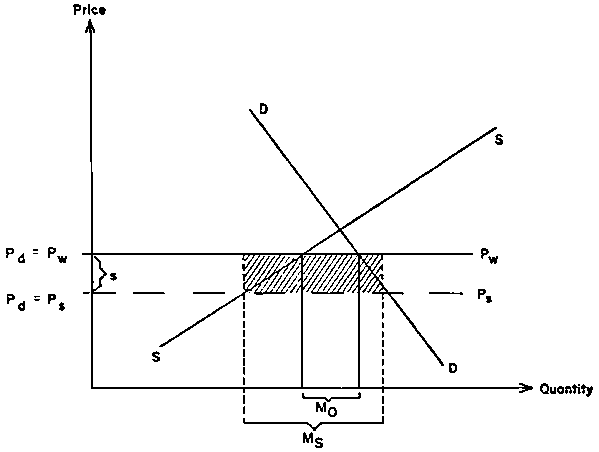
2.14 Some further remarks are called for concerning the implications of dairy import subsidies. First, treating government expenditures and consumers' surplus independently does not tell the whole story because government. expenditure is mainly financed from tax revenues meaning the consumers pay for at least part of their benefits. Second, a different picture emerges if food aid is involved. In figure 6 the government's expenditure could be replaced by free shipments with the same effects on producers and consumers. It is assumed, however, that the extra demand previously did not appear on the commercial market because people lacked the necessary buying power. In figure 7 the availability of food aid would also replace the government subsidy if those imports were simply channelled through to the domestic market. Of course government would benefit from the sales value, i.e. Ms Ps, However, the disincentive effects on producers would remain. Finally, all these calculations also apply where domestic prices are above world market prices and the general effects are the same. The subsidy in figure 7 can be interpreted to denote the effect of other countries' subsidies on their producers, i.e. a decline in world market prices due to protectionist policies of major world market participants. Again, the implications are the same except that the importing country does not have to pay for this. Given past developments in African countries' dairy imports, this interpretation may well describe what actually has happened: depressed world market price levels, basically due to USA and EEC dairy policies, have fuelled Africa's milk demand and dairy imports, thereby hampering the continent's dairy development efforts. However, it remains an open question as to whether a single country benefits from such external subsidies or whether action is necessary to counteract such unfair competition.
Import Tariffs
2.15 In economic terms a tariff has the opposite effects of an import subsidy and needs only brief treatment here. In reversing figure 7 the starting price would simply be PS, MS would denote the tariff, and PW would equal the domestic price including the tariff, i.e. PS + s = Pd. Government revenues then equal that part of the shaded area which results from multiplying imports MO with the subsidy S. With imports being reduced from MS to MO local supplies could increase, thereby adding to producers' welfare what was previously a loss (the area between PW, PS and SS). The consumers would be the losers since milk consumption and real disposable income are reduced as a consequence of higher prices. Their welfare decreases by the area between PW, PS and DD. The overall welfare effect is negative. The consumers' loss exceeds the producers' and government's gains by the two triangles above PS and under SS and DD respectively. By increasing the tariff, government could force supply and demand to balance and no imports would enter the local market.
2.16 It is important to note that the descriptions above are partial analyses which assume all other factors are constant. In areas not included in the diagrams, however, spillover effects may occur and any estimate of overall welfare effects has to be adjusted. To give an example, if a tariff-induced increase in milk production generates employment in the dairy sector this may offset the negative welfare effect of the tariff. Such issues have to be considered before a final judgement can be given. These dynamic effects widen the number of policy objectives that are involved.
2.17 Many African governments have attempted to control trade in foodstuffs directly. They participate in, or even monopolise import activities, by setting up statal or parastatal organisations that often have far-reaching powers. It is hard to generalise about their effects since they can intervene in the market in many ways. Such organisations can be subsidised as well as taxed, reap monopoly rents or have to supply isolated areas with high distribution costs for no extra recompense. All these activities can substitute, complement or offset dairy import policies with the eventual effects on production, consumption, trade and welfare being difficult to assess. In general, state trading tends to act against the market forces rather than reinforcing or complementing them. Frequently, through state trading governments pursue precisely those objectives which the market will not provide for. Keeping consumer prices at an artificially low level despite insufficient supply, or limiting imports in a similar situation are common examples. This often means overall welfare losses. The question 'who gains, who loses' depends on the market situation and on the activity undertaken. The most obvious sign of the effects of state trading against the market forces is the existence of 'black', i.e. free, markets - a common feature of many African countries.
2.18 As has been mentioned, the pursuit of a more complex dairy development strategy will probably involve instruments directed at dairy imports and often use dairy food aid which is bound by certain conditions. The World Food Programme (WFP) dairy projects or the EEC's assistance in national 'food strategies' are examples where specific strategies and programmes use trade policy as a tool. A government's request to be considered as a food aid recipient in a particular year must also be included in the category of measures affecting dairy imports. Such influences have played an increasingly important role in sub-Saharan African countries. Their economic effects have been partly covered in paragraph 2.14.
2.19 The setting of exchange rates is a most important instrument which, while generally used in pursuit of grander objectives, has an impact on dairy imports. The economic interpretation of an overvalued exchange rate is that of an import subsidy; this has already been explained above: in effect an overvalued currency effectively decreases the import price. In a more detailed analysis the overall effects of imported inputs and the distinction between tradeable and non-tradeable goods would need to be considered. In a partial analysis, however, the effect is identical to that of an import subsidy. The reverse applies if the currency is undervalued. During the last decade the exchange rates of many African countries have consistently been overvalued (World Bank, 1983, p. 58). Taken on its own, this would be a decisive influence in boosting dairy imports. In Nigeria, for example, there is strong evidence that the overvaluation of the Naira has substantially fuelled dairy and food imports. However, careful examination of individual countries and their various policy instruments is necessary before reaching any conclusion.
2.20 Price policy is another important issue but it is too complex to be thoroughly covered here. In theory almost all the objectives listed concerning dairy imports can be reached by setting producer or consumer prices. To give an example, by suppressing domestic consumer milk prices below world market levels, a government takes away any commercial incentive to import dairy products and thereby saves foreign exchange. Any pricing policy, however faces the major problem of actually controlling administered prices. Sub-Saharan African milk markets in particular, with their abundance of informal marketing channels and direct producer-consumer links are almost impossible to control effectively. Both Kenya and Mali, to name just two of many possible examples, show at least one additional milk price and respective marketing channel besides the official, controlled market price (FAO, 1981 and 1983b). Apart from the feasibility of trying to reach objectives concerning dairy imports by means of pricing policy, there is the argument of economic efficiency. The most directly applied instrument to reach an objective is likely to be that which is economically most advantageous. A common example is trying to provide higher farm incomes by means of higher producer prices. This inevitably leads to higher economic cost - and presumably financial transfers - than a direct income subsidy because of its distortions on the consumption side (see Ritson, 1977). The experience of the EEC agricultural policy illustrates this point. Similarly, in the example given at the beginning of this paragraph, depressing consumer milk prices to reduce the commercial incentive to import, has then unintended consequence of expanding consumers' demand, possibly beyond domestic supply. The conclusion to be drawn is that the best policy instruments are those that are as closely attached to the respective objective as possible. This means that the best way of influencing dairy imports is through trade policy instruments.
2.21 However, even carefully designed policies can have spillover effects (see Oyejide, 1983) and this complicates any analysis of past effects and makes future policy setting a delicate and complex task. In order to illustrate some of the more theoretical points made and to demonstrate the complexity of the issue, a few examples of actual dairy import policies are given below. This exercise also serves the purpose to further trace the common policy patterns in sub-Saharan Africa that have boosted dairy imports in the last decade. Naturally, within the frame-work of such a general paper only a rather simplistic description of major policies can be given and only tentative estimates about possible effects or causalities can be made. The presentation of these examples is intended to encourage future research, and help in formulating the framework for such research.
2.22 Unlike other policy areas, dairy import policies do not often feature in African government's official statements. This is not surprising since they involve details which do not lend themselves to public speeches or election promises. The consequence is that information on specific objectives about dairy imports is rare. Some FAO and World Bank livestock sector reports include statements on livestock policies but usually these refer to the meat rather than the dairy sector. Partly this reflects the fact that many governments do not have an explicit dairy or dairy import policy. Nevertheless they do have a policy influence.
2.23 Some suitable parameters to indicate dairy import policy patterns would be statistics on tariffs, trade regulations, and marketing patterns. These are often hard to find but two approximations that are readily available are the relative importance of imports in the domestic dairy sector and what proportion of these imports have been commercial. If both variables are relatively high, one conclusion is that the country has followed a policy of relatively open borders, The two selection criteria to identify a relatively open border policy are whether the share of imports in total milk consumption is over 50%, and at least 55% of dairy imports have been commercial (see appendix 4 and table 4). An interesting pattern emerges. Other than the islands in the Indian Ocean, all 18 countries that meet these criteria are located along the West and central African coastline, with the only exceptions being the Central African Republic and Zaire (see table 4). Except for Senegal, which shows a 5% share of the value of dairy imports to total exports, none of these countries' dairy imports seem to put an exceedingly large burden on their foreign exchange account. For Ghana, Nigeria and Senegal the World Bank (1983, p.62) states that they have a high or, in the case of Senegal, medium distortion of the exchange rate, and this may have fuelled dairy imports.
Table 4: - Tentative indicators of an open border policy with regard to dairy imports.
|
|
Imports as % of consumption |
Commercial as % of total imports |
Value of dairy imports as % of total export revenues |
|
Angola |
51 |
84 |
2 |
|
Cameroon |
51 |
83 |
1 |
|
C.A.R. |
56 |
70 |
1 |
|
Congo |
82 |
92 |
1 |
|
Gambia |
68 |
75 |
n.a |
|
Ghana |
88 |
70 |
1 |
|
Guinea Bissau |
57 |
66 |
n.a |
|
Ivory Coast |
94 |
99 |
3 |
|
Liberia |
94 |
90 |
1 |
|
Mauritius |
77 |
91 |
n.a |
|
Nigeria |
66 |
99 |
2 |
|
Reunion |
82 |
99 |
n.a |
|
S. Tome |
83 |
68 |
n.a |
|
Senegal |
60 |
81 |
5 |
|
Seychelles |
83 |
88 |
n.a |
|
Sierra Leone |
69 |
65 |
2 |
|
Togo |
64 |
72 |
1 |
|
Zaire |
91 |
84 |
3 |
SOURCE: see Appendix 4.
Again, the speculative character of such calculation must be stressed and before any more profound conclusions can be reached, national price statistics for dairy products must be available. Were such price data available, the ratio between domestic and import prices in relation to the quantities imported would allow much more insight.
2.24 Kenya, Tanzania, Botswana and Mali are countries for which some information is available. These countries are located in two markedly different ecological zones and thereby feature different milk production patterns and supply potential, i.e. pastoral semi-subsistence in arid or semiarid areas vs. intensive mixed crop-livestock farming in the highlands. The following descriptions include the findings of country studies within the International Scheme for the Coordination of Dairy Development (ISCDD) (FAO, 1978b, 1979, 1981, 1982 and 1983b). The results of the studies have been approved by the respective governments and it can be assumed that statements about policy objectives and activities they contain more or less mirror the governments' attitude towards their dairy sectors.
2.25 Kenya is generally believed to have the potential for meeting domestic milk demand and throughout the 70's the trade balance in dairy products showed a modest export surplus. The government encourages development of regional cooperative dairies to improve market outlets; maintains growth of smallholder milk production; aims to improve nutritional levels and to provide "a stimulus to dairy development" with a school milk programme; and promotes a change to zero grazing systems in the high potential areas where more than three quarters of all dairy cattle are located (FAO, 1981, p.2 f). The trade-off between producer and consumer welfare is alleviated by the government's commitment to and financing of a school milk programme. The major policy instruments used consist of: setting a basic price at the producer and retail level; providing artificial insemination, animal health and other extension services; and running the school milk programme. The Kenyan Ministry of Livestock Development (1980, p. 34) also records the existence of a 50% import duty and a 15% sales tax on dairy products which it wants to be removed at times of strong import demand. Beyond that, no articulate dairy import policy emerges. However, fast increasing demand and the school milk programme led to a milk deficit in 1979/80 which is likely to persist throughout the 80's. The policy influence of creating extra demand for milk is obvious in this case and has been realised by the government (Ministry of Livestock Development, Kenya, 1980, p. 32f). Since 1983, the FAO - World Food Programme (WFP) is providing milk powder and butter-oil shipments to support the Kenyan government-with its school milk programme (FAO-WFP, 1983).
2.26 In interpreting this developments one can conclude that the more general measures on the production side, e.g. input provision could not match the effects of government policy on the demand side. The role of price setting and the adequacy of the marketing system would need further analysis in this respect. The government's reactions, in terms of calling in the WFP and of considering a tax reduction for dairy imports, are well-targeted steps in an import policy, but their effects cannot be seen as yet. The Kenyan example shows how easily a fairly balanced market can be disturbed by government interference. It also shows that different periods are needed for policy instruments to become effective: stimulating milk production is unlikely to show quick effects, whereas dairy imports and the consumer tend to react immediately to incentives.
2.27 In Tanzania, as in Kenya, a large share of the total milk production is retained on farms for food and feed use. Government has followed a long-term dairy development plan since 1975 and claims to piece high priority on the growth of the dairy industry (FAO, 1979, p. 77). The policy objectives behind it are gradually to substitute for the dairy imports which represent about one-fourth of total consumption (see App. 4); to strike a balance between affordable consumer prices and remunerative producer prices so as to increase milk production and supplies to the urban markets. Imports are subject to licensing but according to FAO (1979, p. 89) they are not severely restricted. Imports as food aid are mainly under WFP or stem from the EEC. Total imports equal about 11,000t ME (av. 1980-82) or roughly 6 kg ME per head of population. Despite the stated objectives only irregular and insignificant adjustments to producer prices were made between 1975 and 1980, but prices have more than trebled in the last three years. Now there is a dual price structure, both between regions and between official and free market prices. Milk consumption per head of population is significantly higher in urban than in rural areas; and some processing plants and, therefore, the areas they supply, depend largely on imports for recombination (FAO, 1979, p. 29f).
2.28 There is increasing reliance on imports for the supply of urban areas. Although, at least since 1980, this did not have direct negative effects on. producer prices there is always the danger of severe market disruption. Urban and rural markets tend to be separated to the point where processing plants neglect or even stop collecting fresh milk; in the end the necessary infrastructure breaks down or is never developed. A careful examination will be necessary to see how consumption and price levels in urban and rural areas can be balanced to offset the effects of past government policy. As in the Kenyan case, fostering milk production seems to require longer term strategies and consistent policies throughout, whereas milk consumption and imports are easily manipulated.
2.29 In the case of Botswana government policy and activities are heavily biased towards the beef industry. Unlike Tanzania and Kenya, there is little scope for the development of an intensive dairy industry. Nevertheless, government states as its objectives "to promote dairy production as part of its import substitution policy" and to provide the incentives needed to "generate small farmer dairy development around the major towns" (FAO, 1982, p. 1 f). All imports are subject to exchange control but there is no special control of dairy imports; these account for 10% of all food, beverages and tobacco imports and for an estimated 30% of Botswana's consumption (FAO Trade Yearbook, FAO Production Yearbook). In the absence of price setting, Botswana's milk prices are influenced by those of the Republic of South Africa and its Dairy Control Board which is the main supplier of Botswana's imports (FAO, 1982, p. 10 f). With increasing pressure to reduce imports substantially the government would have to change its present policy to one of controlling dairy imports and providing price support and/or input subsidies. Although there is a possibility of slightly higher production (Konandreas et al, 1983, in particular p. 43) such a policy is likely to lead to overall welfare losses (FAO, 1982, p. 14) .
2.30 Botswana's direct policy towards the dairy sector so far has been laissez-faire. However, the impact of its beef policy and the substantial subsidies incurred (see Hubbard, 1983, p. 270 f.) must be taken into account for an overall picture of national policies. In comparison with Kenya and Tanzania the income implications of domestic milk production seem to be less important. Obviously, the policies pursued must be different in Botswana from those in the previous examples. A policy aiming at intensified dairy development would have to be critically analysed for its overall welfare Implication
2.31 The last example to be described is Mali,1/ a country with low potential for intensive milk productions. However, the economic importance of livestock is substantial (Wilson et al., 1983, p. 18 f and FAO, 1978, p. 44). Until now milk policy had effects only in the Bamako region where the country's one milk processing plant Union Laitiere de Bamako (ULB) is located. This reflects both the government's objective to provide the capital with a reasonable supply of milk and the fact that the majority of milk production in rural areas is consumed there (FAO 1978, p. 49). Consequently, on the fresh milk market only ULB buying and selling prices are subject to price fixing and. government control. However, effects on the supply side, are negligible since the plant's output is almost exclusively recombined milk. On the demand side, it is interesting to note that the prices for direct sales of fresh milk in Bamako are about 50% above the official ULB retail price for recombined milk. This apparently reflects consumer preferences since no black market for ULB milk exists. Commercial imports are subject to licensing and foreign exchange allocation and the parastatal SOMIEX has a monopoly on imports of milk powder and condensed milk in cans. A total of 25,000 t dairy products (in ME) was imported on average 1980-82, including about one third as food aid. According to FAO (1983b, P. 18) more than half of those total imports are consumed in Bamako but this figure may be an underestimate. The capital's estimated milk consumption in 1984 is believed to be 20-25 kg ME per caput. In some parts of the country especially in the northern pastoral areas per caput milk consumption is substantially higher. However, no reliable production figures are available to derive exact figures for milk consumption in Mali.
[1/ Part of the information below was acquired from unpublished sources during early 1984; the results will be published in due course.]
2.32: The role of the Malian government seems to be somewhat similar to that of Botswana. The main problem is the effects of imports on consumption and production resulting from ULB and SOMIEX policy and price setting. The interactions between ULB and the free market as well as ULB's role as a market outlet for local milk producers are crucial for dairy development in the Bamako region (see also von Massow, 1984).
2.33 From the four country examples it appears that government policies seem to be mainly influenced by the agroclimatic potential and the production systems and their respective potential. Government interference seems to be stronger in the high potential countries, whereas in the case of Botswana and Mali, policies and their application are uncertain. At least in Kenya, Tanzania and Mali dairy imports are such that special import policies are already pursued or seem necessary. This is likely to hold true for quite a number of sub-Saharan African countries.