K.J.N. Ndamukong
Mankon Station
Institute of Animal Research
P.O. Box 125 Bamenda Cameroon
Introduction
Materials and methods
Results
Discussion
Acknowledgements
Summary
Mortality in small ruminants was examined under semi-intensive management at the research station at Mankon, Cameroon, and under traditional village management. Mortality rates as influenced by type of birth, sex and age were compared in local and exotic breeds. Significantly more kids than lambs died (P<0.01). Mortality rates were higher in offspring of twin/triplet births than in those of single births. More singles of goats died than of sheep. In all cases except local goats, the highest number of deaths occurred during the first four weeks, the majority dying soon after birth, the mortality rate in this group being higher amongst lambs than kids. More weaned kids than lambs died. Compared to kid/lamb mortality, adult rates were generally lower. Exotic breeds had higher mortality than local breeds. Mortality rates were generally low for all animals reared under the traditional management system. Among exotics, breed differences in mortality rates were not significant (P>0.05). There was no apparent variation in mortality rate during the dry and rainy seasons except in the traditionally managed sheep and goats where the mortality rate was higher in the rainy season. Except where otherwise identified, causes of death were considered to be a complex of nutrition, management and disease factors. The implications of these findings are discussed.
Sheep and goat production in Cameroon is largely in the hands of village farmers who rear them in small flocks of one to ten sheep or goats. A few farmers keep higher numbers, up to three hundred in some cases. Larger flocks (300-800) are found at Government livestock and research stations.
Management of small ruminants at Government stations is semi-intensive. At the Animal Research Station in Mankon, for example, the animals are fed 500 g of 16 per cent protein concentrate (cotton seed cake, corn and rice bran mixture) in the morning, allowed to graze in fenced paddocks for about eight hours during the day and then penned for the night. The traditional village management system requires tethering of animals during the cropping season but allows free range grazing during the non-cropping season.
The principal indigenous breeds of goats in Cameroon are the Cameroon Dwarf and the Red Sokoto. Indigenous sheep breeds include Dwarf Forest sheep, Blackbelly, Fulani Bornu, Fulani Ouda, Foulbe and Kirdi (Masse). In addition to these indigenous breeds, some exotic breeds were imported several years ago for adaptability studies and possible use in upgrading local animals for milk and meat production. Exotic goat breeds include Saanen, Nubian and Toggenburg and exotic sheep include Suffolk, Dorset and Katahdin.
Increased productivity of small ruminants in the tropics is thwarted by poor management which predisposes the animals to disease. Productivity rates are therefore generally low with low kidding/lambing percentages and high mortalities. Peters et al (1981) reporting on low income economic units in West Malaysia indicated an average loss in kids of 14.3 per cent, with a range from 7.4 per cent under intensive to 17.4 per cent under semi-intensive conditions. Adult losses were 6.4 per cent in a range from 3.6 per cent in intensive systems to 7.5 per cent in semi-intensive and semi-extensive ones. Wilson (1982) recorded pre-weaning losses of up to 40 per cent in goats and 30 per cent in sheep and up to 10 per cent in older animals. Losses due entirely to disease were difficult to categorize. Gall & Huhn (1981) report losses of 30-40 per cent of the goat stock, with the young animals being the most strongly affected.
Nutrition has been shown to have a bearing on the severity of infection and the ability of parasites to invade tissues and produce lesions (Rick, 1970). Shortage of food often aggravates parasite damage so that goat stocks suffer severe losses as a result of lowering of resistance (Kurtze, 1982).
Wilson (1982) pointed out that despite the availability of a voluminous and rapidly growing literature on small ruminant disease, real causes of most mortalities are only suspected rather than known. This is because, except in clear-cut cases, death usually supervenes as a result of a complex of factors involving nutrition, management and disease.
In Cameroon data on livestock numbers and accurate assessment of disease, mortality and morbidity rates are not readily available for small ruminants yet this information is indispensable if any positive steps are to be taken to increase productivity. This paper is an attempt to assess mortality rates not only under the traditional village management but also under semi-intensive management at the Animal Research Station in Mankon, Cameroon.
Routine records on births and deaths and veterinary reports on post-mortem examination findings kept at Mankon were analysed. Kid and lamb mortality rates were measured over the period for which accurate records were available. A preliminary survey of disease problems and mortalities in sheep and goats under traditional village management was carried out in Mezam and Momo divisions of Cameroon by use of a questionnaire for the year 1984. Significant differences in mortalities were tested using chi-square.
Mortality rates for kids and lambs are presented in Table 1 and for adults in Table 2. The data are based on mortalities in lambs and kids born at Mankon Station between March 1984 and May 1985 and on traditionally managed kids and lambs from interviews with 40 farmers randomly selected from Mezam and Momo Divisions. From Table 1 it can be seen that more deaths occurred among offspring of twin/triplet births than those of single births. Whereas mortalities occurred at about the same rate in twins/triplets of sheep and goats, significantly more singles of goats died than of sheep (P<0.01). The overall mortality rate was significantly higher (P<0.01) in kids than in lambs and more males than females died. Adult mortality rates were higher for exotic than for local breeds, this being significant (P<0.01) in sheep. Of 35 goat and 15 sheep farmers interviewed, 48.6 per cent with goats and 46.7 per cent with sheep reported the incidence of losses in their flock. In this sector losses on average were higher in kids and adult goats than in lambs and adult sheep.
Table 1. Kid and lamb mortality rates at Mankon station and under traditional management in Cameroon
|
Animal type |
Number in sample |
Mortality rate (per cent) |
|||||
|
Singles |
Multiples |
Males |
Females |
Overall |
|||
|
Station kids: |
local goats |
74 |
42.0 |
50.0 |
54.8 |
37.2 |
44.6 |
|
dairy goats |
61 |
51.5 |
71.4 |
62.2 |
58.3 |
60.7 |
|
|
all goats |
135 |
45.8 |
61.5 |
58.8 |
44.8 |
51.9 |
|
|
Station lambs: |
local sheep |
111 |
19.8 |
75.0 |
32.0 |
31.1 |
31.5 |
|
exotic sheep |
27 |
21.1 |
50.0 |
27.3 |
31.3 |
29.6 |
|
|
all sheep |
138 |
20.0 |
67.9 |
31.1 |
31.2 |
31.2 |
|
|
Traditionally managed kids |
143 |
|
|
|
|
23.8 |
|
|
Traditionally managed lambs |
35 |
|
|
|
|
8.6 |
|
Table 2. Adult mortality rates in sheep and goats in Cameroon
|
Animal type |
Number in sample |
Mortality rate (per cent) |
|
|
Station goats: |
local |
229 |
23.1 |
|
dairy |
89 |
33.7 |
|
|
Station sheep: |
local |
219 |
11.4 |
|
exotic |
47 |
36.2 |
|
|
Traditionally managed goats |
287 |
15.7 |
|
|
Traditionally managed sheep |
92 |
15.2 |
|
A breakdown of mortalities in kids and lambs by age (Table 3) shows that comparatively more kids of dairy goats and lambs of local and exotic sheep died between birth and four weeks of age, the majority dying within the first day of life. Very few kids of the local goat breed died within the same age range.
Table 3. Age specific mortality rates in kids and lambs in Cameroon
|
Age group (weeks)
|
Mortality rate in kids (per cent) |
Mortality rate in lambs (per cent) |
||||
|
Local Breeds |
Dairy Breeds |
Overall |
Local Breeds |
Exotic Breeds |
Overall |
|
|
0-4 |
3.0 |
32.4 |
18.6 |
68.4 |
37.5 |
63.0 |
|
4-8 |
21.2 |
16.2 |
18.6 |
5.3 |
12.5 |
6.5 |
|
8-12 |
30.3 |
21.6 |
25.7 |
7.9 |
37.5 |
13.0 |
|
12-16 |
12.1 |
13.5 |
12.9 |
7.9 |
12.5 |
8.7 |
|
>16 |
33.3 |
16.2 |
24.3 |
10.5 |
- |
8.7 |
A comparison of breed mortality rates showed no significant differences (P>0.05) among the exotic breeds of each species. Similarly there was no significant variation of mortality rate during the dry and rainy seasons except for traditionally managed animals where mortality was higher during the rainy season.
Case histories of animals that died at Mankon Station and in the villages are shown in Table 4. The frequency of the different diseases was not significantly different between sheep and goats. For the animals under traditional village management, only diseases and ailments known to the farmer were considered. The common post-mortem examination findings for the Station are presented in Table 5.
Table 4. Occurrence of disease in sheep and goats at Mankon station and under traditional management in Cameroon
|
Disease syndrome
|
Mankon station (per cent) |
Village management (per cent) |
||
|
Sheep |
Goats |
Sheep |
Goats |
|
|
Weakness/Emaciation |
28.6 |
25.0 |
7.7 |
5.1 |
|
Diarrhoea |
7.1 |
19.1 |
38.5 |
25.6 |
|
Pyrexia |
7.1 |
11.8 |
- |
- |
|
Recumbency |
3.6 |
8.8 |
- |
1.3 |
|
Inappetence |
14.3 |
5.9 |
15.4 |
2.6 |
|
Dullness |
- |
5.9 |
- |
- |
|
Sudden death |
3.6 |
5.9 |
- |
2.6 |
|
Anaemia |
14.3 |
2.9 |
- |
- |
|
Salivation |
7.1 |
2.9 |
- |
2.6 |
|
Dyspnoea |
7.1 |
2.9 |
- |
- |
|
Lameness |
- |
2.9 |
- |
2.6 |
|
Anorexia |
3.6 |
2.9 |
- |
- |
|
Nasal discharges |
- |
1.5 |
7.7 |
12.8 |
|
Abortion |
3.6 |
1.5 |
- |
- |
|
Coughing |
- |
- |
7.7 |
7.7 |
|
Helminthiasis |
- |
- |
7.7 |
3.8 |
|
Mange |
- |
- |
- |
9.0 |
|
Others |
- |
- |
- |
3.9 |
Table 5. Post-mortem diagnoses of diseases in sheep and goats at Mankon Station, Cameroon
|
Post-mortem examination findings
|
Percentage frequency |
|
|
Sheep |
Goats |
|
|
Gastro-enteritis |
11.1 |
16.5 |
|
Pneumonia |
- |
16.5 |
|
Congestion of blood vessels/organs |
11.1 |
13.6 |
|
Hydropericardium |
29.6 |
13.6 |
|
Hydrothorax |
11.1 |
11.7 |
|
Helminthiasis |
18.5 |
8.7 |
|
Oestrus ovis larvae |
- |
7.8 |
|
Anaemia/emaciated carcass |
11.1 |
4.9 |
|
Intestinal torsion |
3.7 |
3.9 |
|
Hydroperitoneum |
7.4 |
2.9 |
This study confirms that the mortality rate is generally higher in kids and lambs than in adults. The results agree with Halpin (1975) who pointed out that the age of the animal has a great effect on its ability to withstand attack by both physical and biological agents. Thus younger animals are particularly susceptible to certain enteric and respiratory infections since they lack immunity. This age group therefore requires greater protection from the harshness of the environment through provision of adequate nutrition, housing and management.
Offspring of twin/triplet births were more prone to death from any cause than offspring of single births. This finding agrees with observations by Wilson (1976a) who pointed out that the death rate of twin lambs was almost twice that of single lambs. Twins/triplets are usually weaker and most of them die of weakness and failure to drink milk soon after birth. Dunn (1982) emphasized that this first milk is essential to provide energy for the kid/lamb, without which it will starve and chill to death. Thus, unless the dam is a good mother, the newly born young should be helped to suck as soon as possible. The time factor is important because the neonate intestine can only absorb colostrum for a time limited to about twelve hours (Dunn, 1982). Newly born kids are comparatively stronger than lambs and so have a greater chance of obtaining colostrum from the mother even if not helped, hence the fewer deaths in kids than lambs between birth and four weeks of age. The first week of life is critical for survival and so greater attention should be given to ensuring that the dam is receiving high quality nutrition in order to produce sufficient milk for its young. Both young and dam should preferably be confined together during this first week. Wilson (1976a) confirmed this observation and attributes many deaths to mismothering. The high mortalities between two and three months are due to debility and weakness, probably as a result of poor lactation performance of the dams and a lack of adequate forage once the dry season has commenced (Wilson, 1976a).
Adult mortalities were higher among exotic than local breeds and among local goats than local sheep. It is now generally agreed that local breeds are more adapted to their environment than exotic breeds and so are more resistant to infection. In terms of disease alone, one might expect a higher mortality rate in sheep than goats because, as Williamson & Payne (1974) have said, sheep are more susceptible to the ill-effects of intestinal parasites than other livestock. Mortality rates in the traditionally managed stock were considerably lower than on station and were approximately the same for both species.
A careful look at the disease syndromes and signs recorded in this paper show the need for improved nutrition and better housing and management. Two points mentioned by Peters et al (1981) need to be re-emphasized here: intensification of control and care of kid/lamb rearing and improving the standard of herd hygiene and disease monitoring. If this is done, most of these disease problems can be overcome and mortality rates in small ruminants could be considerably reduced.
I acknowledge my indebtedness to Fabian Ekue, Alphonse Nfi, Daniel Awa and John Tamufor for allowing me access to the veterinary reports on post-mortem examinations. I also thank Moses Asanji for his patience in reading through the manuscript and making valuable criticisms. The Cameroon Government provided the funding for this work.
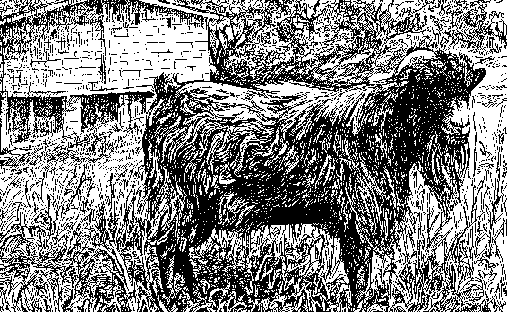
Cameroon grassland (West African Dwarf type) buck at Mankon Station, Cameroon