


D. McKinnon & A. Rocha
Institute of Animal Reproduction and Breeding
C.P. 25 Matola Mozambique
Introduction
Material and methods
Results
Discussion and conclusions
Summary
The comparative performances of Nguni sheep and Landim goats reared at Chobela Experimental Station are described. Goats have the better reproductive performance, but both species are rather prolific. Late age at first parturition and long inter-parturition intervals seem to be a result of management, as recent results tend to show considerable improvement in these parameters. Sheep seem to be more seasonally affected than goats related to better periods for mating/lambing. Mortality rates are not as high as could be expected. No significant advantage in growth rate exists for sheep over goats in the early ages. Subjects for future investigation at station level are proposed. As investigations done on station may not reflect the actual situation in the traditional sector it is considered important to launch a programme of research at village level.
Small ruminants in Mozambique play an important role in the life of the peasant farmer, not only providing meat and cash all year round but also having an important place in certain aspects of traditional village life. They can be found in areas where cattle do not exist: tsetse fly infested country; in the drier areas where their advantages over cattle are most pronounced during extreme drought seasons; and in the boundaries of the urban zones where cattle cannot be reared. Small ruminants are kept mainly in agro-pastoral systems under sedentary management although in some drier areas pastoral/transhumant systems can be found.
The native fat-tailed sheep belong to the Nguni type (Mason & Maule, 1960) and the goat is of the Landim type, described by the same authors. Both species are referred to in Mozambique by the name Landim. Another type of goat, the Pafuri (Mason & Maule, 1960), is to be found in an area in the south-west of the country but their number is very limited.
There is no recent census on the number of small ruminants. Censuses done by two different governmental departments for the same year - 1969 - gave 1.95 and 0.64 million head respectively, with a ratio of sheep:goat of 1:10 and 1:4 (Anon. 1969-1971; 1972). In the same way other aspects of small ruminants, including characteristics of the native breeds, are largely unknown although some work has been done at Chobela Experimental Station (Pinho Morgado, 1955; Paiva do Amaral, 1969).
The present work attempts a comprehensive description of the main characteristics of economic importance for Nguni sheep and Landim goats at Chobela, in order to clarify the characteristics of the breeds and identify the more important fields for future investigation.
Chobela has an area of 3000 ha and is located on the right bank of the Nkomati river, at 25°00'S and 32°14'E, 40 m above sea level. Average rainfall is 700 mm, ranging from 550 to 950 mm. Most rain falls in the hot rainy season from November to April. Mean relative humidity is 71 per cent. Annual average temperature is 23°C, the minimum being 7-10°C in June and July with maximum temperatures of 45°C in November to January.
The main grasses are Themeda triandra, Urochloa pullulans, Panicum maximum, Digitaria spp. and Eragrostis spp., Typical trees are Acacia subalata, and Acacia mossambicencis. Increasing bush encroachment by Sclero cafra can be seen. Other species utilized by small ruminants (especially goats) are Amaranthus deflexus, Panthemin hysterophorus and Crotalaria monteire plus small amounts of the introduced Leucaena leucocephala.
The Chobela flocks comprise 170 and 130 breeding females, sheep and goats respectively. Breeding is year-round, with three per cent of males. New born animals are kept indoors until two months and then allowed out with their dams for one month before being weaned at three months: males are separated from females at weaning. The animals are allowed to graze/browse in a restricted herding system (<8 hours), starting at 07h30 and are confined in the afternoon. At this time water is provided and some hay is also occasionally given, especially to weaned and sick animals.
Adult animals are treated against taeniasis, round worms, and coccidiosis, before and after the rainy season. Weaned animals receive the same treatments every three months until they are one year of age. Animals are dipped for tick control at intervals of one to three weeks, depending on the level of infestation.
Data on reproductive performance, measured as number of parturitions and number born per mated female per year were calculated for 1983 and 1984, as well as litter size. For the study period, each ewe and doe had an average of 1.24 and 1.28 mating seasons per year respectively.
Mean ( ), standard error (s.e.) and coefficient of variation (cv) were calculated (on a preexisting data set) for age at first lambing/kidding, for first parturition interval and for total parturitions intervals, for the period 1962 to 1970 in the case of sheep and 1955 to 1970 in the case of goats.
Twinning percentages were also calculated for total parturitions and individually from the first to the seventh parturition for periods between 1962 to 1970 and 1955 to 1970 for sheep and goats respectively and compared with the results from the 1982-1983 first and second parturitions.
The relationships between season of mating/season of parturition and number of young born and their viability up to eight months were also determined for both species, with reference to the birth season 1983-1984.
For the same period, the mortality rate of adults, and from birth to eight months old are presented, as well as the comparative mortality of singles and individual twins.
Weights at birth, three, six and twelve months for 1983 were calculated for sheep and for goats.
Standard statistical procedures were utilized for data analyses.
Number of parturitions, number of young born and litter size, are presented in Table 1. An average of 63 per cent of ewes lambed in each breeding season while 71 per cent of goats kidded.
The figures for age at first lambing/kidding, first parturition interval, and all parturition intervals for the period 1962-1970 in the ease of sheep and 1955-1970 for goats are shown in Table 2.
Percentage of total parturitions and percentage of parturitions for the first to the seventh lambing/kidding are shown in Figure 1 for the period 1962-1970 and 1982-1983 for sheep, and 1955-1970 and 1982-1983 for goats.
The relationships between season of mating/season of parturition and number of young born and their viability up to eight months are presented in Table 3, for animals born in 1983 and 1984.
The total mortality rate for years 1983-1984 was very similar for both species (16 per cent for sheep and 15 per cent for goats) and for animals to eight months of age it was 20 per cent. Mortality was 63 per cent and 71 per cent for individual twins, in the case of sheep and goats, respectively.
Table 1. Reproductive data for years 1983 and 1984 for small ruminants in Mozambique
|
Species |
n
|
Births |
Total young |
Litter size |
||
|
n |
%1) |
n |
%1) |
|||
|
Sheep |
340 |
269a |
79.1 |
366a |
107.6 |
1.36 |
|
Goat |
260 |
239b |
91.9 |
388b |
149.2 |
1.62 |
Note: 1) % of females in sample
Means in the same column without a common superscript differ significantly (P < 0.01)
Table 2. Age at first birth, first parturition intervals and total parturition intervals (days) in Mozambique
|
|
Age at first birth |
Interval between first and second parturition |
Total parturition interval |
|||||||||
|
n |
|
cv |
n |
|
cv |
n |
|
cv |
||||
|
Sheep |
115 |
772a |
12 |
17 |
92 |
400 |
12 |
29 |
346 |
360a |
8 |
39 |
|
Goats |
155 |
738b |
12 |
17 |
122 |
390 |
12 |
33 |
401 |
391b |
6 |
34 |
Means in the same column without a common superscript differ significantly (P<0.05)
Figure 1.1 Distribution of twin births by parity for two different observation periods in sheep in Mozambique
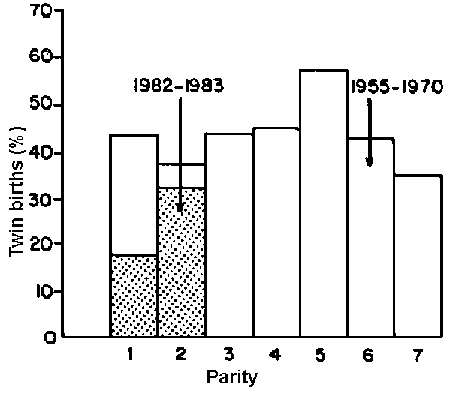
Figure 2.1 Distribution of twin births by parity for two different observation periods in goats in Mozambique
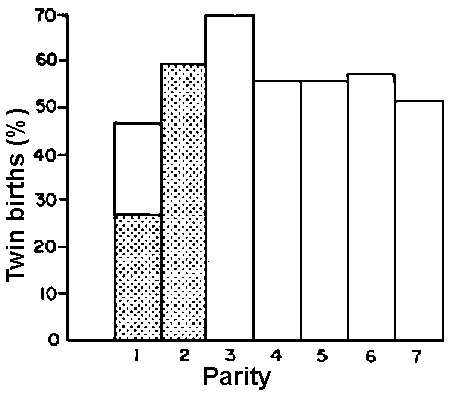
Table 3. Relationships among timing of reproductive events, number of young born and viability in Mozambique sheep and goats
|
Species |
Mating season |
Lambing season |
Females (%) |
Young born as % females |
Viability at 8 months as % of births |
|
Sheep |
Dec-Mar |
May-Aug |
225 |
100.4 |
78.7 |
|
Apr-Jul |
Sep-Dec |
76 |
69.7 |
84.9 |
|
|
Aug-Nov |
Jan-Apr |
118 |
73.7 |
91.9 |
|
|
Goats |
Dec-Mar |
May-Aug |
99 |
121.2 |
75.3 |
|
Apr-Jul |
Sep-Dec |
133 |
115.0 |
83.7 |
|
|
Aug-Nov |
Jun-Apr |
102 |
112.7 |
77.4 |
Weights of animals at birth, three (weaning), six and twelve months of age are presented in Table 4 for animals born in 1983.
The reproductive parameters presented have shown that in au but one of the reproductive traits analysed goats were better than sheep. This is in agreement with the findings of other authors (Peacock, 1982; Wilson, 1982; Okello & Obwolo, 1984). Sheep had a significantly shorter (P<0.01) parturition interval than goats (Table 2). However, this can be partially due to failing to incorporate individual does regularly at the mating season, as in the type of management practiced on the station goats are more difficult to control than sheep.
Paiva do Amaral (1969), working at the same station, found a 79.9 per cent lambing rate, from which 64.0 per cent were twin births: the former value is very similar to the 79.1 per cent lambing rate in the present study but twin births in this study were only 44.6 per cent. However, even the lower figure for twinning rate compares favourably with other African races of sheep reared under experimental station conditions (Fall et al, 1982), in the Masai pastoral system (Peacock, 1982) and under central Mali's traditional management (Wilson, 1984), where values of 12 per cent, 3.9 per cent and 6.0 per cent, respectively, were found.
Table 4. Mean weights for age (kg) at four ages for Mozambique goats and sheep
|
Species and sex |
Mean weight |
||||
|
Birth |
3 m |
6 m |
12 m |
||
|
Sheep: |
|||||
|
|
males |
2.3 |
8.5 |
18.0 |
- |
|
|
females |
2.3 |
8.5 |
16.0 |
21.1 |
|
Goats: |
|||||
|
|
males |
2.4 |
8.9 |
13.5 |
25.2 |
|
|
females |
2.2 |
8.2 |
12.3 |
21.6 |
The Landim goat with a litter size of 1.62 and 56.7 per cent twinning rate compares very favourably with the 10-15 per cent multiple birth rate attributed to the other indigenous breeds of East Africa (Mason & Maule, 1960). It has a slightly inferior twinning percentage to the 59 per cent reported for the West African Dwarf goat under experimental station management (Oppong & Yebuah, 1981).
The late age at first parturition (Table 2) seems to be largely a result of management rather than an expression of late maturing animals since by putting females to mating at a younger age during the period from September 1982 to January 1984 a highly significant (P<0.001) age reduction at first parturition was achieved - from 772 to 614 days for sheep and 738 to 590 days for goats. In the same way utilization of more than one mating season per year reduced the first inter-parturition interval (400 to 384 days for sheep, and 390 to 348 days for goats) although this was not significant (P>0.05) the non-significance probably being due in part to the problems of early detection of non-pregnant females thus not allowing a prompt re-mating of these animals.
The decreased age at first parturition resulted in a decreased percentage of twin births at this stage but the percentage of twins at second parturition returned to the "normal". The pattern of twinning expressed in Figure 1 shows that sheep have maximum twinning at the fifth parturition, while for goats maximum twinning percentage was achieved at the third parturition.
In Table 3 it can be seen that the better mating season for sheep seemed to be March (rainy season), the worst being the dry season period that ranges from April to July. Goats seemed to be less affected by season of mating, achieving the best results during the dry season mating. Explanations for these results might be found in the different feeding behaviour of the two species. Sheep, being predominantly grazers, should be more affected by the drop in nutritional value of the native grasses during the dry season. Goats' browsing behaviour should allow them to maintain a better nutritional status as a result of utilizing leaves and husks of shrubs and small trees, simultaneously being less affected by gastro-intestinal parasites. However the observations cover only two birth seasons and more information is needed before definite conclusions can be drawn.
The mortality rates - 16 per cent for sheep and 15 per cent for goats - are not high, compared with results elsewhere in Africa (Oppong & Yebuah, 1981; Fall et al, 1982; Mack, 1982; Wilson, 1982; Wilson et al, 1984). However, the mortality results presented for sheep are much higher than those previously found by Paiva do Amaral (1969) who reported very low mortality rates -1.6 per cent and 9.0 per cent for adult and young animals respectively. The higher mortality rate for individual twins in comparison to singles is in agreement with the results presented by Peacock (1982) in Kenya. While in Kenya individual twins had higher mortality in sheep than in goats the opposite was found at Chobela where individual twin goats had a higher mortality rate (71 per cent) than sheep (63 per cent).
The weights of sheep and goats were similar at birth and weaning (three months) but at six months sheep were heavier, both for females and males, although at one year, females of both species had the same weight. Paiva do Amaral (1969) found slightly heavier weights for sheep at three months, six months and one year old both for females (13.5, 17.0 and 28.0 kg) and males (13.5, 18.0 kg, 29.0 kg) than is reported in this work.
The results from this study suggest that Nguni sheep and Landim goats are rather productive small ruminants, and that further investigation should be done, particularly in the response of the animals to management techniques aimed at decreasing age at first parturition and to shorter inter-parturition intervals. The possible existence of more appropriate seasonal mating periods, the total production per life of females giving birth at earlier and later ages as well as the desirability of selection for twinning are also interesting subjects for future research. However as small ruminants are mainly reared by the traditional farmer and, as referred to by Wilson & Durkin (1983), the findings obtained under research stations management may not reflect the real situation of the small scale farmer, it is important to launch a programme of research in this sector in order to understand the systems utilized, the characteristics of small ruminant production and the constraints acting against improved productivity.

 ± s.e.
 ± s.e.
 ± s.e.