L.A. Kamwanja J.A. Ayoade & T.P.E. Makhambera
Livestock Department
Bunda College of Agriculture, University of Malawi
P.O. Box 219 Lilongwe Malawi
Introduction
Materials and methods
Results and discussion
Conclusions
Acknowledgements
Summary
A survey was conducted between December 1984 and June 1985 to determine the sex, live and dressed weight, organ weight and the seasonal variation in small ruminants slaughtered at Mitundu, Central Malawi. Least numbers (2-6 per week) were slaughtered between February and April: numbers varied from 8-20 per week the rest of the time. Socio-economic reasons contributing to this variation are discussed. Females (67 per cent of animals slaughtered) were heavier than males (25.7 ± 0.47, 19,6 ± 0.81 and 21.7 ± 0.83 kg for females, entire males and castrates respectively). More than 60 per cent of slaughtered females were over 32 months of age while 80 per cent of males were less than 24 months old. Slaughtered males were 44 per cent and 56 per cent castrate and entire respectively. The dressing percentage ranged from 52.3 and 55.1. Weights of various organs and their contribution to live and dressed weight were similar within and between species except that rams had heavier testes (0.66 ± 0.03 kg) than bucks (0.42 ± 0.01 kg). Reproductive and growth potential of sheep (Dorper and local crosses) on natural pastures and Chloris gayana were also investigated. Twinning rate of ewes was 2.2 per cent and lambing interval was 255 ± 13.5 days suggesting that post-partum anoestrus averaged 105 days. Ram and ewe lamb birth weights averaged 2.63 ± 0.19 and 2.65 ± 0.14 kg. Birth weight of lambs was 8.8 per cent the liveweight of ewes.
Climatic conditions in Malawi range from hot (25°C) and wet (3050 mm) to warm (18°C) and dry (890 mm). The vegetation is characterized by a mixture of scattered low trees, shrubs and grasses which vary according to soil type, moisture and altitude. Most savanna is dormant for several months during the annual dry season (April-November). In 1980-1981 the populations of sheep and goats were 114 200 and 1 575 700 respectively (Anon, 1984). Most small ruminants are on smallholder mixed crop-livestock production systems and have so far received little attention in formulation of research projects. According to a recent survey in Unit 23 of Lilongwe Agricultural Development Division (LADD) the average goat herd size is six animals (Khaila, 1985). Generally, small ruminants complement crop production by grazing vegetation around the home, in bottomlands, on uncultivated areas and on crop residues. In Malawi there is a general scarcity of data on growth, reproductive and other characteristics of small ruminants. This study was initiated to determine the sex, liveweight, weight of various organs and seasonal variation in small ruminants slaughtered at Mitundu market in LADD. Within the same area the reproductive and growth potential of the Malawi hair sheep (Dorper, local and their crosses) were also assessed. It is hoped that once this study is completed both the farmer and middleman will understand the significance of proper management and price controls.
MARKET STUDY
Once a week (1 December 1984 - 30 June 1985) a visit was made to Mitundu market to determine the following: number of sheep or goats slaughtered, sex, liveweight, dressed weight and weights of the head, liver, heart, lung, skin and testes (where appropriate). In total, 274 goats and 16 sheep were slaughtered during this period.
BUNDA STUDY
Various reproductive and growth data were collected from a flock (25 ewes and two rams) of sheep (Dorper, local and their crosses) at Bunda College of Agriculture in order to ascertain the potential of sheep production on a small scale. The flock was allowed to graze indigenous pasture and Chloris gayana between 1983 and 1985. Occasionally the sheep were supplemented with maize bran. Breeding was not controlled as the ewes ran with rams at all times. The flock was weighed monthly and birth weights of lambs were taken within a day of birth.
MARKET STUDY
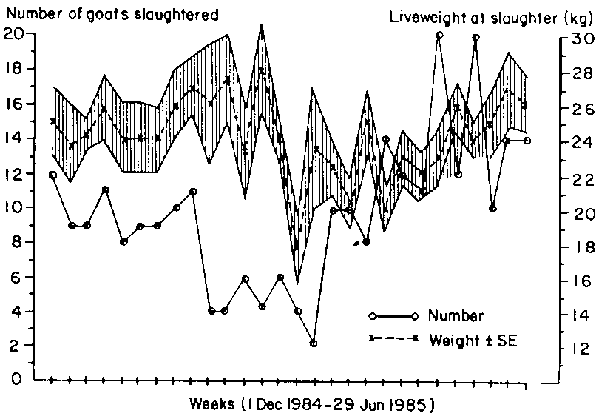
Figure 1 shows weekly variation in total number of goats slaughtered at Mitundu market. For the months of December and January the number of goats slaughtered varied from eight to twelve per week. From February to the first week of April the number was two to six, rising sharply thereafter. There are several possible socioeconomic reasons for this variation. In December/January farmers may sell goats to obtain money since the growing season for most crops has just started. However between February and March most farmers get money from green crops (e.g. maize, groundnuts and beans) therefore they are not desperate to sell animals. This trend should continue from April through June: however, the number of goats slaughtered increases (8-20 per week) possibly because most people have money from sales of crops, the demand for meat therefore increases and goat owners can sell animals at a higher price. Generally this is also a time when beef is scarce. The data agree with the observation that when beef and chicken are not available low income families prefer goat meat to mutton or pork (Phoya & Whelehan, 1982).
Figure 1. Numbers of goats slaughtered and changes in liveweight (kg ± s.e.) over time at Mitundu market, Malawi
Of a total of 274 animals studied 66.8 per cent were females while 18.6 per cent and 14.6 per cent were entire males and castrates respectively. Figure 2 shows that except for one week most goats slaughtered were females while Table 1 shows the percentage of each class of age. About 60 per cent of females slaughtered were over 33 months of age (eight permanent incisors). This may indicate that they have been used for breeding for some time. Half of the males slaughtered were between 18 and 24 months (2-4 teeth). Of these males 44.0 per cent were castrates while 56.0 per cent had their testes intact. This survey may indicate an awareness among rural farmers of the need to keep only sufficient males for breeding. The rest are either sold early or castrated. Peters et al (1981) reported that only 36.0 per cent of goat keepers in their survey in Malaysia practiced castration, this being influenced by religious misconceptions and cultural habits. These aspects were not evaluated in the present study. Sheep accounted for 5.5 per cent of total small ruminants slaughtered at the market which corresponds well with the percentage contribution of sheep (6.8 per cent) to total number of small ruminants in Malawi (Anon, 1984). Of the sheep slaughtered 38.0 per cent were females while 42.9 per cent were older than 33 months.
The mean weights of various part and dressing percentages of goats and sheep by class are shown in Tables 2 and 3. The liveweight of female animals tended to be heavier than that of males. This may have been due to the fact that most females were slaughtered at a much older age than males (Table 1). The liveweights of goats slaughtered (Figure 1) were slightly lower in April and May. The reasons for this were not investigated but they could be related to management at this time. There do not appear to be any differences in the dressing percentages and weights of the head, liver, skin, lung and heart between and within species except for rams which had heavier testes than bucks (Table 2 and 3).
Figure 2. Contribution of different classes of goats to total slaughterings at Mitundu market, Malawi
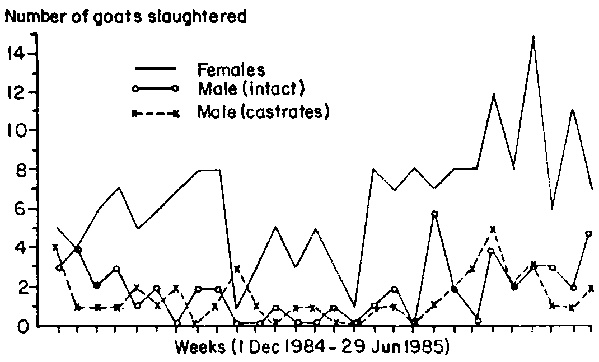
Table 1. Distribution by sex and age class of goats slaughtered at Mitundu market, Malawi (per cent)
|
Class of animal |
Milk teeth |
Number of permanent incissors |
Broken mouths |
|||
|
2 |
4 |
6 |
8 |
|||
|
Female |
0.0 |
11.6 |
10.2 |
16.3 |
40.8 |
21.1 |
|
Male (entire) |
27.5 |
7.5 |
45.7 |
5.0 |
10.0 |
2.5 |
|
Male (castrate) |
6.1 |
42.4 |
27.3 |
9.1 |
12.1 |
3.0 |
Table 2. Data on live and slaughter weights and weights of body organs of Malawi goats (kg)
|
Parameter |
Class of animal |
|||
|
Female |
Entire male |
Castrate |
||
|
Number in sample |
183 |
51 |
40 |
|
|
Liveweight |
15.7 |
19.6 |
21.7 |
|
|
Dressed weight |
13.4 |
10.3 |
11.6 |
|
|
Body parts: |
||||
|
|
head |
1.8 |
1.6 |
1.6 |
|
|
liver |
0.7 |
0.6 |
0.7 |
|
|
skin |
1.7 |
1.5 |
1.6 |
|
|
lungs |
0.5 |
0.4 |
0.5 |
|
|
heart |
0.4 |
0.3 |
0.4 |
|
|
testes |
- |
0.4 |
- |
|
Dressing percentage |
52.3 |
52.4 |
53.6 |
|
Table 3. Data on live and slaughter weights and weights of body organs of Malawi sheep (kg)
|
Parameter |
Class of animal |
||
|
Female |
Male |
||
|
Number in sample |
6 |
10 |
|
|
Liveweight |
32.3 |
28.8 |
|
|
Dressed weight |
17.8 |
15.1 |
|
|
Body parts: |
|||
|
|
head |
1.9 |
2.2 |
|
|
Liver |
0.7 |
0.8 |
|
|
skin |
2.2 |
2.3 |
|
|
Lungs |
0.6 |
0.5 |
|
|
heart |
0.4 |
0.4 |
|
|
testes |
- |
0.7 |
|
Dressing percentage |
55.1 |
52.4 |
|
The relative contribution of various organs to the live and dressed weight is shown in Table 4. The contribution of these organs is similar across species.
BUNDA STUDY
The data were collected from a group of 25 ewes (Dorper, local and their crosses) between 1983 and 1985. The twinning rate in the flock was 2.2 per cent. The average lambing interval was 255 ± 13.5 days. Assuming a gestation length of 150 days the time from parturition to subsequent conception would be 105 days. Berger (1983) reported that the postpartum anoestrus in females fed a high level of nutrition averaged 52.4 days (range 22 to 60 days) while Wilson (1983a) reported a lambing interval of 258-298 days in sedentary sheep in Mali.
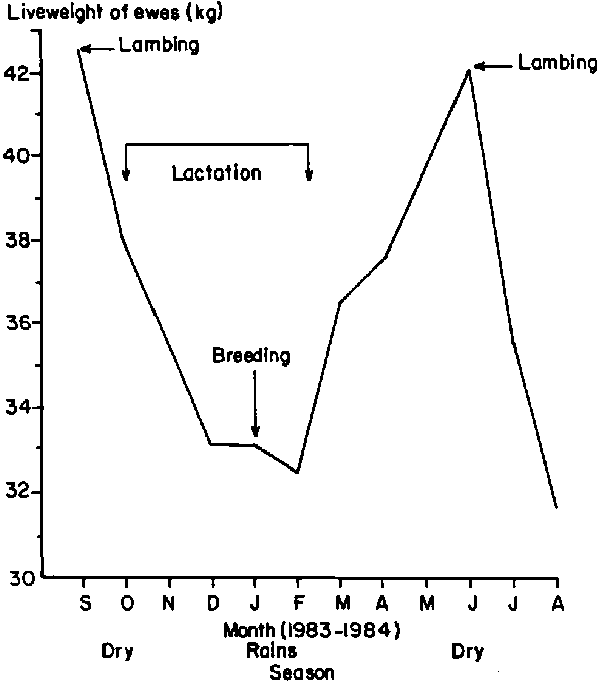
Ram and ewe lamb birth weights averaged 2.63 ± 0.19 and 2.65 ± 0.14 kg respectively. Figure, 3 shows the mean liveweight of ewes between September 1983 and August 1984. The variations in weight are due to lambing, lactation and pregnancy and are also confounded with season. The loss in weight due to lambing was 12.9 per cent. When the ewe and lamb were weighed soon after lambing the birthweight of lambs was approximately 8.8 per cent of the liveweight of ewes. The difference is due to the placenta and fluids expelled in the process of lambing. During lactation the ewes lost 13.8-15.6 per cent of body weight. Scott (1975) reported that during lactation ewes should lose 5-7 per cent of body weight. The excessive loss may be attributed to a low level of nutrition during the dry season.
Table 4. Percentage contribution of various parts of live and dressed carcass weight of small ruminants in Malawi
|
Body part |
Goats |
Sheep |
||
|
% l.w. |
% d.c.w. |
% l.w. |
% d.c.w. |
|
|
Head |
7.2 |
13.7 |
7.1 |
13.3 |
|
Liver |
2.9 |
5.5 |
2.7 |
5.1 |
|
Hide |
6.9 |
13.1 |
7.6 |
14.3 |
|
Lung |
2.0 |
3.8 |
1.8 |
3.5 |
|
Heart |
1.5 |
2.9 |
1.3 |
2.5 |
|
Testes |
2.1 |
4.1 |
2.3 |
4.4 |
Figure 3. Liveweight changes of ewes at Bunda College, Malawi, in relation to reproductive and climatic events
The number of goats slaughtered at the market varied with season. Most of the animals slaughtered were females and they were slaughtered at a much older age than males. The data presented indicate that the farmers keep females in the breeding herd for a long time and may be aware of the problems of inbreeding since males are slaughtered while young and castration is practiced. The longer lambing interval (255 ± 13.5 days) and the drop in weight of ewes during lactation may signify a lower level of nutrition. These results are important in the determination of the price of various parts by middlemen, the biological understanding of small ruminants, the formulation of various models to predict the optimal liveweights for slaughter and the formulation of supplementary feeding regimes to make small ruminant production profitable.
The authors acknowledge G. Mkanansi, M. Phiri, G. Banda and the various people who slaughter small ruminants at Mitundu Market for services rendered during the course of this study. The draft manuscript was typed by Mrs. M.C. Piringu. Financial assistance from the University of Malawi Research and Publications Committee and the Livestock Production Department is also appreciated.
Mouton d'Afrique à queue grasse longue - Bélier de sélection N°991 à la Station de Songa, Rwanda