K. Agyemang1), Negussie Akalework1), A. Voorthuizen2)& F.M. Anderson1)
1. Ethiopian Highlands Programme, ILCA, Addis Ababa
2. Agricultural University, Wageningen, The Netherlands
Introduction
Materials and methods
Results
Discussion
Conclusions
Acknowledgements
Summary
A rapid survey of livestock ownership patterns? flock demography and sheep productivity was undertaken on 120 flocks in four Peasant Associations. Sheep account for 64.7 per cent of the numbers of livestock owned. Mean fleck size was 23.8 head and each flock was owned on average by 1.5 people. Flock sizes ranged from 2 to 83 and owners from 1 to 6. Females totalled 74.8 per cent of the flock, entire males 22.4 per cent and castrates 2.8 per cent. The ratio of breeding males to breeding females was 1:26, breeding females being about 49 per cent of the flock. Lambing occurred all the year round but 5 2 per cent of lambs were dropped in October and November resulting from conceptions in the early part of the main rains. Age at first lambing appeared to be older than in many other African areas. Lambing interval was about 350 days and 4.2 per cent of births resulted in twins. Total flock mortality was estimated at 6.5 per cent. The results are discussed in relation to ILCA's research on Debre Berhan station.
The ILCA Highlands Programme has been carrying out research on the local Menz breed of sheep on station for a number of years. It intends to link future station research with testing of innovations on smallholder flocks in the area of its research station at Debre Berhan.
The testing of innovations and monitoring of sheep on farms outside the station requires the description of existing management practices, ownership patterns and the estimation, in general terms, of flock structure, reproductive and productive parameters. A formal survey with a pre-designed questionnaire was carried out in 120 flocks in four Peasant Associations to determine these parameters. In addition, some farmers were asked on an informal basis to provide information on management practices in their flocks, by answering specific questions put to them by enumerators.
It is estimated that there are 850 households in the four Peasant Associations of which about 80 per cent own five or more sheep with an average number of 16 per flock. Thus, the estimated number of flocks is 640 with a sheep population of about ten thousand. The 120 flocks surveyed represent about 18 per cent of the total.
This report presents results of a preliminary analysis of the data obtained during the survey. It is hoped that based on these results some 80 flocks will be selected for monitoring. Some of these will receive tested innovations from ILCA while the rest will serve as a control group. In both cases, monthly visits will be made to record events such as births, deaths, sales, slaughter, disease situations, and to weigh individual sheep. This will enable a 3-way comparison of performance at the ILCA station, in smallholder flocks receiving innovations from ILCA and in control flocks where only traditional husbandry is practiced.
Four Peasant Associations near the Debre Berhan research station were selected as the target population from which samples of flocks were to be taken. Flocks belonging to 60 farmers who were already participating in ILCA's livestock inventory exercise and an additional 60 flocks chosen at random were selected to constitute the sample. Thirty flocks, 10 small sized (1-13 sheep), 10 medium (14-26 sheep) and 10 large (27 or more sheep) were selected from each Association.
For the formal survey, the sampling unit was the "flock" as herded together and the "farmer" was the caretaker of the flock. A given "flock" could therefore be a collection of smaller flocks, each owned by different persons but all under the management of the "farmer".
A questionnaire designed to generate the relevant information was pre-tested with a few farmers. Questions were framed in such a way that farmers would provide information that was most recent and easy to recall. Four enumerators and two supervisors undertook the survey in November and December 1984.
All species of livestock were included in the survey for the purpose of establishing livestock composition but detailed information was collected only on sheep. All sheep were individually handled and aged by dentition characters, correlated in each case by owners' information. A career history was established for each breeding ewe present in the flock. Information on all offspring, dead, alive or sold was compiled. Historical information on sheep, 77 goats, 448 donkeys, 317 horses and 30 mules was recorded. Of the 5041 sheep on which information was collected, 2852 were in the flocks at the time of the survey.
MANAGEMENT
Housing
Most farmers (82 per cent) housed sheep separately from other species. Among small flocks, the percentage of farmers who housed all livestock together was higher than in medium and large flocks. In addition, pregnant ewes were housed separately during the last few weeks of pregnancy until about 2-4 weeks post-partum.
Feeding
The main feed resource for sheep was native pasture. Grazing took place on fallow land, communal grazing areas, and on stubble, depending on the season. Sheep generally grazed for 10-11 hours a day (07h00 - 18h00) with once a day watering at noon. Source of water was usually a river(s) 1-2 kilometres from the homestead. Sheep and other species of livestock were usually herded together for watering and grazing, although in certain cases cattle were allowed to graze the better pastures. Sheep had access to some hay and straw supplements in periods of severe shortages but farmers in general preferred to feed crop residues to cattle. Sheep in the last stages of pregnancy and lactating ewes also sometimes got supplementary feeding. Barley straw, grass and hay were the main supplements. By-products from local beer, small amounts of grain and salt were also occasionally fed.
Diseases and disease control
From the description of symptoms, it was obvious that many farmers were able to identify diseases such as liverfluke (swelling of neck), coenurus (animal going in circles), diarrhoea, and bloat (swelling of the stomach). Farmers mentioned liverfluke, coenurus, diarrhoea and anthrax, in that order, as the most common diseases. Some farmers treated sheep against liverfluke and lungworm. Drugs were purchased from the Ministry of Agriculture. However, the decision to treat sick animals depended on the availability of cash to the farmer.
Lamb rearing
Most farmers kept new-born lambs and their dams in the house during the first 24-72 hours after which the dams joined the flock for grazing. Farmers also tended to keep lambs inside for periods of up to 60 days during the rainy and drought periods. Some farmers gave cow's milk to weak lambs or when the dam did not produce enough milk.
Shearing
Most farmers sheared their sheep once or twice a year, October to November and April to June. Shearing was mostly done either to get rid of ticks or as a means of cleaning sheep of mud and seeds. Only a small percentage sheared for sale.
Mating
Most farmers had one to three rams running with the flock throughout the year. Rams were usually used for service the first time at about 12 months although rams in exceptionally good body condition were used at younger ages. Rams were usually taken out of service for castration or for sale at the eruption of the second pair of permanent incisors. Exceptionally good rams were not taken out of service until about four years of age.
Castration
Castration was done by a majority of farmers. Age at castration varied, from the appearance of the second pair of permanent incisors to the appearance of the fourth pair. Castration at these ages allows for a service period of one to three years. Rams with exceptionally good body conformation were the ones selected for castration. Castration was primarily a means of getting higher sale prices at a later date. Almost all farmers provided extra feed, mainly barley and beans, to the castrates. Stones and handles of sickles were used to crush the vas deferens.
Culling
Most farmers culled animals for sale in times of financial difficulties. Infertile and old ewes and male lambs were usually first to be culled. Female lambs, castrates and rams were occasionally culled. If the magnitude of the financial problem was such that it would require the sale of large numbers of ewes or other smaller animals, then castrates and rams were first to be culled.
COMPOSITION OF THE LIVESTOCK MIX
Table 1 shows that sheep are the commonest livestock species found in the area. Cattle, donkeys and horses rank second to fourth, respectively. Goats and mules were rare.
FLOCK OWNERSHIP PATTERNS
Of the sheep covered by the survey, 27.1 per cent were in Kormargefia Peasant Association, 23.0 per cent in Karafino, 24.9 per cent in Milki and 25.0 per cent in Faji Bokafia. The ranges in numbers of sheep per flock in the four Peasant Associations were 2-83, 2-51, 6-47 and 2-81.
Table 1. Composition of livestock holdings in four Peasant Associations in the Debre Berhan area
|
Species |
Number |
% of total livestock |
|
Sheep |
2 852 |
64.7 |
|
Cattle |
937 |
22.4 |
|
Goats |
54 |
1.2 |
|
Donkeys |
287 |
6.5 |
|
Horses |
198 |
4.5 |
|
Mules |
30 |
0.7 |
The 2852 sheep in the 120 flocks were said to belong to 183 individuals. The mean number of sheep per flock was 23.8, each contributing owner having 15.6 animals. On average, 1.5 persons had ownership claims in a given flock.
In total, 66.7 per cent of all flocks were owned by one person, 21.7 per cent by two people, 5.8 per cent by three, 4.2 per cent of the flocks by four; and five or six people had sheep in 1.6 per cent of the flocks. The pattern varied a little among associations but overall the picture was the same.
FLOCK DEMOGRAPHY
Of the total live sheep enumerated, 2133 (74.8 per cent) were female, 640 (22.4 per cent) entire males and 79 (2.8 per cent) castrates. Across all sexes, 1325 (45.9 per cent) had only temporary incisors, 201 (7.0 per cent) had one pair of permanent incisors, 177 (6.2 per cent) had two pairs, 233 (8.2 per cent) had three pairs, 468 (16.4 per cent) had four pairs and 464 (16.3 per cent) were broken mouthed. The correlation coefficient between number of permanent incisors (excluding sheep with broken mouths) and approximate age provided by owners for 1081 sheep was 0.89 (P < 0.01). Owners were thus quite accurate in assessing the ages of the animals in their flocks. The mean ages and standard deviations for the various teeth classes are given in Table 2.
The ratio of males with no permanent incisors to females of the same dentition class was 1:1 (431 vs 432). The ratio for older males (one to four pairs of teeth and broken mouth) to females of the same dentition was 1:26 (55 vs 409) suggesting a heavy offtake of males at an early age. If breeding females are considered as those with one or more pairs of permanent incisors, then these were 49 per cent of the total flock. This figure agrees well with the 52 per cent classified by owners as breeding females. Breeding males (six months or older) were estimated to be five per cent of the flocks.
Table 2. Mean ages (months) ± sd provided by farmers of sheep by teeth and sex classification at Debre Berhan, Ethiopia
|
|
Number of permanent incisors (pairs) |
||||
|
0 |
1 |
2 |
3 |
4 |
|
|
Female |
5 ± 6 |
18 ± 5 |
27 ± 6 |
39 ± 7 |
51 ± 15 |
|
Male |
4 ± 3 |
19 ± 8 |
24 |
36 |
36 |
|
Castrate |
- |
29 ± 0 |
26 ± 5 |
34 ± 8 |
53 ± 15 |
About eight per cent of all sheep were reported as purchased or exchanged from other flocks. If the exchanges and purchases include rams and if out-breeding among flocks grazing on communal land occurs regularly, then this would suggest a substantial reduction in inbreeding within the flocks.
REPRODUCTION
Seasonality in lambing
Information on month of birth was available for 899 sheep. The distribution among months of the year suggests year-round lambing with a peak in October and November. Most conceptions took place in June and July, which is the beginning of the major rainy season in the area (Table 3).
Table 3. Distribution of recorded parturitions by sheep in the Debre Berhan area
|
Months |
N° of lambings |
% of total |
|
January |
15 |
1.7 |
|
February |
19 |
2.1 |
|
March |
16 |
1.8 |
|
April |
19 |
2.1 |
|
May |
41 |
4.6 |
|
June |
71 |
7.9 |
|
July |
70 |
7.8 |
|
August |
55 |
6.1 |
|
September |
69 |
7.7 |
|
October |
160 |
17.7 |
|
November |
314 |
34.9 |
|
December |
50 |
5.6 |
Age at first lambing
Of 876 ewes, some 37 (4.2 per cent) without permanent incisors and 93 (12.6 per cent) with one pair had already produced one lamb: 18 ewes (2.0 per cent) with one pair had produced two lambs. These percentage figures are lower than in traditional flocks in many other parts of Africa and it appears that age at first lambing is generally delayed to beyond two years of age.
Annual reproduction rate
In the absence of information on lambing intervals, annual reproduction was computed as the total number of lambs reported born (alive, stillbirths and abortions) in 1984 as a percentage of all breeding females in the flocks in 1984. This gave an annual reproduction rate of 1.03 lambs/ewe/year.
Lambing interval
An approximate lambing interval, assuming an average litter size of 1.0, was calculated as the ratio of 365 (days in a year) to annual reproduction rate 1.03 lambs/ewe/year. This gave a lambing interval of 11.5 months.
Multiple births
Of the 3556 sheep for which owners recollected the birth status, 3278 were listed as single and 288 twin born. This gave a twinning rate of 4.2 per cent. The twinning rate calculated for lambs in the flock during the time of survey was 3.9 per cent.
GROWTH AND WEIGHT
All sheep in the flocks at the time of the survey were weighed. The months of the year at weighing represent the early part of the dry season when sheep would be expected to be in average condition. Overall mean body weight for 2388 sheep was 18.9 ± 8.5 (s.d.) kg. The mean body weights of sheep for different teeth classes and for three sexes is shown in Table 4. In general, castrates were heavier than males and females in the same dentition class and males were generally heavier than females of the same class.
Table 4. Mean weights (kg) of sheep by teeth and sex classification
|
Sex |
Number of permanent incisors (pairs) |
||||
|
0 |
1 |
2 |
3 |
4 |
|
|
Female |
13.0 ± 6.6 |
22.7 ± 2.9 |
24.7 ± 3.6 |
25.6 ± 3.2 |
27.7 ± 3.0 |
|
Male |
12.3 ± 6.3 |
27.2 ± 5.6 |
30.4 ± 5.3 |
33.8 ± 3.7 |
28.7 ± 4.0 |
|
Castrate |
- |
30.8 ± 3.7 |
33.4 ± 3.3 |
34.3 ± 4.1 |
39.6 ± 4.9 |
MORTALITY AND DISPOSALS
Of the 5041 sheep on which owners gave information, 6.5 per cent were said to have died, 7.8 per cent had been slaughtered and 25.1 per cent sold. Of the 977 lambs reported born in 1984, only 44 were said to have died, giving an estimated mortality rate of 6.5 per cent (birth to 12 months) for lambs. The overall mortality of 4.5 per cent for 1984 is probably biased downwards. It is possible that some of the animals said to have been sold or slaughtered actually died.
OWNERSHIP PATTERNS AND FLOCK STRUCTURE
The ownership pattern of sheep flocks in the four Peasant Associations surveyed was very similar. The relationships between owner(s) of sheep and the caretaker were not established in this study. If the average relationship between a caretaker and owner(s) is that of kinship or if a formal "contract" exists between caretaker and owner(s), then preferential treatment of sheep based on ownership of individual sheep within a flock would not be expected. On the other hand, preferential treatment, for example selective feeding of supplement in drought periods, could occur if caretaker-owner(s) relationships were far removed from kinship or if there was no proper arrangement between them. The high percentage of single ownership gives some guarantee that any tested innovations passed on to farmers would be applied to entire flocks rather than parts of flocks.
Ranges in flock size in the four Peasant Associations were also similar, though the classification of flocks into sizes and subsequent selection of samples might have partly accounted for the similarity in the range. The practical implication of the similarity in ownership and flock size is that future work on sheep could be carried out in one or two Peasant Associations should manpower and other resources be limiting.
REPRODUCTIVE PERFORMANCE
Estimates of reproductive parameters from this survey could only be approximate since information provided by farmers over a period of time would necessarily carry some element of unreliability. Nevertheless, those estimates from the survey do not differ very much from those obtained from performance recorded flocks at ILCA's station and may be judged to be a good indication of the breed performance in the traditional production systems.
BODY WEIGHT
From station flock data mean weight for females at four months of age was 10 kg and that of females which had three or more lambings and at four months post-partum status was 26.6 kg. While the estimates from station and survey flocks are not directly comparable because of large standard deviations on the ages in the latter group, the figures indicate that body weights achieved in the traditional production systems are within the range achieved by ILCA's station flocks. The weights of sheep in small, medium and large flocks were found to be similar.
From the comparisons of reproductive and productive performance for the Menz sheep flocks at ILCA's research station and in flocks from the traditional production systems, it would appear that the gap between reproductive performance at the station and outside the station is wider than the gap between productive performance (body weight). It is possible that the lower annual reproduction rate ensures the maintenance of good body weight in traditional flocks.
Future analyses of station data should explore the relationships between long lambing intervals and weight changes. If such a relationship is found not to be important, more emphasis should be put on developing innovations that will improve the reproductive performance of flocks in the traditional production systems.
The authors wish to acknowledge the contributions of Trevor Wilson during the design of this survey and for useful suggestions in preparing the report. Wolde Ab W/Mariam and Abebe Misgena established contacts with the Peasant Associations' leaders without which the survey could not have been carried out.
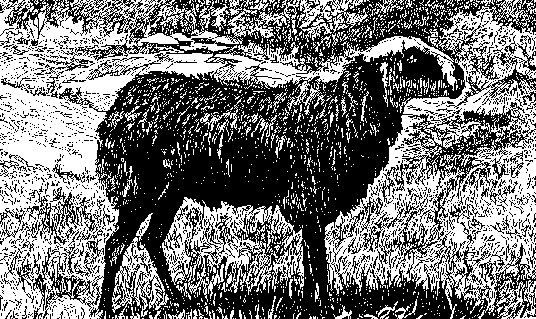
Ram of the Menz breed (East African fat-tailed type) in the Ethiopian highlands