History
Environmental features
Vectors and trypanosomes
Ranch management and production methods
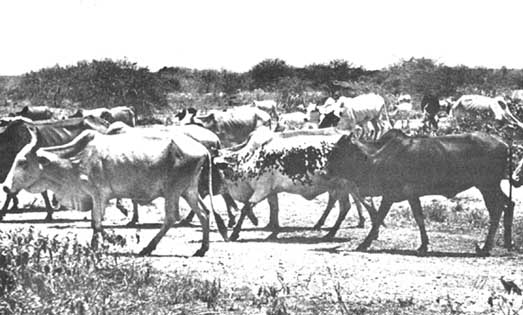
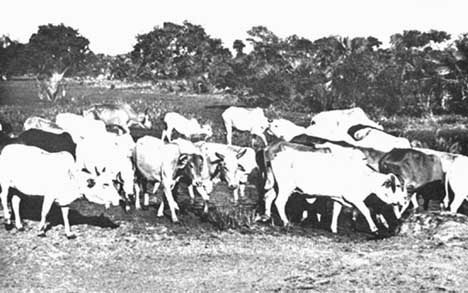
Mkwaja Ranch was established in 1954 by Amboni Ltd. with the intention of supplying the labour force on their sisal estates with meat. Prior to Amboni acquiring the lease, the land had been more or less untouched bush for many years. Local female East African Zebu (Figure 5) were purchased from the Central Province and Boran bulls were imported from Kenya. Since this time ranch-bred bulls, together with semen obtained from Boran bulls at Kabete Artificial Insemination Centre, Kenya, have been used and therefore the herd can now be considered as grade Boran (Figure 6).
Figure 5. Small East African Zebu cattle.
Reproduced with permission from Advances in Parasitology, Academic Press.
A major factor in the establishment of the ranch was the availability of the prophylactic drug Antrycide prosalt (a mixture of quinapyramine chloride and sulphate, Imperial Chemical Industries Ltd.) which, for the first time, allowed susceptible cattle to be maintained in tsetse-infested areas of East Africa. The original objective was to rely on a chemoprophylactic regime only in the short term. It was envisaged that the profit realised during this period could be used to offset the costs of tsetse, and hence trypanosomiasis, elimination. This was to be achieved by a combined programme of establishing a barrier of cleared vegetation around the ranch, erecting game fencing, and eliminating the vector within the barrier by use of insecticides, game shooting, selective clearing and controlled burning.
Figure 6. Grade Boran cattle at Mkwaja Ranch.
Thus, a barrier 1 km wide was established around the northern area of the ranch and tsetse control programmes were implemented. However, the results achieved were not the positive ones expected. The two main problems were the unexpected speed with which the vegetation in the cleared barrier regenerated, and the difficulty of identifying tsetse foci which prevented effective action being taken against them. Goats were introduced into the barrier in an attempt to control regeneration of bush, but with very little effect.
By 1957, the tsetse-trypanosomiasis policy had already been modified, when it was decided that, with the use of prophylaxis, it was possible to have a viable operation with a reduced fly population. The selective clearing operations were discontinued but insecticidal spraying around handling facilities and along the Msangasi River was undertaken intermittently in an effort to limit the fly challenge. In 1959, efforts to maintain the barrier ceased and it was opened up for grazing. Thus the goal of tsetse eradication was, at least temporarily, abandoned and a shift to a policy reliant upon a combination of the prophylactic Antrycide, complemented by limited efforts to control the tsetse population, took place.
Concern over the possibility of drug resistance led to a switch from a prophylactic to a curative regime using Berenil during the period 1962 to 1964. By 1964 the combined approach of controlling the tsetse population by spraying and of controlling trypanosomiasis by the use of Berenil was abandoned and a new prophylactic regime, backed up by Berenil, was adopted. This came about partly because the costly spraying programme was thought to be having a negligible effect, but mainly because a field experiment with the newly available Samorin had proved successful.
A chemoprophylactic regime based on Samorin has now been in operation at Mkwaja for nearly 20 years, and apart from the sterile male field trial described below, no efforts have been made to control the vector.
Ford and Blaser (1971) discuss at some length the ecological impact of stocking the ranch on its vegetation. The stable equilibrium of flora and fauna that had previously existed in the area was destroyed by the introduction of a large biomass of primarily grass-eating cattle. This resulted in less grass being available to fuel the fires which were an important factor in restricting the spread of woody vegetation and maintaining open grassland. The result at Mkwaja was therefore a reduction in the grazing area as doum palms (Hyphaene sp.) and Acacia zanzibarica proliferated. This led to 'overstocking' and the accompanying decline in productivity discussed below. The ranch management realised by 1964/65 that bush encroachment was a major problem, possibly a greater one than that of disease.
In 1967 an extensive programme of bush clearing was started in the northern area of the ranch, and between 1967 and 1975 more than 6500 ha of primary bush was cleared. This was achieved using D7 caterpillars and Fleco brushcutters. Regeneration of cleared areas was tackled with small D4 caterpillars and Marden brushcutters for heavy regrowths, or by hand slashing followed by application of arboricide for lighter regrowths. Doum palms were killed by the application of diesel fuel into their hearts. This intensive period of bush clearing ended when all available effort was directed to the construction of a fly-barrier prior to a sterile male tsetse field trial. On completion of this project, major mechanical bush clearing was again undertaken and between 1978/79 and 1980/81 a further 2900 ha were cleared. By 1981 approximately 50% of the 19500-ha northern area had been cleared of its original vegetation, and it is envisaged that this effort will continue as resources become available. Table 4 shows the area of primary bush cleared by year. No bush clearance has been attempted in the southern area.
As part of a pasture improvement trial undertaken by the Swiss Federal Institute of Technology, goats were imported into the ranch in 1975, with the objective of using them to control regeneration of woody vegetation. The authors of the report of this trial were enthusiastic about the use of goats in controlling regrowth, but the ranch management does not believe they were really effective (Kloetzli et al, 1981). Although goats are believed to be less susceptible to trypanosomiasis than cattle they were maintained on a drug regime similar to that adopted for the cattle on the ranch, with the twin objectives of minimising losses due to trypanosomiasis and of preventing the goats from acting as a trypanosome reservoir.
Table 4. Primary bush cleared in the northern area of Mkwaja Ranch, 1967-81.
|
Yeara |
Area cleared (ha) |
|
1967/68 |
260 |
|
1968/69 |
759 |
|
1969/70 |
503 |
|
1970/71 |
1244 |
|
1971/72 |
1186 |
|
1972/73 |
117 |
|
1973/74 |
773 |
|
1974/75 |
1937 |
|
1978/79 |
1210 |
|
1979/80 |
485 |
|
1980/81 |
1184 |
|
Total |
9658 |
a Financial year i.e. April to March.
Although originally steers were fattened at Mkwaja, the ranch is now effectively a breeding unit, calves being transferred at weaning to better grazing elsewhere. This approach was adopted because of two factors. Firstly, the final weight that ranch-fattened steers achieved began to decline in the mid-1960s. Ford and Blaser (1971) attributed this to 'overstocking', although they argued that the situation was more complex than simply having too many cattle on the ranch. "If the ranch was overstocked", they said, "it was overstocked with trees, shrubs and wildlife and not with cattle". If all woody vegetation except that required for timber, shade or windbreaks could have been removed and prevented from regeneration they estimated that the ranch could support 20-40% more than the peak cattle population reached in 1965/66 i.e. as many as 20000 animals. The problems of eliminating bush however are considerable and the decision was made to transfer calves at weaning to Amboni's sisal estates. Secondly, in parts of Amboni's sisal estates where sisal growth was unsatisfactory, its cultivation had been discontinued and good quality pasture developed instead. Although tsetse are present on the estates, the challenge is less than that known to exist on the ranch.
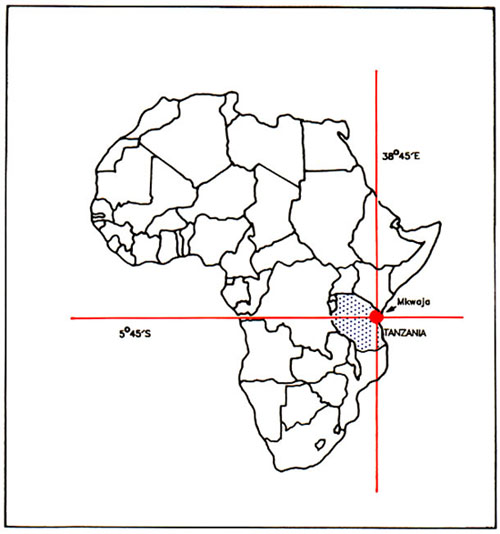
Mkwaja Ranch is located on the Tanzanian coast in Pangani District about 100 km south of Tanga (Figure 7). The ranch covers an area of approximately 47250 ha. Its southern boundary follows the Mligaji River, the eastern boundary lies up to 8 km from the coast and the western boundary follows the line of the Ruvu-Mnyusi railway.
Mean annual rainfall measured at the ranch headquarters for the period 1972 to 1982 was 1055.8 mm with a range of 613.8 to 1444.5 mm (Table 5) and for the 20-year period of 1964 to 1983 was 997.6 mm. Rainfall is bimodal with the long rains normally occurring from March to May and the short rains from October to December. The latter failed in 3 consecutive years (1974 to 1976) during the study period.
Figure 7. Location of Mkwaja Ranch, Tanzania.
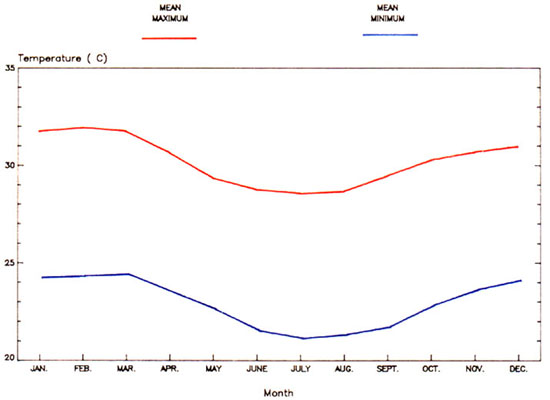
Mean monthly maximum and minimum temperatures for the period 1972 to 1982 measured at the ranch headquarters are shown in Figure 8. Monthly maximum temperatures ranged from 32.1°C in March to 28.7°C in July, while corresponding minimum temperatures ranged from 24.5 to 20.9°C.
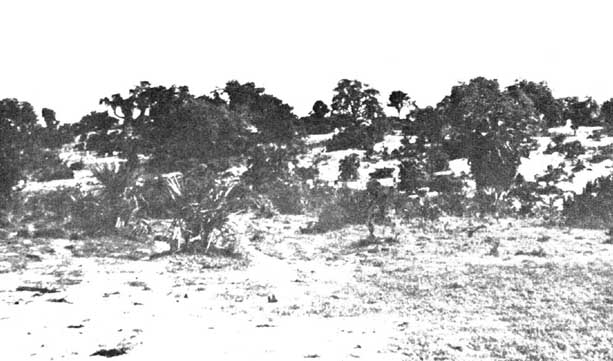
Soils on the ranch are mainly sandy loams of low nutrient content and exchange capacity, overlying coral rag, with heavy alluvial blackcotton clays in the valleys and flood plains. The vegetation at Mkwaja has been extensively described (Skovlin and Williamson, 1978; Kloetzli et al, 1981), but in summary can be characterised as coastal forest-savanna mosaic (Figure 9). Although substantial areas of the northern area have been cleared of primary vegetation, all parts of the ranch have adjacent gallery forest, scrubby areas or wooded pastures. There are large areas of wooded grassland with vigorous growths of doum palm and Acacia zanzibarica. The ranch manager estimates that 75% of the ranch is available for grazing, the remainder either having too dense vegetation or consisting of steep-sided ravines.
Table 5. Total annual rainfall, total and mean monthly rainfall, and number of rain days by season at Mkwaja Ranch headquarters, 1972-82.
|
Year |
Total annual
|
Season 1 |
Season 2 |
Season 3 |
Season 4 |
||||||||
|
(January to February) |
(March to May) |
(June to September) |
(October to December) |
||||||||||
|
rainfall |
Total rainfall |
Mean monthly rainfall |
No. of rain days |
Total rainfall |
Mean monthly rainfall |
No. of rain days |
Total rainfall |
Mean monthly rainfall |
No. of rain days |
Total rainfall |
Mean monthly rainfall |
No. of rain days |
|
|
(mm) |
(mm) |
(mm) |
(mm) |
(mm) |
(mm) |
(mm) |
(mm) |
(mm) |
|||||
|
1972 |
1002.5 |
86.6 |
43.3 |
4 |
577.2 |
193.7 |
37 |
77.3 |
19.3 |
10 |
261.4 |
87.1 |
12 |
|
1973 |
1018.4 |
59.5 |
29.8 |
7 |
561.4 |
187.1 |
23 |
69.2 |
17.3 |
12 |
328.3 |
109.4 |
10 |
|
1974 |
668.1 |
27.0 |
13.5 |
3 |
384.8 |
128.3 |
26 |
165.6 |
41.4 |
22 |
90.7 |
30.2 |
13 |
|
1975 |
826.1 |
29.9 |
15.0 |
5 |
441.7 |
147.2 |
35 |
186.6 |
46.7 |
22 |
167.9 |
56.0 |
17 |
|
1976 |
613.8 |
22.4 |
11.2 |
4 |
428.6 |
109.5 |
25 |
175.7 |
43.9 |
24 |
87.1 |
29.0 |
11 |
|
1977 |
1305.9 |
137.8 |
68.9 |
11 |
245.2 |
81.7 |
26 |
402.1 |
100.5 |
20 |
520.8 |
173.6 |
25 |
|
1978 |
1377.3 |
172.0 |
86.0 |
12 |
556.5 |
185.5 |
36 |
138.0 |
34.5 |
16 |
510.8 |
170.3 |
33 |
|
1979 |
1288.6 |
312.8 |
156.4 |
15 |
568.8 |
189.6 |
33 |
162.3 |
40.6 |
17 |
244.7 |
81.6 |
18 |
|
1980 |
928.3 |
138.1 |
69.1 |
5 |
263.5 |
87.8 |
18 |
82.8 |
20.7 |
15 |
443.9 |
148.0 |
23 |
|
1981 |
1140.4 |
20.7 |
10.4 |
4 |
620.8 |
206.9 |
41 |
124.5 |
31.1 |
14 |
374.4 |
124.8 |
20 |
|
1982 |
1444.5 |
0.0 |
0.0 |
0 |
524.6 |
174.9 |
32 |
279.8 |
70.0 |
37 |
640.1 |
213.4 |
27 |
|
Mean |
1055.8 |
91.5 |
45.8 |
6.4 |
461.2 |
153.8 |
30.2 |
169.4 |
42.4 |
19.0 |
333.6 |
111.2 |
19.0 |
|
Season category |
Dry |
Long rains |
Dry |
Short rains |
|||||||||
Figure 8. Mean monthly maximum and minimum temperatures at Mkwaja Ranch headquarters, 1972-82.
Figure 9. General view of the Mkwaja Ranch environment.
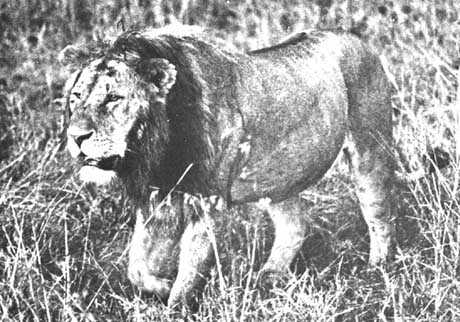
The range of wild mammals present is extensive, particularly in the southern area, including, in order of probable abundance, warthog, waterbuck, bushpig, reedbuck, bushbuck, baboon, buffalo, duiker, dik dik, sable antelope, hartebeest, giraffe, hippopotamus, kudu and porcupine (Gates et al, 1983). Predators include lion (Figure 10) and hyena and very occasionally wild dog. Leopards were previously present but have been eliminated by trapping. It is estimated that wildlife represents about 25% of the animal biomass on the ranch (Skovlin and Williamson, 1978).
Figure 10. The main predator at Mkwaja Ranch.
Three species of tsetse flies were identified by the extensive survey carried out in 1976/77. These were G. m. morsitans Westwood, G. pallidipes Austen and G. brevipalpis Newstead (Gates et al, 1983). Previous unpublished surveys conducted in 1957/58 did not detect G. m. morsitans but did encounter G. austeni. It is possible that G. austeni is still present, but the species was not detected in the recent survey, possibly because of the fly collection technique used a moving black screen rather than bait oxen. G. m. morsitans has almost certainly invaded Mkwaja since the early 1960s.
The distribution of the three species varies throughout the ranch. In the 1976/77 survey G. m. morsitans and G. pallidipes were most commonly found in the same location, but in some habitats only one species was present. Areas of relatively open woodland characterised by a predominance of medium to large isolated trees and only small (50-100 m2) thickets, were favoured by G. m. morsitans. Interiors of large (25 ha and more), dense thickets contained only G. pallidipes. More frequently both species have been found in the same location, typically where a flyround passed through open woodland within 20-30 m of the larger thickets.
The years 1969 to 1976 had below average rainfall and by the end of this dry period G. brevipalpis was confined to riverine gallery forest where there were permanent pools of water. Both 1977 and 1978 were years of above average rainfall and in mid-1978 the first G. brevipalpis found away from the riverine habitat were caught in dense forest 4 km from the nearest permanent water. Fly numbers gradually increased and within 2 years of the onset of the heavy rains, G. brevipalpis was being found in addition to G. m. morsitans and G. pallidipes in semi-open woodland up to 300 m from forest.
At the end of 1977, estimated densities (males per km2) of G. m. morsitans were 630 and 1080 and of G. pallidipes 255 and 265 in the northern and southern areas respectively. Bush clearing at Mkwaja has concentrated on more open woodland in the northern part of the ranch. The habitat of G. m. morsitans has therefore been considerably reduced in this area, accounting for its lower apparent density compared to the southern area. The habitat of G. pallidipes has remained virtually untouched throughout the ranch and the apparent densities of this species are similar in the northern and southern areas.
Between February and May 1976 engorged G. m. morsitans and G. pallidipes were captured for an analysis of their food sources. Although the 12000 head of cattle on the ranch were estimated to represent 75% of the 'animal biomass', they accounted for only 5.6% of the total blood meals. The host species are shown in Table 6, reproduced from Tarimo et al (1983).
Trypanosomiasis is endemic and more than 37000 blood slides examined over a 10-year period have shown that T. congolense is the most commonly detected species (93%) followed by T. vivax (6%) and T. brucei (1%). No data are available concerning fly infection rates. Biting flies other than tsetse, including Tabanids and Stomoxys are also present and mechanical transmission of trypanosomiasis cannot be ruled out.
Internal organization
Herding
Registration of calves
Weaning
Breeding
Culling
Marketing
Disease control
Wild predators
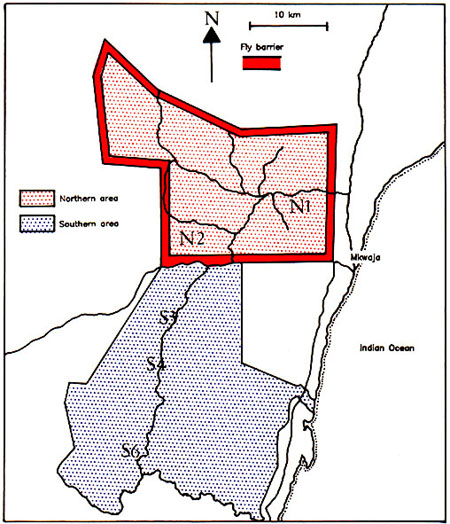
The ranch is divided into two blocks of roughly equal area (Figure 11). The northern area is surrounded by the remnants of the fly barrier and contains the ranch's administrative and workshop facilities. Approximately 50% of the northern area has been cleared of its primary vegetation, while the southern area is still in its natural state, modified only by grazing pressure. For administrative purposes the ranch is divided into nine sections, six in the northern area and three in the southern area. Each section is equipped with water dams, dips and spray-races for the control of tick-borne diseases, and handling facilities. A veterinary guard supervises health procedures of all the herds in each section.
At the ranch headquarters are based a veterinary surgeon who also acts as ranch manager, a microscopist, and personnel engaged in record keeping, administration and maintenance. Facilities include offices, stores for drugs, chemicals and fuel, a workshop, a diesel generator, a radio link with Amboni Ltd. at Tanga, a weighcrate, handling facilities and a slaughterhouse. The ranch has its own station, with cattle-loading facilities, on the Ruvu-Mnyusi railway, which is a link line between the Tanga-Moshi and Dar-es-Salaam-Kigoma mainlines, and therefore transport of animals by rail is relatively easy.
Heifers and breeding cows are kept in about 20 herds ranging in size from 225 to 300 head. Each herd is given a name and records show the location of herds within the ranch on a month-by-month basis. When the number of animals in a herd drops below 200, due to culling and natural mortality, herds are amalgamated to bring the number back up to between 225 and 300. Each herd has its own night paddock and herdsmen keep watch at night to deter predators. During the study period the breeding herd averaged 4800 cows and 180 bulls. Except when health or other routine procedures require animals to be handled, herds are turned out to graze at 06.00 hours and return to their night paddocks at about 18.00 hours. No supplementary feed is supplied to any animals. Mineral licks were used until 1979. All animals are watered once a day prior to returning to their night paddocks. Rain water is collected and stored in around 30 earth dams that have been constructed throughout the ranch. The possibility of using bore holes has been investigated, but both near-surface and deep bore holes are saline.
All calves are registered, weighed and tagged within 7 days of birth. Each herd is allocated to three herdsmen who are able to identify cow/calf pairs. Calves are weighed using a portable weighcrate and at the same time are tagged in both ears with a metal tag bearing their unique identification number. Regular checks are carried out and missing tags replaced as necessary. In addition, the ears are clipped to provide a permanent means of establishing the age of an animal. The identification number of calf and dam, date of registration, sex, weight, herd and description of colour are recorded in the field record book, and later this information is transferred to the cow's record card and a new card is started for the calf.
Calves are weaned at approximately 8 months of age after weighing. Their weaning weights and weaning dates are entered into a field record book. Later this information is transferred to both the cow's and calf's record cards. After weaning, all calves, except males from A.I.-sired herds, are divided into male and female herds and transferred from the ranch to neighbouring sisal estates. Heifers return to the ranch for bulling at approximately 36 months. Prior to bulling they are weighed and according to their weights are either culled (less than 200 kg), assigned to either natural service breeding herds (200-280 kg) or to A.I. herds (280 kg and greater). Surplus heifers are sold to other ranches when available, but usually all suitable heifers are required to maintain Mkwaja's breeding herds.
Table 6. Identification of blood meals in Glossina captured by vehicle trapping at Mkwaja Ranch, 1976.
|
Host |
Feeding activity of Glossina |
|||||||||
|
G. morsitans |
G. pallidipes |
Total for both species |
||||||||
|
Males |
Females |
Males |
Females |
|||||||
|
Number |
Percentage |
Number |
Percentage |
Number |
Percentage |
Number |
Percentage |
Number |
Percentage |
|
|
Warthog |
143 |
57.2 |
36 |
50.0 |
27 |
56.2 |
87 |
40.1 |
293 |
49.9 |
|
Bushpig |
49 |
19.6 |
21 |
29.2 |
10 |
20.8 |
66 |
30.4 |
146 |
24.9 |
|
Bushbuck |
27 |
10.8 |
12 |
16.7 |
3 |
6.3 |
34 |
15.6 |
76 |
12.9 |
|
Ox |
9 |
3.6 |
3 |
4.1 |
7 |
14.6 |
14 |
6.5 |
33 |
5.6 |
|
Goat |
10 |
4.0 |
|
|
1 |
2.1 |
2 |
0.9 |
13 |
2.2 |
|
Buffalo |
7 |
2.8 |
|
|
|
|
11 |
5.1 |
18 |
3.1 |
|
Reedbuck |
2 |
0.8 |
|
|
|
|
2 |
0.9 |
4 |
0.7 |
|
Rodent |
1 |
0.8 |
|
|
|
|
1 |
0.5 |
3 |
0.5 |
|
Man |
1 |
0.4 |
|
|
|
|
|
|
1 |
0.2 |
|
Total |
250 |
|
72 |
|
48 |
|
|
217 |
|
587 |
Reproduced by permission of OAU/STRC.
Source: Tarimo et al (1983).
Figure 11. Positions of the northern and southern areas and five locations at Mkwaja Ranch.
Male calves from natural service herds are all castrated between 8 and 18 months of age. All male calves from A.I.-sired herds are left entire and remain on the ranch until an initial selection is made at 18 months of age for breeding bulls. Selection criteria are bodyweight and conformation. Animals not selected are castrated and moved to the sisal estates for finishing. A second selection is made at 30 months, again based on weight and conformation; rejected animals are castrated. Animals selected at 30 months are first used for breeding at 45 months of age. Steers return to the ranch for weighing prior to marketing, at an average age of 45 months.
Heifers with the highest (greater than 280 kg) pre-bulling weights are assigned to herds in which A.I. is used. When oestrus is detected heifers and breeding cows are inseminated once with semen obtained from the A.I. centre at Kabete, Kenya. Cows and heifers are pregnancy-tested at around 5 months by rectal examination and empty animals (approximately 30%) are sent for natural service.
For natural service herds a bull to cow ratio of 1:20 is used. Bulls are left in the breeding herds for 3 months. Fresh bulls are sometimes introduced towards the end of the mating season when the original bulls are observed to be inactive. For the duration of the study period two breeding seasons have been used. For most herds, bulls are kept in the breeding herds from August to October, but for a few herds the mating season is December to February.
From 1954 the official culling policy of the ranch has been to remove from the breeding herd cows which failed to produce a live calf each year. From 1960 to 1982 this policy was-followed less strictly than previously. Culling was also carried out in the case of diseased or injured animals. Heifers are culled, prior to entering the breeding herd, on the basis of weight, any animal weighing less than 200 kg being rejected. Animals showing anatomical defects or which suffer certain diseases, e.g. parasitic otitis, are also culled. Bulls are not culled at any particular age, but continue to be used until their mating activity is observed to decline. Very small and defective calves are culled at or before weaning.
Originally Mkwaja was established to supply meat to the workforce on Amboni's sisal estates. The ranch management realised, however, that it would be more profitable to market their Mkwaja-bred beef to buyers who paid a premium for quality. Therefore they adopted a policy of buying from Tanganyika Packers Ltd., or when this source of supply failed, from upcountry cattle markets, mature steers, which they finished and sold to the sisal workforce, reserving a proportion of ranch-bred steers for the quality fresh meat market in Dar-es-Salaam. This policy was started during the 1973/74 financial year and by 1977/78 only bought-in stock were sold to the estates. Bought-in steers invariably arrive in poor condition and require treatment for internal parasites (especially liver fluke, Fasciola gigantica) and trypano-somiasis. Halofuginone is used to control East Coast Fever and when supplies of this drug are not available the buying-in policy is stopped. Since these animals originate from foot-land-mouth disease endemic areas they represent a risk of infection and are consequently kept away from the ranch, going directly to the estates. Emergency slaughters, which are not condemned as unfit for consumption, are sold mainly to the ranch workforce, although there is a limited local trade to outsiders.
Trypanosomiasis control measures are detailed fin Chapter 7. All animals are vaccinated against rinderpest and annually against anthrax, blackquarter and pasteurellosis. In addition, breeding stock are vaccinated against foot-and-mouth disease and campylobacteriosis (Campylobacter fetus) and heifers against Brucella abortus.
Tick-borne diseases are controlled by a strict programme of dipping or spraying; twice weekly using an organo-phosphorus acaricide in the wet season, and once a week using toxaphene in the dry season. This is augmented by hand-dressing with an organo-phosphorous acaricide in used engine oil (2% v/v) which is applied to tick predilection sites e.g. under the tail. Hand dressing is interposed between routine dipping/spraying with the need being assessed by observation of tick infestation. East Coast Fever has been successfully controlled and there have been no cases for more than 20 years. Anaplasmosis is treated with oxytetracycline.
Salmonellosis epizootics have occurred sporadically, e.g. in 1977/78, affecting calves in particular. No treatment is employed, but large night paddocks are used in an attempt to reduce the risk of infection caused by crowding.
The principal internal parasite is Haemonchus sp. and animals below the age of 24 months are treated approximately every 3 months with an anthelmintic. Liver fluke is not present on the ranch. There was an outbreak of foot-and-mouth disease in 1977/78 in spite of the vaccination programme.
An ear infection caused by the worm Rhabditis bovis, which can lead to damage of the central nervous system and death, was responsible for a number of emergency slaughters.
Wild predators are a significant cause of mortality particularly in calves. Lions and hyenas are the most important but leopards and wild dogs have also killed animals. Leopards have now been virtually eliminated from the ranch by a programme of trapping. Wild dogs are rare visitors, but in spite of shooting, trapping and poisoning of carcasses, lions and hyenas are still a problem.
In conclusion, Mkwaja Ranch has been developed and maintained by good management and disease control measures in an area of heavily infested tsetse savanna, an ecological situation representative of vast areas of Africa.