Samorin
Berenil
Experiment 1
Experiment 2
General conclusion
Over the 30 years that Mkwaja Ranch has been in existence the rearing of cattle has depended on the use of trypanocidal drugs. During the 10-year study period covered by this report, two trypanocidal drugs were employed. These were Samorin, used as a prophylactic, and Berenil, used as a therapeutic. It is important to consider the background of both these drugs.
Samorin, isometamidium chloride, is manufactured by May and Baker Ltd. (Dagenham, England); the same drug is sold in francophone countries of Africa as Trypamidium by Specia Ltd. (Paris, France). Isometamidium chloride (Berg, 1960) is a stable, dark purple/red powder with a solubility in water of 6% w/v at 20°C. Prophylactic activity against trypanosomes can last for several months depending on the level of tsetse challenge, species of trypanosome, pathogenicity of different strains of trypanosomes, and possibly the condition of the animal. The chemical's prophylactic action is thought to be a result of its relatively slow rate of resorption. Hill and McFadzean (1963) concluded from experiments with mice that the deposit of isometamidium chloride at the site of injection was of prime importance for prophylaxis and that deposits in the liver and kidneys were of secondary importance.
Samorin is generally prepared as a 2% w/v solution in distilled or cooled, boiled water. It is given by deep intramuscular injection at the dose rate 0.5-1.0 mg/kg bodyweight. Care must be taken with the site and method of inoculation if severe local reactions, caused by leakage from intramuscular sites to subcutaneous tissue, are to be avoided.
Samorin has been in widespread use for over two decades and the question of the existence of drug resistance must be considered. Folkers (1966) failed to induce drug resistance in cattle despite repeated low dosage (0.25 mg/kg) given to cattle over a 15-month period. More recently, Wilson et al (1975) found no isometamidium-resistant strains in their cattle studies in Kenya. Nevertheless, there are now reports from several countries of the development of drug resistance (reviewed by Leach and Roberts, 1981). However, the extent to which true drug resistance occurs awaits and requires investigation (cf. Chapter 1), as most reports have been made solely on the basis of the development of parasitaemia within a few weeks of treatment. Formal proof in the form of a bovine- or mouse-screening test has rarely been obtained. Bourn and Scott (1978) in their study of working oxen in Ethiopia suspected that isometamidium-resistant strains had developed and demonstrated in mice that T. congolense isolates in the area under study were resistant to homidium bromide, a phenanthridium drug related to isometamidium. In spite of this, oxen remained in good condition while on isometamidium prophylaxis. Using test cattle, stocks of T. congolense with reduced susceptibility to Samorin have been demonstrated in Zimbabwe (Lewis and Thomson, 1974) and in Kenya (Gitatha, 1981), while Pinder and Authie (1984), using a mouse-screening system, found that certain stocks of T. congolense isolated from cattle in Burkina Faso also exhibited reduced susceptibility.
Berenil, diminazene aceturate, is manufactured by Farbwerke Hoechst (Frankfurt, West Germany). It is a diamidine and is a stable, yellow, odourless powder. Diminazene aceturate is a fast-acting drug with an immediate curative effect but little prophylactic action against bovine trypanosomiasis. Thus, Wellde and Chumo (1983), using steers treated with Berenil 1 hour to 39 days prior to infection with a Berenil-sensitive strain of T. congolense, were unable to demonstrate any significant prophylactic activity after 6 days following treatment. Berenil is normally prepared as a 7% solution in distilled water or cooled, boiled water and is given at a dose of 3.5 - 7.0 mg/kg body weight by deep intramuscular injection. Local reactions to subcutaneous or intramuscular injections are negligible. Well documented evidence of Berenil resistance is limited although Berenil-resistant strains of T. vivax have been reported in West Africa (Jones-Davies, 1967) and in East Africa (Mwambu and Mayende, 1971). No cross-resistance between isometamidium chloride and diminazene aceturate has been reported (Leach and Roberts, 1981).
At Mkwaja Ranch, a number of experiments have been conducted to compare the efficacy of trypanocidal drugs and their strategic use. Between 1975 and 1977, two major experiments were carried out with Samorin and Berenil on cattle before and after weaning. This chapter describes the outcome of these studies, the preliminary results of which were reported by Blaser et al (1979). In addition to allowing an evaluation of the different drugs, these experiments, by including untreated control animals, demonstrated the level of tsetse fly challenge and trypanosomiasis risk to which cattle on Mkwaja Ranch were exposed. In the first experiment, the study was carried out on weaned animals. In the second, both the pre-weaning and postweaning stages were included.
Cattle. In December 1974, 100 calves (50 males and 50 females) with an average age of 6 months were selected. During February 1975, the animals were weaned and transferred to the Msangazi Valley area where the tsetse fly challenge is higher than in the breeding areas. Throughout the period of study, the animals were kept with several hundred cattle of the same age.
Drug strategy. Prior to weaning, all calves were treated monthly with Berenil at 3.5 mg/kg. On 17th March 1975, when aged approximately 9 months, the experimental animals were divided into three groups and treated with the appropriate trypanocidal drug for their groups. As a result of five deaths prior to weaning, 95 animals were used as follows:
Group 1: 37 calves (18 males, 19 females) were treated with Samorin.
Group 2: 40 calves (20 males, 20 females) were treated with Berenil.
Group 3: 18 calves served as untreated controls.
Samorin was administered at 0.5 mg/kg by deep intramuscular injection into the neck. Berenil was given at 3.5 mg/kg also by deep intramuscular injection. The timing of treatment was as described in Chapter 7 for the herd as a whole. Thus, starting from March 1975, all animals in Groups 1 and 2 were treated with Samorin or Berenil respectively every 2 to 3 months until the experiment was terminated in October 1977, month 31 of the study, when the cattle were approximately 40 months of age. In all other aspects of management and disease control the experimental animals were treated in the same way as the rest of the herd.
Parameters assessed. The parameters assessed included survival, anaemia as estimated by measurement of packed red cell volume per cent (PCV), parasitaemia by thick blood smear, cause of death by post-mortem examination and weight changes in kg.
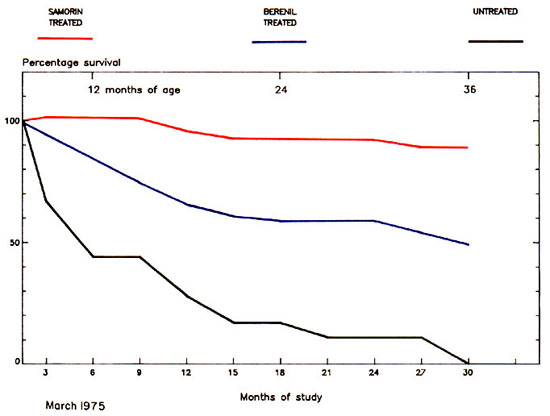
Survival. Major differences in survival emerged among the three groups of cattle (Figure 12). The massive tsetse fly challenge that exists on Mkwaja Ranch was confirmed by the fact that none of the untreated cattle survived beyond 30 months of the study. By 3 months after the start of the experiment, 6 untreated cattle were dead and by 12 months, 13 of the 18 (over 70%) had succumbed. The fact that 5 animals were able to survive beyond this time, 2 for over 2 years, probably reflects innate differences in susceptibility to trypanosomiasis in cattle at Mkwaja, as there is little doubt that all animals exposed must have become infected.
On the other hand, in the group of cattle treated with Samorin, only 4 out of 37 animals (11%) died during the 31 months of study; no animal died during the first 9 months and only one died in the last 15 months of the experiment. The use of Berenil was not nearly as effective as Samorin. Thus, 21 of the 40 animals (52%) in the Berenil-treated group died. However, it was of interest that 14 deaths occurred during the first 12 months while the remaining 7 animals succumbed during the next 21 months. This result might suggest that the Berenil regime was leading to acquired resistance to trypanosomiasis.
Disease progress. As systematic examination of blood smears for trypanosomes was not carried out, it was not possible to evaluate the overall prevalance of trypanosomes. However, during the last 3 to 4 months of the study the tsetse challenge was reported to be very high. On the few occasions when cattle were bled at this time, up to 20% of the Samorin-treated animals and nearly 50% of the Berenil-treated group were infected, while the two surviving untreated controls were consistently infected. T. congolense was the most common trypanosome species identified on thin blood smears (approximately 90%) and T. vivax was found in the remainder.
After 31 months of tsetse challenge at Mkwaja Ranch 33 of the 37 cattle (89%) treated with Samorin were alive but only 19 of the 40 animals (48%) treated with Berenil had survived. All of the 18 untreated cattle died.
In the same way, PCV estimations were not carried out on a regular basis and the group means gave little indication of the actual situation within each group. Thus, after animals died, usually with a low PCV, the group mean rose. Nevertheless, the Samorin-treated group showed no evidence of anaemia until the end of the study (Table 7).
Towards the end of the study, the surviving Berenil-treated cattle had developed severe anaemia. It was during this period that the tsetse challenge was reported to be high and a large number of trypanosome-positive cases were found. In the untreated cattle, all developed marked anaemia. The large standard deviations observed in this group (Table 7) reflected the marked heterogeneity in susceptibility in these cattle, with some animals developing severe anaemia more quickly than others.
Cause of death. Under the conditions prevailing on this large ranch, it was not possible to carry out postmortem examinations on all the animals that died. However, in those cases where the carcass was available it would appear that trypanosomiasis and predation by lions were the main causes of death (Table 8).
Thus, in the untreated group, trypanosomiasis was confirmed in six of the nine cases necropsied; lions accounted for the other three. Of the five Berenil-treated animals necropsied, trypanosomiasis was diagnosed in two, snake-bite in one and lions accounted for the remaining two. On the other hand, in the Samorin-treated cattle, trypanosomiasis was not diagnosed and lion accounted for the death of the only two carcasses found for examination. Although it was not possible to confirm the cause of death in the majority of cattle, as the only differences in the management of the three groups of cattle was the use of trypanocidal drugs, we conclude that the cause of death in the cases not necropsied was most likely trypanosomiasis.
Table 7. Packed red cell volume estimations in three groups of cattle, Mkwaja Ranch, 1975-77.
|
Group |
|
Packed red cell volume (PCV) (%) |
||||||
|
Month of studya: |
0 |
9 |
12 |
24 |
27 |
31 |
||
|
1. Samorin |
||||||||
|
|
Mean |
|
36 |
33 |
32 |
33 |
33 |
28 |
|
|
SD |
|
4 |
5 |
6 |
4 |
4 |
4 |
|
|
Number |
|
37 |
37 |
35 |
34 |
33 |
33 |
|
2. Berenil |
||||||||
|
|
Mean |
|
34 |
30 |
30 |
31 |
30 |
21 |
|
|
SD |
|
3 |
5 |
6 |
4 |
5 |
4 |
|
|
Number |
|
40 |
30 |
26 |
23 |
21 |
19 |
|
3. Control |
||||||||
|
|
Mean |
|
32 |
27 |
28 |
30 |
24 |
- |
|
|
SD |
|
3 |
8 |
7 |
4 |
6 |
- |
|
|
Number |
|
18 |
8 |
5 |
2 |
2 |
0 |
a At month 0 (March 1975) the animals had just been weaned and were approximately 9 months of age. At month 31 (October 1977) they were approximately 40 months of age.
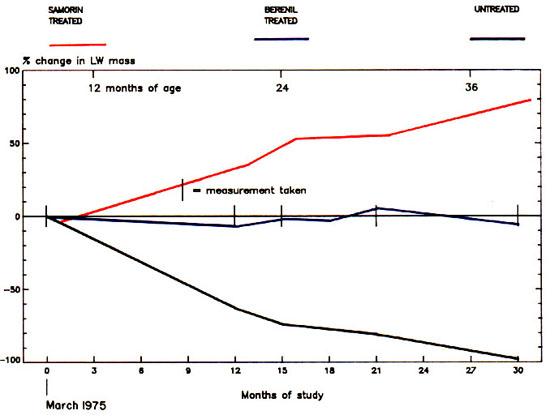
Weight changes. Marked differences among the groups in the total liveweight mass produced were evident (Table 9). Thus, at the start of the experiment the total liveweight of the 37 cattle in the Samorin-treated group was 5032 kg and 31 months later was 9042 kg in the 33 survivors, an increase of 80% (Figure 13). In contrast, the starting total liveweight mass of the 40 Berenil-treated cattle of 4920 kg had dropped by 8% to 4598 kg in the 19 surviving animals by 31 months. The untreated group did not survive.
Conclusion. The level of tsetse challenge at Mkwaja Ranch is such that cattle cannot survive without the use of trypanocidal drugs. Even the regular use of the highly effective therapeutic drug Berenil was not enough to keep significant numbers of animals alive and productive. Only with Samorin was it possible to maintain productive animals at Mkwaja.
Table 8. Cause of death among three groups of cattle Mkwaja Ranch, 1975- 77.
|
Diagnosis of cause of death |
Samorin group |
Berenil group |
Control group |
|
(No. of animals) |
|||
|
No necropsy |
2 |
16 |
9 |
|
Lion |
2 |
2 |
3 |
|
Snake bite |
0 |
1 |
0 |
|
Trypanosomiasis |
0 |
2 |
6 |
|
Total |
4 |
21 |
18 |
|
No. of cattle at risk |
37 |
40 |
18 |
Because of the success of Samorin in post-weaned cattle, it was decided to explore the use of Samorin in pre-weaned calves from an early age and compare it with different Berenil strategies.
Cattle. Eighty female calves were selected from the Vuga and Umba herds in November 1975 at the age of 4 to 6 weeks. They were maintained at the Ruande section along with several hundred other suckling animals of the same age. The animals were weaned during July 1976 at around 9 months of age.
Table 9. Mean weight changes among three groups of cattle, Mkwaja Ranch, 1975-77.
|
Group |
Month of study |
0 |
12 |
15 |
21 |
32 | |
|
1. Samorin | |||||||
|
|
Mean weight change (kg) |
|
136 |
196 |
229 |
231 |
274 |
|
|
SD |
|
28 |
25 |
N |
N |
40 |
|
|
Number of animals |
|
37 |
35 |
34 |
34 |
33 |
|
2. Berenil | |||||||
|
|
Mean weight change (kg) |
|
123 |
177 |
202 |
224 |
242 |
|
|
SD |
|
15 |
21 |
N |
N |
29 |
|
|
Number of animals |
|
40 |
26 |
24 |
23 |
19 |
|
3. Control | |||||||
|
|
Mean weight change (kg) |
|
123 |
165 |
192 |
200 |
0 |
|
|
SD |
|
40 |
15 |
N |
N |
0 |
|
|
Number of animals |
|
18 |
5 |
3 |
2 |
0 |
N = not known.
After 31 months of tsetse challenge at Mkwaja Ranch, the total liveweight mass of the Samorin-treated cattle had increased by 80%, while that of the Berenil-treated group had dropped by 8%. The untreated group produced nothing.
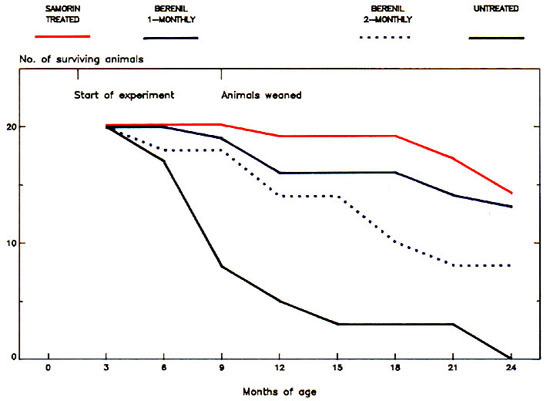
The experiment started when the animals were 4 to 6 weeks old. By weaning all 20 of the Samorin-treated calves were alive, one calf of the Berenil once per month group had died, 2 calves of the group that received Berenil every 2 months had died, while 12 of the untreated group of 20 calves had succumbed. After weaning all groups suffered severely: 6 of the Samorin-treated group, 6 of the Berenil once per month group, 10 of the Berenil every 2 months group and the remaining 8 animals in the untreated group died.
Drug strategy. Starting at 4 to 6 weeks of age, the 80 calves were divided into 4 groups of 20 animals each and treated as follows:
Group 1: Animals were given Samorin at 0.5 ma/kg at 2-monthly intervals.
Group 2: Animals were given Berenil at 3.5 ma/kg at 2-monthly intervals.
Group 3: Animals were given Berenil at 3.5 ma/kg every month (the ranch policy for calves).
Group 4: Animals were maintained as untreated controls.
The experiment was continued until October 1977, when the cattle were approximately 2 years old.
Parameters assessed. The same parameters as in Experiment 1 were measured.
Survival. As in the previous experiment, major differences in survival were found among all four groups (Figure 14). By weaning, only 8 of the 20 untreated calves (40%) were alive, whereas all 20 of the calves under Samorin prophylaxis were alive. Only one of 20 calves treated once a month with Berenil and two of 20 treated with Berenil every second month were dead by 9 months of age. After weaning, all groups suffered severely. Of the remaining eight untreated cattle, all were dead by 21 months of age, although the variation in survival (despite the fact that all animals were likely to have been infected) probably reflects, as in the previous experiment, the existence of innate differences in susceptibility to trypanosomiasis in cattle at Mkwaja. At this time, three of the Samorin group had died and a further three died during the subsequent 3 months leaving 14 survivors out of 20 (70%) at the termination of the study in October 1977. The group treated with Berenil once a month performed nearly as well as the Samorin-treated animals in terms of survival, with 13 animals (66%) alive at the end of the experiment. The animals treated with Berenil every second month suffered most severely of the treated groups and there were only eight survivors (40%) by October 1977.
Disease progress. Routine examination of blood smears was not carried out in this study. Nevertheless, in June 1977 the incidence of trypanosome infection in Groups 1, 2 and 3 was 22%, 58% and 33% respectively, reflecting the high tsetse challenge which was reported to be occurring around this period. At this time, the three surviving untreated controls were all parasitaemic. As in the previous experiment, T. congolense accounted for 90% of the infection and T. vivax for 10%.
In this study, PCV levels were not measured in any systematic way. What was obvious from the limited data available was that the animals which died usually exhibited low PCV levels (15% or less) and that the mean average PCV was higher in the Samorin-treated animals and in the cattle given Berenil once a month.
Cause of death. When necropsies were possible, trypanosomiasis was found to be the major cause of death (Table 10).
Table 10. Cause of death among four groups of cattle, Mkwaja Ranch, 1975-77.
|
Diagnosis of cause of death |
Group 1 |
Group 2 |
Group 3 |
Group 4 |
|
(Samorin |
(Berenil |
(Berenil |
(Control) |
|
|
bimonthly) |
bimonthly) |
monthly) |
||
|
(Number of animals) |
||||
|
No necropsy |
6 |
5 |
6 |
8 |
|
Lion |
0 |
0 |
0 |
1 |
|
Plant poisoning |
0 |
0 |
0 |
1 |
|
Salmonellosis |
0 |
0 |
0 |
0 |
|
Trypanosomiasis |
0 |
6 |
1 |
10 |
|
Total |
6 |
12 |
7 |
20 |
|
No. of cattle at risk |
20 |
20 |
20 |
20 |
In the untreated control cattle, trypanosomisis accounted for ten deaths, lion for one, plant poisoning for one and the remaining eight carcasses were not available for necropsy. In Group 2 (Berenil every second month), 6 of the 12 animals necropsied died of trypanosomiasis and one animal of salmonellosis. In only one of the seven cases necropsied in Group 3 (Berenil once a month) was a diagnosis possible and this was confirmed as trypanosomiasis. In the Samorin-treated animals, trypanosomiasis was not diagnosed in any of the six animals that died. The number of deaths in this group was much higher than in the equivalent group in Experiment 1 over the same time period. It was concluded that some unidentified factor other than trypanosomiasis accounted for this difference and, as a result, the poorer performance of this group when compared to Experiment 1.
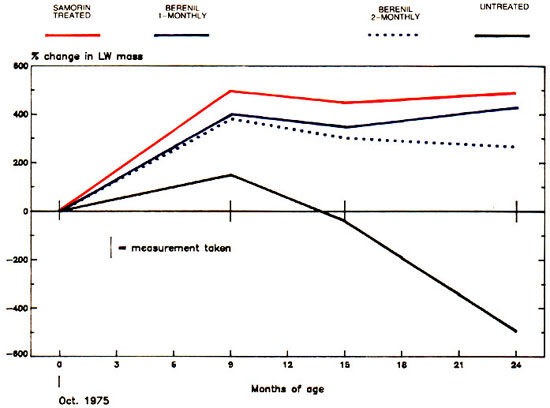
Weight changes. The four groups of cattle showed marked differences in total liveweight mass produced (Table 11, Figure 15).
Table 11. Mean weight changes among four groups of cattle, Mkwaja Ranch, 1975-77.
|
Group |
Month of agea: |
Birth |
9 |
15 |
24 | |
|
1. Samorin (bimonthly) | ||||||
|
|
Mean weight change (kg) |
|
25 |
125 |
119 |
176 |
|
|
SD |
|
N |
N |
N |
38 |
|
|
Number of animals |
|
20 |
20 |
19 |
14 |
|
2. Berenil (bimonthly) | ||||||
|
|
Mean weight change (kg) |
|
24 |
101 |
102 |
158 |
|
|
SD |
|
N |
N |
N |
.28 |
|
|
Number of animals |
|
20 |
18 |
14 |
8 |
|
3. Berenil (monthly) | ||||||
|
|
Mean weight change (kg) |
|
25 |
106 |
108 |
164 |
|
|
SD |
|
N |
N |
N |
39 |
|
|
Number of animals |
|
20 |
19 |
16 |
13 |
|
4. Control | ||||||
|
|
Mean weight change (kg) |
|
24 |
89 |
93 |
0 |
|
|
SD |
|
N |
N |
N |
0 |
|
|
Number of animals |
|
20 |
8 |
3 |
0 |
a The calves were born in October 1975. N = not known.
In the Samorin-treated cattle (Group 1) the total liveweight increase from birth (20 animals) to 24 months (14 animals) was from 500 kg to 2464 kg. The corresponding increase in Group 3 (Berenil once a month) was from 500 kg (20 animals) to 2132 kg (13 animals). In the animals treated with Berenil every second month the gain was much less and was from 480 kg (20 animals) to 1264 kg (8 animals). No control cattle survived.
Once again in this second experiment, the Samorin-treated group produced the greatest liveweight mass. It should be noted that because of the deaths which occurred in the Samorin group after weaning, there was no change in total liveweight mass between weaning at 9 months and 24 months of age. Furthermore the average weight of Samorin-treated animals at 24 months was 53 kg less in the second experiment (176 kg) than in the first (229 kg).
Conclusion. As in Experiment 1, untreated cattle could not survive at Mkwaja Ranch. Confirming the previous result, the Samorin-treated group performed best in terms of survival and liveweight mass produced. What was of further interest was that Samorin was the most effective drug in protecting calves prior to weaning. Of the two Berenil strategies tested, Berenil once a month was markedly superior to Berenil every second month and was almost as effective as Samorin. However, the once-a-month strategy would be twice as costly in terms of manpower and drugs.
As in the previous experiment, the Samorin-treated group performed best. The Samorin-treated cattle produced a total liveweight mass of 2464 kg, the group treated with Berenil once per month 2132 kg (14% less) and the group treated with Berenil every 2 months 1264 kg (49% less than the Samorin group). The untreated group produced nothing.
From the results of these two experiments on approximately 180 cattle studied for up to 31 months, it is obvious that ranching is only possible at Mkwaja with the use of trypanocidal drugs. Because of the high persistent tsetse challenge, Samorin with its long prophylactic action was significantly more effective than Berenil. When it is considered that at Mkwaja Ranch the tsetse challenge is recognised as being among the highest in Africa, the findings of these studies have far-reaching implications for the use of Samorin chemoprophylaxis to control trypanosomiasis in cattle throughout the tsetse-infested areas of Africa.