Age at first calving
Calving interval
Season of calving
Number of calves born per breeding female in the herd
Discussion
A total of 20 heifers whose date of birth was known had themselves given birth by the end of the study. The mean age at first calving of these animals was 1505 ± 103.3 days (49.5 ± 3.34 months).
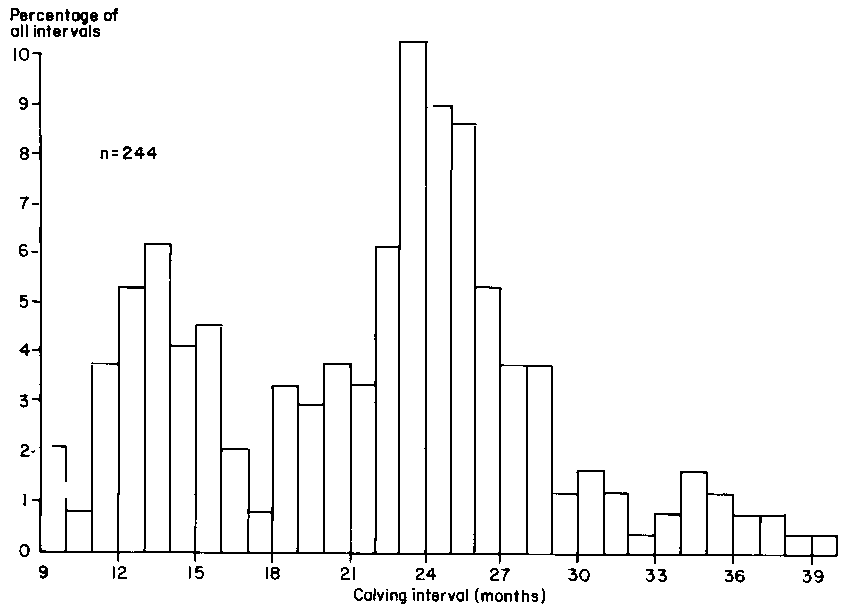
The observed calving interval ( ± s.d.) was 665 ± 202.2 days (n = 244) or just under 22 months, the
coefficient of variation being 30.3%. As can be seen from Figure 28, there is
a distinct bimodal pattern to the distribution of these intervals with peaks
at 12 to 16 months and at 23 to 26 months, and some indications of a third minor
peak at around 36 months.
± s.d.) was 665 ± 202.2 days (n = 244) or just under 22 months, the
coefficient of variation being 30.3%. As can be seen from Figure 28, there is
a distinct bimodal pattern to the distribution of these intervals with peaks
at 12 to 16 months and at 23 to 26 months, and some indications of a third minor
peak at around 36 months.
The analysis of variance of this trait (Table 21) demonstrates that parity (i.e. dam's age) significantly affected the length of the next parturition interval. The least-squares means for the main variables affecting calving interval are given in Table 22. The observed sample mean (665 days) differs somewhat from the computed overall least-squares mean (644 days) as the latter is adjusted for the unequal subclass numbers. The general trend appeared to be one of reducing interval with increasing parity until older ages were reached when the interval between carvings increased sharply. There was a clearly longer interval after the birth of a male calf than after that of a female. Month of birth had a considerable but non-significant effect on the subsequent parturition interval, which ranged from a minimum of 565 days after a January calving to a maximum of 723 days after a post-rains calving in October and November. There were also considerable though non-significant differences between herds within each of the two subsystems.
Figure 28. Frequency distribution of calving intervals in cattle.
Table 21. Analysis of variance of calving interval for agropastoral cows in central Mali.
|
Source of variation |
d.f. |
MS x 10-3 |
|
System |
1 |
109 |
|
Month |
11 |
21 |
|
Parity |
4 |
142** |
|
Sex |
1 |
46 |
|
Herd (millet) |
3 |
40 |
|
Herd (rice) |
4 |
21 |
|
Remainder |
220 |
40 |
**P<0.01.
Table 22. Least-squares means for calving interval of agropastoral cows in central Mali.
|
Variable |
n |
|
± SE | |
|
Overall |
244 |
644 |
18 | |
|
System |
|
|
| |
|
|
Millet |
104 |
617 |
26 |
|
|
Rice |
140 |
671 |
21 |
|
Parity |
|
|
| |
|
|
1 |
772 |
646a |
29 |
|
|
2 |
47 |
602a |
33 |
|
|
3 |
32 |
654ab |
39 |
|
|
4 |
39 |
585a |
34 |
|
|
'9' |
54 |
734b |
32 |
|
Sex |
|
|
| |
|
|
Female |
136 |
630 |
21 |
|
|
Male |
108 |
659 |
24 |
Note: '9' are births of unknown parity assumed to be ³ 3.Within variable groups, means followed by different letters differ significantly (P<0.05). Variable groups without any letters did not show a significant difference in the analysis of variance.
When the age at death of a calf was introduced as a covariant, the subsequent parturition interval was lengthened significantly (t = 2.68, P = 0.011) for each day of survival of the calf, the relationship being:
Parturition interval = 499.5 + (age at calf death x 0.318) days
The repeatability (± SE) of the 244 intervals for a total of 166 cows was 0.182 ± 0.0138.
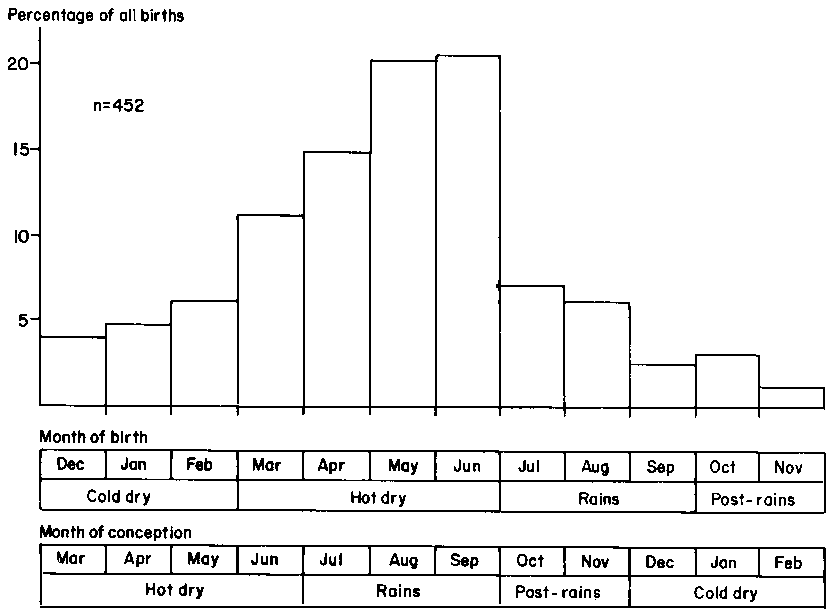
The monthly distribution of 452 carvings (relating to all animals born in completed years of the study) is shown in Figure 29 which also shows the season of conception, assuming this occurred approximately 9 months previously. Some 56% of au calves were conceived during the 3-month period of the rains.
When correlation coefficients were calculated for the number of births per month and rainfall 9 and 10 months previously, there were highly significant correlations (respectively r = 0.562 and 0.563, d.f. = 70, P<0.001) for the pooled data over 6 years. Correlations were significant for rainfall both 9 and 10 months earlier for individual years. Correlations between rainfall 11 and 12 months previously and the number of calves born were not significant. Details of these coefficients and significance levels are given in the Appendix.
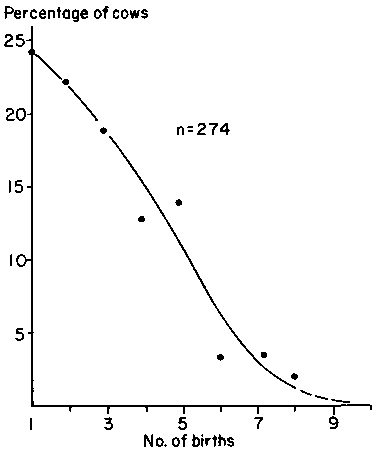
Reconstruction of cow histories (by observation and by questioning of owners for cow calving data before the study began) indicated that the 274 cows in the study which had calved at least once had given birth to a total of 797 calves Cows having given birth to one to eight calves respectively accounted for 23.0, 21.2, 23.7, 16.1, 10.9, 1.8, 1.8 and 1.5% of all cows, the average number of calves born per cow being 2.91. Numbers of calves born to those cows still in the herds (i.e. whose reproductive careers were still in progress) at 30 June 1984 are shown in Figure 30: the average number born to each of these animals was 3.02.
There is a slight anomaly in these calculations due to assuming that the first calf of mature cows of unknown history is the third for that animal. However, changing this to four would hardly affect the general conclusion that very few cows bear more than five calves. The average lifetime production is of the order of three calves per cow. Most cows therefore either died or were called from the herd at about 9 years of age (this being age at first parturition + interval to second calf + interval to third calf + time of weaning third calf).
Figure 29. Seasonal distribution of conceptions and calvings for cattle in central Mali.
It has been suggested that indigenous cattle in the tropics normally drop their first calf at 3 to 4 years of age (Mahadevan, 1966). Under improved management where seasonal nutritional stress can be reduced, it is indeed possible to achieve first calving at 43 months. This has been the case at Niono on the government research station (ILCA/IER, 1978) under exactly the same climatic conditions as pertained in this study. Nonetheless, even under these improved conditions, in series of bad rainfall years or when supplementary feed supplies could not be provided, age at first calving was delayed. Traditional owners in the dry areas of Africa have, for many years, complained of delayed first carvings due to "lack of fodder resources" although they do not always associate this lack with overstocking in general. There has been to date little empirical evidence for this assertion, but the firm data on age at first calving from 20 heifers in this study support the view that first parturitions do not generally occur until the beginning of the fifth year of a cow's life.
The calving interval of 665 days is equivalent to an approximate calving rate of 55% (365 x 100/665). In Sudan, under similar climatic conditions, a rate of 40% was calculated for sedentary cattle, this improving to 65% for migratory cattle where nutritional stresses could be expected to be mitigated to some extent (Wilson and Clarke 1976a). Based on questionnaire surveys rather than on observation, estimated rates for other sedentary cattle in Mali are 55% (Coulomb, 1970). Rates of 60% (Coulomb, 1971) and 63% (Wilson and Wagenaar, 1983) for transhumant cattle have been calculated from questionnaire data collected in Niger. Where nutritional stresses are reduced by research station management, calving intervals can be progressively reduced - at Niono, for example, from 561 to 423 days from 1966 to 1973 (ILCA/IER, 1978).
The effects of year were not obtained during this study and month of calving had no significant effect, possibly because of the generally long calving interval. However, the general effect of month of calving was that which would be expected if nutrition were the major factor in reproductive rate. Thus a calving in the cold dry season allowed conception during the next rainy season, leading to shorter intervals than the mean. The effect of parity was also as expected since older, weaker cows took longer to recover from pregnancy and lactation stress, this resulting in longer intervals. The effect of the sex of the calf is interesting, male calves apparently delaying conception by putting more strain on cows. A similar calf sex effect has been observed in red deer in Scotland (Clutton-Brock et al, 1982) where calving intervals 11 days longer after males were attributed to longer gestation intervals, heavier calf weights and more frequent and more intensive suckling by male calves. The effect of the age at death of the calf on calving interval can be attributed to the suppression of lactation anoestrus.
Figure 30. Number of calves born per cow in central Malian herds.
The repeatability of 0.182 is better than the average of all published data for this trait in tropical cattle, calculated as 0.131 by Payne (1970). It is as good as, or better than, other African records: 0.05 for Northern Sudan Zebu (Alim, 1964) and 0.09 to 0.18 for the Small East African Zebu (Mahadevan et al, 1962). However, it is still a relatively low value and it is more than likely that the observed variation is due to environmental rather than hereditary additive factors. Seeking improvement of this trait through breeding would therefore appear to have little chance of success, at least until better control of the external environment is achieved.
Nutritional effects on the reproductive pattern are clearly demonstrated in the seasonality of calving (Figure 29). The results obtained in this study confirm other observations made in dry northern Africa. In Sudan, 62.5% of all calves were born in the period April to June (Wilson and Clarke, 1976a). In Niger, owners reported that 40% of calves dropped in May and August (Coulomb, 1971) and in a recent survey, also in Niger, 57% of calves were born in July to September (Wilson and Wagenaar, 1983). This phenomenon is not confined to dry northern Africa but occurs also in southern Africa, where breeding restrictions are not practiced and where rainfall is seasonal. In Swaziland, both Brown (1959) and Butterworth (1983) have reported marked seasonality in calving. The latter author found a normal unimodal curve of calf births, with 57% and 55% of the annual total occurring in October to December in the High Veld and Middle Veld respectively. The values of r in Butterworth's study, which included 7 years' data, were 0.89 and 0.83 for rainfall 10 and 11 months previously, and 0.74 for 9 months previously. Reproductive response in the current study, which probably occurred even before the onset of weight gain, was thus more rapid than in Swaziland.
Additional evidence that nutrition is the major constraint to reproduction in the traditional environment comes from the bimodal distribution of calving intervals shown in Figure 28, with those cows failing to conceive in the first rainy season not conceiving until the next. This pattern has also been observed in Niger where 38% of calving intervals were around 11 to 13 months and 24% around 24 to 25 months: there were no intervals at 19 and 20 months and only one at 18 months (Wilson and Wagenaar, 1983).
Poor nutrition is in large part responsible for the low average number of calves born to cows in the herd. The average of 2.9 calves per cow results from late first parturitions, long calving intervals and early exhaustion of the body reserves leading to an early culling age. Cows are unproductive for long periods of their life but continue to consume natural fodder resources, thus further aggravating an already critical feed supply situation. Improved fodder production or better utilisation of existing production would do much to reduce nutritional stress, particularly in the dry season, and thus improve the reproductive rate.

 (days)