Price formation in a free market
Objectives of livestock pricing policies
Instruments of livestock products pricing policies
Conflicts between objectives and pricing instruments used
Reasons for government pricing intervention policies
In almost every country, developed and developing alike, governments intervene in agricultural markets. 4 In particular, all African states formulate and implement policies which affect agricultural and food prices. The reasons for government intervention in price determination are many and varied.
4. A distinction can be made between interventions due to market failures and interventions arising from other motives. The former set of interventions can be justified on theoretical grounds, but the general body of literature on the price policies of developing countries takes a very negative view of the latter. It is the latter set of interventions that are considered in this chapter.
This chapter begins with a description of the process of price formation in a free market in order to provide a benchmark against which subsequent discussions of government intervention in pricing policy can be viewed. It then reviews the multiple objectives of livestock price policies in the selected countries and analyses the main instruments employed to influence both producer and consumer prices. It examines the conflicts that often arise among the different policy objectives and assesses the appropriateness of some of the instruments in use. It concludes with a discussion of the arguments that have been advanced to rationalise government intervention in pricing policies.
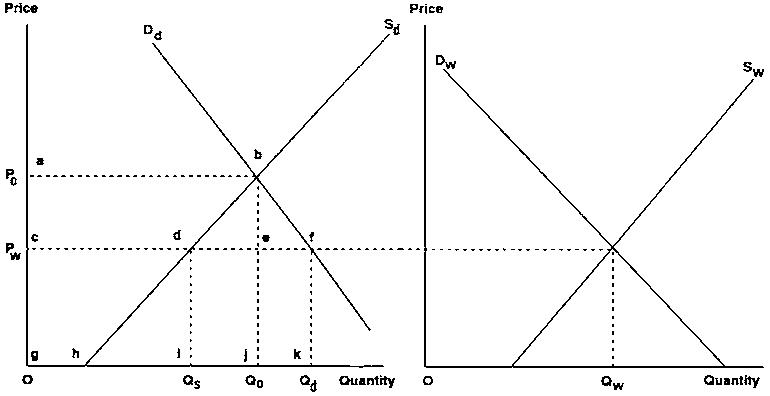
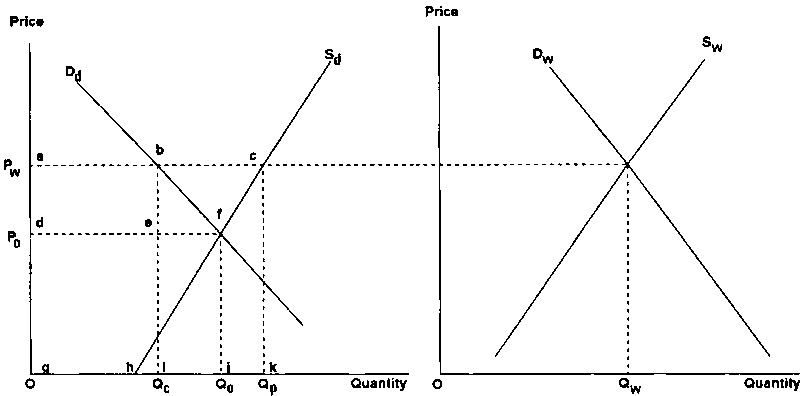
The process of price formation and the level of prices in a free market can be used as the norm by which market behaviour and prices obtained under government intervention can be evaluated. In this respect, it is useful to consider first, a situation where a commodity market in a given country is isolated from the world market and, second, a situation where free trade is possible. Given the characteristics of the study countries, it is also helpful to distinguish between the product for which a country is a potential importer (say, milk) and that for which a country is a potential exporter (say, beef).
In Figure 1a, the supply curve Sd shows the quantity of milk supplied per time period at different prices by producers in country 1. The demand curve Dd shows the quantity of milk demanded per time period at different prices by consumers in the same country. Since in this example the market for milk is isolated from the rest of the world, the market-clearing equilibrium is achieved with quantity Qo sold at price Po.
In Figure 1b, the supply curve Sw represents the total quantity of milk supplied to the world market per time period at different prices by all other countries. Dw represents the quantity demanded from the world market by all other countries. Market-clearing equilibrium is established in the world market with Qw traded at price Pw.
If the barriers that previously prevented trade with international markets are now removed, the outcome is quite different from the earlier result without international trade. Milk can now be traded at the border of country 1 at price Pw, the world price, 5 which is below the domestic market-clearing price, Po. Domestic demand increases from Qo to Qd and domestic supply falls from Qo to Qs. The gap, Qd-Qs is now imported from the world market at price Pw.
5. It is assumed here that since the production and consumption of milk in country 1 is very small in comparison to the quantity traded internationally, the effect on the world price of country 1's market becoming integrated with the rest of the world trading system is negligible. This is sometimes referred to as the "small country' assumption. The same assumption holds for the second case described in Figure 2.
Figure 2 illustrates the second market situation where a country is a potential exporter of beef. When the domestic market is isolated from the world market, Qo of beef is sold at price Po. With free trade between country 2 and the rest of the world, domestic consumption decreases to Qc, domestic production increases to Qp, and a quantity equal to Qp-Qc is exported to the world market at price Pw.
Figures 1 and 2 also show the welfare gains/losses resulting from trade. Figure 1a indicates that by importing milk at Pw, consumers in country 1 are better off in two ways: they can buy their original quantity of milk Qo at the lower price Pw, and they can increase the amount consumed to Qd. Their welfare gain is the area abfc, which is sometimes referred to as the increase in consumer surplus. This increase in consumer surplus is the amount of money consumers would have been willing to pay to consume the additional quantity Qd-Qo but do not need to pay because they can purchase all the milk they want at Pw. This gain in consumer welfare is obtained partially at the expense of domestic producers. In the absence of trade, total producer revenue is equal to abjg; total producer cost is bjh. The producer surplus or income is equal to the difference, abhg. With the fall in price to Pw, producer incomes fall by the amount abcd. This is a loss in producer welfare which accrues to consumers because of the fall in price.
It is obvious from Figure 1a that consumers have gained more than producers have lost. Consumers could reimburse producers for their losses and would still be net gainers by area bfd. This triangle represents the gains from trade.
Similarly, in Figure 2 the welfare gains from free trade in beef compared to the situation where country 2's market is isolated from the world market, are represented by the area of the triangle bcf. This is the excess of the gain in producer surplus, abcfd over the loss in consumer surplus, abfd.
These results thus indicate that trade can provide a net gain in economic surplus for countries 1 and 2. Although not shown here, it can also be demonstrated that with free trade a country can maximise the welfare gains from trade. However, several important points are hidden in the apparently simple analyses presented above.
First, the world price Pw, is usually quoted in foreign currency (e.g. US dollars). To make Pw comparable to the domestic price, Po, a conversion at some exchange rate is required. The rate that is used obviously has a significant effect on how Pw compares with Po.
Second, as shown above, the opportunity to trade internationally creates several adjustments in the domestic commodity market. For one thing, it changes the price facing domestic producers and consumers of the commodity in question. This has important implications for income distribution and resource allocation and, perhaps more importantly, for other commodities and the entire economy.
Third, international commodity markets are notoriously unstable and fragmented. For livestock products, this instability arises partly as a result of climatic and biological conditions and partly due to inadequate information and knowledge about current and expected economic opportunities. The result, often, is wide fluctuations in world prices which, in turn, can cause large fluctuations in the incomes of farmers or, in the case of exporting countries, in foreign exchange earnings.
These fluctuations can go beyond what a government is willing to accept and hence may attempt to institute some measure of price stabilisation.
The points raised above, while by no means exhaustive, do provide a basis for understanding why governments have rarely been prepared to allow free international trade and accept the prices that ensue from it. While government pricing interventions may arise out of a misunderstanding of the relationship between trade and social welfare, often the departure from free trade arises because a government wants to achieve objectives that may pertain to safeguarding public welfare or raising government revenue. The next section examines some of these objectives.
The self-sufficiency objective
The export promotion objective
The inflation control and market stabilisation objectives
The government revenue raising objective
The improved nutrition objective
The employment creation objective
Although there are many different objectives behind livestock pricing policies pursued in the study countries, they can be summarised under six headings, viz: food self-sufficiency, export promotion, stabilisation and inflation control, government revenue generation, improved nutrition and employment creation. The specific livestock development objectives pursued in each of the selected countries are shown in Table 11. While the objectives are, to a certain extent, mutually reinforcing, in a number of eases there can be conflict between them.
Table 11. Major livestock policy goals in the study countries, 1975-85.
|
Goal |
Country |
|||||
|
Côte d'Ivoire |
Ethiopia |
Mali |
Nigeria |
Sudan |
Zimbabwe |
|
|
Self-sufficiency |
X |
X |
X |
X |
X |
X |
|
Export promotion |
|
X |
X |
|
X |
X |
|
Stabilisation and inflation |
X |
|
X |
X |
X |
X |
|
Government revenue generation |
X |
X |
X |
X |
X |
X |
|
Improved nutrition |
|
|
|
X |
|
X |
|
Employment creation |
|
X |
|
X |
|
X |
The following notes sketch the main features of the objectives listed summarily above.
Of all the stated objectives, the basically consumer-oriented objective of attaining meat and milk self-sufficiency ranked as the most common. 6 As Table 11 indicates, this objective is sought after by all the study countries. This is not surprising given the nutritional importance of meat and milk in the diet and the political risks associated with shortages of these products. Equally important is the desire to reduce dependence on imports in the face of foreign exchange shortages and unpredictable world prices.
6. Self-sufficiency was an important goal in the study countries from the early 1970s to the early 1980s. Government documents now refer to the goal of improved food security in livestock projects. The two terms are often used interchangeably, but they are not synonymous. Food self-sufficiency aims at meeting all the staple food needs of a country from domestic production. It is a narrower concept than food security which aims at ensuring access for all at all times to a level of food sufficient for an active and healthy life (World Bank, 1986a). The two key components of food security are food availability (through domestic production and/or trade) and food access (through home production or purchase).
Ideally, the self-sufficiency objective could be achieved by following a producer-oriented price policy. This was the approach followed by the Republic of Korea in the 1960s and particularly since 1970 with respect to rice. By raising the real producer price of rice and implementing other price-related incentive measures, Korea was able to achieve self-sufficiency in rice in 1977 while the yield of rice per hectare outstripped that of Japan and the United States (Paukert, 1988).
While similar policies could, in principle, be applied to the livestock subsector, this has not usually been the practice in SSA where priority has been given instead to cheap food policies that have benefited consumers more than producers. As can be seen in Chapter 4, even in those instances where producer prices have risen, restrictive trade and exchange rate policies have been partly responsible for those increases.
More importantly, judging by the production and consumption trends presented in the previous chapter, self-sufficiency in meat and milk has not been achieved for any considerable length of time in most of the study countries. In fact, the self-sufficiency ratios 7 of meat and more so of milk have tended to decline over the last 10 years, although there are considerable fluctuations in the ratios among countries and between consecutive years.
7. Defined as the ratio of domestic production to total consumption.
Thus, while the Korean example and other similar cases indicate that appropriate pricing policies can move a country toward the goal of self-sufficiency, inappropriate policies, on the other hand, can lead to outcomes that are exactly opposite to those intended or at least stated. It is important to note here that most of the study countries, undoubtedly, possess considerable animal resources. However, there are virtually no detailed analyses of the comparative advantage that each country has in the production of particular livestock products. Such studies dealing with issues concerning international markets, appropriate border price policies and foreign exchange management, can give policy makers an idea of the feasibility or desirability of achieving self-sufficiency by providing a unified framework for assessing the advantages that a country has in the production of meat and/or milk.
This objective stems from the desire of most governments to improve the contribution of the livestock subsector to net foreign exchange earnings. It is another frequently expressed production objective of livestock products pricing policy. As Table 11 indicates, it is important in four of the six selected countries.
Generally, the rate of growth of exports will depend on the stimulus from export markets and on the incentives provided by domestic price and trade policies. However, even with a strong external stimulus, domestic price policies may still impede the growth of exports in several ways. First, it is obvious that exports of livestock and their products will increase only if growth of production exceeds growth of domestic consumption. This might require producer prices to rise to border price levels to spur production and restrict consumption. But if prices are controlled at both the producer and consumer levels, this may discourage production and encourage consumption - the opposite of the desired effect of promoting export.
Secondly, the manner in which the state intervenes in export marketing can have a profound impact on the level of exports. In most SSA countries, export marketing is under tight government control, when not a state monopoly. 8 These intervention agencies have been used in the past as instruments of taxation with often negative consequences for exports.
8. Among the livestock exporting countries considered in this study, government parastatals intervene directly in export marketing by purchasing and exporting livestock and animal products in Ethiopia and Zimbabwe, while the parastatals provide only regulatory and service functions in Mali and Sudan.
In addition, inappropriate exchange rate policies can have deleterious effects on the development of the livestock export sector. Indeed, it has been argued that part of SSA's decline in agricultural exports stems from lack of international competitiveness as a result of overvalued exchange rates, export taxation etc (FAO, 1986b; Oyejide, 1986). The relative importance of these direct and indirect price control policies in promoting or inhibiting the growth of livestock output, including exports, in the study countries is examined empirically in Chapter 5.
Livestock production is inherently unstable given its dependence on climatic and other environmental conditions. This instability is a major source of price fluctuations for livestock products. The stabilisation objective can take two forms: price and income. With respect to the former, the aim is to minimise price fluctuations with a view to shield both consumers and producers from the full impact of erratic nominal price variations. The income stabilisation objective, on the other hand, is basically producer-oriented. For-instance, Nigeria's agricultural policy document states that one of the policy objectives of the livestock subsector is to improve and stabilise rural income emanating from livestock production and processing (Nigeria, 1988). The aim here is to reduce the fluctuations in prices which may lead to an undesired change in real incomes of producers.
Virtually all the countries studied included price stabilisation objectives in their agricultural policies. A common mechanism for reducing abnormal fluctuations in agricultural prices is for a government agency to act as buyer and seller of last resort, entering the market to purchase supplies when prices are very low and selling later when diminishing supplies drive up prices. However, this kind of measure has not been applied to the livestock sector of the study countries mainly because of the perishability of the products, relying instead, on consumer price controls in countries pursuing this objective (e.g. Côte d'Ivoire, Mali, Sudan and Zimbabwe). At the same time, pricing policies aimed at reducing year-to-year fluctuations have been pursued, particularly in Zimbabwe, to protect producers against losses caused by the vagaries of weather and price fluctuations in the world market.
At this point, it is perhaps useful to distinguish between seasonal and erratic (i.e. atypical) price variations. Seasonal price variations of a regular type serve a useful purpose by reconciling demand with seasonally changing supply and production costs. Conversely, erratic price variations create uncertainty for producers which may retard specialisation and lead to faulty production decisions. Also, low-income consumers are particularly vulnerable to sudden price surges. Thus, attempts to eliminate seasonal price fluctuations altogether by relying, for example, on consumer price controls often destroys the incentive for private sector inter-temporal arbitrage and increases the need for further government intervention. A policy aimed at reducing erratic price variations, on the other hand, can help lessen the uncertainty about future prices. This can encourage private dealers to engage in inter-temporal arbitrage, for example, by buying animals in areas of feed shortage and moving them to areas with more fodder or processing facilities to overcome problems of perishability. These practices will also benefit consumers ultimately. However, this requires making the distinction between seasonal and erratic price variation, which is rarely done.
Another pertinent point is that some economists have argued that what is of crucial importance to producers is stabilising their income, ant stabilising the prices of their produce (Stiglitz, 1987). Their argument is that if price and quantity are negatively correlated, stabilising prices may actually exacerbate the fluctuations in income. There is some validity in this argument, particularly with respect to beef production, since other studies have established that the short-run slaughter response is almost always in a direction opposite to the current change in domestic producer price (Rodriguez, 1985; Jarvis, 1986).
Turning to the inflation control objective, the underlying motive is that it is necessary to keep down producer prices in order to make exports competitive and to constrain consumer price increases which could put upward pressure on wage levels and the prices of manufactured goods. However, a fact that is often ignored is that price policy alone cannot be used to keep inflation in check. The experiences of some of the countries studied indicate that price controls will fail to curb, and may even exacerbate, inflation. This happens when the fixed prices for meat and milk and other consumer goods are too low in relation to existing supply and demand. Scarcity of goods sold at controlled prices rapidly develops, and a parallel market is created with prices higher than would exist in the absence of price controls. Producers faced with unattractive prices shun or reduce their supplies to the official marketing agencies and sell instead on the parallel market. As a result, the proportion of goods sold at the controlled prices falls, while the proportion of parallel market sales grows, with an inflationary effect. Sudan and Zimbabwe have lately experienced this problem with regard to milk and meat, respectively.
Another objective of pricing policy is to raise revenue for government development tasks. The principal source of government revenue is, of course, taxation. Trade taxes (e.g. import tariffs and export taxes) are commonly used in all the study countries. In Mali, for example, the World Bank (1975) estimated that export taxes together with other levies and fees (e.g. butchers' and cattle dealers' licences, slaughtering fees etc) contributed about 6% of total public revenues (amounting to FCFA 11 612 million) in 1970-72. Apart from generating revenue, trade taxes also have an important influence on the prices received and paid by producers and consumers: export taxes on livestock products tend to lower domestic prices, while import tariffs tend to raise domestic prices.
In addition, pricing policy has often been pressed into service to raise government revenue because most developing countries lack an adequate administrative base for imposing direct taxes. The main instrument for this is the marketing board that purchases livestock products at low prices and either resells them domestically or exports them, at higher prices. The difference, which constitutes the government's profit from livestock price policy, can be a significant addition to government revenue.
The Livestock and Meat Corporation (LMC) of Ethiopia and the Cold Storage Commission (CSC) in Zimbabwe were partly set up for this purpose. Unfortunately, over the last few years, the governments of Ethiopia and Zimbabwe have had to subsidise these agencies instead of deriving revenue from them. In the case of the CSC, the problem arises partly because it has the responsibility of purchasing beef for domestic as well as export marketing. Until 1983, Zimbabwe pursued a cheap beef for consumers policy. CSC's export earnings were used to subsidise and lower the consumer price of beef. Thus, the Government of Zimbabwe was indirectly taxing producers while subsidising consumers. Even then the export earnings of the CSC could have added to government revenue, but the government chose instead to use the funds to reduce the cost of keeping consumer beef prices low.
This objective plays a prominent part in the justification of pricing policies in two of the study countries (Table 11). Its aim is to increase the level of household consumption of animal proteins - superficially, a highly praiseworthy objective. Its implementation is, however, problematic.
Ideally, for this objective to be achieved, producer prices need to be high enough to provide producers adequate incentives to expand output while keeping consumer prices low enough, or at least designed in such a way as to enable the poorer classes to benefit more than the wealthier ones. But a marked increase in the prices of meat and milk to encourage production can have a significant impact in threatening the standard of living of urban workers, leading to demands for higher wages and creating inflationary pressures in the economy. Moreover, attempts to increase food prices suddenly, as in Sudan in early 1985, have frequently been the immediate reasons for strikes and riots. However, attempts to suppress consumer price increases through subsidies can put an enormous strain on government budgets, leading to increased government borrowing and a possible expansion in the money supply that in itself can be inflationary. Zimbabwe, for example, experienced problems emanating from escalating consumer subsidies in the 1970s and early 1980s.
More importantly, the use of consumer subsidies means favouring the urban sector (rich and poor) at the expense of the rural population since such schemes are easier to administer in cities than in inaccessible rural areas. Also, if consumer prices are reduced by paying producers low prices, urbanites (rich and poor) again benefit at the expense of rural dwellers and this may discourage expansion of output. Thus this objective, meritorious at first sight, can be very negative from the point of view increasing production and the equitable distribution of benefits, if adequate care is not taken in its implementation. In terms of concrete achievement, available evidence presented elsewhere (Williams, 1989) indicates that not much progress has been made toward the attainment of this objective, for example, in Nigeria. The situation is not largely different in Zimbabwe, the other country pursuing this objective.
The idea underlying this objective is to use pricing policy to provide rural employment through expanded livestock production, processing and marketing. The labour intensive nature of some aspects of livestock production (e.g. dairy production) suggests that the direct and indirect employment effects of expansion can be substantial. Such rural employment opportunities can help to stem the tide of rural to urban migration and ease the pressure on social amenities in the cities. Further, since average rural incomes are often several times lower than average urban incomes, it is not surprising that governments concerned with long-term agricultural development are willing to consider using pricing policy to encourage more labour intensive livestock production systems.
High producer prices that will provide the incentive for expanding production through adoption of innovative approaches constitute a necessary condition for the attainment of the employment creation objective. As can be seen from the next chapter, real livestock producer prices increased slightly over the past decade in two of the countries pursuing this objective. Nevertheless, evidence of an upward trend in real producer prices does not resolve the question of whether these prices rose enough to encourage the kind of investment needed to create additional employment opportunities. Besides, other technical production problems and economic policies pursued in some of these countries have worked to offset whatever incentive was forthcoming from the rising producer prices. For example, in Nigeria beginning in the 1970s the government established a number of dairy processing plants near the major urban centres. The milk for processing was to come from associated government dairy farms and from local collection. However, the inadequate purchase prices offered by the plants made local milk collection difficult. The plants' production activities started relying on reconstituting imported powdered milk which was cheaper than locally produced milk because of depressed international prices and appreciation of the real exchange rate of the Naira during this period. Thus, both internal and external factors have militated against the attainment of the employment objective. The picture just painted for Nigeria is not altogether atypical of the situation in the other countries attempting to implement this objective.
Price controls
Input and consumer price subsidies
Import duties and quantitative import restrictions
Export taxes, licences, quotas and bans
Before examining the conflict inherent in attempting to implement the aforementioned objectives, it will be useful to review briefly the instruments through which livestock pricing policies are applied. Although there are a variety of intervention tools for influencing livestock product prices, the main instruments in use in the study countries are summarised in Table 12.
Table 12. Major instruments of livestock products pricing policies in the study countries, 1975-85.
|
Instrument |
Country |
|||||
|
Côte d'Ivoire |
Ethiopia |
Mali |
Nigeria |
Sudan |
Zimbabwe |
|
|
Controlled producer prices |
|
X |
|
|
|
X |
|
Controlled consumer prices |
X |
|
X |
|
X |
X |
|
Input subsidies |
X |
|
|
X |
|
|
|
Consumer price subsidies |
|
|
|
|
|
X |
|
Import tariffs |
X |
|
X |
X |
X |
X |
|
Import licences |
X |
|
X |
X |
X |
X |
|
Foreign exchange allocations |
|
|
X |
X |
X |
X |
|
Export taxes |
|
X |
X |
|
X |
|
|
Export licences |
|
X |
|
|
X |
|
As the table clearly shows, no single instrument is ever used alone in a country. Frequently, a number of instruments are used concurrently. Understanding the interrelationships between instruments is of crucial importance in designing effective price policies. In what follows, the pricing instruments listed summarily in Table 12 are discussed under four major headings: price controls; price subsidies; import measures and export measures.
Controlled or administered producer prices are used by governments in some of the countries studied to implement purchase price policies for basic food and exportable commodities. A complementary instrument, in the form of a marketing board, is usually employed in conjunction with price controls. Despite the great difference in the countries' situations, the basic approach is to establish fixed or minimum producer prices for the commodities under consideration, with a parastatal purchasing part of the total output. In determining the level at which to fix producer prices, various considerations including technical, economic and political factors are often taken into account. An example of this basic model is provided by the producer price policy of Zimbabwe with regard to beef and milk.
The parastatals responsible for the purchase and marketing of these two commodities are the Cold Storage Commission (CSC) and the Dairy Marketing Board (DMB), both under the control of the Agricultural Marketing Authority (AMA). The producer price-fixing process begins when the AMA conducts initial hearings with farmers' associations on the cost of production incurred within alternative commercial farming systems. Based on the submissions of the farmers' associations and on the trading accounts received from the CSC and DMB, the AMA makes recommendations on producer prices to the Ministry of Agriculture. The latter also holds meetings with farmers' associations to Bet their views on pricing issues. On the basis of these meetings, the ministry's own cost estimate of production, and on the AMA's recommendations, the Minister of Agriculture in consultation with the appropriate senior officials then decides on the appropriate producer prices to recommend to the Ministerial Economic Co-ordinating Committee (MECC), which is composed of the ministers of the relevant ministries. After considering AMA's proposals, MECC makes recommendations to the cabinet where the final decision on producer prices is taken. The producer prices arrived at in this fashion are then implemented by the CSC and DMB in their purchases of beef and milk from livestock producers.
There are variations to this process of producer price fixing in terms of the relative weight given to economic and political considerations. However, some aspects of this basic approach can be found in Ethiopia and, to a limited extent, in Sudan especially with regard to milk produced by the government-sponsored Kuku Cooperative Dairy Production Scheme and in the cattle ranching and fattening operations of Société de développement des productions animales (SODEPRA) in northern Côte d'Ivoire.
Having decided on producer prices to be paid by parastatals, governments may again intervene by stipulating the prices at which their agencies must sell their products on the domestic market. In cases where the agencies' domestic selling prices (set by government) are inadequate to cover their handling costs and the costs of purchasing products at the government-guaranteed producer prices, subsidy payments may be needed. For example, in Zimbabwe in 1984 and 1986, the CSC needed 8.5 million and 6.0 million Zimbabwean dollars, respectively, because of trading deficits incurred as a result of government control of both purchase and wholesale selling prices (CSC, unpublished data).
At the other end of the spectrum, consumer prices set by official decree are also prevalent in most of the study countries (Table 12). This instrument is normally intended to check price rises in order to hold down increases in the cost of living and to make livestock products available to low-income consumers at affordable prices. The consumer prices set in this manner are, therefore, ceiling prices. Frequently, a subsidy is involved as indicated, for example, by a Zimbabwean government policy document which noted that "for a number of decades past governments pursued a policy aimed at keeping the prices of basic foodstuffs, i.e. maize meal, meat..., as low as possible, whilst at the same time set producer prices at a level high enough to guarantee that consumer demand was met. Such a policy involved direct government intervention through the payment of subsidies to bridge the difference between official procurement prices and official selling prices since any increase in producer prices, if allowed to be passed on to the final consumer, would place an unacceptable burden on the majority of the population at the lower income level" (Zimbabwe Gov't, 1988).
While rationing appears to be an important complement to consumer price controls as it limits demand to the amount of goods available at the fixed price, it is not commonly used in the study countries. Thus, in the absence of rationing, consumer price control tends to be either ignored or, when enforced (at considerable financial cost to the government), give rise to a parallel market with much higher prices to consumers.
Furthermore, past experience in some of the study countries has emphasised the frequent tendency for price control regimes to be unduly rigid, raising difficulties when changes are required as happened, for example, in Sudan in 1985. Also, consumer price controls can hinder the flow of good quality animals to domestic markets, especially during periods of limited supply, because butchers may hold back on purchases due to doubts about their ability to operate at reasonable profit margins. The net effect is to reduce beef supply in those areas where price control is enforced. However, price controls are increasingly recognised as the wrong instrument for providing cheap food to urban consumers and for carrying the main burden of anti-inflationary policies. For these reasons, as well as prodding by the World Bank and the International Monetary Fund, decontrolling of prices is now taking place in virtually all of the study countries applying this instrument.
Input subsidies are an integral part of livestock price policy in two of the study countries (Table 12). The motive behind input subsidisation is to provide incentives to producers, not by raising the price of their products, but, rather, by lowering their costs of production. Measures, which may include subsidies for credit, concentrate feeding, veterinary services, transportation and reduced import duties, are frequently designed to bring about increased livestock production by encouraging producers to use modern technical packages. In Côte d'Ivoire, for example, SODEPRA provides subsidised feeds, drugs and veterinary services to livestock producers in the northern part of the country.
In Nigeria, immediately after independence, regional governments helped finance the introduction and distribution of concentrate feeds to pastoralists. Also during the oil boom, i.e. 1975-1983, the federal government made credit available to livestock producers at concessionary rates to promote the use of new inputs. In addition, the government has been encouraging commercial banks to lend to livestock producers by absorbing some of the risks involved through the Agricultural Credit Guarantee Scheme. This scheme, established in 1978, guarantees loans made by commercial banks to the agricultural sector and thus serves to lower the price of credit for those seeking capital to invest in food and livestock production. Loan guarantee statistics showed that between 1978 and 1986, total guaranteed loans amounted to 316.9 million Naira out of which 173.9 million, or about 55%, went to livestock production.
Moreover, the Nigerian Government has sought, albeit unsuccessfully, to cheapen the price of land for livestock and other agricultural production projects. The government's land decree of March 1978 reserves for the state governments, rural land not under active exploitation. The prime objective of the decree is to make it easier for the state governments to acquire land for public purposes, including the establishment of large- scale grazing reserves and ranching schemes. Unfortunately, as argued elsewhere, these input price reducing measures have not been totally effective in raising the level of livestock production in Nigeria (Williams, 1989). For the most part, these instruments have been manipulated to benefit the large-scale commercial livestock producers at the expense of the small-scale pastoralists who account for the bulk of livestock production in the country.
In contrast to input subsidies intended primarily for producers, consumer price subsidies represent a real effort to keep down the prices of food including livestock products consumed by most of the populace. The cost of this policy is borne either by agricultural producers in the form of low purchase prices or, more often, by the government. Once implemented, consumer subsidies are difficult to withdraw or to reduce substantially. However, because governments naturally attempt to limit this cost in one way or another, there are a number of differing subsidy instruments.
The most general, i.e. untargeted subsidy, consists of subsidising the consumer prices of a few selected items, usually beef and milk, with no restriction on the quantity bought and open to everyone. Although this could benefit all income classes to the extent of their purchases of the subsidised commodities, more often than not, the urban population benefits most on account of its higher incomes and political clout. Such an untargeted subsidy frequently runs counter to the goal of equity, and may actually increase inequality. At the same time and because of the extent of consumer coverage, it is an extremely costly policy putting a huge burden on government budgets. This policy instrument of consumer price subsidy is used in Zimbabwe, particularly with respect to beef, and less explicitly in those countries (e.g. Sudan and Mali) where governments attempt to enforce consumer price controls.
Another instrument that is also implicitly used in Zimbabwe is targeted subsidies which attempt to direct consumer subsidies to certain designated groups, for whom low-priced food is essential, while containing budgetary costs. The containment of budgetary costs is pursued indirectly through geographical targeting and self-targeting. Geographical targeting is based on locating retail shops in areas inhabited mainly by low-income groups. For example, the CSC in Zimbabwe has established a number of tru-stores (i.e. retail outlets) in high population density areas to provide consumers with low-quality beef at affordable (i.e. effectively subsidised) prices. 9
9. By 1988, five tru-stores had been opened in Harare and seven in Bulawayo. The CSC is considering opening up more of such stores in the future (Zimbabwe Gov't, 1988).
The self-targeting approach, which relies mainly on the fact that different income groups have different food consumption habits, has also been advocated in Zimbabwe as a way of reducing the budgetary costs to the government of beef and milk subsidies. Its justification lies in the fact that low-grade beef and milk consumers dominate the domestic beef and milk demand in Zimbabwe. For example, a government policy document estimates that demand for low and high quality beef stands at 92 and 8%, respectively, of total domestic demand. The same document goes on to state that "our domestic market is dominated by low-income consumers and is extremely sensitive to price changes" (Zimbabwe Gov't, 1988). Similarly, sterilised milk, with a longer shelf life, is more popular in the rural areas than fresh milk. Thus, subsidies are concentrated on low-quality beef and sterilised milk consumed predominantly by the poor, rather than high-grade beef and fresh milk consumed relatively more by the middle and upper-income classes.
Import tariffs are one of the traditional and most widely used instruments for raising the prices of imports and are used in virtually all the countries studied. They can be manipulated to give local producers whatever degree of protection is desired by insulating domestic prices from international price fluctuations and from the effects of imports subsidised at their source. This is precisely what the government of Côte d'Ivoire has done to stem the downward pressure on domestic cattle and beef prices arising from imports of highly subsidised beef from the European Community (EC). Since 1983, the Ivoirien government has imposed import duties of approximately 25% on beef imports from the EC to lessen the negative impact of such imports on domestic beef prices.
Import duties are also frequently used to generate revenue and discourage the consumption of certain products. In Nigeria, for example, the 1961 federal government's budget statement provided the justification for subsequent use of this instrument for raising revenue by claiming that tariff increases were imposed upon goods consumed by the better-off classes of the community. The statement added that "no one could reasonably maintain that imported meat, butter..., constitute indispensable or significant items in the family budget of the low income groups which form the bulk of our population" (Nigerian Gov't, 1987).
Thus, tariff increases were imposed to serve as an indirect consumption tax and to raise revenue for the government. Between 1977 and 1986 imported livestock products attracted custom duties ranging from 10-30% of the c.i.f. value of the imported products.
Moreover, quantitative import restrictions, effected through import licences, foreign exchange allocations, physical quota limits on imports and outright bans constitute another quick-acting and powerful livestock policy instrument that is widely used in some of the study countries to protect domestic producers against competition from cheaper import supplies. These measures are also used to serve other ends. For instance, a 1988 Nigerian Government policy document maintained that "to serve as an incentive for increased production, government's ban on the importation of beef and other meats will remain in force" (Nigerian Gov't, 1988). However, a more powerful reason for imposing these measures, and one that is rarely made explicit, is the windfall gains that often accrue to those with rights to import licences and quotas. In the case of Nigeria, it is now well understood that prior to the introduction of the foreign exchange market in 1986, those responsible for trade restrictions together with those who had access to import licences and foreign exchange allocations were able to gain from the rents implied by the price differential between domestic and world prices. Thus, a reasonable inference is that rent-seeking is at least partly responsible for the implementation of these import-restrictive measures in some of the study countries.
These export-restricting instruments are widely used in the livestock exporting countries included in this study, to lower domestic prices and frequently to prevent local prices from rising to international levels when the latter lie above the former. They are also used to ensure that domestic consumption demands are met before any export. Thus in July 1986, the Government of Sudan imposed a ban on livestock exports in order to satisfy domestic consumption. Prior to that time and beginning in the late 1970s, there was a 5% export tax on small ruminants and their meat products, while export duties of 20 and 15% were imposed on cattle and beef, respectively. 10 In addition to these taxes, a would-be exporter, amongst other things, must obtain an export license, pay an initial export registration fee and subsequently an annual export registration renewal fee and must also set aside 30% of the quantity intended for export for the domestic market. The official taxes and fees paid for exporting cattle originating from Nyala in western Sudan in 1983/84 are itemised in Table 13.
10. The export duties on cattle and beef consist of a 15 and 10% export tax based on the free-on-board (f.o.b.) value of exports and a 5% development tax on each product based on the free-alongside-ship (f.a.s.) value of exports.
The specific nature of the taxes and other fees imposed on the export of livestock and meat products in Sudan is not unique to this country. They are common in some of the other exporting countries studied, including Ethiopia and Mali.11 While variable taxes and levies, as temporary measures, can improve domestic price stability, a long-term sustained use of these price control instruments inevitably negates the incentive to producers and carries the danger of introducing significant price distortions to the disadvantage of the livestock subsector in the long-run.
11. For a detailed account of the official levies on the export of livestock in Mali see Delgado (1980: p. 378).
Having briefly discussed the objectives and instruments of livestock pricing policies in the study countries, the issue of economic and political trade-offs between the different objectives and the difficulties often encountered in achieving desired objectives through the chosen policy instruments are examined in the next section.
The review of livestock price policy objectives in the previous section emphasised one central point - the multiplicity of objectives, both in the context of individual countries as well as for all the study countries as a group, with a consequent scope for conflict and contradiction.
Table 13. Official taxes and fees required for exporting cattle in Sudan, 1983/84. a
|
Item |
(Sudanese pound/head) |
|
Export registration fee b |
11.70 |
|
Export tax |
81.92 |
|
Development tax |
27.31 |
|
Clearance and seaport charges |
8.00 |
|
Health fees at the port |
4.00 |
|
Export service fees paid to LMMC |
6.00 |
|
Bank fees for foreign exchange transactions |
4.20 |
|
Omdurman market fees (including vaccination and quarantine) |
6.68 |
|
Nyala market fees (including health and local taxes) |
6.08 |
|
Total c |
155.89 |
In 1983/84, 1 Sudanese pound = US$ 0.769.
a. Cattle originating from Nyala in western Sudan.
b. Actual registration fee amortised and pro-rated over the number of animals exported.
c. Total levies may vary slightly between different producing areas due to differences in local market charges.
Sources: Sudan Gov't (1986); LMMC (1984).
In the first instance, the possibility of conflict between price policy objectives is indicated by the fact that, in five out of the six countries studied, the national policy included as objectives both the provision of producer price incentives and the stabilisation or lowering of consumer prices. The dilemma here is how to ensure cheap food, including meat and milk, for consumers without depressing producer prices to the extent that incentives for increased production and marketable surplus are jeopardised. Moreover, most governments want to safeguard the nutritional welfare of urban dwellers and poorer income groups, while at the same time trying to avoid the disruptive effects that rising and unstable livestock product prices can have on the cost of living and consequently on wage levels. In principle, with an appropriate set of pricing instruments, it should be possible to reconcile these conflicting objectives, but this is rarely achieved.
This brings us to the second important point which is that, even when an apparently non-conflicting set of objectives (e.g. export promotion and employment creation) is chosen, attempting to implement them all through a single pricing instrument may create conflicts and inconsistencies. For example, if higher producer prices are used to pursue the aforementioned objectives, this may encourage increased production, employment and may even result in exportable surplus. However, if producer prices are too high, domestic demand may drop and exports may become uncompetitive thus dampening the growth of output with a possible decline in employment.
A somewhat different issue is the extent to which the choice of a pricing instrument is dictated by a primary concern for livestock policy objectives, rather than for macro-economic objectives largely external to the livestock subsector. For instance, a key macroeconomic variable for the livestock subsector is the exchange rate. As can be seen in the next chapter, until recently virtually all the study countries maintained an overvalued exchange rate that adversely affected the livestock subsector by shifting the terms of trade against exports and in favour of imports and non-tradeables. Governments often responded to the resulting trade imbalances by placing stiff tariffs or quotas on imports; and yet these same measures have been frequently justified on the grounds that they will bring about the realisation of food self-sufficiency.
Similarly, there is a potential conflict between achieving domestic livestock production objectives through the price mechanism and maintaining external trade balance. The traceable nature of livestock products and production inputs implies that the choice of a particular set of pricing intervention instruments (e.g. import tariffs/quotas, export taxes/subsidies and exchange rates) can have a considerable impact on both the performance and fortunes of the subsector, the overall balance of payments and the growth of the national economies. The point is simply that when pricing instruments are used to achieve, say, macro-economic objectives, they may have an indirect ill effect on livestock policy objectives as they were not implemented with the latter in mind, resulting in inconsistencies between macroeconomic objectives and livestock policy objectives.
These problems are further compounded when pricing decisions affecting the same commodities or inputs are made by a variety of government departments. For example, as indicated in the previous section, it is not uncommon to find the producer prices of meat and milk being determined by a ministry of agriculture, while a ministry of trade and commerce is responsible for fixing consumer prices. At the same time, interest rates for credit schemes and the foreign exchange rate that affects the domestic price of exports and imported livestock products, are usually set by the ministry of finance or the central bank. Frequently, definite positions based on different criteria are assumed by the different government departments before co-ordination of their pricing decisions is taken. In some cases, such co-ordination is inadequate or nonexistent. As a result, there can be confusion regarding objectives and approaches and the pricing instruments may be used in ways different from those originally intended.
Altogether these problems raise doubts as to the degree of effective control that governments have in using the price mechanism to achieve some of their declared livestock policy objectives. It is fairly obvious that several of the goals discussed in the previous section are conflicting, yet governments in most cases still pursue them. The question is raised: Why do governments persist in pursuing these goals through price intervention policies? This is examined in the next section.
Although there now exists a wide variety of arguments on why governments intervene in agricultural pricing, two strands of the debate are relevant to this study. On the one hand, some economists like Stiglitz (1987) have argued that to understand the nature of government interventions in agricultural markets, one must approach the problem from the perspective of the second best. The main problem is that most developing countries do not have the administrative capacity to implement an effective and equitable income tax system. As a result, the marginal social cost for implementing an income tax system may be unduly high. According to Stiglitz, failure to recognise this fact, i.e. the lack of a first-best solution to revenue generation, has given rise to much of the controversy over state intervention. Thus, naive views advocating non-interference and free markets, or even the more sophisticated view based on optimal tax theory that government should not impose trade taxes, become untenable once it is recognised that government has limited instruments for collecting revenue (implying that some distortionary taxation is necessary) and redistributing income (so that one way of improving the welfare of the poor may be through taxes on commodities consumed by the rich, with revenue so generated used to subsidise the poor).
On the other hand, those in the public choice tradition like Robert Bates (1981) argue that misguided price intervention policies pursued by governments in Africa are the result of short-sighted decisions made by rulers on the basis of political self-interest. For Bates, the impartiality of the state cannot be taken for granted. Rather, the elite controlling state power often pursues policies designed to maintain itself in power. He argues that policies which appear incomprehensible and irrational make perfect sense when viewed from this angle. Thus, price intervention policies which exploit the rural sector in many African countries can be understood once it is recognised that farmers and pastoralists make poor coalition partners because of their limited political power and resources extracted from them are used to benefit the elite directly or strengthen its power by appeasing the better organised and more powerful urban population. Similarly, Ghai and Smith (1987) argue that government control over the agricultural marketing system (through marketing boards, import licences and foreign exchange allocations) brings with it control over substantial resource flows that governments may use for their own purposes or allow different groups or individuals to enjoy as a way of dispensing political patronage.
Undoubtedly, the various perspectives of this debate on government intervention are valuable and need to be carefully scrutinised. Nonetheless, the wide variety of policies pursued by governments in the study countries and their different outcomes suggests that the relative importance of these explanations will differ from country to country. The evidence presented in this chapter on the objectives and instruments of livestock price policies shows the relevance of these different perspectives in explaining the behaviour of governments in the study countries.