
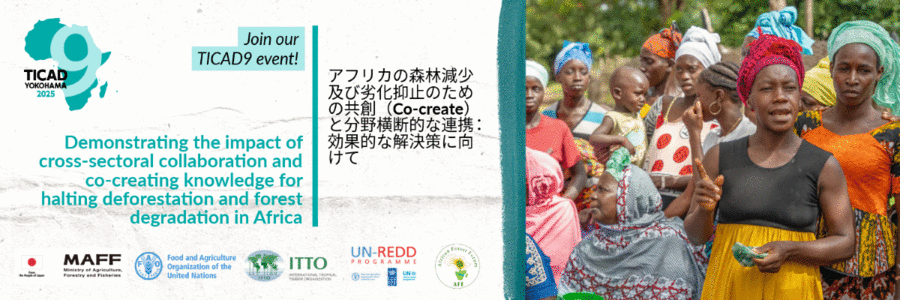
Demonstrating the impact of cross-sectoral collaboration and co-creating knowledge for halting deforestation and forest degradation in Africa
Date: 21 August 2025, 17 :00 – 18 :00 (Japan time) /10 :00-11 :00 CEST
Format: In person and webinar
Organized by: Forestry Agency of Japan, FAO, ITTO, and UN-REDD/AFF initiative
Languages: English and Japanese
Location : Yokohama, Japan, at S-08, Pacifico Yokohama Exhibition Hall D
Webinar registration: https://bit.ly/TICAD9-def
Background
Africa is home to some of the largest and most biodiverse forest biomes in the world. Ranging from the tropical moist forests in the Congo Basin and the Upper Guinea forests of West Africa over Southern Africa’s woodlands to the mountainous forests of East Africa, forests in Africa are as diverse as they are significant to the continent’s economies, societies and people. Not only do Africa’s forests generate income and employment from the sale and exchange of sustainable wood and non-wood forest products, but they also provide vital ecosystem services. For instance, Africa’s forests help to control the climate acting as carbon sinks and coolants that contribute to regulating rain fall and minimizing extreme weather, and they serve as hosts to the continent’s rich biodiversity. They thereby secure the livelihoods of millions of people, including farmers, who rely on these ecosystem services for their agricultural productivity.
Yet, despite their importance, Africa’s forests are disappearing at an alarming rate. Africa is the region with the highest deforestation rate worldwide. In the period 2015-2020, nearly half of global deforestation took place in Africa. Deforestation and forest degradation are thereby increasingly threatening the continent’s delicate ecosystem equilibrium with possible dramatic impacts for food security, economic development and poverty alleviation.
Halting deforestation and forest degradation has therefore become a priority of many African governments as they advance their sustainable development agendas. Across the African continent, governments are actively engaged in developing and/or implementing their halting deforestation strategies, while engaging with international partners to enhance impact and scale.
These efforts are closely aligned with key international and continental initiatives, including the African Union’s Agenda 2063, which envisions an environmentally sustainable and climate-resilient Africa and calls for the transformation and industrialization of economies through value addition to natural resources, alongside urgent action on climate change and environmental protection; Paris Agreement on Climate Change, under which forest protection is integral to achieving nationally determined contributions (NDCs) for emissions reduction; The Kunming-Montreal Global Biodiversity Framework, which sets targets for halting biodiversity loss and restoring degraded ecosystems, including forests.
This session situates itself within these broader political and institutional commitments by showcasing innovative, evidence-based solutions for forest conservation. These include collaborative initiatives developed between African countries and international partners, through knowledge co-creation and technical cooperation. The event will explore transformative forest conservation strategies by highlighting solutions harnessing balanced conservation and production practices as well as forests' essential roles in biodiversity, climate mitigation, and adaptation, and food security. One initiative is the “Solutions-tree: Solutions to halting deforestation – through sustainable agrifood systems transformation” which has been developed by FAO with support from the government of Japan and UN-REDD to assist countries in identifying solutions to underlying deforestation drivers. First pilots in Benin and Guinea have demonstrated the Solutions-tree’s use for developing halting deforestation strategies. The session will also feature insights from Ghana on the perspectives of cost-effective forest interventions, to inform economically viable and impactful strategies. The session will also highlight ITTO’s important work of supporting Western African countries, including Cote d’Ivoire and Togo, in scaling sustainable agroforestry systems and rehabilitating degraded forests for increased food security.
Objectives
- Demonstrate the wide range of African governments’ actions and solutions to halting deforestation and forest degradation.
- Showcase how collaboration and co-creating knowledge with African countries are advancing the halting deforestation agenda.
- Raise awareness of existing solutions and tools that have been developed by international organizations to support African countries in turning the tide on deforestation and forest degradation.
- Foundation laid for a regional exchange to broaden engagement and forge partnerships to address deforestation in the region.
AGENDA:
Moderator’s welcome: Ms Jennifer CONJE, Director of Forest Management, ITTO
Opening remark: Mr Alue Dohong, Assistant Director-General and FAO Regional Representative for Asia and the Pacific
Keynote: Innovative solutions to Halt Deforestation and promote sustainable agriculture: Mrs Serena Fortuna, Senior Forestry Officer and Team Leader, Halting Deforestation, Degradation, and Emissions Team, FAO Forestry Division
Panel discussion: Realizing forest solutions - A future with reduced deforestation through sustainable agriculture
- Prof Labode Popoola, Executive secretary of African Forest Forum (AFF)
- Ms Roselyn Fosuah Adjei, Former REDD+ Focal Point. Director of Forestry Commission Training Centre of Ghana. REDD+, Forest Governance and Climate Policy Expert.
- Mr Awessou Kohomlan Beranger: Senior Officer of Water, Forests and Hunting, Ministry of Living Environment and Transport in charge of Sustainable Development of Benin
- Côte d'Ivoire : Video presentation supported by ITTO - Mr Polycarpe Masupa Kambale, Projects Manager, ITTO
Closing remarks: Mr KOCHI Kiyotaka, Director, International Forestry Cooperation Office, Planning Division, Forestry Agency, Ministry of Agriculture, Forestry and Fisheries of Japan

Alue Dohong
Assistant Director-General and FAO Regional Representative for Asia and the Pacific
Alue Dohong as Assistant Director-General and FAO Regional Representative for Asia and the Pacific, with effect from 15 May 2025. Before joining FAO, Mr Dohong, a national of Indonesia, served as Senior Advisor to the Minister for Environment and Head of the Environment Control Agency of the Republic of Indonesia since December 2024. He previously served as Vice-Minister in the Ministry of Environment and Forestry of the Republic of Indonesia from 2019 to 2024. Mr Dohong began his career in 1994 as a Lecturer at the University of Palangka Raya, Indonesia, specializing in peatland restoration, environmental management, and sustainable development within the Master’s Programme in Natural Resources and Environment. He also served as Kalimantan Site Coordinator for the Wetlands International-Indonesia Programme in Palangka Raya, Central Kalimantan, a role he held from 2003 to 2011. He then worked as an Expert with the Central Kalimantan REDD+ Liaison Office from 2011 to 2013. He later served as Deputy Head for Construction, Operation, and Maintenance (COM) at the Peatland Restoration Agency (BRG) in Indonesia, from 2016 until 2019. Mr Dohong holds a Doctor of Philosophy in Environmental Management from the University of Queensland, Australia, a Master of Science in Environmental Management from the School of Geography at the University of Nottingham, United Kingdom, and a Bachelor of Science in Economic Development from Palangka Raya University, Indonesia

Serena Fortuna
Team Leader and Senior Forestry Officer, Halting Deforestation, Degradation, and Emissions Team, FAO Forestry Division
Ms. Serena Fortuna is the Team Leader for halting deforestation, degradation, and emissions in the FAO Forestry Division of the Food and Agriculture Organization of the United Nations (FAO) and a member of the UN-REDD Management Group. Ms. Fortuna has twenty-four years of working experience, spent between FAO and other international organizations (CGIAR, IUCN, UN Environment) in the field of climate change mitigation and adaptation, reducing deforestation and forest degradation, coastal ecosystem management, and disaster risk reduction. She joined FAO efforts supporting countries on the REDD+ process since 2012, with emphasis on aspects related to enhanced governance, integrated landscape approach, and synergies with agriculture. In her professional life, she has been based in Rome, Bangkok, and Panama, gaining experience in fieldwork, project management, and team coordination in Asia, Latin America, and at the global level.

Roselyn Fosuah Adjei
Former REDD+ Focal Point. Director of Forestry Commission Training Centre of Ghana. REDD+, Forest Governance and Climate Policy Expert.
Roselyn Fosuah Adjei is a Distinguished Humphrey Fellow of the United States Department of State and a highly accomplished REDD+, Forest Governance, and Climate Policy Expert. She has gained over 19 years of work experience in Ghana's government and has served as the Director, Climate Change at the Forestry Commission for the past 7 years, and has recently been appointed as the Director of the Forestry Commission Training Centre. With global funding, she has managed diverse forest landscape programs. She has also served as a guest lecturer at the University of Ghana, Yale University, the London School of Economics, and the Forestry Commission Training Centre.
On the international front, she sits on the UN-REDD and the Architecture for REDD+
Transactions (ART) Boards and is a globally known voice for Forests and REDD+. Travelled to over 25 countries, she has been instrumental in the Government-to-Government Forest and Agriculture Commodity Trade Dialogue (FACT) and other international processes, such as the Forest & Climate Leaders’ Partnership (FCLP)
Secretariat, which Ghana and the United States of America served as inaugural co-chairs.
To add, she currently holds a Young Professionals & Youth Coalition (YPYC)/MTN PULSE award for Africa Role Model Women Executive in Leadership and Shero of the Year Award from the 7th Edition of Ghana Outstanding Women Awards.
Roselyn holds a master’s degree in Carbon Management from the University of Edinburgh, Scotland, and a bachelor’s degree in Natural Resources Management from the Kwame Nkrumah University of Science and Technology in Kumasi, Ghana. She is currently pursuing doctoral studies at the University of Ghana, Legon, in Migration and Climate Change.

Beranger Gbènakpon Kohomlan Awessou
Senior Officer of Water, Forests and Hunting, Ministry of Living Environment and Transport in charge of Sustainable Development of Benin
Beranger Gbènakpon Kohomlan Awessou is a Senior Conservator of Water, Forests, and Wildlife in Benin, with more than 20 years of service in the country’s forestry administration. He holds a master’s degree in Tropical Plant Biodiversity from the University of Montpellier 2 (France) and is recognized as an expert in the sustainable management of African tropical forests, particularly in the conservation of forest ecosystems and tropical plant biodiversity.
Over two decades, Mr. Awessou has led and coordinated numerous initiatives in participatory forest management, remote sensing–based environmental monitoring, landscape restoration planning, and the monitoring and evaluation of climate action.
Since 2015, he has been an active member of Benin’s REDD+ team and currently serves as the national coordinator for REDD+ readiness in the country. This strategic role enables him to align national efforts to combat deforestation and forest degradation with international mechanisms for reducing emissions from these processes.
A specialist in cross-sectoral collaboration, Mr. Awessou has worked closely with ministries, local governments, NGOs, development partners, and communities. Notably, he contributed to the development of Benin’s National REDD+ Strategy (as MRV Team Leader), the implementation of participatory forest management plans, and the assessment of restoration opportunities under the MEOR framework.
His expertise includes land-use change mapping, national greenhouse gas inventories (LULUCF sector), agroforestry, and the establishment of results-based monitoring and evaluation systems. As a reviewer for scientific journals, he is committed to sharing knowledge with policymakers and practitioners. Through his career, he exemplifies how the co-creation of knowledge between public, scientific, and community stakeholders can generate concrete solutions to halt deforestation and forest degradation in Africa

Labode Popoola
Scholar and Executive Secretary of African Forest Forum (AFF)
Labode Popoola is an accomplished scholar with more than 25 years of senior management experience, working in various institutions across Africa and beyond. He holds a 1990 PhD in Forest Economics from the University of Ibadan, Nigeria. His academic career has seen him occupying every academic position in the university system, ranging from undergraduate programme coordinator, sub-deanship, departmental headship, deanship of the postgraduate school, to Vice-Chancellor. He founded the University of Ibadan Centre for Sustainable Development in 2010 and served as its pioneer Director for five years.
As an experienced researcher and project leader, Labode Popoola has led several internationally funded research projects involving over USD4 million, including the MacArthur Foundation USD 900,000.00 grant for the establishment of the master’s in Development Practice (MDP) Programme. The University of Ibadan was one of the 10 Universities that won the grant involving over 70 Universities across the globe in 2009. He was also a team member and Steering Committee member of the USD 1.75 Million Japanese Trust Fund (JTF) Grant for Education for Sustainable Development in Africa (ESDA). He was a member, FAO Expert Committee on Economics of Sustainable Forest Management in the Tropics (2004); Vice Chairman, National Agroforestry Training and Education Group (2005); Chairman, Committee of Deans of Postgraduate Schools in Nigerian Universities (2008 - 2010); Focal Person and Consultant, African Forest Forum (AFF) (2008 to 2023), General Secretary, West African Research and Innovation Management Association (WARIMA) - 2010 to 2015 and President, WARIMA-2015 to November, 2021. He was also a member of the Academic Steering Committee of the Global Association of MDP Programmes. He served as Director, United Nations Sustainable Development Solutions Network (UNSDSN)-Nigeria and member, Leadership Council of the Network. He was appointed a member and later the Chairman of, Project Steering and Advisory Committee of the Africa Forest Forum (PSAC), Nairobi, in 2021. He was also a member of the Technical Support Team (TST) of the African Forest Forum; a Member of the International Peer Review Committee (IPRC) of the Southern African Research and Innovation Management Association (SARIMA) until 2023. In a career spanning close to four decades, Labode has successfully supervised some 30 doctoral theses, published over 170 articles in reputable outlets, and traversed some 130 countries on all continents.
Labode has won several awards and honours. They include an award for Invaluable Service in Agroforestry from the International Centre for Research in Agroforestry, Nairobi (2001), an award for excellent service to the forestry profession by the Council of the Forestry Association of Nigeria. He served as the Vice-Chancellor of Osun State University, Nigeria, from 2016 to 2021. He is currently the Executive Secretary-CEO of the African Forest Forum, Nairobi, Kenya

Polycarpe Masupa Kambale
Projects Manager, Division of Forest Management Secretariat of International Tropical Timber Organization (ITTO)
Mr. Polycarpe Masupa Kambale has more than 30 years of experience in the forestry area working with the following institutions/organizations (in chronological order):
1) From 1988 to 1996, in the Government of Democratic Republic of the Congo (DRC), through the Ministry of Environment, as a civil servant in charge of the review and internal monitoring of forest-related projects/programmes financed by bilateral and multilateral partners (Belgium, Canada, Japan, African Development Bank, European Commission, World Bank, etc.) and implemented by the DRC’s Ministry of Environment.
2) From 1996 to 2002, in the Secretariat of African Timber Organization (ATO), as forest policy analyst officer, as well as in charge of forestry statistics, at the ATO Secretariat based in Libreville (Gabon)
3) From 2002 to 2025, in the Secretariat of International Tropical Timber Organization (ITTO), located in Yokohama (Japan), now serving as Projects Manager for mainly supervising ITTO projects being implemented in Africa and covering the following areas: reforestation and forest landscape restoration, sustainable forest management, community-based forestry, etc. He had also occasionally supervised a few projects implemented in the Asia-Pacific and Latin America tropical regions (Costa Rica, Indonesia, Papua New Guinea, and Peru). He is Fluent in French and English (two of the three ITTO Secretariat working languages), Lingala and Swahili (African languages spoken in DRC, as well as in Central and East Africa regions), and Kinande (native ethnic language).

Kochi Kiyotaka
Director, International Forestry Cooperation Office, Forestry Agency, Ministry of Agriculture, Forestry and Fisheries, Japan
Kochi Kiyotaka has led International Forestry Cooperation policies and programs at the Forestry Agency of Japan (FAJ) since April. He has almost 20 years of experience in forestry and the forest industry, such as national forest management, development of forestry technologies, promotion of wood utilization, international forestry cooperation, and climate change measures. During his career, he was also assigned to the Cabinet Office, overseas diplomatic missions, and a prefectural government. His past regional assignments include Hokkaido, Yamanashi, and Ishikawa.

Jennifer Conje
Director of Forest Management at the International Tropical Timber Organization (ITTO)
Ms. Jennifer Conje is the Director of Forest Management at the International Tropical Timber Organization (ITTO), where she heads a division working on field projects and policy issues related to sustainable forest management and tropical forests, including climate change adaptation/mitigation, sustainable harvesting and utilization, rehabilitation and restoration, fire management, and biodiversity conservation. Ms. Conje has worked on environmental and sustainable development issues for over 24 years. Before joining ITTO, Ms. Conje served as Assistant Director of Policy within the USDA Forest Service (USFS), International Programs office, where she oversaw the agency’s engagement in international forest policy processes, environmental conventions, and bilateral/multilateral trade agreements. Ms. Conje has held international leadership positions, including as Chairperson of the ITTO Council in 2016, and Chairperson of the Asia Pacific Economic Cooperation’s (APEC) Experts Group on Illegal Logging and Associated Trade (EGILAT) (2022 -2023). Early in her career, Ms. Conje worked as a management consultant with Accenture LLP, helping large companies and governmental agency clients with business process improvement and risk management.