

Resources
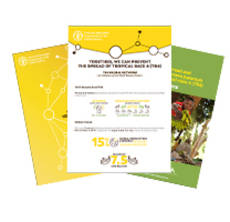
Together, we can prevent the spread of TR4
Investments in agriculture, including banana sector innovation, are crucial to increase the capacity for agricultural productivity, while sustainable food production systems are necessary in achieving #ZeroHunger. With a general public audience in mind, the brochure 'Together, we can prevent the spread of TR4' seeks to explain why bananas and plantains are essential crops around the world for both their economic importance and deep cultural roots. It also highlights the main ways to combat the spread of Tropical race 4 (TR4) which causes the disease Banana Fusarium Wilt (Banana FW).
Search resources
A Novel Effector FoUpe9 Enhances the Virulence of Fusarium oxysporum f. sp. cubense Tropical Race 4 by Inhibiting Plant Immunity
15/05/2025
Chitosan Coacervates with the Biocontrol Fungus Pochonia Chlamydosporia Stimulate Musa Acuminata Growth and Inhibit Banana Fusarium Wilt Fungus
15/05/2025
Bacillus velezensis Isolate X5 Stimulates the Resistance of Resistant and Susceptible Banana Varieties to Foc Through Different Mechanisms
13/05/2025
Characterization of Plant Defensin (PDF) Genes in Banana (Musa acuminata) Reveals the Antifungal Ability of MaPDF2.2 to Fusarium Wilt Pathogens
09/05/2025
Bikaverin as a molecular weapon: enhancing Fusarium oxysporum pathogenicity in bananas via rhizosphere microbiome manipulation
29/04/2025
Fusaric acid-mediated S-glutathionylation of MaAKT1 channel confers the virulence of Foc TR4 to banana
09/04/2025
RNA interference-based gene silencing of dicer-like 2 in Fusarium oxysporum f. sp. cubense tropical race 4 mitigates fusarium wilt disease in banana
01/04/2025
Ensuring genetic uniformity and fusarium wilt (TR4) resistance in shoot tip derived plantlets of wild species M. rubra
12/03/2025
Bacillus velezensis YN2111 reveals the potential role of Amine Oxidase in Fusarium Wilt response in Cavendish bananas
10/03/2025
The views expressed in this information product and the articles above are those of the author(s) and do not necessarily reflect the views or policies of FAO.