

Resources
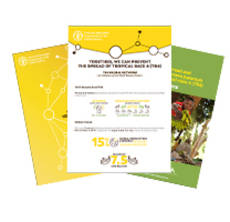
Together, we can prevent the spread of TR4
Investments in agriculture, including banana sector innovation, are crucial to increase the capacity for agricultural productivity, while sustainable food production systems are necessary in achieving #ZeroHunger. With a general public audience in mind, the brochure 'Together, we can prevent the spread of TR4' seeks to explain why bananas and plantains are essential crops around the world for both their economic importance and deep cultural roots. It also highlights the main ways to combat the spread of Tropical race 4 (TR4) which causes the disease Banana Fusarium Wilt (Banana FW).
Search resources
Optimization of a CRISPR-Cas9 in vitro protocol for targeting the SIX9 gene of Fusarium oxysporum f.sp. cubense race 1 associated with banana Fusarium wilt
10/03/2025
Molecular docking and comparative transcriptome analysis of Fusarium oxysporum f.sp. cubense grown in 2,4-di-tert-butyl phenol amended medium deciphers the antifungal action of 2,4-di-tert-butyl phenol
01/03/2025
Current Progress in Microbial Biocontrol of Banana Fusarium Wilt: A Systematic Review
28/02/2025
Transcriptome analysis provides insights into the role of TLP16 in Musa acuminata Resistance to Fusarium oxysporum f. sp. cubense wilt
22/02/2025
Rapid and sensitive detection of Fusarium oxysporum f. sp. cubense tropical race 4 using a RPA-DETECTR assay
18/02/2025
Rapid and sensitive detection of Fusarium oxysporum f. sp. cubense tropical race 4 using a RPA-DETECTR assay
18/02/2025
Deciphering the microbiome dynamics in an effective banana Fusarium wilt biocontrol interaction system
12/02/2025
Discovery of MK8383s with Antifungal Activity from Mangrove Endophytic Fungi Medicopsis sp. SCSIO 40440 Against Fusarium Wilt of Banana
12/02/2025
Genome-Wide Profiling of bZIP Transcription Factors and FocbZIP11’s Impact on Fusarium TR4 Pathogenicity
09/02/2025
Identification of a ubiquitin-protein ligase MaUPL6 modulating the response to Fusarium wilt in banana
05/02/2025
The views expressed in this information product and the articles above are those of the author(s) and do not necessarily reflect the views or policies of FAO.