

Soil doctors: Empowering Colombia’s banana farmers from the ground up
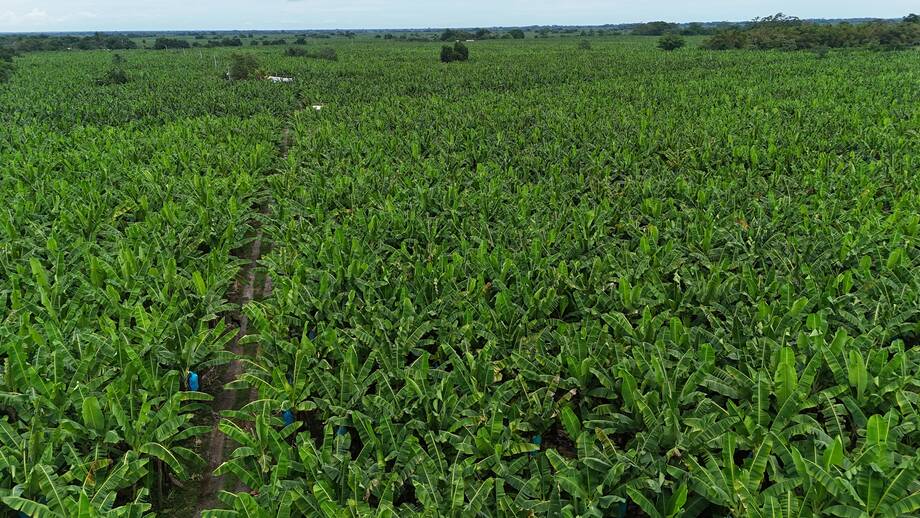
In the department of Magdalena, Colombia, farmers are becoming “soil doctors,” using science-based FAO tools to strengthen their leadership and safeguard their soils. @Agrosavia
Soil is the basis of all food systems, yet it is under unprecedented strain. Across the world, this finite resource faces mounting pressure from climate shocks and human-driven land use changes, leading to erosion, compaction, salinisation and acidification. In banana and plantain systems, the stakes are even higher. Soil health is a critical line of defense against destructive soil-borne diseases, such as Fusarium wilt, a quarantine fungal disease capable of wiping out entire banana plantations.
Faced with these challenges, the World Banana Forum Secretariat of the Food and Agriculture Organization of the United Nations (FAO) joined forces with FAO’s Global Soil Partnership (GSP) to bring the Global Soil Doctors Programme (GSDP) to Colombia’s banana sector. With financial support from the German retailer Kaufland, the pilot initiative set out to empower small-scale producers with practical, science-based tools to manage their soils sustainably.
The programme was implemented nationally by AGROSAVIA, the Colombian Agricultural Research Corporation and long-standing GSP partner, in close collaboration with FAO Colombia and leading producer organizations.
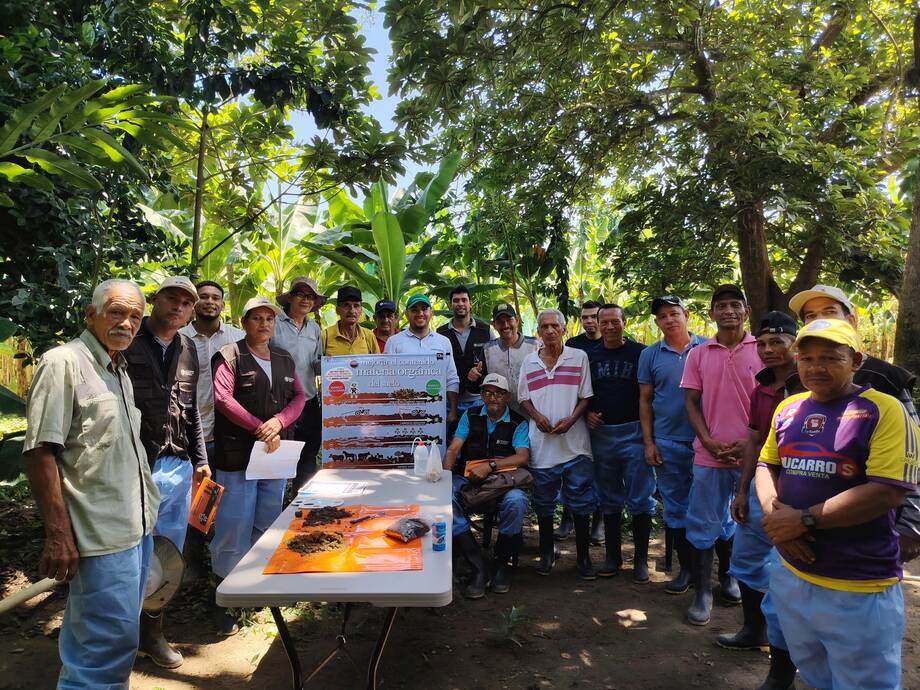
Trainers teaching basic soil concepts to farmers using GSDP’s educational posters at AGROSAVIA’s Caribia Research Center, Zona Bananera.@Agrosavia
Using the programme’s cascade learning approach and its educational material (posters, field exercises, checklists etc.), the pilot began with the virtual training-of-trainers (ToT) sessions focused on soil fertility. Nine trainers took part, representing the Colombian Banana Growers Association (AUGURA), the Association of Banana Growers of Magdalena and La Guajira (ASBAMA), FAO Colombia, the University of La Guajira and EMPREBANCOOP.
Drawing on their field experience, the module was adapted to reflect the specific conditions, practices and constraints of banana and plantain production systems in Magdalena.
In May, these trainers gathered at AGROSAVIA’s Caribia Research Center in Zona Bananera for a final session. They revisited the physical, chemical and biological properties of soils and learned simple, visual techniques to assess soil health directly in farmers’ fields.
With this foundation in place, the trainers stepped into their role as facilitators. They conducted a two-day, in-person training for local small-scale banana growers at AGROSAVIA’s Research Center Caribia, in Zona Bananera. In total, 47 farmers took part in the initial phase. Through hands-on exercises, they explored soil structure, texture, pH, microbial activity, root health and nutrient management in banana plants – connecting scientific concepts with their own observations.
From knowledge to action
The learning did not stop in the classroom or the experimental plot.
Participants returned to their communities and shared what they had learned, reaching more than 235 farmers across Zona Bananera, Ciénaga, Dibulla and Riohacha. After completing this step, they were formally accredited as soil doctors, continuing to promote improved soil management within their networks.
Now the focus is shifting from learning to application.
With guidance from technicians in their associations or cooperatives, farmers are beginning to incorporate plant residues, build organic matter, establish cover crops and set up vermicompost systems. These changes take time, but they are rooted in a clearer understanding of the soil – and that understanding is spreading across the region.
AGROSAVIA has also developed communication and audiovisual materials to support dissemination, while an implementation guide tailored to banana systems in Colombia is being finalized. The goal is now to enable replication and scaling up across the country and beyond.

Through collaboration between FAO, national research institutions and producer organizations, Colombian farmers are building healthier soils and more resilient banana production systems. @Agrosavia
The pilot demonstrates how collaboration across institutions can translate global expertise into local impact, connecting science with farmers’ knowledge. Through the partnership between the World Banana Forum Secretariat, the Global Soil Partnership, AGROSAVIA, FAO Colombia, national producer associations and Kaufland, smallholder farmers are gaining the tools to become active stewards of their land.
By empowering farmers to better understand and manage their soils, FAO is advancing its mission to promote sustainable agriculture, protect natural resources and support inclusive and resilient agrifood systems.
In Colombia’s banana-growing regions, soil science is not confined to laboratories: it is passed on to the hands of farmers, shaping a more sustainable future from the ground up.