




23 December. Situation remains serious along Red Sea coast
The current Desert Locust situation remains particularly worrisome in Yemen, Saudi Arabia and Eritrea.
In Yemen, ground control operations continue on the northern and central coast of the Red Sea and, on a much smaller scale, on the Gulf of Aden coast where hopper bands were decreasing as fledging occurred and new immature groups and swarms were forming in all areas. A few immature swarms were seen in the foothills near the Saudi Arabia border and Sada’a, and northwest of Aden.
In Saudi Arabia, groups of mature adults and a few swarms formed and laid eggs on the central Red Sea coast near Qunfidah and the southern coast near Jizan. Aerial and ground control operations are underway.
In Eritrea, groups of mature adults were seen laying eggs on the central coast to the north and south of Massawa in early December. Ground control operations were in progress. The situation is less clear on the northern coast near the Sudan border.
In Sudan, breeding continues in the Tokar Delta on the Red Sea coast where hopper groups are present and adult groups are maturing and laying eggs. Hopper bands have formed in the northeast subcoastal areas in Wadi Oko near Tomala. Control operations are in progress in both areas. Only solitarious adults have been seen on the southern coastal plains near the border of Eritrea.
In Northern Somalia, small-scale breeding is in progress on the escarpment north of Burao where low numbers of hoppers and adults are present. Previously reported hopper bands on the northwest coast were not seen during surveys in the second week of December. The current situation is being clarified in Puntland where a swarm was reported in early December.
In Mauritania, the situation is improving in the northwest as a result of 50,000 ha of control operations and drying vegetation. Small groups of mainly late instar hoppers and adults persist in some areas.
In Niger, small-scale breeding occurred in parts of Tamesna and the Tenere, while scattered adults are present in the southeast Air Mountains and the Tadress area.
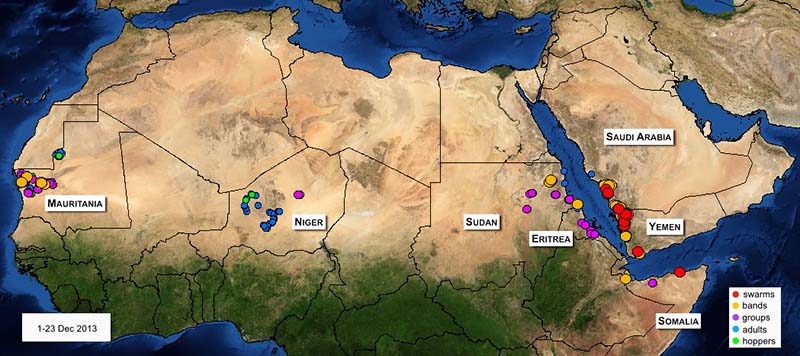
Current situation.
6 December. Small swarms arrive in Horn of Africa
Recent reports indicate that Desert Locust infestations are present in coastal areas of northern Somalia that were affected last month by a rare tropical cyclone.
The cyclone brought heavy rains and flooding. Adult groups and a few small swarms are thought to have crossed the Gulf of Aden from southern Yemen to coastal areas of northern Somalia on winds associated with the cyclone. So far, two areas appear to be affected: the northeast where mature gregarious adults were seen copulating this week on the coast between Las Koreh and Bosaso, and on the northwest coast where there were unconfirmed reports of hopper bands west of Berbera near Gerisa. Survey teams are being mobilised to confirm the infestations.
As it is the beginning of the winter breeding season, egg-laying in areas of recent rains will cause hatching, hopper band formation and a further increase in locust numbers in the coming months.
The situation continues to remain very serious in Yemen where an increasing number of new generation immature swarms are forming on the northern coast of the Red Sea, and in Eritrea as control operations continue against hopper bands on the central coast near Massawa where new swarms may form shortly.
In Sudan, breeding is underway on the Red Sea coast in the Tokar Delta, and adults have appeared further south towards the border of Eritrea. Survey and control operations are in progress.
Efforts continue to control an outbreak in northwest Mauritania that developed in October. Control operations are in progress against hopper bands and groups of hoppers and adults.
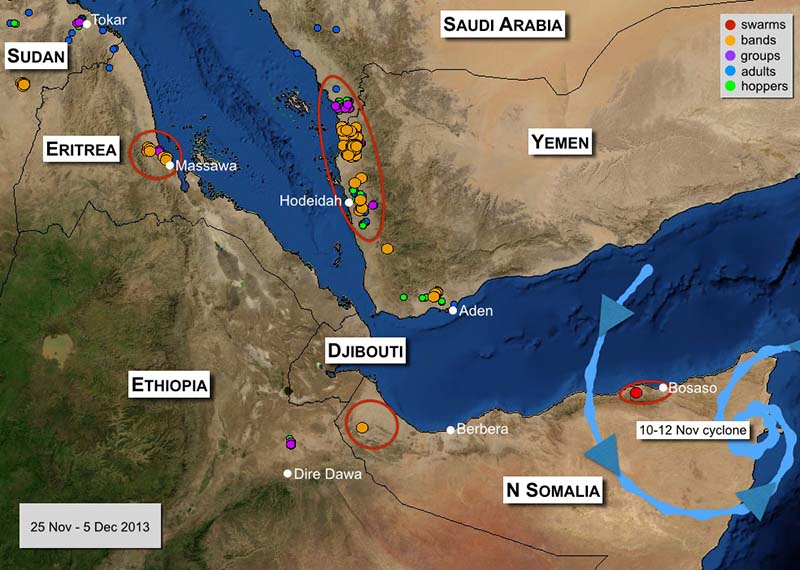
Threatening situation in winter breeding areas.
3 December. Situation threatening along the Red Sea coast and in Mauritania
The Desert Locust situation worsened during November along both sides of the Red Sea and in northwest Mauritania.
Locusts continue to gregarize and form hopper bands and groups of hoppers and adults in Mauritania, Yemen, and Sudan. A few swarms have formed in Sudan and Yemen. An outbreak developed in Eritrea during November as a result of good rains in August and October, followed by undetected breeding.
Although control operations intensified in all countries, including aerial control operations in Eritrea, a second generation of breeding in December and January will cause locust infestations to increase further and more hopper bands and small swarms will form along both sides of the Red Sea and, to a lesser extent, in northwest Mauritania.
Winter breeding may also occur in northwest Somalia where a tropical cyclone brought heavy rains and flooding in November.
All efforts are required to reduce locust numbers and the potential threat to crops in the affected countries.
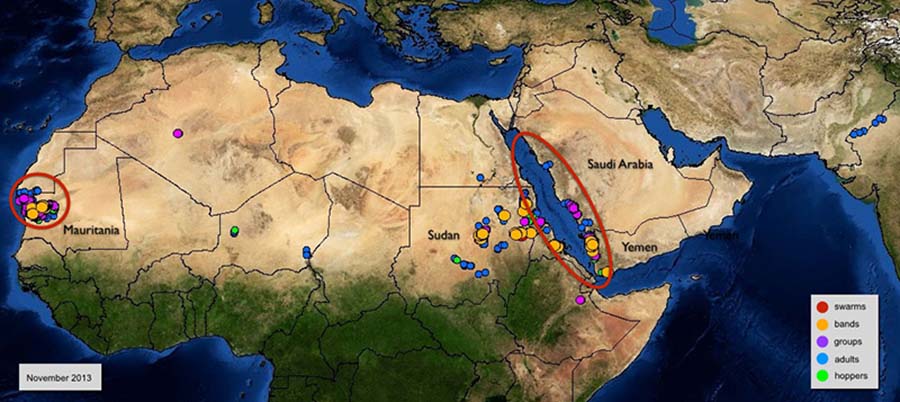
Current Desert Locust situation.
19 November. Potentially dangerous situation may develop in Mauritania, Sudan and Yemen
Control operations are in progress in northwest Mauritania, the interior of northern Sudan, and on the Red Sea coast in Yemen where hopper bands are currently forming as a result of local breeding. There is a risk that a potentially dangerous situation may develop in the coming months. Consequently, intensive survey and control operations should be maintained.
In Mauritania, an outbreak developed in the northwest during October and good rains fell in early November. As a result, hoppers continue to form groups and bands while adults are forming groups in Inchiri, Dakhlet Nouadhibou, southwest Adrar and northern Trarza. Ground teams have treated more than 13,000 ha so far in November.
In Sudan, hopper and adults are forming groups in those areas that remain green after the summer rains in the interior to the northwest of Khartoum and along the Atbara River. Hopper bands have also formed in these areas. Ground teams have treated more than 2,200 ha so far in November. More adult groups are expected to move from the interior to the Red Sea coast in the coming weeks.
In Yemen, breeding continues along the northern coast of the Red Sea where first generation hoppers are forming groups and bands. Adults are maturing and forming groups. Second generation egg-laying starting about ten days ago and hatching and band formation are expected to commence from the end of November onwards. Ground teams treated about 8,000 ha during the first decade of November. Smaller infestations are present on the southern coast near Aden.
In Eritrea, ground teams are treating hopper infestations in cropping areas on the Red Sea coast near Shelshela, and there are unconfirmed reports of locusts further north near the Sudanese border.
In northern Somalia, a rare tropical cyclone brought heavy rains to the northwest coast which is a traditional winter breeding area for the Desert Locust. Surveys will be undertaken shortly to check the areas.
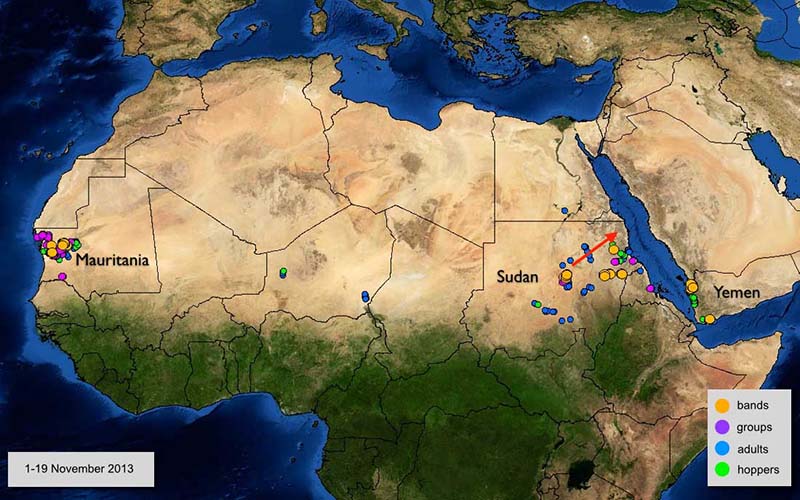
Current Desert Locust situation.
4 November. Serious situation developing in several countries
Desert Locust infestations are increasing and hopper bands have formed in several countries. The situation remains the most serious in Yemen as swarms formed in the interior where control operations were not possible in October, moved to the Red Sea and Gulf of Aden coastal plains, and laid eggs that hatched and hoppers are forming groups and small bands. A few adult groups have reached adjacent coastal areas of Saudi Arabia near Jizan and control operations are underway. Local breeding is in progress on the central Red Sea coast.
An outbreak has developed within an area of about 120,000 km2 in west and northwest Mauritania where adults arrived from summer breeding areas in the south, concentrated, matured, and formed groups. Egg-laying started in September and continued throughout October when hatching occurred and hoppers began forming small groups and bands. Ground teams have treated nearly 3,000 ha so far.
An outbreak may be developing in the interior of Sudan where vegetation is drying out, causing locusts to form groups and hopper bands. Although control operations are in progress, a few adult groups moved to the winter breeding areas in the northeast and the Red Sea coast and laid eggs. Hatching will occur in early November and hoppers could form groups, especially in northeast Sudan and southeast Egypt where good rains fell in late October.
Good rains that fell last month will allow breeding to continue and cause locust numbers to increase further in Yemen, northwest Mauritania and northeast Sudan. More hatching is expected in November and there is a risk that additional groups of hoppers and adults as well as small hopper bands and perhaps a few small swarmlets could eventually form.
As the seasonal rains have ended in the northern Sahel, vegetation is drying out in the summer breeding areas, causing locusts to concentrate in parts of northern Mali, Niger and Chad where small groups could form during November.
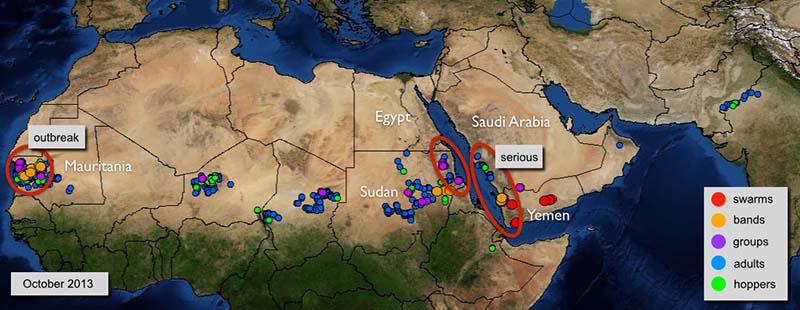
Desert Locust situation in October.
11 October. Swarms in Yemen; outbreak in Mauritania
Several immature swarms have been reported in the summer breeding areas of the interior of Yemen in Wadi Hadhramaut. More swarms are likely to arrive from the plateau area to the north between Minwakh, Hazar and Thamud where locals have reported infestations. The swarms are expected to eventually reach the Gulf of Aden and Red Sea coastal plains in Yemen. Survey and control operations continue to be hampered by insecurity and beekeeping.
In Mauritania, an outbreak is developing in the Aguilal Faye area east of Nouakchott where locust densities are increasing and have reached up to 40,000 adults/ha (4/sq. m). Breeding conditions remain favourable and mature solitarious and transiens adults have started to form a few small groups and lay eggs. Other infestations are present in the centre and northwest between Tidjikja, Atar and Tasiast. So far, ground teams have treated 145 ha. More groups are expected to form in the coming weeks.
In Niger, ecological conditions remain favourable for breeding in parts of the Tamesna Plains and Air Mountains where low numbers of solitarious hoppers and adults persist. As vegetation dries out, adults may form a few small groups during October.
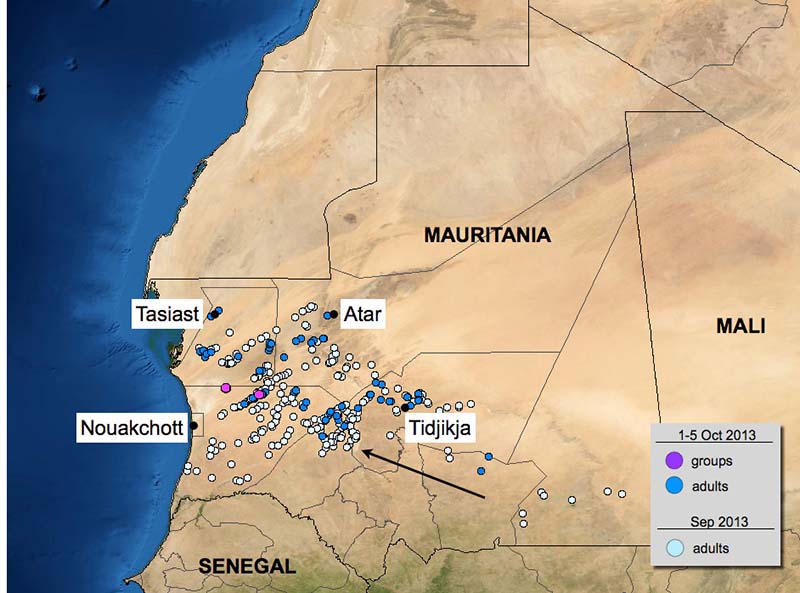
Mauritania.
4 October. Desert Locust situation remains dangerous in Yemen
The Desert Locust situation remains worrisome in Yemen where hopper and adult groups, bands and swarms formed in the interior during September. Only limited control operations could be carried out due to insecurity and beekeeping. Small swarms will form during October in these areas and move to the Red Sea and Gulf of Aden coasts of Yemen where adults have already arrived and laid eggs that hatched and hoppers formed groups and bands.
Elsewhere in the Central Region, small-scale breeding is underway in eastern Sudan between the Nile River and the Red Sea Hills. Early egg-laying and hatching has occurred in the winter breeding areas in the northeast in Wadi Oko. Adults will appear on the Red Sea coast during October and lay eggs with the onset of the rains. Early breeding is also in progress on the central Red Sea coast in Saudi Arabia where small groups of hoppers and bands have formed.
In West Africa, breeding continues to cause locust numbers to increase in the northern Sahel between Mauritania and Chad. Small groups could form in some areas as vegetation dries out. A further increase is expected primarily in west, central and northwest Mauritania where breeding will continue in October.
In South-West Asia, only low numbers of solitarious adults are present in a few places along both sides of the Indo-Pakistan border where monsoon rains ended in September. No significant developments are expected.
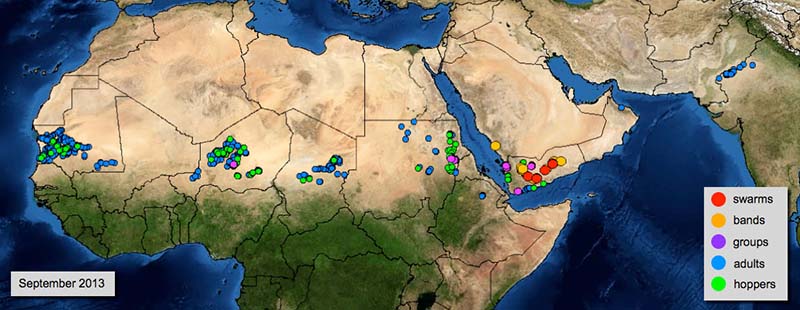
Current Desert Locust situation.
17 September. Desert Locust situation potentially dangerous in Yemen
New reports indicate that the Desert Locust situation has deteriorated further in Yemen and is potentially dangerous. Groups of hoppers and adults as well as hopper bands and adult swarms are forming in the interior as a result of good rains and breeding during the summer. Most of the infestations are located along the foothills near Marib and Bayhan but important populations are also present in very remote and isolated areas north of Wadi Hadhramaut and on the edge of the Empty Quarter between Al Abr, Hazar and Thamud. These areas are extremely difficult to access, and it is here where an outbreak occurred in 2007 that led to a swarm invasion in the Horn of Africa.
The extent of the current infestations is not well known but it appears that widespread breeding may have occurred in the interior, most of which could not be detected or confirmed due to the difficulties of undertaking regular ground surveys because of prevailing insecurity and limited resources. Breeding is still in progress in many areas. During the remainder of September, more hatching and band and swarm formation are expected.
Control operations are being coordinated by the Government and should commence in the coming days. However, many areas cannot be treated due to beekeepers and insecurity. Consequently, adult groups and small swarms are likely to escape detection and control. As vegetation dries out, they are expected to move to the coastal plains along the Gulf of Aden and the Red Sea. So far, limited movements have occurred, including a small swarm that arrived on the northern Tihama coastal plains of the Red Sea in early September. Breeding is in progress in both coastal areas where hoppers are forming small groups in some places.
At the moment, Desert Locust populations are expected to remain in Yemen. However, if northerly winds develop over the Gulf of Aden and persist for several days, there is a risk that some swarms could move south from the interior of Yemen, cross the Gulf of Aden and reach northern Somalia and perhaps adjacent areas of eastern Ethiopia.
All efforts should be made to undertake survey and control operations in Yemen while neighbouring countries should be on alert.
Elsewhere, the situation remains calm. Small-scale breeding continues in the summer breeding areas in the northern Sahel of West Africa and Sudan, and along both sides of the Indo-Pakistan border.
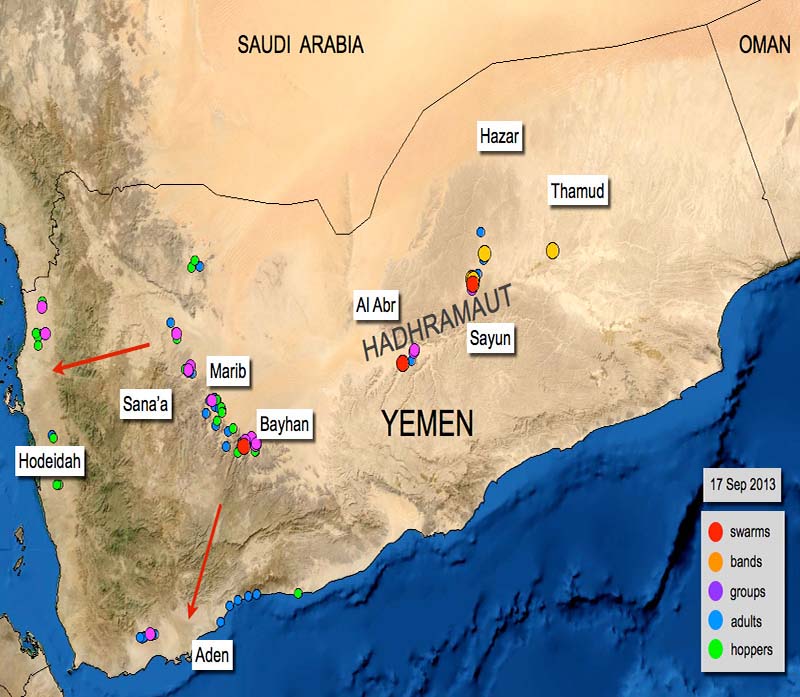
Desert Locust hopper bands and swarms are forming in Yemen.
3 September. The Desert Locust situation remains worrisome in Yemen
The Desert Locust situation remains generally calm except in Yemen where hopper and adult groups and at least one swarm have been reported in the interior. Breeding conditions remain favourable for the formation of small hopper bands and swarms during September but survey and control operations are not possible due to insecurity and beekeepers. Consequently, there is a high risk that locust populations will increase further.
So far, very little breeding has been detected in the summer breeding areas of the Sahel from Mauritania to western Eritrea even though unusually good rains fell in August much further north than usual. Consequently, locust numbers will increase during September as breeding continues. Once vegetation starts to dry out next month, small groups may form in some places.
Low numbers of adults are present along both sides of the Indo-Pakistan border where little breeding has been detected despite good monsoon rains and favourable ecological conditions.
Regular surveys should continue in all affected countries to monitor the situation closely.
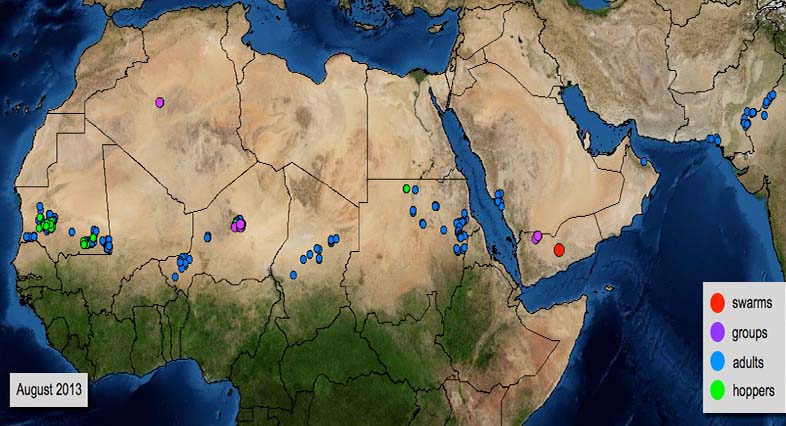
Desert Locust situation.
12 August. Good rains fall in summer breeding areas
During the first decade of August, unusually heavy rains fell in the summer breeding areas of Sudan, causing widespread flooding and destruction in North Darfur, North Kordofan, Khartoum, River Nile and Kassala states. Rainfall was heaviest in the central part of the Desert Locust breeding area (North Kordofan and Khartoum). More rain is expected in the coming days. Once floodwaters recede, ecological conditions are likely to remain favourable for breeding for several months. Currently, low numbers of solitarious adults are scattered throughout the above-mentioned areas. Small-scale breeding is likely to be in progress and will cause locust numbers to increase.
In West Africa, good rains also fell in parts of the summer breeding areas in the northern Sahel. Heavy rains fell on the Tamesna Plains between Menaka, Mali and Tahoua, Niger. Heavy rains also fell in Mauritania near Aioun El Atrous, Kiffa and Atar, and in northeast Chad between Abeche and Fada. Low numbers of solitarious adults have been reported in Mauritania, Niger and Chad, and are likely to be present in northeast Mali.
Given the likelihood of an increase in locust infestations from summer breeding, national ground surveys should be undertaken in all countries on a regular basis to monitor the situation closely during the next few months.
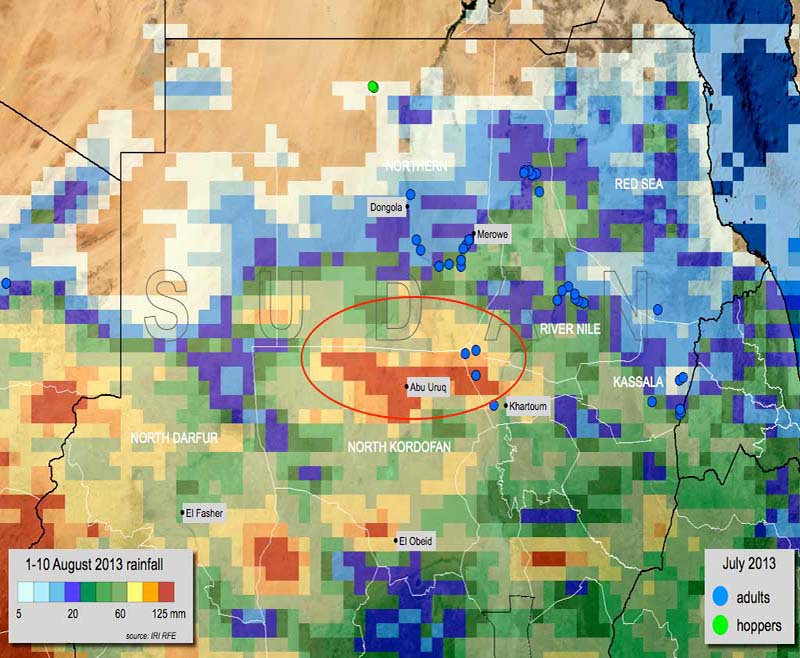
1-10 August 2013 rainfall in Sudan.
2 August. Desert Locust situation remains serious in Yemen
The Desert Locust situation improved during July as locust infestations declined in the northern part of the Central Region and in the spring breeding areas of Northwest Africa. Nevertheless, the situation remained serious in the interior of Yemen where breeding occurred, causing locust numbers to increase. Control operations were not possible due to insecurity.
Low numbers of solitarious adults appeared in the summer breeding areas of the Sahel in West Africa and Sudan, and along both sides of the Indo-Pakistan border. During the forecast period, small-scale breeding will cause locust numbers to increase in all of these areas.
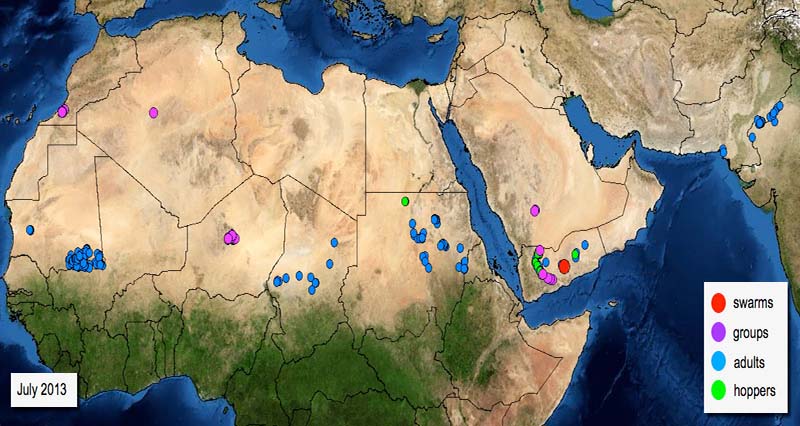
Locust movements from spring to summer breeding areas.
3 July. Desert Locusts shift from spring to summer breeding areas
Desert Locust populations are in the midst of shifting from their spring breeding areas to summer breeding areas. As a result of good spring breeding, initial locust numbers are expected to be somewhat higher at the beginning of this year's summer compared to normal years. Therefore, it is important that surveys commence in the summer breeding areas and continue on a regular basis to monitor the situation.
In the Western Region, small groups of adults continue to form south of the Atlas Mountains in Morocco and Algeria as well as in south-central Libya. Additional groups and perhaps a few small swarms are likely to form from any infestations that are not detected or controlled, and move south where they will disperse in the northern Sahel of Mauritania, Mali, Niger and Chad in the coming weeks. Egg-laying will commence with the onset of the seasonal rains and one generation of breeding will cause locust numbers to increase during the summer.
In the Central Region, small groups of adults and swarms arrived during June in the interior of Yemen where they dispersed and are expected to breed, causing locust numbers to increase and small hopper groups and bands to form. Adult groups also formed and moved south in Egypt, heading towards the summer breeding areas in central Sudan. There is a risk that additional groups and perhaps a few small swarms could arrive in these areas from Saudi Arabia in early July. The adults are expected to disperse and lay eggs with the onset of the rains, causing locust numbers to increase.
In the Eastern Region, unusually good and widespread rains associated with the monsoon have fallen in the summer breeding areas along both sides of the Indo-Pakistan border. This will allow one generation of breeding to occur that will cause locust numbers to increase in both countries.
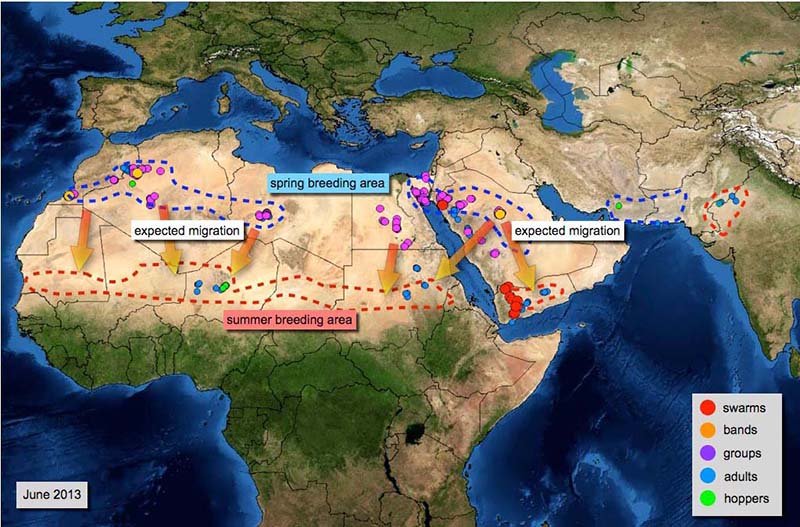
Locust movements from spring to summer breeding areas.
16 June. Desert Locust swarms invade northern Yemen
Groups of Desert Locust adults are leaving spring breeding areas in the Sinai, Israel and northwest Saudi Arabia and migrating south towards summer breeding areas in Yemen and Sudan. In the past few days, an increasing number of immature adult groups were seen moving south in the Asir Mountains in western Saudi Arabia from Tabuk to Mecca and Bisha. Some of the groups moved onto the central Red Sea coastal plains near Lith and flew out to sea towards Sudan. Other groups continued south towards Wadi Najran and crossed the border into northern Yemen on 13 June to the edge of the empty Quarter east of Sadaa. During the following days, there were additional reports of swarms arriving in Yemen from the north and moving into the summer breeding areas of the interior, nearly reaching Bayhan on the 16th. More groups and small swarms can be expected to move into the interior of Yemen between Marib, Ataq and Hadhramaut during the remainder of June.
In Egypt, no further hopper infestations have been reported in the Sinai and near Lake Nasser but there has been an increasing number of immature adult groups seen in both areas. Groups of immature adults have also been seen in the Western Desert, suggesting that adults are moving south towards the summer breeding areas in the interior of Sudan.
There is a high probability that adult groups and a few small swarms will reach the vast summer breeding areas in the interior of Sudan where they will disperse between Darfur and western Eritrea, mature and lay eggs with the onset of the seasonal rains. So far, rains remain south of 14N in Sudan.
All efforts are required to monitor the situation closely and undertake the necessary control operations, especially in Sudan and Yemen.
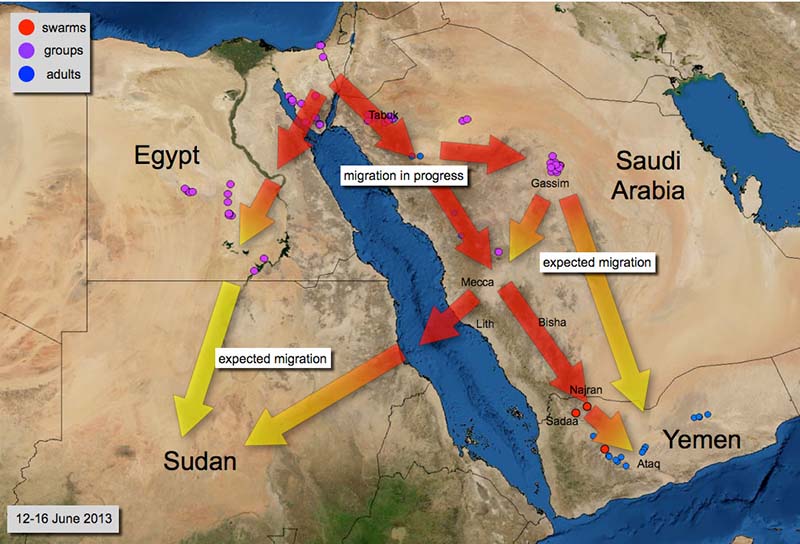
Locust movements in the Central Region.
3 June. Groups of adults forming in spring breeding areas
In the Sinai Peninsula, hoppers continue to form groups and small bands along both sides of the Egypt/Israel border where hatching occurred in mid-April. Hoppers are fledging and forming immature adult groups and small swarms. Initially, the adults will move back and forth across the border and could threaten crops. This is expected to be followed by a southwesterly migration to the summer breeding areas in central Sudan during June. Similar infestations are also present in southern Sinai. Aerial and ground operations continue in the northern Negev Desert of Israel. Survey and control operations are also in progress in adjacent areas of the Sinai in Egypt but are limited due to insecurity.
Elsewhere in Egypt, breeding occurred near Qena and Lake Nasser (Garf Husein and Tushka) where groups of hoppers were treated.
In Saudi Arabia, control operations continue on the northern Red Sea coast and subcoastal areas near Tabuk where hopper bands are present and a few immature swarms have formed. Hatching may occur in the interior near Gassim that could give rise to hopper groups and perhaps a few bands that would fledge by the end of June.
In Sudan, the situation has reportedly improved in the north where hopper bands were present along the Nile Valley near Wadi Halfa. Adult groups and small swarms could form from any undetected infestations in June and move to summer breeding areas in central Sudan. Similar infestations may also appear from the northern Red Sea and disperse over a large area, extending from Darfur to western Eritrea where breeding will occur with the onset of the summer rains.
In Northwest Africa, control operations continue in the spring breeding areas south of the Atlas Mountains in Morocco and Algeria as well as in parts of southern Libya where hopper groups and small bands are now fledging and adults are forming small groups. A few small swarms could also form in areas that cannot not be accessed or treated.
In West Africa, groups of adults and perhaps a few small swarms will appear in the northern Sahel of Mauritania, Mali, Niger and Chad from spring breeding areas in Northwest Africa. In Niger, small-scale breeding is in progress in the Air Mountains as a result of early rains. Summer breeding will commence with the onset of the seasonal rains.
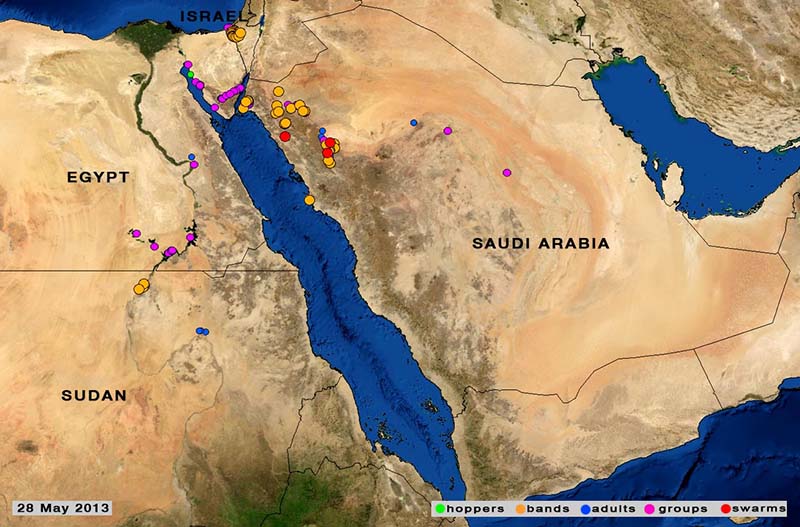
Current situation.
28 May. New adult groups and small swarms form in Sinai
Hoppers continue to form groups and small bands in the northern Sinai Peninsula along both sides of the Egypt/Israel border where hatching occurred in mid-April. Some of the hoppers have fledged to form immature adult groups and small swarms. Fledging is expected to continue for about one more week, causing an increasing number of immature adults to form groups and small swarms from infestations that are not detected or treated in both countries. Initially, the adults will move back and forth across the border and could threaten crops. This is expected to be followed by a southwesterly migration to the summer breeding areas in central Sudan during June. Similar infestations are also present in southern Sinai. Aerial and ground operations continue in the northern Negev Desert of Israel. Survey and control operations are also in progress in adjacent areas of the Sinai in Egypt but are limited due to insecurity.
Elsewhere in Egypt, breeding is underway near Qena and Lake Nasser (Garf Husein and Tushka) where groups of hoppers were treated.
In Saudi Arabia, control operations continue on the northern Red Sea coast and subcoastal areas near Tabuk where hopper bands are present and a few immature swarms have formed. No further infestations have been reported in the interior near Gassim since 18 May.
In Sudan, the situation has reportedly improved in the north; however, hopper bands are still present along the Nile Valley near Wadi Halfa. Adult groups and small swarms could form from any undetected infestations.
In Northwest Africa, limited control operations were undertaken recently in the spring breeding areas south of the Atlas Mountains in Morocco and Algeria against hopper groups and small bands.
Current situation.
As a result of egg-laying in mid-March and low temperatures, hatching occurred from mid-April onwards in the western Negev Desert of Israel and in the Sinai Peninsula of Egypt where hoppers are now forming groups and bands in both areas.
In Israel, survey and control operations are in progress by ground and air to find and treat as many hopper infestations as possible before they become adults in June. The new adults may form small groups and swarms that could threaten agriculture crops. The last time breeding occurred and hopper bands formed in Israel was more than 50 years ago in April 1961.
In Egypt, insecurity is hampering survey and control operations in the Sinai. Breeding has been detected in a few places but hopper groups and bands may be forming in other areas that are inaccessible in central and southern Sinai.
Any adult groups and swarms that form in either country are likely to move south during June to the summer breeding areas in the interior of central Sudan that extend from Darfur to western Eritrea.
In Saudi Arabia, breeding continues in the northwest near Tabuk and control operations are underway. Some groups of adults moved into the interior near Hail and Riyadh, and breeding occurred on the edges of irrigated alfalfa crops near Gassim. There is a risk that some groups or small swarms could reach southwest Iran and continue moving eastwards.
In Sudan, breeding is in progress in the north where control operations continue against hopper bands that are forming along a 1,000 km stretch of the Nile Valley. New adults are expected to form groups and small swarms in May that could threaten agriculture crops. Smaller-scale breeding occurred near Lake Nasser in southern Egypt.
In Northwest Africa, spring breeding is in progress in the northern Sahara of Algeria and, to a lesser extent, on the southern side of the Atlas Mountains in Morocco. Control operations have been undertaken in Algeria.
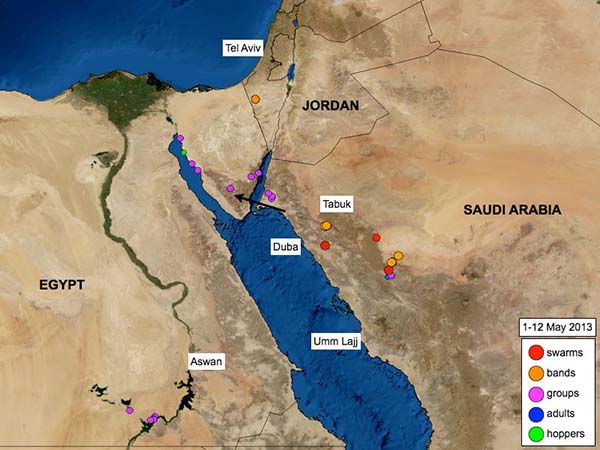
Current situation.
3 May. Small swarms expected to form shortly in Nile Valley (N Sudan)
The Desert Locust situation remains serious in northern Sudan where hopper bands continue to be present in or near cropping areas along a 1,000 km stretch of the Nile River. Some of the hoppers have reached the fifth and last instar stage. New groups of adults and small swarms are expected to form in May and remain in cropping areas where substantial damage could occur. Unless early rains fall in the summer breeding areas further south that extend from Darfur to Eritrea, the adults are likely to remain in the Nile Valley where they would mature and could lay eggs in June. There is a low risk that some groups and small swarms could move west towards the northern Sahel in West Africa. Survey and control operations are in progress in the infested areas.
The other concern is breeding that is underway in subcoastal areas of the northern Red Sea in Saudi Arabia where hopper bands are present between Tabuk and Kaybar and more hatching is expected in the Tabuk area in early May. Although survey and control operations are in progress, new adults could form groups and small swarms during May and move to the interior of the Arabian Peninsula where good rains have fallen on the edge of the Empty Quarter in Saudi Arabia, the interior of Yemen and in northern Oman. If locusts arrive in any of these areas, they are expected to mature quickly and lay eggs.
In Northwest Africa, spring breeding is in progress south of the Atlas Mountains in Morocco and Algeria where hopper groups and small bands have formed in some areas. Breeding will continue during May, which could lead to the formation of adult groups and small swarms that would move south in June to the northern Sahel in West Africa. So far, early rains have fallen in the Air Mountains in Niger, which should allow ecological conditions to become favourable for breeding. This is a low risk that a few groups and small swarms could appear in the Air during June from Sudan.
All efforts are required to monitor the situation closely and undertake the necessary control operations.
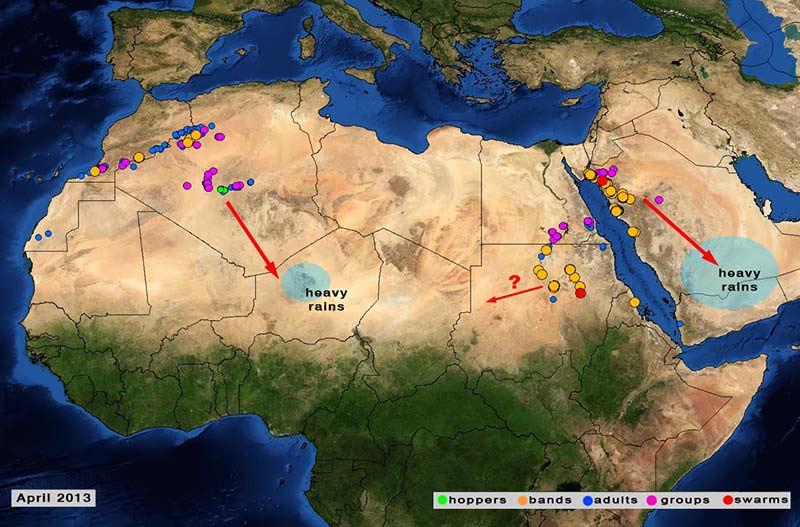
Current situation.
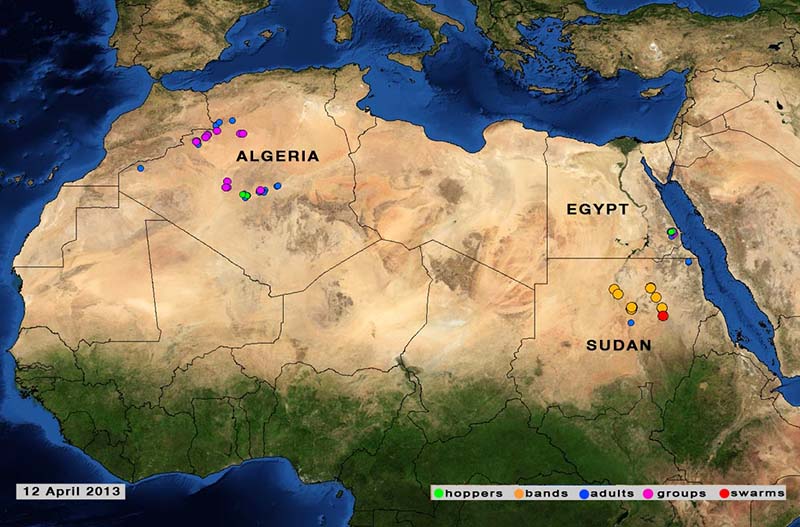
12 April. Hopper bands continue to form along the Nile River in Sudan
The Desert Locust situation continues to be serious in northern Sudan where a few groups of adults are still laying eggs, hatching is in progress and hoppers are forming small bands near crops along a 1,000 km stretch of the Nile Valley between Wadi Halfa and Ed Damer. Survey and control operations are in progress against mainly second instar hopper bands to prevent new swarms from forming in May.
Locust populations continue to decline in winter breeding areas along both sides of the Red Sea. No further infestations were seen on the southern coastal plains in Sudan between the Tokar Delta and the Eritrean border. In southeast Egypt, a limited second generation of breeding continues in the Abraaq area where groups of adults are laying eggs and hoppers are present. Ground control is in progress.
The situation has also improved further north in the Sinai Peninsula where no additional locust infestations have been reported. Control operations have come to an end in Israel, Palestine and Jordan and, so far, there has been no signs of hatching from earlier egg-laying.
Good rains fell at the end of March in the interior of the Arabian Peninsula from Hadhramaut in Yemen to the Empty Quarter in Saudi Arabia. Ecological conditions are expected to be improving and locusts may appear in both areas.
In Northwest Africa, groups of adults are laying eggs in northwest and central Algeria, and hatching of solitarious hoppers has commenced in a few places. Survey and control operations are in progress. Small-scale breeding is also underway in adjacent areas of northeast Morocco.
In South-West Asia, good rains fell in the spring breeding areas of the interior in southeast Iran (Jaz Murian Basin) and in adjacent areas of western Pakistan (Turbat Valley, Baluchistan). So far, only a few locusts have been reported in Iran.
Current situation.
3 April. Hoppers hatching and forming bands along Nile River in Sudan
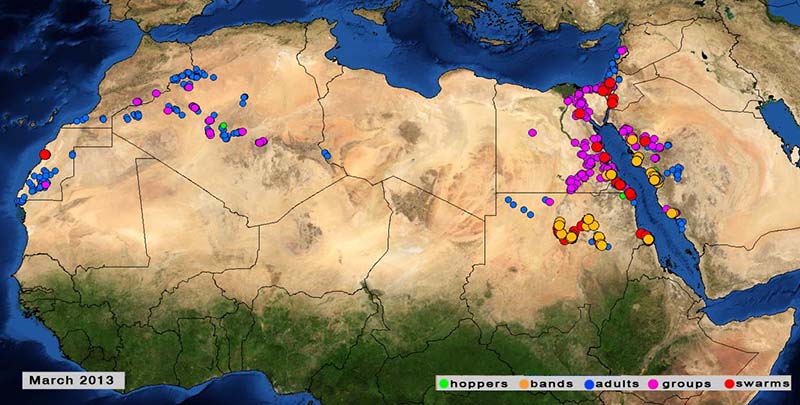
The Desert Locust situation continues to remain serious in the Central Region. Hopper bands and swarms continued to form in the winter breeding areas along both sides of the Red Sea during March. Locust numbers declined after mid-March due to control operations, dry vegetation and migration to the Nile Valley in Sudan and Egypt, and northwards to the Sinai Peninsula, Israel, Palestine, Jordan and Lebanon.
There remains a moderate risk of a few small mature groups arriving in southern Israel in early April from infestations that may be present in remote and inaccessible areas of the central Sinai Peninsula. Thereafter, the situation should become calm.
In northern Sudan, control operations are in progress against hoppers that are hatching and forming bands near crops along a 1,000 km stretch of the Nile in northern Sudan. Swarms could form in May and threaten crops, and a second generation of breeding could take place before the summer.
There is a risk that adult groups and perhaps a few small swarms will move from the Red Sea coast of Saudi Arabia to the interior where one generation of breeding could occur in areas that received good rains in March. If so, swarms may form by June. Breeding could also occur in the interior of Yemen where good rains fell in late March.
In Northwest Africa, locust numbers are gradually increasing in Algeria and Morocco where egg-laying has started in the spring breeding areas south of the Atlas Mountains. Hatching and small groups of hoppers will form in May.
March 2013 situation.
20 March. Widespread hatching starts along Nile River in Sudan
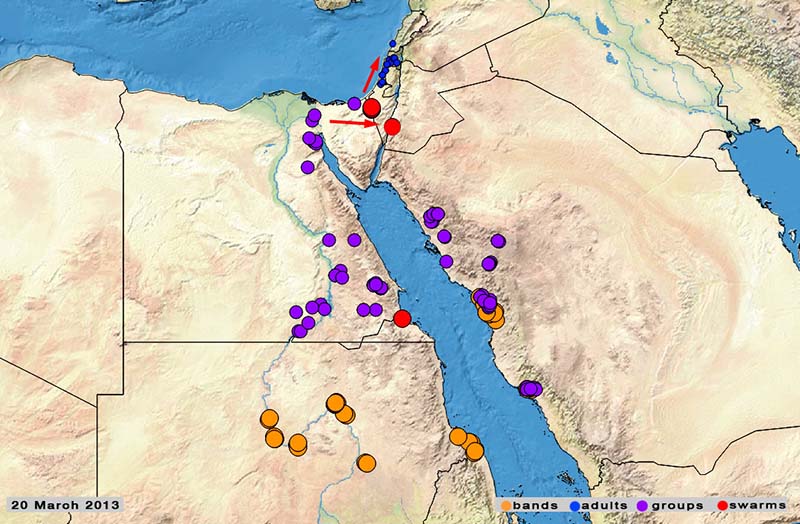
No further swarms have been reported recently along the Nile River in northern Sudan but substantial egg laying is thought to have occurred over a considerable distance of some 1,000 km near crops, stretching from Wadi Halfa to Atbara. Hatching began last week and hoppers are forming small but dense patches and bands. Hatching will continue for at least another week and more bands will form. In the northeast, the situation improved and few locusts remain on the Red Sea coast and near the Egypt border. On the southern coast, control operations continue against infestations near the Eritrea border.
In Egypt, locust infestations declined on the southeast coast of the Red Sea near the Sudan border due to control operations and drying conditions. On the other hand, groups of adults continue to be reported further inland near Lake Nassor, in the Red Sea Hills, east of Cairo, and in the northern Sinai Peninsula.
In Saudi Arabia, control operations continue against hopper groups, bands and adult groups on the Red Sea coastal plains mainly north of Jeddah and, to a lesser extent, to the south near Lith. Some adult groups moved further north along the coast.
In Israel, ground and aerial control operations continue against adults that are maturing and started to lay eggs in the northern Negev Desert.
In Jordan, one swarm was reported in the south moving towards Quweira on 14 March.
In Lebanon, low numbers of immature adults were seen in coastal areas on about 15 March.
Additional movements are expected during the remainder of March and all countries should remain on alert.
Hatching commences along the Nile in northern Sudan.
12 March. Groups and swarms move in the Central region
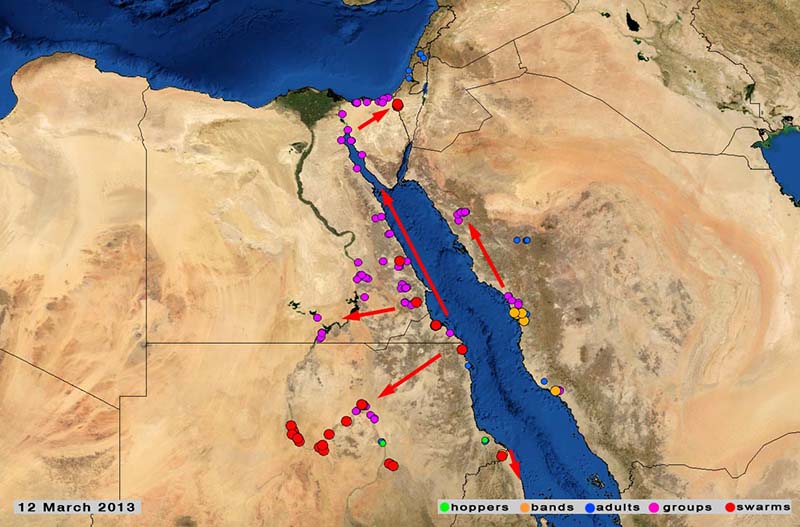
The Desert Locust situation continues to remain serious along both sides of the Red Sea. In the past few days, more groups and small swarms have moved from the breeding areas on the coast into the interior of Sudan, Egypt and Saudi Arabia. More locusts have also arrived in Israel and Eritrea. Survey and control operations are underway in all countries. Additional movements are expected during the remainder of March and countries should remain on alert.
EGYPT. Vegetation is drying out on the Red Sea coast and subcoastal areas except in the El Shazly and Abraaq areas where a second generation of egg-laying is underway. In the past few days, more groups of immature and mature adults appeared from the coast in Upper Egypt along Lake Nasser and the Nile between Abu Simbel and Kom Ombo. During periods of warm southerly winds, more immature adult groups moved north along the Red Sea coast to Suez and the northern Sinai between Ismailia and El Arish. Similar infestations are likely to be present in the central Sinai where many areas are inaccessible. Ground teams treated nearly 7,000 ha so far in March, and 40,000 ha during the campaign. There is a risk of small groups and swarms arriving in the northeast during periods of warm southerly winds.
ISRAEL. Another wave of immature adults and small groups occurred from the Sinai on 10 March, reaching many coastal areas and the northern Negev Desert. No significant damage has occurred. Ground and aerial control operations treated nearly 2,000 ha so far in March. There is a risk of small groups and swarms arriving during periods of warm southerly and southwesterly winds.
PALESTINE. Small groups of immature adults have been reported in a few places in Gaza, most recently on 10 March. Many of the groups are moving back and forth across the Egypt/Israel border.
JORDAN. Low numbers of immature gregarious adults arrived in the Aqaba Valley on 10 March. Field teams have been deployed, but control was not required. There is a risk of small groups and swarms arriving in the south during periods of warm southerly and southwesterly winds.
SAUDI ARABIA. Groups of immature and mature adults persist on the Red Sea coast between Masturah and Yenbo and, to a lesser extent, near Lith. Groups of mature adults have moved further north towards Khaybar and Duba where egg-laying is reported. Ground and aerial control operations treated nearly 7,000 ha so far in March, and more than 40,000 ha during the campaign. There is a risk that small groups and perhaps a few small swarms will appear in the vast spring breeding areas of the interior. This may be supplemented by locusts arriving from the western side of the Red Sea.
SUDAN. Breeding continues on the southern Red Sea coast near Eritrea where hopper bands, immature and mature swarms are present. Infestations are declining in the northeast near the Egypt border as groups and swarms moved to the Nile Valley. More mature swarms have been seen recently along the Nile between Atbara and Dongola where they are laying eggs in crops. Ground and aerial control operations treated 36,000 ha so far in March, and more than 150,000 ha during the campaign.
ERITREA. Breeding is in progress on the northern Red Sea coastal plains at the Sudan border. A swarm was reported on the escarpment near Afabet.
Elsewhere, fragments from a small immature swarm were seen on 6 March in western Algeria near Beni Abbes. These locusts probably originated from recent breeding in the Western Sahara.
Groups and swarms have moved from the Red Sea coast.
5 March. Desert Locust swarms move to Sinai and Israel
Remnants of several small immature Desert Locust swarms that appeared in Cairo, Egypt on 2 March were seen the following day near the international airport on the eastern edge of the city. Several small immature swarms moved to the northern Sinai Peninsula where they were seen on the northern coast near Bir El Abd and El Arish on 4 March. On the same day, locals reported seeing locusts south of El Arish near Jebel Halal, and at least one small swarm crossed the nearby border into the northern Negev Desert of Israel where it was seen in the Nitzana area near Be'er Milka. Control operations were undertaken immediately in both countries, and no damage to crops was reported.
Locust teams in both countries are checking all areas for any further infestations. There is a risk that a few more locusts from the Sinai will arrive in the Negev today on northwesterly winds, and some could reach adjacent areas of the Aqaba Valley in Jordan. From tomorrow onwards, the possibility of additional locust groups and small swarms moving into Israel and Jordan will decline considerably as the winds shift and come from the north and northeast.
FAO will continue to keep all affected countries informed on a regular and timely basis.
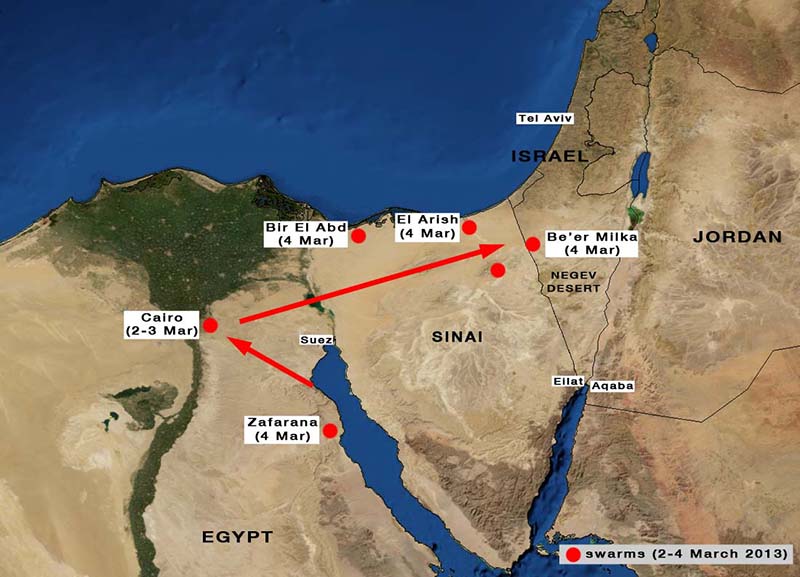
A few small swarms moved across the northern Sinai Peninsula.
3 March. Desert Locusts arrive in Cairo
On 2 March, at least one immature swarm appeared in the afternoon in the eastern Cairo districts of New Cairo and Mokattam and dispersed into several smaller swarmlets. The locusts originated from breeding that has been in progress since November in southeast Egypt between Berenice and the Sudanese border. As vegetation dried out, small groups and swarms of immature adults moved slowly north along the Red Sea coast, reaching Marsa Alam on 8 February, Hurghada on the 16th and Zafarana on the 26th. From there, a few moved to Cairo yesterday.
The locusts reached Cairo by flying on warm southerly and southeasterly winds associated with a low pressure system over the central Mediterranean. As this system moves further east in the coming days, the winds will shift and come from the west and then from the north by 5 March. As locusts fly with the wind, this will allow them to move towards northeast Egypt, the Sinai and, perhaps, Israel and southwest Jordan today and tomorrow. Therefore, it is unlikely that more locusts will appear in Cairo, and the threat to the Sinai, Israel and Jordan should decline after Monday.
National locust teams in Egypt undertook control operations in east Cairo yesterday evening. Survey and control operations continue in all infested areas of the country. Israel, Lebanon and Jordan have been alerted.
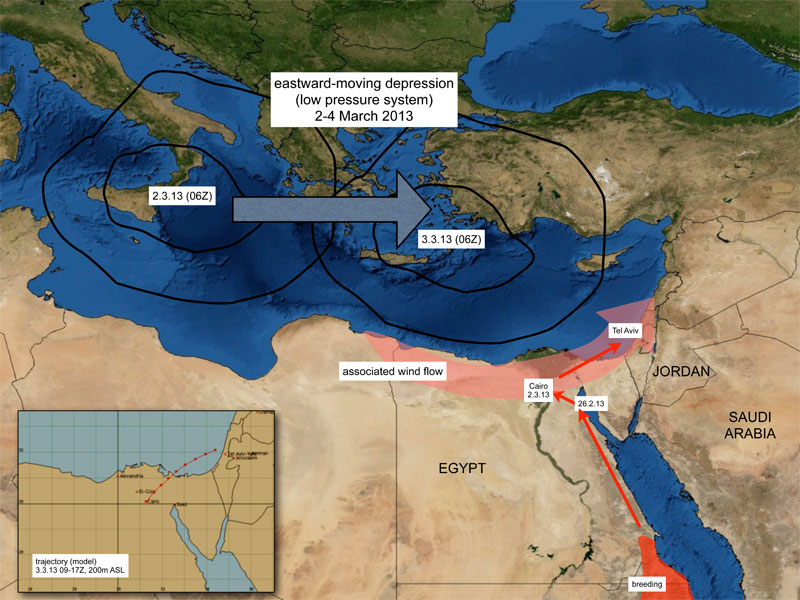
Locusts can move to NE Egypt, Sinai and Israel on 3-4 March.
27 February. Swarms move to northern Egypt and Sudan
The Desert Locust situation continues to remain worrisome along both sides of the Red Sea where hoppers and adults are forming groups, small bands and swarms in northeast Sudan, southeast Egypt, on the Red Sea coast along both sides of the Sudan-Eritrea border, and on the northern Red Sea coast in Saudi Arabia. Some groups and swarms have moved out of these areas recently.
In Sudan, immature adult groups and swarms plus a few mature adult groups and swarms moved from the northeast, crossing the Nubian Desert, and reaching Abu Hamed on 13 February and the Nile Valley as far north as Dongola by the 23rd. Although control operations were immediately launched, damage was reported on winter crops and date palms. Hopper bands and swarms were also present on the southern coast.
In Egypt, immature adult groups and swarms moved north along the entire stretch of the Red Sea coast, reaching Ras Gareb (south of Suez) on 26 February. Other adult groups nearly reached the Nile Valley north of Aswan.
In Eritrea, at least one swarm arrived on the northern Red Sea coastal plains from adjacent border areas in Sudan on 22 February.
In Saudi Arabia, a few groups of immature adults and an immature swarm moved north in sub coastal areas towards Duba in the past few days. A second generation of breeding is underway on the northern coastal plains between Rabigh and Yenbo where hatching started a few days ago and new hopper groups and bands are forming. Hopper bands are present on the central coast near Lith.
Aerial and ground control operations continue in Sudan and Saudi Arabia while ground control operations are in progress in Egypt.
The current outbreak originated from breeding during the past summer in the interior of Sudan where adult groups and swarms formed and moved to southern Egypt and northeast Sudan in November. A few groups crossed the Red Sea to Saudi Arabia while several groups and swarms appeared in coastal areas on both sides of the Sudan-Eritrea border. First generation breeding occurred from November to January.
FORECAST
There is a low to moderate risk that a few adult groups and small swarms may continue north along both sides of the Red Sea in Egypt and Saudi Arabia, reaching the Nile Delta, the Sinai Peninsula and beyond during periods of warms winds associated with eastward-moving Mediterranean depressions. Israel, Jordan and Lebanon should be on alert.
A second generation of breeding will occur in Sudan, Egypt and Saudi Arabia in March but it is expected to be on a smaller scale due to control operations and drying conditions. Consequently, hatching and hopper band formation will occur during March and new swarms could start to form in early April. By then, ecological conditions are likely to be dry along both sides of the Red Sea, unless further rains fall, and the swarms would move to the vast spring breeding areas in interior of Saudi Arabia and perhaps reach southern Iran and western Pakistan.
All efforts are required to maintain survey and control operations in the affected countries in order to find and treat all infestations and reduce the potential threat to crops and of migration to the spring breeding areas.
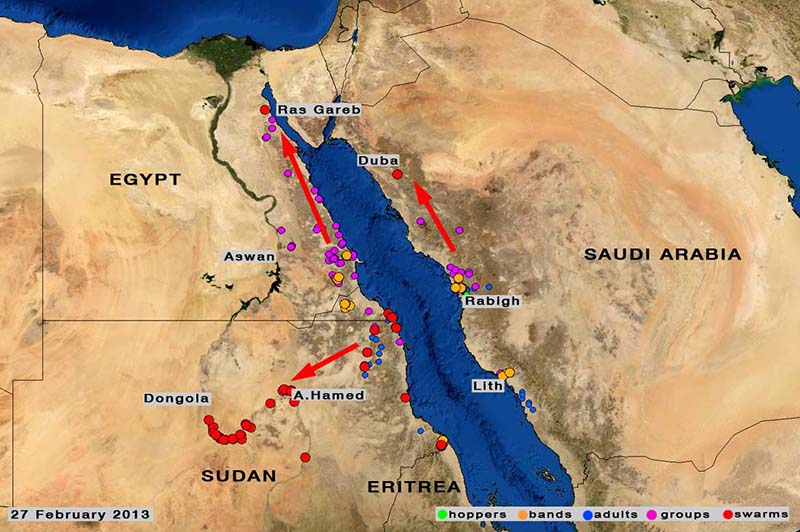
Swarms move from Egypt/Sudan border.
17 February. Swarms invade crops in northern Sudan
There have been numerous reports of immature Desert Locust swarms invading cropping areas in northern Sudan in the past few days. The swarms have originated from the winter breeding areas on the Red Sea coastal plains and subcoastal areas in northeast Sudan and southeast Egypt. The situation is potentially dangerous as more swarms are expected to form in the coming weeks that could move into parts of northern Sudan and southern Egypt. All efforts are required to control the infestations and protect winter crops.
At least six immature swarms and a number of immature adult groups were present on the Red Sea coastal plains of Sudan between Mohamed Qol (2054N/3709E) and the Egyptian border. Locals reported seeing the swarms flying high and crossing the border. At least one immature swarm and many immature adult groups were present in subcoastal areas on the western side of the Red Sea Hills in Wadi Diib. Several immature swarms moved to the west, reaching the interior of northern Sudan and the Nile Valley between Abu Hamed (1932N/3320E) and Dongola (1910N/3027E), including Merowe (1830N/3149E) and Ed Debba (1805N/3055E), on about 14 February, attacking winter crops and fruit orchards. Aerial and ground control operations were immediately launched and have treated at least five swarms so far.
On the southern coastal plains of the Red Sea in Sudan, four small immature and maturing swarms and groups of adults were reported and treated near the border of Eritrea. Control operations were also carried out in Eritrea recently. Breeding is in progress and late instar hopper bands and fledglings are present in both countries.
In southeast Egypt, ground control operations continue against immature adult groups and swarms on the coast and in subcoastal areas between the Sudan border and Marsa Alam (2504N/3454E). Aerial and ground control operations also continue on the Red Sea coast in Saudi Arabia against hopper bands and mature swarms north of Jeddah and, to a lesser extent, on the central coast near Lith (2008N/4016E).
More swarms are expected to form in northeast Sudan and southeast Egypt in the coming weeks. If no further rains fall and vegetation dries out, some of these swarms could move into the interior of both countries and also cross the Red Sea to the coast of Saudi Arabia. As ecological conditions remain favouable along the border of Eritrea and Sudan, breeding will continue, causing additional hopper bands and small swarms to form. All countries should remain on high alert and make every effort to find and treat all infestations.
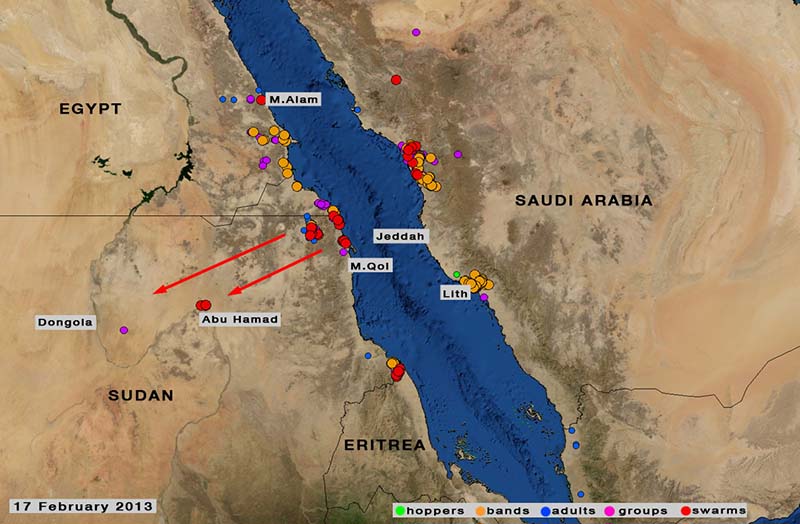
Swarms move from Red Sea coast to northern Sudan.
14 February. Swarms form on the Red Sea coast
The Desert Locust situation remains worrisome in the winter breeding areas along both sides of the Red Sea. Hoppers continue to form numerous groups and bands on the coastal plains in southeast Egypt, northeast Sudan, on the border of Eritrea and Sudan, and on the coast of Saudi Arabia near Lith and Yenbo. Despite intensive control operations, including aerial operations in Saudi Arabia, new swarms are forming near the Sudan/Egypt border and in Saudi Arabia. Some of the swarms moved north along the coast, reaching Marsa Alam in Egypt. The swarms in Egypt and northeast Sudan are immature and will not be ready to lay eggs for about three weeks while the swarms in Saudi Arabia and on the border of Eritrea were maturing and starting to lay eggs. Hatching and band formation will commence in these areas by the end of this month and continue during March. Consequently, locust numbers are expected to increase in the coming month. All efforts are required to control the infestations in order to reduce potential migration to the vast spring breeding areas in the interior of Saudi Arabia.
Elsewhere, the situation remains calm. Limited control operations were carried out in the southern part of Western Sahara against groups of immature adults. A few small immature swarms appeared and were treated in adjacent areas of northwest Mauritania.
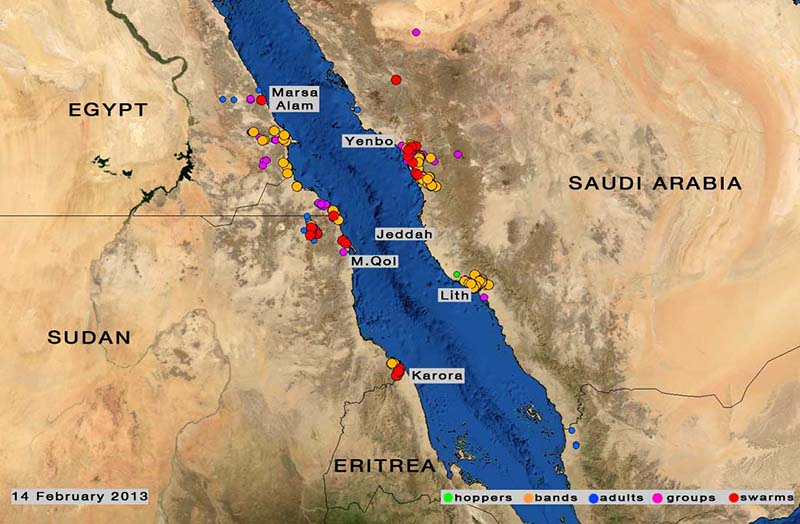
Hopper bands and swarms along the Red Sea coast.
4 February. Situation remains serious along both sides of the Red Sea
The Desert Locust situation continues to remain serious in the winter breeding areas along both sides of the Red Sea. More hopper groups and bands have formed in the past few weeks on the coast in southeast Egypt, northeast Sudan and on the central and northern coasts in Saudi Arabia. A few hopper groups and small bands have also formed along both sides of the Sudan/Eritrea border. Ground control operations are progress in all countries, supplemented by aerial operations in Sudan and Saudi Arabia. A second generation of breeding is likely to occur in the coming months that will cause locust numbers to increase further. All efforts are required to control the infestations in order to reduce potential migration to the vast spring breeding areas in the interior of Saudi Arabia in about March.
In the Western Region, the situation has calmed down in the Sahel where only small residual infestations are present in parts of northern Niger and perhaps in northern Mali. Several adult groups and small swarms formed in the southern part of Western Sahara during January and moved to adjacent areas of northwest Mauritania. Control operations were undertaken in Mauritania and Morocco. Low to moderate numbers of locusts are expected to persist in both countries. Elsewhere, a few small adult groups were treated in irrigated areas near Adrar in the central Sahara in Algeria, and scattered adults were present along the southern side of the Atlas Mountains in Morocco.
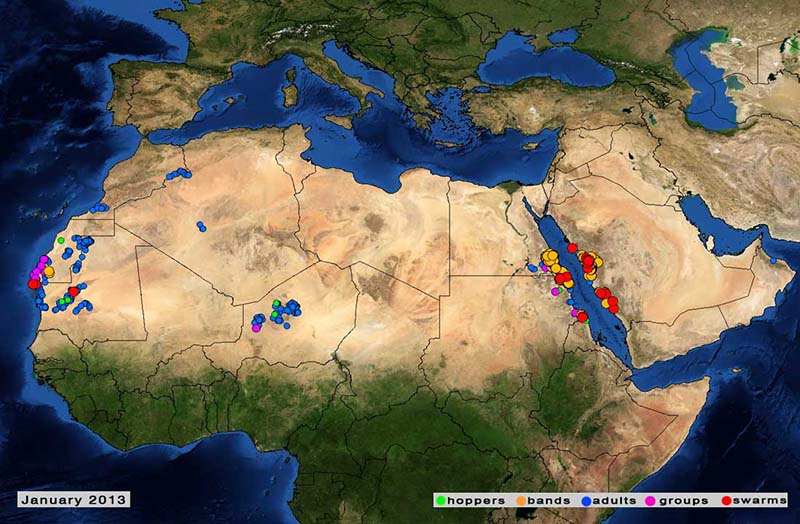
Hopper bands and swarms along the Red Sea coast.
24 January. Control operations against swarms and bands on the Red Sea coast
The Desert Locust situation remains serious in the winter breeding areas along both sides of the Red Sea. During January, ground and aerial control operations continue against hoppers bands and a few swarms in northeast Sudan (15,600 ha) and on the Red Sea coast in Saudi Arabia (3,500 ha). Ground control operations are in progress against similar infestations in southeast Egypt (3,100 ha). Another generation of breeding will occur in the three countries, causing locust numbers to increase further. Recently, a few swarms were seen laying eggs on the coastal plains near the Sudan/Eritrea border. All efforts are required to monitor the situation carefully and undertake the necessary control operations.
The Desert Locust situation is currently calm in the Western Region. In Niger, residual populations of scattered immature solitarious adults are present in Tamesna and Air while small-scale breeding is in progress in a few places in the Air Mountains. In Algeria, limited control operations were undertaken against small infestations of adults near irrigated areas in the central Sahara (Adrar). In Morocco, control operations (1,400 ha) were undertaken recently against groups of immature adults in the southern part of the Western Sahara. Limited operations are also in progress in adjacent coastal areas of northwest Mauritania, and scattered immature adults are present in parts of the north and northwest. Low temperatures will delay locust maturation and limit movements within the Region.
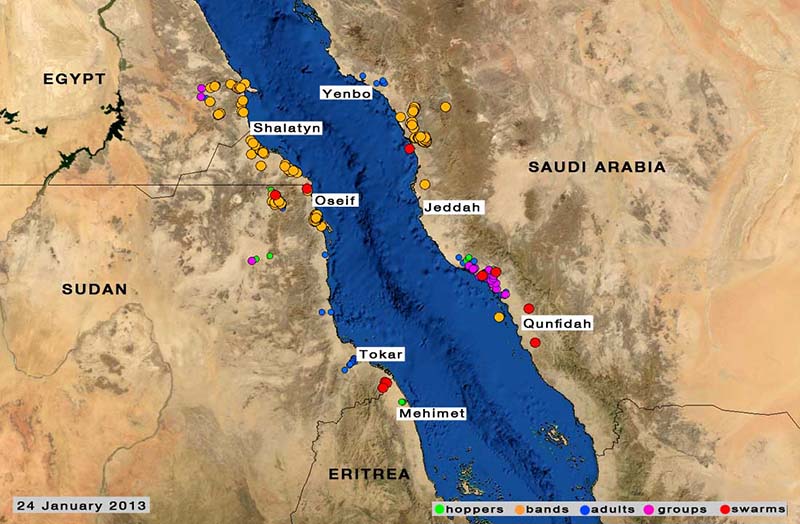
Hopper bands and swarms along the Red Sea coast.
4 January. Swarms and bands persist on the Red Sea coast
The Desert Locust situation improved in the Sahel of West Africa as locust numbers declined during December due to control operations in Niger and Mauritania and drying conditions. On the other hand, the situation remained serious in winter breeding areas along both sides of the Red Sea where adult groups and small swarms laid eggs, giving rise to hopper bands in Egypt, Sudan and Saudi Arabia. Although control operations were undertaken, more breeding is expected and small hopper bands and swarms are likely to form during the forecast period. In Northwest Africa, small-scale breeding and low temperatures will cause locust numbers to increase slowly in Western Sahara, northwest Mauritania and southern Algeria where small groups and hopper bands may form. All efforts are required to monitor the situation and undertake the necessary control operations.
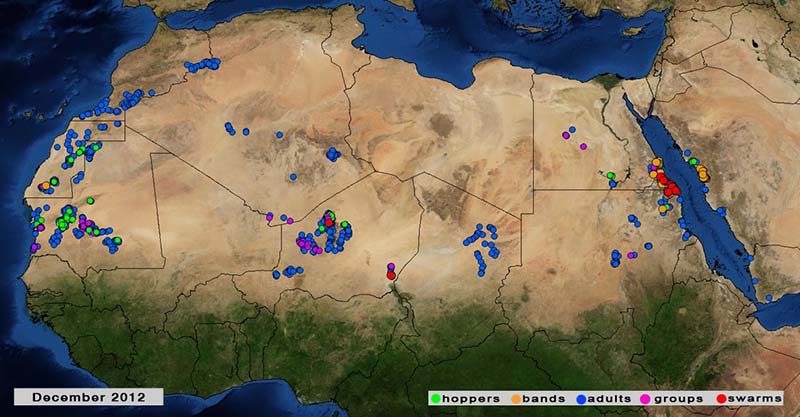
Winter breeding on the Red Sea coast.