
Expected outputs
- Strengthened capacity to manage commercial fisheries, with particular focus on small-scale fisheries
- Enhanced integration of emerging monitoring, control and surveillance technologies in the fight against illegal, unreported and unregulated fishing
- Integrated ecosystem-based management tools and ecosystem approach to biodiversity protection and sustainable fisheries
- Innovative blue economy solutions accounting for the fishery sector
- Knowledge management and outscaling
| Total contribution | USD 7 273 973 (USD 5 million GFCM / USD 2.27 million UNEP-MAP) |
| Duration | 2023–2026 |
| Funded by |
|
| Implemented by |
|
| Executed by |
|
| Beneficiaries | Albania, Algeria, Bosnia and Herzegovina, Lebanon, Libya, Montenegro, Morocco, Tunisia and Türkiye. |

News
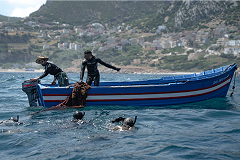
A decade on: How Port State Measures are locking IUU catches out of markets
Standing behind small microscopes on Belyounech beach, in Fnideq, northern Morocco, children spent World Oceans Day learning about the wonders of our marine ecosystems and why they need to be taken care of.
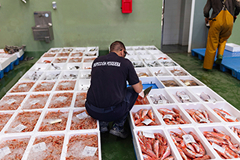
A decade on: How Port State Measures are locking IUU catches out of markets
Ten years ago, the fight against illegal, unreported and unregulated (IUU) fishing reached a major milestone with the entry into force of the FAO Agreement on Port State Measures (PSMA).
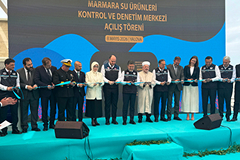
Türkiye inaugurates a new fisheries control centre to strengthen the fight against IUU fishing
The inauguration marks a significant milestone in Türkiye’s efforts to strengthen its monitoring, control and surveillance (MCS) capacity, and constitutes a concrete advancement in fisheries management. It also underscores the country’s commitment to transparent, data-driven fisheries governance in alignment with international standards.
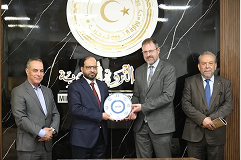
Libya reinforces its involvement within the GFCM to boost food security and coastal livelihoods
Fisheries and aquaculture play a vital role in Libya’s food security and coastal livelihoods. With the longest Mediterranean coastline in Africa, Libya is well placed to leverage its marine potential to support national development and economic resilience.
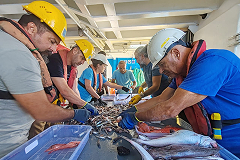
The GFCM completes the fourth scientific survey on fisheries resources in Lebanon
The General Fisheries Commission for the Mediterranean (GFCM) in partnership with the Ministry of Agriculture of Lebanon, the National Council for Scientific Research of Lebanon, FAO Lebanon and the Mediterranean Fisheries Research Production and Training Institute of Türkiye carried out the fourth scientific at-sea survey of fisheries resources along the Lebanese coast.

Turning the tide for Mediterranean fisheries
The Mediterranean Sea has long been a source of life, culture, and livelihoods for millions of people living along its shores. Leading efforts to protect this unique marine environment is the General Fisheries Commission for the Mediterranean (GFCM).

From policy to action: major advances in the fight against IUU fishing
Countries in the Mediterranean and the Black Sea are taking action to level the playing field for legitimate fishers in the region and ensure that seafood is obtained through regulated activities.
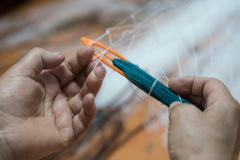
The FishEBM approach: bridging conservation and coastal livelihoods
A holistic approach to the sustainable management of fisheries in the Mediterranean and the Black Sea.
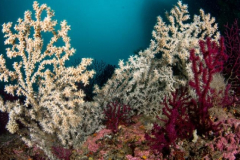
Fisheries restricted areas and how the GFCM contributes to biodiversity conservation
Two decades ago, the GFCM established the first fisheries restricted area (FRA) in the Mediterranean and the Black Sea in support of fisheries management. In spring 2025, the eleventh FRA will enter into force.
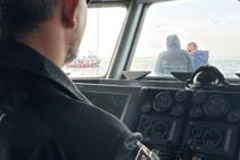
From coast to coast: enhancing cooperation to eradicate IUU fishing in the Mediterranean
Illegal, unreported, and unregulated (IUU) fishing remains a major threat to marine ecosystems, undermining sustainable fisheries and biodiversity conservation.
Towards healthy ecosystems: the GFCM’s multifaceted approach to mitigating interactions between fisheries and vulnerable species
The Mediterranean and Black Sea region, despite its susceptibility to climate change and other impacts, remains one of the world’s biodiversity hotspots due to high species richness, endemism, and the occurrence of rare and vulnerable species, including marine mammals, sea turtles, seabirds, and several species of sharks and rays.
Non-indigenous species expansion: Challenges and opportunities
Gökova Bay, Türkiye as a successful model
GEF Council endorses two FAO/GFCM projects supporting sustainability in Mediterranean and Black Sea fisheries
The Global Environment Facility (GEF) has endorsed two projects of more than USD 12 million to reverse the overexploitation of select commercial fisheries in the Mediterranean and the Black Sea.