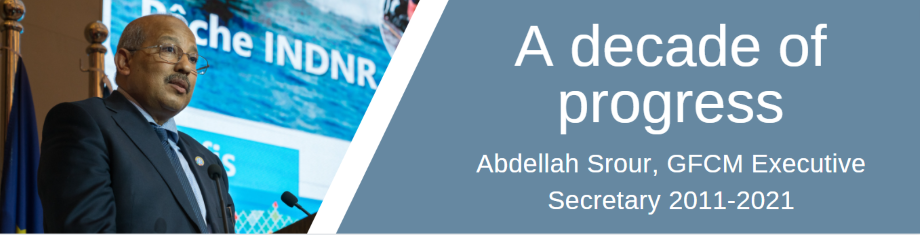
The past 10 years under our Executive Secretary, Mr Abdellah Srour, have marked a turning point in the evolution of the GFCM, modernizing its institutional framework and creating a stronger basis to become a more efficient organization, delivering against a wide range of emerging issues for the sustainability of Mediterranean and Black Sea fisheries and aquaculture.
His mandate and his drive in facilitating the adoption and implementation of ministerial declarations, regional plans of action and the GFCM strategies will be remembered as a cornerstone of the needed transformation of the fisheries and aquaculture sector in the Mediterranean and Black Sea, meeting ambitious objectives for the region and consolidating the GFCM at the forefront of enhanced fisheries management and innovative aquaculture development.
His leadership enabled GFCM’s vision by fostering collaborations, championing new initiatives, attracting increasing political and financial support and creating a dynamic network based on open engagement and constructive science-policy interface.
Through the implementation of the GFCM 2030 Strategy, we will capitalize on the achievements made during the past 10 years and intensify this progress.
The Mediterranean: a beating blue heart for our cultures and societies
As the year draws to a close, it’s traditionally a time for reflection – to look back, and to look forward too.
This is certainly the case for me as 2021 marks the last of ten years during which I’ve had the honour to serve as the Executive Secretary to the General Fisheries Commission for the Mediterranean (GFCM) of the Food and Agriculture Organization of the United Nations (FAO).
Anyone who lives in this unique part of the world will know that the sea is the beating blue heart of Mediterranean cultures and societies – and it’s a precious gift we all share. The same is true of the living resources it provides and on which so many people depend.
When it comes to fisheries, international cooperation and coordination are critical – after all, fish stocks pay no attention to national borders. While collaboration between countries is not always easy, thanks to their support and that of the European Union, international organizations, NGOs and civil society, the GFCM has grown rapidly in size, effectiveness and reputation over the last decade.
We’ve been increasing our operations, building our knowledge base, and working to unlock the funding needed to achieve our long-term sustainability objectives – in the last ten years we’ve increased our budget by more than 600 percent.
This has meant we’ve been able to expand beyond our headquarters in Rome, to create technical units in each of the five Mediterranean and Black Sea subregions. These subregional units allow the grassroot realities of life across the Mediterranean to be considered at the international level and hence help the GFCM adapt its operations to local conditions and issues, gain and share knowledge, and coordinate the tailored technical and scientific assistance our specialists provide to fishers and others in the field.
As the GFCM has become more modern and efficient, we’ve collectively been able to set more ambitious goals. During my tenure and thanks to the efforts of all countries and the EU, the GFCM has begun reversing the negative trends of overfishing that had been threatening the future of many important fish stocks. The new GFCM 2030 Strategy, adopted this year by all the countries of the Mediterranean, will push this mission even further. Our ultimate aim is to secure a sustainable future for fisheries and aquaculture in the Mediterranean, building on the lessons we’ve learned so far and accelerating efforts to meet the many challenges that remain.
The GFCM 2030 Strategy is particularly important to me, as it’s the result of a participatory process built on strategic cooperation which has fostered open dialogue with an ever-wider range of stakeholders. Today, the GFCM can rely on a vast network of partners among international organizations and initiatives, ministries, universities and research institutes, civil society organizations, professional associations and cooperatives, as well as the private sector. I’m proud to have been part of building a common vision that considers everyone’s opinions and reflects everyone’s priorities.
Although I’m stepping back from my hands-on role, I’ll be watching the future of fisheries and aquaculture in the region with hope and anticipation. There is huge work still to do, but if we keep working together – across specialisms, sectors, communities, countries – then there’s every reason to believe that we can put these vital industries on a sustainable footing in the long term.