
New GFCM publication showcases results of research programme on red coral in the Mediterranean Sea

Red coral (Corallium rubrum) is an emblematic species of the Mediterranean Sea, long valued and harvested in the region for millennia. In the past, its shallow populations were nearly depleted in some areas due to excessive fishing pressure.
To improve knowledge on the species and strengthen the management of red coral fisheries in the region, the General Fisheries Commission for the Mediterranean (GFCM) of the Food and Agriculture Organization of the United Nations (FAO) conducted a research programme on red coral. Funded by the European Union, the programme was implemented from 2020 to 2023 by research institutes and universities, in cooperation with national administrations across the Mediterranean.
“The research programme enabled data collection on the status of red coral stocks, including colony demographic structures, catches by fishing ground, observer data, socioeconomic aspects, growth and habitat conditions, providing valuable knowledge to managers and fishers,” said Adel Gaamour, researcher at the National Institute of Marine Sciences and Technologies of Tunisia.
The detailed findings of the research programme have now been released in a new GFCM publication. The report presents the results of data collection activities conducted in Croatia, France, Greece, Italy and Tunisia and provides insights into the population genetics of red coral across Mediterranean subregions, the stock assessments carried out, as well as the socioeconomic dimensions of red coral harvesting. It also highlights the results of targeted training and capacity-development activities conducted with other partner countries, including Algeria, Malta and Morocco.
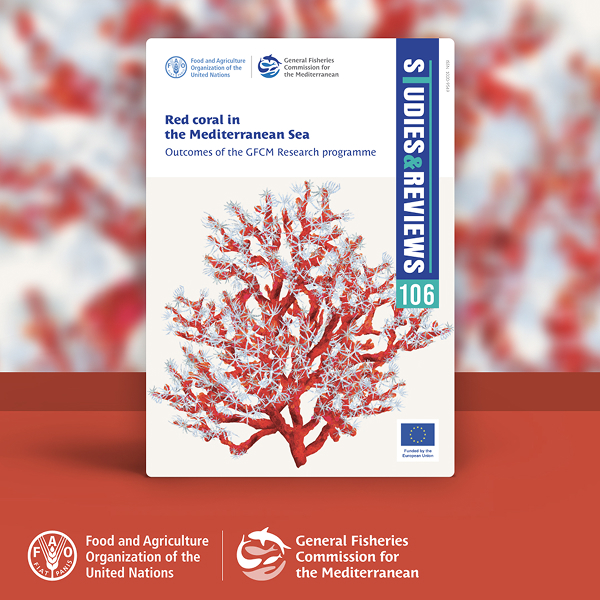
Cover of the GFCM publication
The results of the research programme informed the development and subsequent adoption of a GFCM recommendation on long-term measures for the sustainable exploitation of red coral. Positive developments are already seen at country level.
“This research programme has allowed us and will hopefully allow us to continue collaboration with countries that were previously more difficult to reach,” said Federica Costantini, associate professor in marine ecology, BiGeA, University of Bologna, Italy. “And above all, from a practical point of view, it enabled us to create protocols (for molecular analysis and for data analysis) that can then be used in the future by these countries for the management and conservation of this species.”
“Based on the findings of the research programme, Tunisia is currently developing legislation to regulate red coral fisheries,” explained Gaamour. “The proposed framework includes provisions on designated fishing areas, authorized fishing gear and the minimum harvestable size of red coral. In parallel, we have developed an operational manual for red coral harvesting and marketing in close collaboration with coral divers, relevant ministries, fisheries authorities, observers and inspectors to promote sustainable harvesting and ensure the effective implementation of the new regulatory framework.”
Check out this video for more details on the GFCM research programme on red coral:
Cover photo: ©FAO-GFCM/Claudia Amico