
Launch of Phase II of the Soils4Nutrition project in Burkina Faso to improve soil health and nutrition
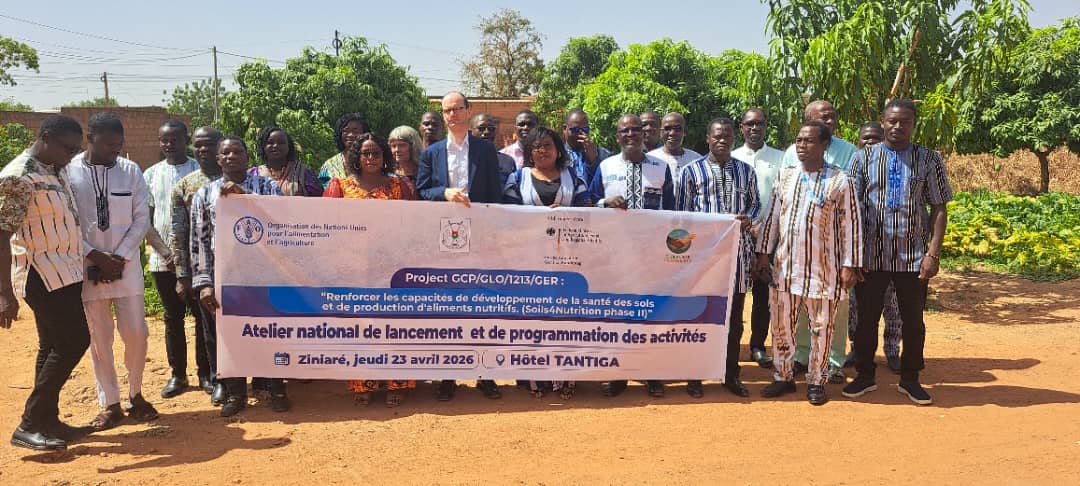
On 23 April 2026 in Ziniaré, public sector representatives, technical and financial partners, farmers, NGOs and community organisations gathered at the Tantiga Hotel in Ziniaré for the official launch of the Soils4Nutrition Phase II project. The project is being implemented by the Burkinabe government with support from the Food and Agriculture Organisation of the United Nations (FAO) and the Global Soils Partnership (GSP), and funded by German development cooperation. Burkina Faso has approximately 9 million hectares of soil resources, of which 31 percent are affected by severe soil degradation, leading to resulting in low soil fertility, poor agricultural productivity, limited crop diversification, and increasing food and nutrition insecurity, The Soils4Nutrition initiative aims to sustainably improve soil health and, consequently, the nutritional quality of agricultural produce.

In her opening remarks, the representative from the Ministry of Agriculture, Ms Estelle Zoungrana, praised the participants’ commitment and emphasised that the project is fully in line with national priorities. “The development and implementation of this project stem from the Government’s stated commitment to effectively combat soil degradation, which is essential for the implementation of the agro-pastoral and fisheries initiative. Restoring soil health is therefore an investment in the future of our agriculture and in the nutrition of our people,” she emphasised, before officially declaring the activities launched.
The partners took turns to highlight the importance of this project. Jan Meise, chargé d’affaires at the German Embassy in Burkina Faso, emphasised that: “This support forms part of the German government’s strategy to promote high-quality production at the national level. In his view, the implementation of the Soils4nutrition project will improve soil quality and, consequently, the quality of the food consumed by the population.”
In her remarks, Ms Thorunn Wolfram, GSP Secretary at the FAO, highlighted that this second phase aims to consolidate the progress made and broaden the impact of the actions already underway. This is a view shared by all stakeholders: without healthy, living soils, it is difficult to ensure a nutritious, balanced and sufficient food supply.
Following the opening speeches, the workshop which hosted 20 participants provided an opportunity to get down to business. During the working sessions, participants reviewed the planned activities and the implementation arrangements. The project aims to train 35 ‘soil doctors’ (these are champion farmers who are willing to train other farmers in their community on sustainable soil management), build the skills of over 1,000 farmers and trial sustainable land management practices across more than 14 pilot sites (Koubri, Ziniaré and Manga). In total, over 300 farmers will receive direct training and several thousand more will be made aware of the initiative.
Particular attention will be paid to women and youth, who play a central role in production systems. The aim is to make interventions more inclusive and better suited to the realities on the ground.
The discussions were frank and constructive. A number of concerns were raised, including the need to monitor results more effectively, to strengthen the involvement of national research bodies, and to ensure the continuity of activities once the project has ended. Everyone emphasised the importance of working in synergy with existing initiatives in order to avoid duplication and maximise impact.
 Against this backdrop, there is a shared recognition that, despite significant efforts, soil degradation remains a worrying reality in Burkina Faso and continues to weigh heavily on agricultural yields. Hence the importance of this project, which focuses on training, awareness-raising and practical solutions to reverse the trend.
At the end of the meeting, the next steps were defined, notably the finalisation of the training modules and the planning of field activities. Participants left with a clear roadmap and a shared objective: to make soil health a lever for sustainably improving food and nutritional security.
With Soils4Nutrition Phase II, Burkina Faso is confirming its commitment to taking far-reaching action, starting from the very foundation: the soil. Because that is where it all begins.
Media coverage