
+Cotton Project participates in training on integrated pest and disease management for cotton
Representatives from Argentina and Paraguay, with project support, learned about innovative and sustainable solutions developed in Brazil.
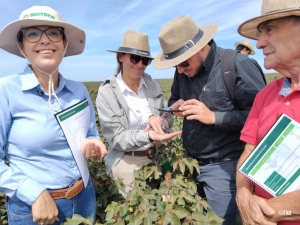
Brasilia, Brazil, May 15, 2026 – The +Cotton Project supported the participation of one representative from Argentina and one from Paraguay in a field day and training course on Integrated Pest and Disease Management for Cotton, organized by the Brazilian Cotton Producers Association (ABRAPA) on May 13–14 in Cristalina (Goiás) and Brasilia (Federal District).
The activity promoted knowledge exchange among specialists, researchers, producers, and representatives of the cotton sector, focusing on strengthening technical capacities for the sustainable management of pests and diseases, including control of the cotton boll weevil, one of the main challenges to the sustainability of the cotton production chain in Latin America.
The +Cotton Project is implemented by the Food and Agriculture Organization of the United Nations (FAO) and the Government of Brazil through the Brazilian Cooperation Agency (ABC/MRE).
From Paraguay, Matthew Giesbrecht, member of the Scientific Commission of the IDEAGRO Foundation, participated; from Argentina, Daniela Vitti Scarel, from the National Institute of Agricultural Technology (INTA), Reconquista unit, joined the mission. Also participating were project coordinator Adriana Gregolin, ABC project analyst Hugo Leão, and Embrapa Cotton researcher Bruna Mendes Diniz Trípode.
Matthew Giesbrecht, from the IDEAGRO Foundation, thanked the international cooperation initiative for the opportunity to participate in the course and emphasized that Brazil is a technological reference due to its advanced biotechnology and varieties not yet available in his country.
“Integrated Pest Management (IPM) is one of the most sustainable paths we can follow. Brazil has made significant progress in the control and management of the cotton boll weevil,” he said.
Paraguay has been significantly revitalizing its cotton production, especially in the Chaco region, considerably expanding cultivated areas over the last five years while investing in innovation, genetics, and fiber-processing infrastructure.
Integrated pest and disease management is currently a key tool for reducing production costs, increasing productivity, and protecting the environment. One important challenge identified during the training is the adoption of good agricultural practices across extensive cotton production areas and associated crops.
IPM requires studies, monitoring, and continuity in its application to achieve positive economic and environmental returns for farming systems. The +Cotton international cooperation initiative has been promoting IPM adoption in partner countries.
For the international participants, the mission represented a concrete opportunity to access successful experiences and field-applied technologies, strengthening national strategies for sustainable production.
Daniela Vitti Scarel, from INTA Reconquista, noted that in her region there are no widely used bioinsecticides for cotton production.
“This is very promising and encouraging — learning about technologies being validated here, in a country with much larger cotton production than Argentina,” she said.
According to the specialist, Argentina’s largest cotton-growing areas are currently concentrated mainly in the central-northern region. Three or four provinces hold the largest production areas: Chaco, Santiago del Estero, and Santa Fe. Cotton is also cultivated in Formosa, as well as in smaller areas in San Juan, San Luis, Córdoba, and other provinces.