Greening synergies: Innovative solutions to halt deforestation through sustainable agricultural supply chains and financial enablers
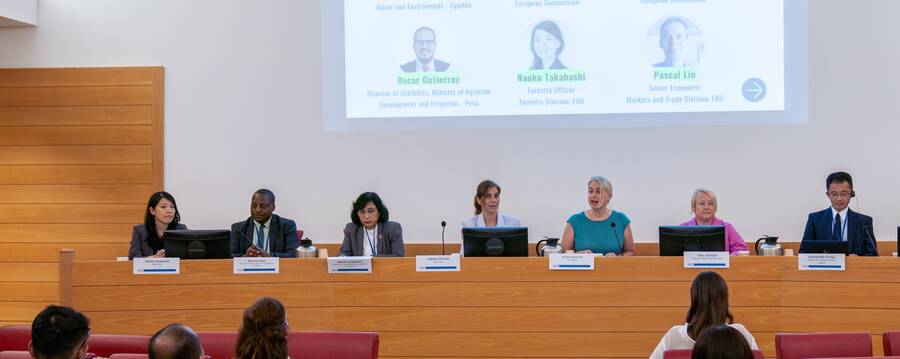
At the 27th Session of the Committee on Forestry (COFO), held in Rome from July 22-26, representatives from Indonesia, Peru, Uganda, Japan, and the European Union (EU) joined experts from the Food and Agriculture Organization (FAO) and various stakeholders for the 9th World Forest Week (WFW) side event titled "Greening Synergies: Innovative Solutions to Halt Deforestation through Sustainable Agricultural Supply Chains and Financial Enablers."
The event explored a range of solutions aimed at achieving a sustainable balance between agricultural and forestry objectives while halting deforestation. It highlighted supply chain approaches and financial innovations to amplify ground-level efforts. Aligned with the COFO-COAG agenda on “Linkages between agriculture and forestry,” the event presented recent developments in conserving forest resources, achieving climate goals, and enhancing livelihoods through the transformation of agrifood systems.
The "Solutions-tree" interactive online platform was introduced, calling for collaboration from countries and partners to identify solutions for sustainable commodity production while protecting forest ecosystems. Financial solutions were showcased as key enablers for forest-positive practices, alongside an analysis of public expenditures to improve policy coherence and align spending with climate, sustainability, and economic goals.
Background
The fundamental background for the event is the continued demand from countries for guidance on technical and governance dimensions on reducing forest loss, promoting sustainable livelihoods and economies; as well as the COFO (Committee on Forestry) & COAG joint call during their 2022 sessions to: “achieve better synergies between [agriculture and forestry] through inter-sectorial approaches, for more sustainable agrifood systems”.
To accelerate progress and showcase the range of existing solutions for reducing forest loss related to agricultural expansion, FAO – thanks to the support of the Government of Japan and in collaboration with partners including through the UN-REDD Programme - is developing a new analytical framework to link deforestation drivers and solutions using a “Solutions-tree” structure. The Solutions-tree platform is being built as an interactive online platform/gateway that aims to create a better understanding of the underlying factors driving agriculture-linked deforestation and to facilitate access to the existing solutions and practical tools that can address this trade-off.
A recent collaboration between FAO’s Forestry Division (NFO), the Agrifood Economic Division (ESA) and the Statistics divisions (ESS) has enabled the adaptation of MAFAP (Monitoring 3 and Analysing Food and Agricultural Policies) tools to analyze policy coherence through the lens of public expenditures.
Organizers: MAFF Japan, FAO, UN-REDD Programme
Date and place: 25 July 2024, FAO HQ, Rome
Moderator: Astrid Agostini, Senior Adviser – Climate and Environment, FAO Investment Centre
Opening remarks: Tiina Vähänen, Deputy Director of the Forestry Division of the Natural Resources and Sustainable Production stream of FAO; and Kawashima Yutaka, Senior Policy Analyst for International Affairs, Forestry Agency, Ministry of Agriculture, Forestry and Fisheries of Japan
Watch the recording: Available in English, French and Spanish
Download presentations:
Innovative solutions, a glimpse on the Solutions-tree and finance opportunities to halt deforestation – Serena Fortuna
Watch the Solutions-tree video:
Available here
More on our Speakers
More on our Speakers
| Ms. Astrid Agostini is the Senior Adviser – Climate and Environment in the FAO Investment Centre with a particular focus on climate and carbon finance, food systems transformation and nature. Before taking up this role in 2022, she led the REDD+ and National Forest Monitoring Cluster in the Forestry Division. Ms. Agostini was a member of FAO’s strategy team on sustainable agriculture and led technical work on climate smart agriculture and sustainable bioenergy. She co-authored FAO’s 2016 flagship report on Climate Change, led FAO’s first analysis of NDCs, and as Team Leader for Climate Finance coordinated FAO’s early portfolio development with the GCF. She joined FAO in 1999 in the Investment Centre as a natural resource economist and worked in Africa, Latin America, Asia and Eastern Europe on investment projects with the World Bank, IFAD, AfDB, EBRD and the GEF. Astrid holds an MA in philosophy, politics and economics from the University of Oxford and an MSc in environmental and resource economics from University College London (UCL). | ||
| Ms. Tiina Vähänen is the Deputy Director the Forestry Division of the Natural Resources and Sustainable Production stream. In her previous role, she has led FAO work on REDD+ and national forest monitoring. She has worked on international forest and natural resources policy issues at FAO since 2001 and led the organization of the 14th World Forestry Congress in 2015. She has coordinated FAO’s contributions to the global climate change debates, notably UNFCCC, and managed FAO forestry contributions to other international agreements and the Collaborative Partnership on Forests. Ms Vähänen has M.Sc. on Forestry and Agriculture. | ||
| Mr. KAWASHIMA Yutaka is the Senior Policy Analyst for International Affairs, Forestry Agency, JAPAN. In his previous position, he managed the Forest Carbon Sink Strategy Office of the Forestry Agency and participated in UNFCCC COP and IPCC AR6 process. Since 2009, he had been engaged in international cooperation on sustainable forest management and tree breeding study at the Japan International Cooperation Agency (JICA) and the Forest Tree Breeding Center of the Forestry and Forest Products Research Institute (FFPRI). Since joining the Forestry Agency in 1988, he had been involved in national forest management. Mr. KAWASHIMA has Master of Law and Bachelor of Agriculture. | ||
| Mr. Bob Kazungu is an Ag. Assistant Commissioner for Forestry in charge of Assessment and Monitoring at the Ministry of Water and Environment of Uganda, and the Uganda’s National REDD+ Focal Point. Mr. Kazungu holds a Master of Science degree in Forestry with over 20 years of forestry management. In addition to Kazungu’s key function of ensuring that all forestry efforts are compiled and reported to different structures, he is key in policy and forestry law formulation in Uganda as well as preparation of standards and guidelines. | ||
| Mr. Oscar Gutiérrez, Director of Statistics and Agrarian Information, Ministry of Agrarian Development and Irrigation, Peru. Oscar Gutierrez is an Agricultural Engineer with a background in agricultural innovation and development. Since January 2023, he has been working at MIDAGRI. Prior to this role, Mr. Gutierrez was the Coordinator SEAR for AGRO RURAL's project aimed at enhancing the capacities of the DRA's, where he worked from September 2021 to November 2023. From 2018 to August 2021, Mr. Gutierrez served as the Coordinator for the Improvement of the Agricultural Statistics System under the PIADER Project at UEGPS - MINAGRI. Earlier in their career, Mr. Gutierrez worked with the National Agricultural Innovation Program (PNIA), funded by the World Bank, as a Specialist in Competitive Funds from August 2015 to November 2016. Additionally, he was the Project Specialist at the National Institute of Agricultural Innovation (INIA), where he worked from August 2011 to July 2015. With a career in key roles within major agricultural organizations, Mr. Gutierrez brings a wealth of knowledge and expertise to the field, driving advancements in agricultural practices and policies. | ||
| Ms. Haruni Krisnawati is a Senior Advisor to the Minister - Ministry of Environment and Forestry, Republic of Indonesia. Prior to this position, she was a principal researcher in forestry and climate change issues within the Research, Development and Innovation Agency of the Ministry. She received her PhD from the School of Forest and Ecosystem Science, the University of Melbourne, Australia. She has done a lot of works and published several journal articles and books in the areas of climate changes, carbon assessment, GHG emission accounting and MRV for the land-based sector, including mangroves and peatlands. | ||
| Ms. Serena Fortuna is the Halting deforestation, degradation and emissions Team leader in the FAO Forestry Division of the Food and Agriculture Organization of the United Nations (FAO) and member of the UN-REDD Management Group. Ms. Fortuna has twenty-three years of working experience, spent between FAO and other international organizations (CGIAR, IUCN, UN environment) in the field of climate change mitigation and adaptation, reducing deforestation and forest degradation, coastal ecosystem management and disaster risk reduction. She joined FAO efforts supporting countries on REDD+ process since 2012, with emphasis on aspects related to enhanced governance, integrated landscape approach and synergies with agriculture. In her professional life, she has been based in Rome, Bangkok and Panama gaining experience on field work as well as on project management and team coordination in Asia, Latin America and at global level.
| ||
| Mr. Simon Gmeiner holds a Master’s degree in Political Sciences and Economics, as well as a Master of Arts in EU International Relations and Diplomacy from the College of Europe. He currently works as a Policy Officer at the European Commission’s Directorate General for International Partnerships where he leads the EU’s work with producing countries through the global Team Europe Initiative on Deforestation-free Value Chains, which seeks to promote an inclusive transition to sustainable and deforestation-free production and supply chains. He has previously specialised on sustainable supply chains as well as trade and development issues at IFC/World Bank, UNDP and GIZ | ||
|
Mr. Antoine Haouchine is policy officer in the Green Diplomacy and multilateralism Directorate of the DG Environment of the European Commission. As part of the deforestation team, he is in charge of preparing the entry into application of the EU regulation on deforestation. During its past experience, he worked as policy advisor for the French Ministry of the Environment on the UN Convention to Combat Desertification and on international forest related processes.
| ||
| Ms. Naoko Takahashi is a Forestry Officer at the Food and Agriculture Organization of the United Nations (FAO). She focuses on knowledge generation and technical assistance in halting deforestation, decoupling agriculture supply chains from deforestation, including enhancing finance solutions for sustainable supply chains and forestry practices. She has over fifteen years of experience between FAO, bilateral organization, and environmental consultancies, where she implemented on-the-ground actions on forestry and climate change/landscape approach/REDD+ projects, primarily across the Asia-Pacific region, collaborating with agri-business corporations and climate finance investors through public-private partnerships that seek to integrate natural resource conservation and landscape management with sustainable business development. | ||
| Mr. Pascal Liu is a Senior Economist for the FAO Markets and Trade Division. He has extensive experience in international development and environmental awareness. He has been with the Food and Agriculture Organization (FAO) for over two decades, holding various roles. Since 2012, he has served as a Senior Economist, leading economic analysis and policy advice. From 2004 to 2011, he worked as an Economist, conducting economic research and supporting policy development. Earlier, from 1998 to 2003, he was a Commodity Specialist, focusing on commodity markets and trade. Before joining FAO, Mr. Pascal worked with the International Labour Organization as an Associate Professional Officer from 1993 to 1996 and held program officer roles at the Conseil Général de Lot et Garonne and the French Embassy. He holds an MSc in Development Economics from the London School of Economics and Political Science (LSE) and an Ingénieur Agronome degree from the Institut national agronomique Paris-Grignon. |