


Market analysis and development of forest-based enterprises

The Market analysis and development of forest-based enterprises module is intended for forest managers, forest user groups and landowners wishing to establish forest-based enterprises to generate sustained cash income from forests. The module outlines the principles that should be considered in a market analysis and development approach to the creation of forest enterprises, the key elements of enterprise development plans, and the steps to be taken in developing such plans. The module also provides links to tools and case studies to foster effective markets analysis and development of forest-based enterprises.
Basic knowledge
This module is intended for forest managers, forest user groups and landowners thinking of establishing forest-based enterprises to generate sustained cash income from forests.
What is market analysis and development?
In most developing countries, an estimated 80–90 percent of forest businesses are small and locally run, and small-scale enterprises generate more than 50 percent of total forest-sector employment. With increasing demand for forest products and services, helping such businesses operate in a profitable, socially beneficial and environmentally sustainable manner is a pressing challenge.
An approach called “market analysis and development” provides a framework for planning local forest enterprises. It consists of four main phases that guide potential entrepreneurs through a simple, clear, participatory process to plan and develop their enterprises. Partnerships with relevant national and subnational government institutions , civil-society organizations, international organizations and the private sector are likely to be most effective in assisting local entrepreneurs to pursue the market analysis and development approach.
Principles
The following basic principles should be considered in a market analysis and development approach to creating forest enterprises:
Related modules
Market analysis and development of forest-based enterprises contributes to SDGs:


- sustainability – refers to processes that increase economic benefits and improve livelihoods without causing negative social or environmental impacts;
- screening the five aspects of the business environment that need attention in enterprise development – market/economy/finance; environment; social/cultural; institutional/legal; and technology/product research and development;
- strategic alliances – between entrepreneurs and service providers and among businesses in the value chain;
- participation – relevant if supporting enterprise development as facilitator;
- capacity development – relevant if supporting enterprise development as facilitator; and
- gender sensitivity – relevant if supporting enterprise development as facilitator.
In embarking on a market analysis and development approach, the following conditions should apply:
- The business environment is conducive to enterprise development (for example, there are suitable administrative, legal and fiscal facilities), including long-term access to, or tenure of, forest resources.
- National, provincial or district administrations or other political authorities are supportive (e.g. they facilitate access by small forest enterprises to financial institutions and government incentives, minimal red tape is involved in, for example, the registration of businesses, and infrastructure for moving, storing and marketing, etc., is accessible).
- There are markets for forest products or services at the local, national or international levels, as well as relevant trade channels and service-delivery organizations.
- There is sufficient capital or a financial strategy to cover initial capital needs.
The four phases of enterprise development (see an illustration of the process here, and in more depth provides a detailed explanation) generally involve the following activities:
- An assessment of the existing situation to identify realistic enterprise prospects, with the aim of providing an overview of tree and forest resources and potentially marketable products and services, as well as of the constraints and opportunities for those resources, products and services. The net result will be a shortlist of potential resources and products.
- Surveys to assess the viability of short-listed forest products and the selection of those products and services most relevant to the new business.
- The formulation of an enterprise development plan that integrates all the strategies and services needed for the success of the new enterprise.
- Resource mobilization, and networking with business service providers.
- The continuous monitoring of operations and adjustments, as required, in the light of changes in any of the five areas of the business environment (i.e. market/economy/finance; environment; social/cultural; institutional/legal; and technology/product research and development).
In more depth
Enterprise development plan
A key output of the market analysis and development approach is an enterprise development plan, which should have the following elements:
- General description of the enterprise. What is the enterprise about? What are its mission and vision?
- Products and services. What are the products and services that the enterprise will supply? What is their competitive advantage? How are they produced and commercialized?
- SWOT (strength, weakness, opportunities and threats) analysis. What are the strengths and weaknesses of the enterprise? What are the main threats and opportunities?
- Market development strategy. What are the objectives for marketing and sales? Which market segment will the enterprise target? Who are the customers and what is their profile (existing and potential)? Who are the competitors? What are they offering, and what makes them different? What makes the enterprise’s products and services attractive?
- Resources management/environmental strategy. Assess whether the resource can regenerate (and in what time) and can be harvested sustainably. What are the costs involved in maintaining the resource for supplying the enterprise with its raw materials?
- Social strategy. This element deals with the social and equity relationships among enterprise participants (both male and female) and ensures that participation, decision-making and the distribution of benefits are equitable.
- Institutional strategy. This strategy addresses the legal aspects regulating the enterprise, the impact of policies on the enterprise, and the organizational structure needed to ensure that the enterprise maintains links with supporting institutions at all levels.
- Technological strategy. This strategy sets out the technological options best adapted to the values and concerns of the entrepreneurs.
- Operational plan. How will the enterprise operate in producing its products and services? What staff qualifications and training are needed to meet enterprise production and growth requirements?
- Management and business support plan. This is the staff management strategy, the aim of which is to provide a supportive resource for business development (e.g. in terms of administration, information technology and work space).
- Financial plan: What are the capital requirements? What is the financial strategy of the enterprise? What is the profit-and-loss projection, at least for the first years?
The process to be followed in developing the plan has four main phases.
Phase 1 is exploratory; its purpose is to investigate the existing situation. During this phase, potential entrepreneurs:
- obtain an overview of tree and forest resources and potential products;
- identify the constraints and opportunities of those resources and products;
- shortlist a range of products; and
- understand that working in a group can create a stronger market position.
Phase 1 should provide a realistic indication of enterprise prospects, taking into consideration the available resources, social conditions, financing, market demand and potential investors. The objective is to help potential entrepreneurs discover the products that are best suited to their economic situations while ensuring that the resource is used sustainably. To create viable enterprises and reduced risks, potential entrepreneurs learn to select enterprise ideas that take into account social, environmental, institutional and technological factors.

In Phase 2, the potential entrepreneurs gather the information they need to assess the viability of the products and services shortlisted in Phase 1 and decide on the most sustainable and appropriate type of enterprise. In-depth feasibility studies are conducted on shortlisted products and services to evaluate the scale of potential markets, analyse trends and identify constraints to market access. The most promising products and services are selected on the basis of these feasibility studies.

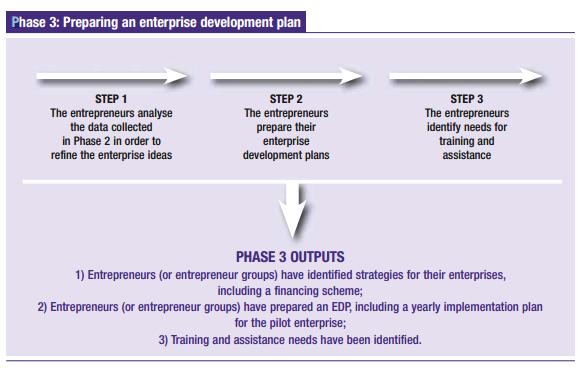
The aim of Phase 3 is to formulate an enterprise development plan that integrates all the strategies and services needed for the success of the new enterprise. The plan is then analysed to assess the assistance the entrepreneurs will need to start their enterprises.
In Phase 4, entrepreneurs are guided through the process of obtaining funds to set up their enterprises and the training they need, as identified in their enterprise development plans. Entrepreneurs are assisted in starting up their enterprises, and they learn to monitor the activities of their enterprises. In this pilot phase, entrepreneurs can test their capacity to link with business service providers and refine their operational and organizational mechanisms. Finally, entrepreneurs are trained to strengthen their abilities in marketing and natural resource management.

Business services. How to obtain financial services to provide investment, working capital, insurance and savings facilities is a crucial consideration in the enterprise development process. Businesses linked in the value chain can provide financial services to one another; financial institutions (e.g. banks) are another potential provider.
Non-financial business development services might be needed for a range of non-financial inputs, such as:
- operational or generic services, to provide, for example, training and skills development and information and advice on technology information; and
- strategic or specific services, such as networking and brokering, market information and research, packaging and advertising.
Supporting forest enterprise development. Support programmes for small and medium-sized forest enterprises should pay careful attention to the context in which they hope to operate. An assessment of potential areas of growth is critical to any preliminary analysis of enterprise support. Different approaches may be needed, depending on whether the target region is forest-rich or forest-poor and politically stable or in a post-conflict situation.
It is important to distinguish between support to help the very poor survive and avoid descending into greater poverty, and support that will build assets sufficient to climb out of poverty. Equity concerns should also be central to considerations throughout the support process.
Supporting institutions can help improve the business environment for small and medium-sized forest enterprises. The main components of the business environment are:
- general macroeconomic policies;
- the legal and regulatory framework, which translates policies into practical laws and regulations – with their associated costs of compliance; and
- the institutional (or organizational) framework, which coordinates the regulation, promotion, monitoring and representation of both the macroeconomic environment and small and medium-sized enterprises.
The market analysis and development approach focuses on flexible, demand-led interventions. For it to succeed, it is critical that facilitators do not provide actual services but, rather, that they build capacity to provide the services and link service providers with those who most need them.
Further detailed guidance and support can be found in the tools and cases of this module.
Women and men can have different roles in establishing forest-based enterprises in developing countries. The entrepreneurship of women in forestry may be constrained by cultural, economic and social obstacles. Among them: centralized ownership and difficultly gaining access to natural resources, cultural barriers to access markets, and poor access to extension, technologies, training and credit.
Although many women have a high-level knowledge of sustainable management of forestry, species diversity and conservation methods, they often have few opportunities to apply this in their own enterprises. In fact, despite the lack of sex-disaggregated data, available research shows the trend is that women are mostly confined to small-scale retail trade, while men run larger businesses. Women work predominantly in the informal sectors, as primary collectors and sellers of Non-Wood Forest Products (NWFPs), while men dominate more formal sectors and the timber trade. Moreover, the presence of women at a managerial, technical and professional level is still low. This is mainly due to traditionally defined gender roles.
Important improvements would include collection of
sex-disaggregated data, and the creation of networks and associations of
women to increase their political and economic weight. It would be
valuable to conduct gender-disaggregated value-chain analysis of
mainstream forest timber and non-timber forest products to be considered
in the policy-making process and technical research.
Resources
Agbeibor, W. Jr. 2006. Pro-poor economic growth: role of small and medium sized enterprises. Journal of Asian Economics 17, pp.35-40.
Beaver, G. 2002. Small business, entrepreneurship and enterprise development. Pearson Education Limited.
Butler, D. 20006. Enterprise planning and development small business and enterprise start-up survival and growth. University of Kent.
Donovan J., Stoian, D. & Poole, N. 2008. Global review of rural community enterprises. The long and winding road to creating viable businesses, and potential shortcuts.
FAO. 2013. Smallhoder integration in changing food markets.
Gibb, A. & Li, J. 2003. Organizing for enterprise in China: what can we learn from the Chinese micro, small, and medium enterprise development experience. Futures 35, pp.403-421.
Hallberg, K. 2000. A market-oriented strategy for small and medium enterprise. World Bank.
Hoffmann, W.H. & Schlosser, R. 2001. Success factors of strategic alliances in small and medium-sized enterprises - An empirical survey. Long Range Planning 34, pp. 357-381.
Manu, Y., Iddrisu, A. & Yoshino, Y. 2012. How can micro and small enterprises in Sub-Saharan Africa become more productive? The impacts of experimental basic managerial training. World Development, vol. 40, no3, pp.458-468.
McPherson, M. 1996. Growth of micro and small enterprises in Southern Africa. Journal of Development economics, vol. 48, pp.253-277.
Mead, D.C & Liedholm, C. 1998. The dynamics of micro and small enterprises in developing countries. World Development, vol. 26, no 1, pp.61-74.
Moore, S.B. & Manring, S. L. 2009. Strategy development in small and medium sized enterprises for sustainability and increased value creation. Journal of Cleaner Production 17, pp.276-282.
Nair, CTS. 2007. Scale markets and economics: small scale enterprises in a globalizing environment. Unasylva 228, vol. 58, pp.3-10,
Nichter, S. & Goldmark, L. 2009. Small firm growth in developing countries. World Development, vol. 37, no 9, pp.1453-1464.
Piatkowski, M. 2012. Factors strengthening the competitive position of SME sector enterprises. An example for Poland. Procedia Social and Behavioral Sciences. 8th International Strategic Management Conference.
Peres, W. & Stumpo, G. 2000. Small and medium-sized manufacturing enterprises in Latin America and the Caribbean under the new economic model. World Development, vol. 28, no 9, pp.1643-1655.
Rocha. E.A.G. 2012. The impact of the business environment on the size of the micro, small and medium enterprise sector; preliminary findings from cross-country comparison. Procedia Economics and Finance, International Conference on small and medium enterprise development with a theme: innovation and sustainability in SME development.
Rogerson, C.M. 2001. In search of the African miracle: debates on susccessful small enterprise development in Africa. Habitat International 25, pp.115-142.
Molnar, A., Liddle, M., Bracer, C., Khare, A., White, A. & Bull, J. 2007. Community-based forest enterprises. Their status and potential in tropical countries. ITTO Technical Series no.28.
This module was developed with the kind collaboration of the following people and/or institutions:
Initiator(s): Sophie Grouwels - FAO, Forestry Department
Contributor(s): Kata Wagner, Jeremie Mbairamadji - FAO, Forestry Department
Reviewer(s): Tropenbos International
This module was revised in 2017 to strengthen gender considerations.
Initiator(s): Gender Team in Forestry
Reviewer(s): Sophie Grouwels - FAO, Forestry Department