

Resources
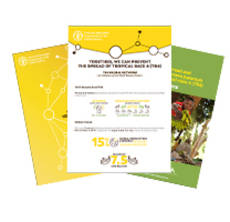
Together, we can prevent the spread of TR4
Investments in agriculture, including banana sector innovation, are crucial to increase the capacity for agricultural productivity, while sustainable food production systems are necessary in achieving #ZeroHunger. With a general public audience in mind, the brochure 'Together, we can prevent the spread of TR4' seeks to explain why bananas and plantains are essential crops around the world for both their economic importance and deep cultural roots. It also highlights the main ways to combat the spread of Tropical race 4 (TR4) which causes the disease Banana Fusarium Wilt (Banana FW).
Search resources
Early detection of banana fusarium wilt caused by Fusarium oxysporum f. sp. cubense using hyperspectral with a metric learning strategy
19/03/2026
Host suppression of the novel virulent effector FocSP1 improves banana resistance to Fusarium oxysporum f.sp. cubense tropical race 4
10/03/2026
Living With Epidemic Plant Diseases: Colonial Plantation Regimes, the Transformation of Indigenous Foodways and De-Peasantization
10/03/2026
Pyrolytic wood vinegar from industrial crop residues as a bio-based fungicide for Fusarium control in banana cultivation
01/03/2026
Exploring the biocontrol potential of Streptomyces sp. B2008 through mechanistic insights into the antifungal effect of actinomycin D
01/02/2026
Screening commercial disinfectants to strengthen on-farm biosecurity for the prevention of Fusarium wilt of banana Tropical Race 4 in Ecuador
01/02/2026
Effects of Nitrogen Form and Concentration on Growth and Chlorophyll Fluorescence Parameters of Banana Seedlings Before and After Foc TR4 Infection
29/01/2026
"Efficacy of biocontrol agents in suppressing Fusarium oxysporum f. sp. cubense TR4, the causal pathogen of Fusarium wilt of banana in Bihar"
27/01/2026
Integrated disease management (IDM) for Fusarium wilt of banana in India: The effect of organic amendments, waterlogging and cultivation with paddy rice on disease severity
26/01/2026
A MaERF 110‐MaMYB 308 Transcriptional Module Negatively Regulates Lignin‐Mediated Defence Against Fusarium Wilt in Banana
06/01/2026
The views expressed in this information product and the articles above are those of the author(s) and do not necessarily reflect the views or policies of FAO.