

Carbon footprint of the banana supply chain
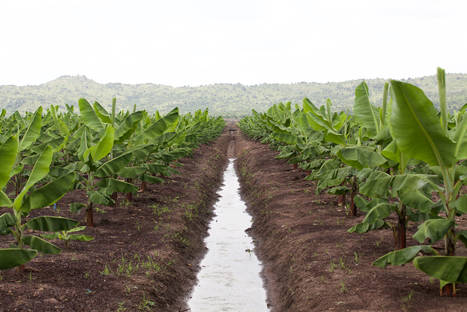
The term “carbon footprint” refers to the amount of greenhouse gases produced by an item or activity. It is measured in carbon dioxide equivalent (CO₂e), which represents the amount of carbon dioxide that would have the same impact on climate change. Over the past decade, it has become a widely used tool for environmental assessment.
A product's carbon footprint is calculated by adding up all materials, energy, and waste used throughout its lifecycle and multiplying these by emission factors and global warming potentials (GWPs). In the banana industry, emissions occur across the entire value chain, which can be divided into three main stages: production and packing, transport and shipping, and ripening (for exported bananas). However, only 15%–20% of global banana production is traded internationally. Major producers such as India and Brazil export very little, as most of their production is consumed domestically.
The ISO 14064 standard, which quantifies greenhouse gas emissions and removals, is a key tool for estimating carbon footprints in banana companies. Other important frameworks include ISO 14040 and ISO 14044, which focus on Life Cycle Assessment (LCA), and PAS 2050 Carbon Footprint Verification, published by the British Standards Institution.
However, carbon footprint results can vary significantly depending on the methodology, scope, and boundaries used. Each study must be adjusted to local conditions and emission factors. Some assessments also include land-use change, consumer transport, and food waste in their calculations. As the field evolves, multiple methodologies are being refined to better align with growing expectations.
Despite the banana's importance as a global commodity, few carbon footprint studies have been published. The results vary widely based on the methodology and data used: from 324g to 1124g CO2e/kg of bananas.
While different studies define boundaries differently, most agree that maritime transport (including refrigerants) is the largest contributor to the banana supply chain's carbon footprint, followed by the production and use of fertilizers and the manufacturing and preparation of cardboard boxes in packing stations.
Activities contributing to the banana industry carbon footprint
Farm production
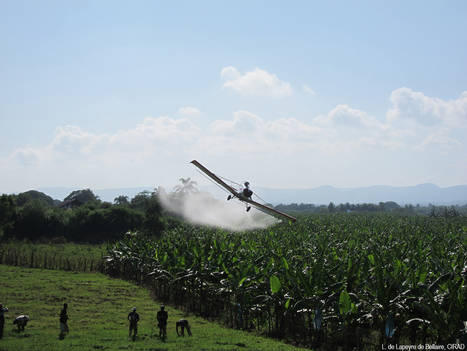
In the primary production stage banana farming does not significantly contribute to greenhouse gas (GHG) emissions. Studies analyzing emissions "from cradle to retail" estimate that primary production accounts for between 16% and 20% of total GHG emissions. The main sources of carbon emissions on banana farms include:
-
Fabrication and acquisition of materials: Energy used indirectly for producing and transporting plant materials, plastics, and tools needed to establish and maintain farms, prepare fields, and facilitate on-farm transport.
-
Production and use of plastics.
-
Use of chemical fertilizers, particularly nitrogen and potassium, which are prevalent in monoculture production.
-
Use of chemical pesticides.
-
Harvesting: Mechanized harvesting increases the carbon footprint compared to manual harvesting.
-
Packing: Energy consumption for the production and preparation of cardboard boxes, including fumigation with fungicides, in packing stations. Dole has reported that this stage accounts for 8% of the total carbon footprint, with carton box production being the most significant contributor.
Use of fertilizers
The production and application of inorganic fertilizers, particularly nitrogen-based ones, represent the second largest source of greenhouse gas emissions in the banana supply chain, following maritime transport. Various carbon footprint assessments in the banana sector have determined that nitrogen-based fertilizers account for between 24% and 49% of the total GHG emissions generated on farms.
Practices reducing the impact of inorganic fertilizers:
Intercropping |
|
Cover cropping |
|
Crop rotation |
|
Weed management |
|
Water conservation |
|
Soil conservation |
|
Precision agriculture |
|
Fertilizer application |
|
Transport and shipping
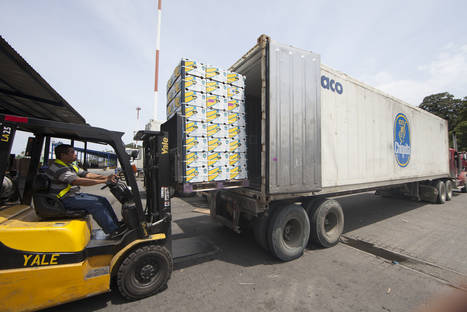
Transport and shipping contribute the most to GHG emissions in the exported banana value chain, primarily due to energy use, including fuel consumption, electricity, and refrigeration. Maritime transport has the greatest impact. Distribution logistics within the destination country account for approximately 12% of the total carbon footprint, while transport and storage combined contribute between 62% and 67%.
Road transport
Road transport—from plantations to ports in producing countries and from ports to ripening centers and distribution points in destination countries—relies heavily on fuel, leading to significant GHG emissions.
Maritime transport
Cargo ships used for banana transportation generate substantial GHG emissions, particularly when operating on low-cost, low-quality fuel. Reports from producing and trading companies indicate that maritime transport accounts for around half of their total CO₂ emissions, making it a major factor in the banana sector’s carbon footprint.
Refrigeration
Refrigerated cargo ships consume large amounts of energy and refrigerants (such as ethylene), further increasing emissions.
Contribution from land transport
Lowering fuel consumption is key to reducing GHG emissions in land transport. For every 100 gallons of diesel burned, approximately 1 ton of GHG is released into the atmosphere.
Possible measures to reduce emissions include:
- Implementing programs to reduce fuel, energy, and water consumption
- Reducing vehicle idling
- Improving vehicle aerodynamics
- Enhancing freight logistics and performance through collaborative transportation initiatives
- Installing automatic tire-inflation systems
- Using wide-based or single-wide tires
- Switching to low-viscosity lubricants
- Reducing vehicle weight
- Adopting hybrid vehicle technologies and alternative fuels
- Providing driver training programs
- Expanding intermodal transport (combining road and rail)
- Improving cold-logistics management
- Using compressed natural gas (CNG) tractors for port haulage
- Using liquefied natural gas (LNG) tractors for heavy loads and mountainous routes
- Evaluating “only natural gas” equipment as CNG and LNG networks expand
- Using re-refined oils and retread tires, which require less energy and emit fewer GHGs during production
- Reducing vehicle speeds to 100 km/h (62 mph), significantly improving fuel efficiency
- Conducting annual environmental self-inspections
Contribution from maritime transport
Refrigerated containers, which are 20- or 40-foot units equipped with cooling systems for banana transport, have reduced the carbon footprint of banana shipping by 33%–42% compared to traditional refrigerated vessels (reefers). However, they still contribute significantly to the sector’s GHG emissions.
Since the introduction of refrigerated containers, emissions have decreased due to:
- Improved container design and the transition to lower-emission refrigerants
- Smart software that controls refrigeration based on product temperature rather than maintaining a constant internal temperature, reducing energy use by up to 50%
- Enhancements in engine efficiency
- Shortening transportation distances by developing alternative production sources
- Replacing older containers with more efficient models
- Eliminating Freon R12 refrigerant and replacing it with R134a
- Substituting R141b blowing agents with lower-emission alternatives
- Implementing improved monitoring and control equipment
Ripening
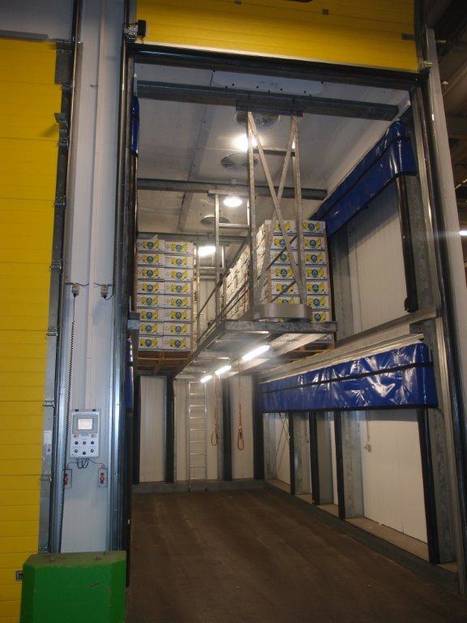
Ripening centers and retail distribution account for approximately 10% of total greenhouse gas emissions in the banana value chain. Of these emissions, 75% come from energy consumption, 22% from distribution centers, and 1% from ethylene production. |
Ripening is a complex process that requires careful control of several factors:
- Ethylene, a hydrocarbon, is used to trigger the ripening process once bananas reach their destination.
- Maintaining a stable temperature is crucial, as fluctuations can affect fruit quality. Temperatures below 13°C or above 18°C can damage the bananas' appearance.
- Constant air circulation is necessary to ensure even ripening.
- When using ethylene gas, concentration levels must remain consistent.
To reduce greenhouse gas emissions in ripening centers, companies have adopted strategies to cut energy consumption by half, including:
- Using natural refrigerants such as ammonia and water.
- Installing energy-efficient lighting.
- Implementing patented reversed air technology to optimize airflow.
- Recovering heat generated by ripening bananas to heat warehouses and offices.
- Maximizing natural daylight through roof tunnels.
- Promoting low-emission mobility by using electric cars and scooters.
References
References
FAO. 2014. Agriculture’s green house gas emissions on the rise
FAO. 2014. Agriculture, forestry and other land use emissions by sources and removals by sinks 1990-2011 Analysis
Chapter 9: Calberto G., Staver C., Siles P. 2015. An assessment of global banana production and suitability under climate change scenarios (in Elbehri A. 2015. Climate Change and Food Systems. Global assessments and implications for food security and trade)
Chapter 9: Calberto G., Staver C., Siles P. 2015. An assessment of global banana production and suitability under climate change scenarios (in Elbehri A. 2015. Climate Change and Food Systems. Global assessments and implications for food security and trade)
Government of India. 2015. India’s Intended Nationally Determined Contribution
Republic of the Philippines. 2015. Intended Nationally Determined Contributions Communicated to the UNFCCC on October 2015
UNFCCC. 2014. UNFCCC Country Brief 2014: Philippines
Office of the President of the Philippines. 2014. Executive order n.174 Institutionalizing the Philippine Greenhouse Gas Inventory Management and Reporting System
Federative Republic of Brazil. 2015. Intended Nationally Determined Contribution
Elbehri A., Staver, C., Hospido A., Skully, D. 2015 Cambio Climático y Sostenibilidad del Banano en el Ecuador. Evaluación de Impacto y Directrices de Política
Government of Costa Rica. Minsitry of Environment and Energy. 2015. Costa Rica’s intended nationally determined contribution
Republic of Peru. 2015. Intended Nationally Determined Contribution from the Republic of Peru
Svanes, E., Aronsson A.K.S., 2013. Carbon footprint of a Cavendish banana supply chain
Lescot T., 2012. Carbon Footprint Analysis in Banana Production
Elbehri A., Staver, C., Hospido A., Skully, D. 2015 Cambio Climático y Sostenibilidad del Banano en el Ecuador. Evaluación de Impacto y Directrices de Política
Roibás L., Elbehri A., Hospido A. 2014. Carbon footprint along the Ecuadorian banana supply chain: Methodological improvements and calculation tool
Roibás L., Elbehri A., Hospido A. 2014. Carbon footprint along the Ecuadorian banana supply chain: Methodological improvements and calculation tool
Iriarte A., Almeida M.G., Villalobos P., 2014. Carbon footprint of premium quality export bananas: Case study in Ecuador, the world's largest exporter
FAO. 2014. Agriculture, forestry and other land use emissions by sources and removals by sinks 1990-2011 Analysis
Liu, Z., Dong, X.,Liu, Z. 2014. Carbon Storage and Carbon Dioxide Sequestration of Banana Plants at Different Growth Stages
Lasco, R., Lales, J., Arnuevo, M., Guillermo, I., De Jesus, A.C., Reinero Medrano, Bajar, O., Mendoza, C.V. 2000. Carbon Dioxide Storage and Sequestration in the Leyte Geothermal Reservation, Philippines
Guimarães, D.V., Gonzaga, M.I.S., Melo Neto, J de O., 2014. Management of soil organic matter and carbon storage in tropical fruit crops
Zemek, O.L. 2009. Biomass and Carbon Stocks Inventory of Perennial Vegetation in the Chieng Khoi Watershed, NW Viet Nam
FAO Global Alliance for Climate-Smart Agriculture. What is CSA?